A Quick Look at the Latest Moves of the 24-Year-Old 'AI Stock God': Sixty Percent of the Portfolio Hedging Against Semiconductor Downturn

marsbitPublished on 2026-05-18Last updated on 2026-05-18

Abstract

24-year-old AI investing prodigy Leopold Aschenbrenner's fund, Situational Awareness LP, has disclosed its Q1 2026 13F holdings. The fund's total portfolio nominal value surged 148% to $13.7 billion, driven by both investment gains and significant new capital inflows. The most striking move was the establishment of massive short-term hedges against potential volatility in the AI semiconductor sector. Over 60% of the fund's nominal exposure is now in put options (bets on declines) targeting major AI hardware stocks like NVIDIA (NVDA), VanEck Semiconductor ETF (SMH), Broadcom (AVGO), and AMD. Notably, the fund also holds call options (bets on rises) on some names like Micron (MU) and TSMC, indicating it expects extreme price swings in these stocks. Alongside these hedges, the fund remains a long-term bull on AI infrastructure. It significantly increased its equity stakes in companies like GPU cloud provider CoreWeave (CRWV) and added to positions in power/energy infrastructure firms like Bloom Energy (BE), albeit after taking substantial profits on the latter. The fund also exited positions in optical communication hardware (LITE, COHR) and reduced leverage by clearing out large call option positions on Intel and CoreWeave. In essence, the portfolio reflects a dual strategy: cautious on near-term semiconductor valuations and potential over-extension, while maintaining a conviction that the true long-term bottlenecks and value will be in the underlying infrastructure powering...

Original | Odaily Planet Daily (@OdailyChina)

Author | Azuma (@azuma_eth)

No Confidential Treatment Requested! No Complete Sell-Off! The 13F filing for Situational Awareness LP, the fund run by the new "AI Stock God" Leopold Aschenbrenner, was officially published this evening.

  • Odaily Note: For details about Leopold Aschenbrenner's personal story, see 'SBF's Junior, Turned $225 Million into $5.5 Billion in One Year'.

This means the first assumption in our morning article 'Fastest Reveal Expected Today, the Entire Internet Awaits the 24-Year-Old 'AI Stock God's' Version of the Answer' was accurate. Situational Awareness LP indeed submitted its filing quite late on the May 15th deadline, causing the SEC to be unable to publish the document on its website that day. The market had to wait through another weekend until the SEC resumed work on Monday to see the fund's holdings disclosure.
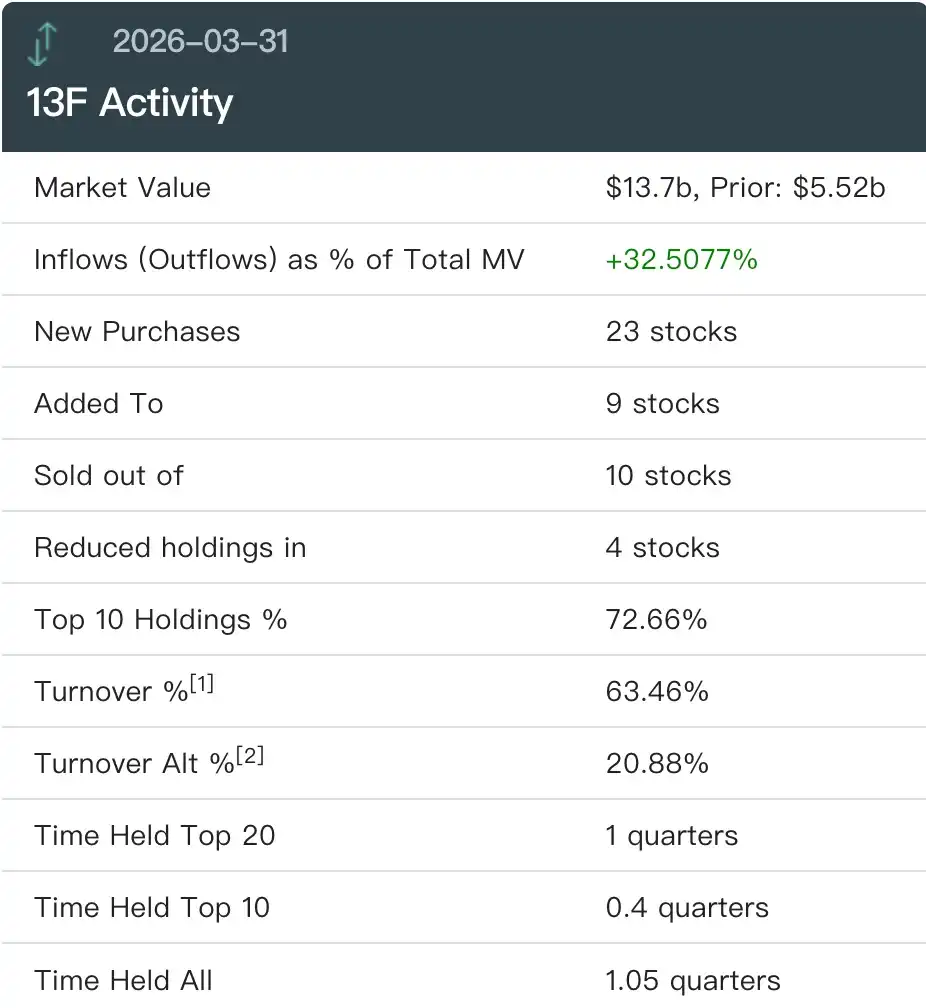
According to this latest 13F filing, as of March 31, 2026, the nominal total value of Situational Awareness LP's holdings has increased to $13.7 billion, more than doubling (up 148%) from $5.52 billion as of December 31 last year.

  • Odaily Note: It's important to note that in the statistical methodology of US stock 13F filings, the market value of option assets is typically shown as the "Notional Value" of the underlying stock, not the actual premium cost paid by the fund. This means that although the fund has built a semiconductor hedge wall with hundreds of billions in nominal asset value, its actual cash cost consumed (maximum potential loss) is much smaller, representing a typical high-leverage macro hedge.

Additionally, this quarter, net inflows accounted for 32.51% of the fund's total holdings value. This indicates the fund's explosive growth isn't solely due to portfolio appreciation but also includes very substantial external new capital subscriptions (i.e., new capital injection).

Frenetic Portfolio Adjustment

The filing also shows that Situational Awareness LP executed drastic portfolio adjustments in Q1.

  • New Purchases: 23 stocks (including options);
  • Added To: 9 stocks;
  • Sold Out Of: 10 stocks (including options);
  • Reduced Holdings In: 4 stocks (including options).

New Purchases: Sixty Percent of Portfolio Hedging Semiconductor Downturn
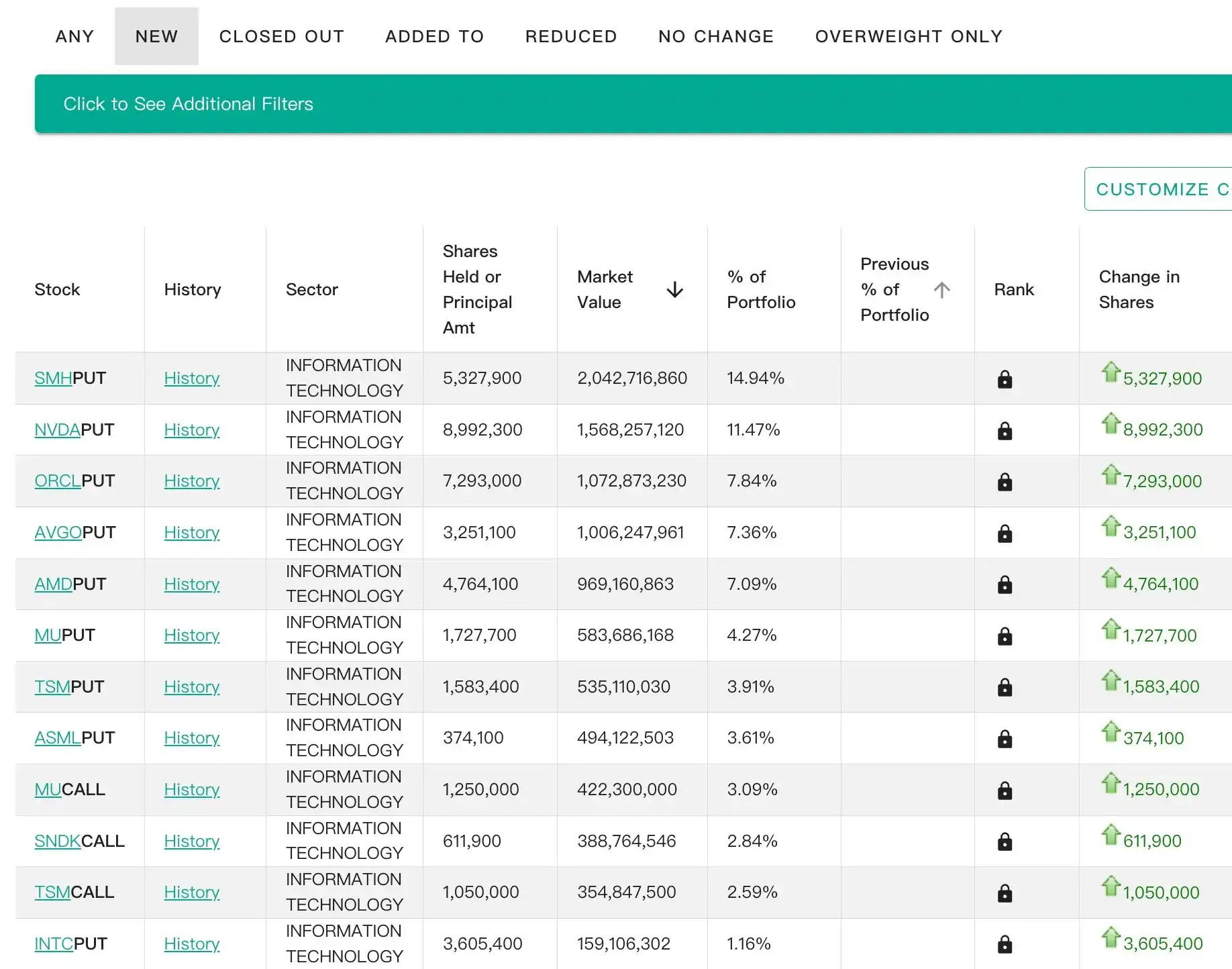
  • Odaily Note: The chart above only covers new stock purchases valued over $100 million. For all 23 new stock purchases, click the "portal" to view.

First, let's look at the new purchase activity, which is the most shocking piece of information in Situational Awareness LP's entire 13F report — in Q1, the fund conducted systematic risk hedging on the AI semiconductor and computing hardware sector through large-scale Put option positions.

Let's look at the data directly:

  • SMH PUT (VanEck Semiconductor Core ETF Put Option): 14.94% weighting (market value $2.04 billion) — Largest new position;
  • NVDA PUT (NVIDIA Put Option): 11.47% weighting (market value $1.56 billion) — Second largest new position;
  • ORCL PUT (Oracle Put Option): 7.84% weighting;
  • AVGO PUT (Broadcom Put Option): 7.36% weighting;
  • AMD PUT (AMD Put Option): 7.09% weighting;

Just the above top five Put option holdings account for 48.7% of Situational Awareness LP's $13.7 billion nominal total holdings value. Adding the subsequent Put options on Micron (MU), TSMC (TSM), ASML (ASML), and Intel (INTC), over 60% of the fund's nominal portfolio is betting on or hedging against a decline or severe volatility in core AI hardware stocks.

It's also noteworthy that Situational Awareness LP simultaneously bought both Call and Put options on the same stock. For example, while buying Micron Puts (MU PUT, 4.27%), it also bought MU CALLs (3.09%); while buying TSMC Puts (TSM PUT, 3.91%), it also bought TSM CALLs (2.59%).

This is a two-way bet strategy commonly used by hedge funds. It suggests the fund believes Micron (memory chips) and TSMC (foundry) may experience stock price movements far exceeding market expectations in upcoming 2026 earnings reports or industry cycles due to geopolitics or extreme supply-demand imbalances — significant one-way volatility large enough can generate profits on both sides.

Added To: Still Favors SanDisk, CRWV in Common Stock
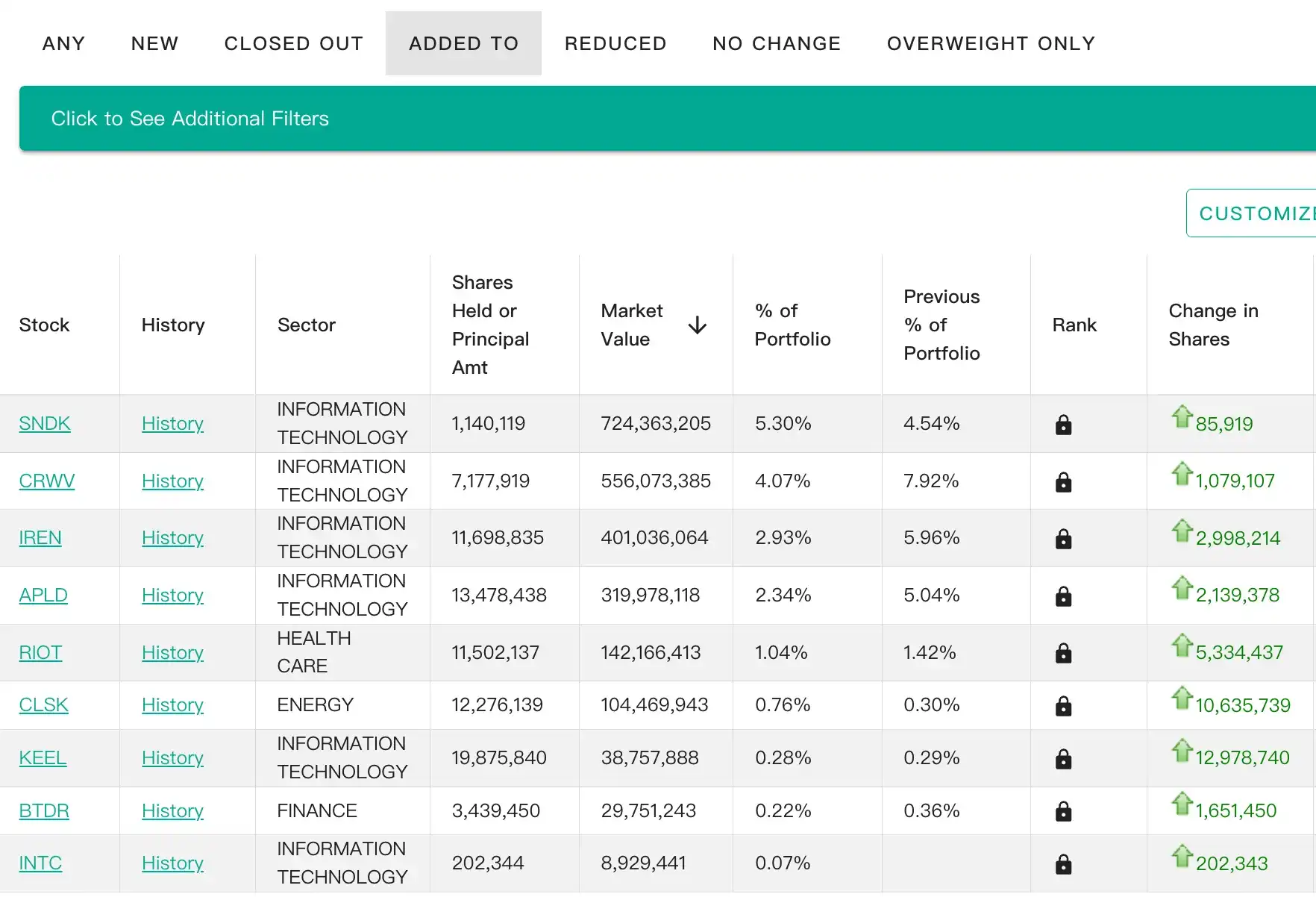
Regarding additions, Situational Awareness LP opted for common stock rather than options, increasing holdings in 9 stocks.

In Q1, Situational Awareness LP added a small amount of 85,000 shares of SanDisk (SNDK), bringing total holdings to 1.14 million shares, with a holding value as high as $724 million, accounting for 5.30% of the entire investment portfolio. This is one of the very few super-heavyweight positions in Situational Awareness LP's portfolio held entirely in common stock form.

Another noteworthy action is that Situational Awareness LP significantly increased its holdings by over 1.07 million shares of CoreWeave (CRWV) in Q1, pushing the holding value to $556 million, a 4.07% weighting. CoreWeave is one of the most closely watched AI GPU cloud service infrastructure companies currently, and an important partner in NVIDIA's ecosystem. After its IPO, Situational Awareness LP swiftly incorporated it into its core portfolio and aggressively increased its position. This indicates that while the fund is shorting NVIDIA's short-term valuation (via PUTs), it remains extremely bullish on cloud giants that directly convert GPUs into computing power for renting to various models.

Furthermore, Situational Awareness LP also added to positions in KEEL, IREN, APLD, RIOT, CLSK, BTDR, and other computing or power infrastructure companies, continuing the logic championed by Leopold Aschenbrenner that "electricity is the new oil."

Sold Out Of: Unwinding Intel Call Leverage, Exiting Optical Communications
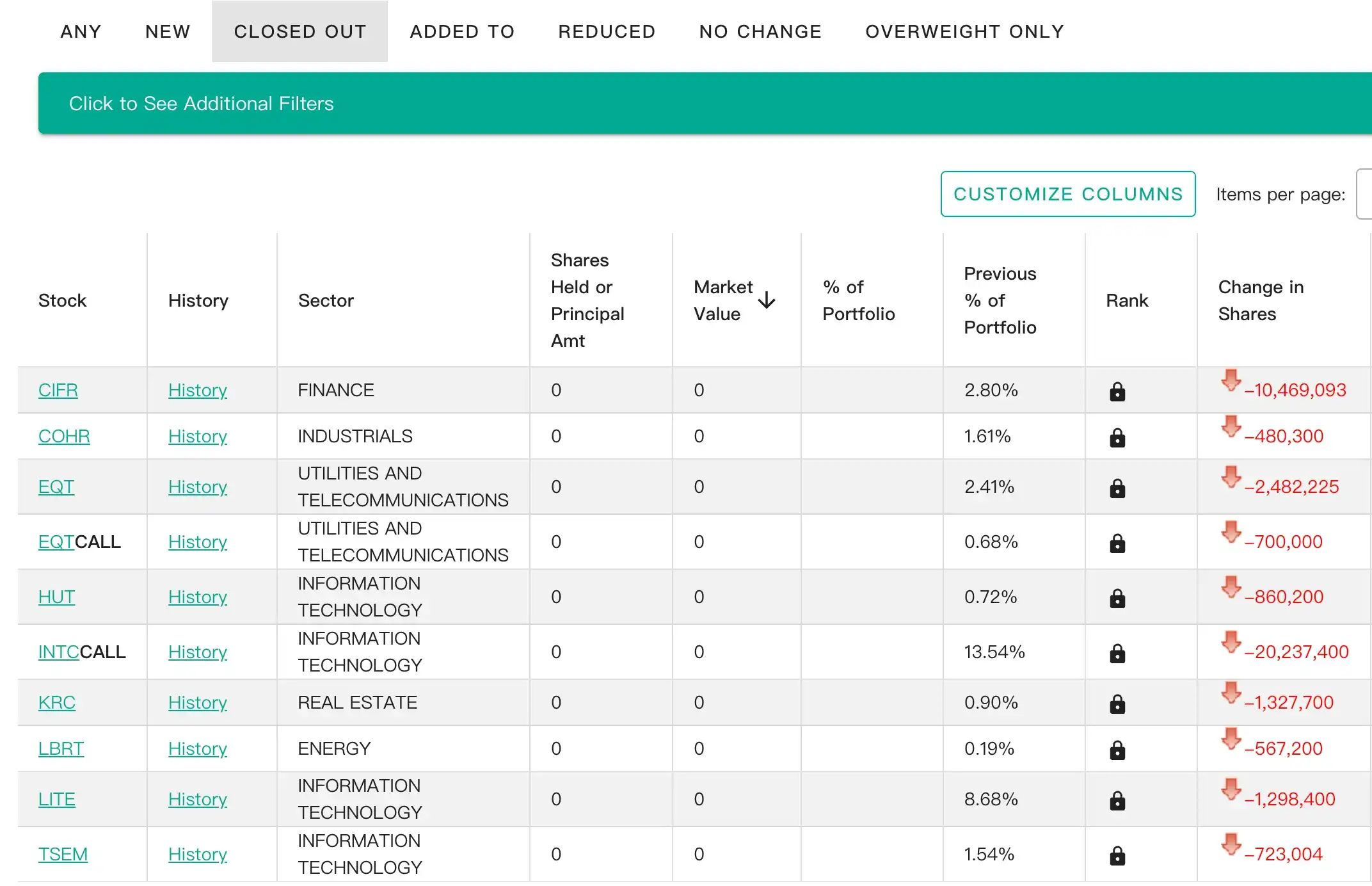
Regarding complete sell-offs, Situational Awareness LP's biggest move was completely unwinding its leverage from Intel Call options (INTC CALL). In the previous disclosure period, Situational Awareness LP had bet over 13% of its portfolio on Intel Call options (a staggering 20.23 million option contracts), a highly leveraged directional bet. This quarter, it completely sold out, shifting to holding a small common stock position (0.07% weighting).

Additionally, Situational Awareness LP completely exited LITE (8.68% weighting last period) and COHR (1.61% weighting last quarter) in Q1. LITE and COHR are both global top-tier optical communication chip and optical module (Optical Transceivers) giants. This exit indicates Situational Awareness LP is withdrawing from the AI optical module/network hardware sector.

Situational Awareness LP also sold out of CIFR (2.80% weighting last period) and HUT (0.72% weighting last period) in Q1. Both are cryptocurrency mining companies (including CORZ, which was reduced in the next section). Considering the additions to similar companies like RIOT, CLSK, BTDR, this is likely routine portfolio adjustment.

Reduced Holdings: Substantial Profit-Taking on BE
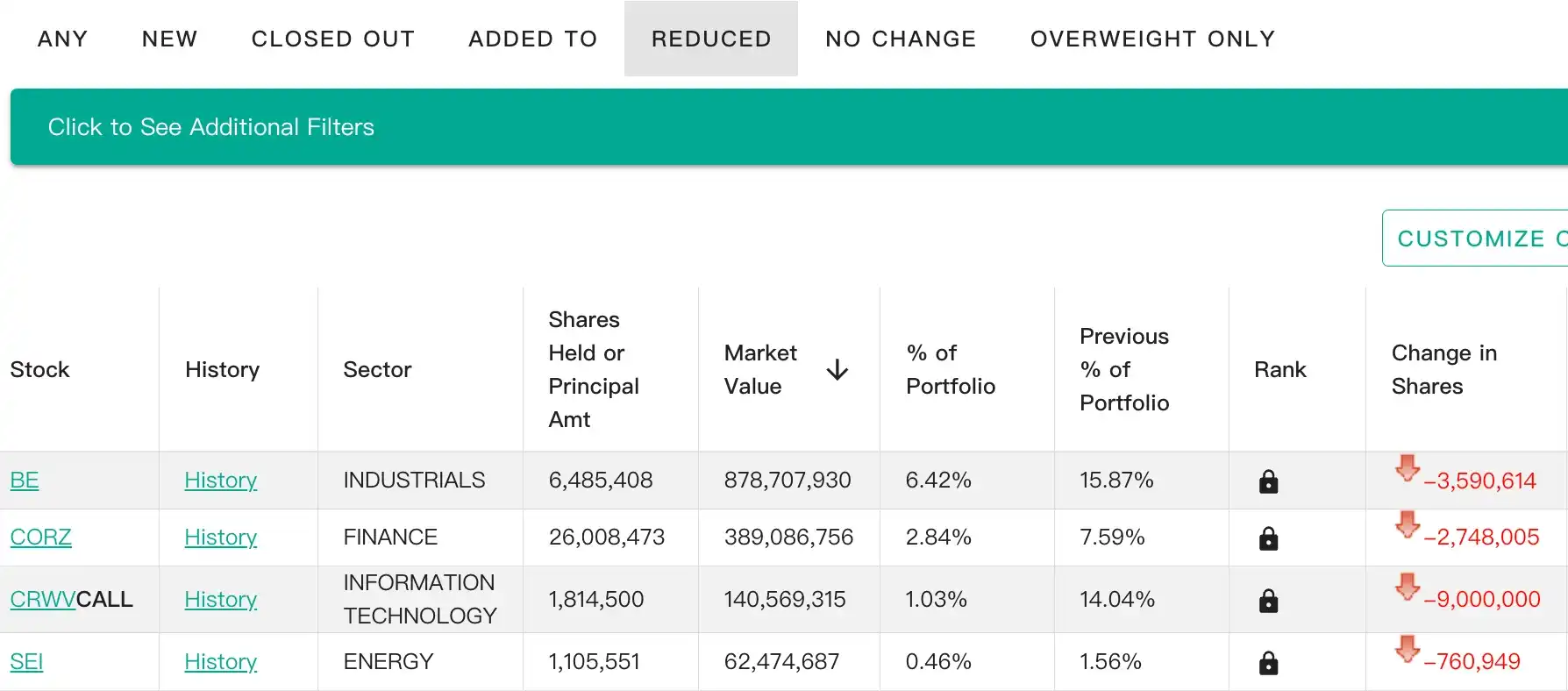
Finally, looking at the reductions, Bloom Energy (BE) was the largest holding disclosed in Situational Awareness LP's previous 13F filing. In Q1, the fund reduced its position by 3.59 million shares, causing its weighting to plummet from 15.87% last quarter to 6.42%.

Bloom Energy focuses on solid oxide fuel cell technology and is a core target for data center "on-site power" that bypasses traditional grids. Considering the remaining position is still significant, the reduction likely doesn't mean Situational Awareness LP is no longer bullish on the company, but more likely routine profit-taking.

CoreWeave Call options (CRWV CALL) were Situational Awareness LP's second-largest reduction (weighting plummeted from 14.04% to 1.03%). As mentioned earlier, the fund has shifted to holding CRWV in common stock form, so this is more about reducing leverage.

Situational Awareness LP also reduced its holdings in Core Scientific (CORZ) by 2.74 million shares, lowering its weighting from 7.59% to 2.84%. CORZ is a leading Bitcoin miner transitioning to AI computing power hosting. However, considering Situational Awareness LP added other miners still in transition with potentially more attractive valuations this quarter, reducing CORZ seems more like partial profit-taking.

What Is the 'AI Stock God' Really Thinking?

If looking only at the surface data of this 13F, many might draw a simple, crude conclusion — Leopold Aschenbrenner, who once proclaimed "AGI by 2027," has turned bearish on AI.

But the reality is clearly not that simple. In Situational Awareness LP's portfolio structure, there are actually two seemingly contradictory, yet highly unified, main themes.

  • On one side, there is extreme vigilance towards short-term valuation bubbles in the 'chip sector.' Situational Awareness LP has used Put option positions of staggering nominal size to essentially "buy crash insurance" for almost the entire AI semiconductor industry chain, including NVIDIA and Broadcom;
  • On the other side, there is a near-fanatical optimism about long-term AI infrastructure demand. Whether it's CoreWeave, Bloom Energy, or a series of power, transformer, and data center-related companies, they all essentially point to the same deterministic logic — AI's computing power war has entered the deep end.

This is perhaps Situational Awareness LP's core judgment at present. What will truly be scarce in the future may not be GPU chips themselves, but the energy, power systems, and data center infrastructure supporting these GPUs' continuous operation. GPU production can keep expanding, and advanced processes will eventually ramp up, but megawatt-level power supply capacity, transformers, transmission systems, and large-scale data center construction cycles are difficult to replicate simultaneously in a short time. Compared to the 'selling picks and shovels' logic already fully priced by the market, Leopold Aschenbrenner seems more focused on where the real bottlenecks might emerge in the next phase of the AI industry.

This also explains why Situational Awareness LP is simultaneously buying massive semiconductor Put options to hedge against severe volatility risks in the AI hardware sector, while continuing to heavily invest in GPU cloud services, power, and computing infrastructure assets.

In a sense, this 13F is less a simple holdings disclosure and more like Leopold Aschenbrenner's roadmap judgment for the next phase of evolution in the AI industry chain.

When a genius investor who rose to fame rapidly by All-in on AI starts deploying billions in nominal positions to buy insurance for the AI sector, it at least indicates one thing — even the most steadfast AI bulls of this era have begun to take volatility seriously.


Related Questions

QAccording to the article, what is the most significant new position taken by Situational Awareness LP in Q1 2026, and what does it represent?

AThe most significant new position is a $2.04 billion notional value in SMH (VanEck Semiconductor ETF) put options, accounting for 14.94% of the fund's portfolio. It represents a large-scale hedge against a potential downturn or high volatility in the AI semiconductor and hardware sector.

QWhy did Situational Awareness LP simultaneously buy both call and put options for stocks like Micron (MU) and TSMC (TSM)?

AThe fund used a dual-option strategy (straddle/strangle) for these stocks, indicating a belief that their prices could experience extreme volatility in either direction due to factors like geopolitical tensions or severe supply-demand imbalances. This strategy profits if the stock price makes a large move up or down, regardless of the direction.

QWhat is the apparent contradiction in Situational Awareness LP's investment strategy as described in the article, and how is it explained?

AThe apparent contradiction is the fund's massive bearish bets (put options) on AI semiconductor stocks alongside substantial bullish investments in AI infrastructure companies like CoreWeave and Bloom Energy. This is explained by the fund's core thesis: it is hedging against short-term valuation bubbles in the 'chip makers' while remaining bullish on the long-term, structurally scarce necessities for AI—specifically, the energy, power, and data center infrastructure needed to run the chips.

QWhat major sector did Situational Awareness LP exit in Q1 2026, as indicated by its sell-outs?

AThe fund exited the AI optical modules/network hardware sector by completely selling out its positions in LITE and COHR, which are leading companies in optical communication chips and transceivers.

QWhat was the primary reason suggested for the fund's large reduction in its Bloom Energy (BE) position?

AThe primary reason suggested for the large reduction in the Bloom Energy position was likely routine profit-taking. The fund still maintains a significant holding (6.42%), indicating it likely remains positive on the company's long-term prospects related to on-site power generation for data centers.

Related Reads

Fei-Fei Li's Team Clarifies the Concept of 'World Models', Sora Merely a Renderer

"World Models" has become a widely used yet confusing term in AI. To address this, a team led by Fei-Fei Li and World Labs proposed a functional taxonomy based on the Partially Observable Markov Decision Process framework. This taxonomy categorizes systems called "world models" into three distinct projections: Renderers, Simulators, and Planners. Renderers, like OpenAI's Sora and other video generation models, focus on producing photorealistic visual outputs for human perception. They prioritize visual fidelity over physical accuracy. Simulators, such as NVIDIA Omniverse, aim to compute precise future environmental states for computational tasks like engineering analysis or digital twins. Planners, like Vision-Language-Action models, take in observations and goals to output executable actions for robots or agents. The article clarifies that most current "world models," including Sora, are primarily Renderers. They generate convincing visuals but lack the core ability to simulate state transitions based on actions, a key requirement for a true world model in classic reinforcement learning definitions. This conceptual confusion has practical implications, leading to potential misalignment in technology selection, investment, and public understanding of AI capabilities. Clear categorization is crucial. It helps enterprises avoid costly mistakes (e.g., using a renderer for robot training), allows investors to accurately assess markets, and enables researchers to build comparable benchmarks. While future systems may integrate these functions, recognizing current boundaries is essential for honest assessment and progress.

marsbit6m ago

Fei-Fei Li's Team Clarifies the Concept of 'World Models', Sora Merely a Renderer

marsbit6m ago

Bloomberg Uncovered: How Do China's Wealthy Circumvent the Annual $50,000 Limit to Transfer Assets?

**Summary: How Wealthy Chinese Circumvent $50,000 Annual Foreign Exchange Limits** Despite China's strict capital controls, including an annual $50,000 per person foreign exchange quota, an estimated $150 billion in funds still leaves the country annually via various gray and underground channels. This report outlines the evolution of China's "capital wall" and the methods used to bypass it. **The Evolving Capital Controls:** * **Foundation (1994):** The system of "current account convertibility with strict capital account controls" was established. * **Quota Set (2007):** The $50,000 individual annual forex purchase limit was formalized. * **Crackdown Begins (2015-2017):** Following market volatility, enforcement tightened. Banks were required to scrutinize transactions, and channels like using UnionPay cards for Hong Kong insurance premiums or buying overseas property were blocked. * **Digital & Legal Upgrades (2024-2026):** Enhanced algorithms now flag suspicious patterns (e.g., "smurfing"). The Common Reporting Standard (CRS) provides Chinese tax authorities with data on citizens' offshore accounts. Unlicensed cross-border brokers have been targeted. **Five Primary Methods for Moving Capital:** 1. **Underground Banking / "Hawala" (Duiqiao):** The largest-scale method. No money crosses borders. Clients pay RMB to a domestic account; an overseas associate deposits equivalent foreign currency into the client's offshore account. Risks include high fees, account freezes, and legal penalties. 2. **"Smurfing" or "Ant Moving":** Using multiple individuals' $50,000 quotas to pool funds for one offshore recipient. Increasingly detected by anti-money laundering algorithms. 3. **Trade Invoice Manipulation:** Businesses over-invoice imports or under-invoice exports via offshore shell companies, creating a pretext to transfer excess funds abroad under the guise of trade. 4. **Channel Migration:** After a crackdown on internet brokers, funds flow toward more compliant but costly channels like major banks' cross-border wealth management services or Qualified Domestic Institutional Investor (QDII) quotas. 5. **Structural Arrangements:** High-net-worth individuals use complex, high-cost legal structures involving offshore trusts, insurance, and investment migration programs to transfer asset ownership. **Regulatory Response: Focusing on People, Not Just Money** The current strategy extends oversight from enterprises to **individual residents**. Tools like CRS allow retroactive visibility into offshore assets. Cryptocurrencies, once seen as a potential loophole, are now actively monitored and prosecuted as an illegal channel. The underlying driver remains: with significant wealth concentrated among millions of affluent households seeking diversification amid domestic economic shifts, the incentive to move assets offshore persists despite regulatory barriers.

marsbit26m ago

Bloomberg Uncovered: How Do China's Wealthy Circumvent the Annual $50,000 Limit to Transfer Assets?

marsbit26m ago

Ethereum's Ballmer Moment: As Everyone Is Bearish, the Circulating Supply Is Disappearing

"Ethereum's Ballmer Moment: Circulation Shrinks Amid Bearish Sentiment" Amid widespread bearish sentiment, with prominent figures like Bankless founder David Hoffman selling ETH and young developers flocking to Solana, some argue Ethereum is entering its "Ballmer era"—akin to Microsoft's perceived stagnation under Steve Ballmer. While surface-level criticisms about slow protocol development, cautious leadership, and competitive pressure are valid, underlying fundamentals tell a different story. Approximately 30% of ETH is staked, major holders like BitMine are accumulating, and spot ETFs continue to absorb supply. Regulatory clarity, including the SEC/CFTC's March ruling on staking rewards and the potential passage of the CLARITY Act, is transforming crypto from a regulatory threat into a legitimized framework. This institutionalization, alongside a shrinking circulating supply (with net issuance around 0.23% annually), creates significant buy-side pressure independent of fee-based value capture. The broader crypto total addressable market is expanding through regulated stablecoins, tokenized assets, and institutional adoption. While public chains face competition from permissioned alternatives, the winning model appears to be permissioned assets settling on public chains like Ethereum and Solana. The author advocates a non-maximalist, barbell strategy: holding ETH for its institutional role and supply squeeze, SOL for consumer/throughput trends, BTC as a macro hedge, and a basket of next-gen L1s. Key bullish drivers for ETH include rapid circulation shrinkage, potential Q2 staked ETF approvals, regulatory tailwinds solidifying its role as a default settlement layer, and the optionality of an eventual "Satya moment" leadership shift. Despite bearish consensus, the current setup—where crypto is "not hot" and regulatory groundwork is being laid—presents a compelling investment opportunity. The crypto cycle's focus may have shifted to AI, but blockchain infrastructure is gaining a legal and institutional foothold precisely while attention is elsewhere.

marsbit26m ago

Ethereum's Ballmer Moment: As Everyone Is Bearish, the Circulating Supply Is Disappearing

marsbit26m ago

Trading

Spot
Futures

Hot Articles

Discussions

Welcome to the HTX Community. Here, you can stay informed about the latest platform developments and gain access to professional market insights. Users' opinions on the price of AI (AI) are presented below.

活动图片