After 10 Years, Altman Finally Has the Person He Wanted

marsbitPublished on 2026-06-18Last updated on 2026-06-18

Abstract

After a decade of waiting, OpenAI CEO Sam Altman has finally secured his desired collaborator: Noam Shazeer, a legendary AI researcher and co-author of the seminal "Attention Is All You Need" paper that introduced the Transformer architecture. Shazeer has announced his departure from Google to join OpenAI as Head of Architectural Research. Shazeer, a crucial early Google employee who returned to Google DeepMind in a high-profile $2.7 billion deal two years ago, confirmed his move on social media platform X. Altman expressed his long-standing desire to work with Shazeer, stating the 10-year wait would be worth it. OpenAI's research lead, Mark Chen, welcomed Shazeer, highlighting his foundational work on Transformer, Mixture-of-Experts (MoE) models, and efficient decoding, which have profoundly shaped modern AI. His departure is seen as a significant blow to Google's Gemini project, where he served as a technical co-lead. Industry observers note this move represents a major win for OpenAI in the ongoing AI talent war, with some quipping that OpenAI acquired his expertise "for free" after Google's massive investment.

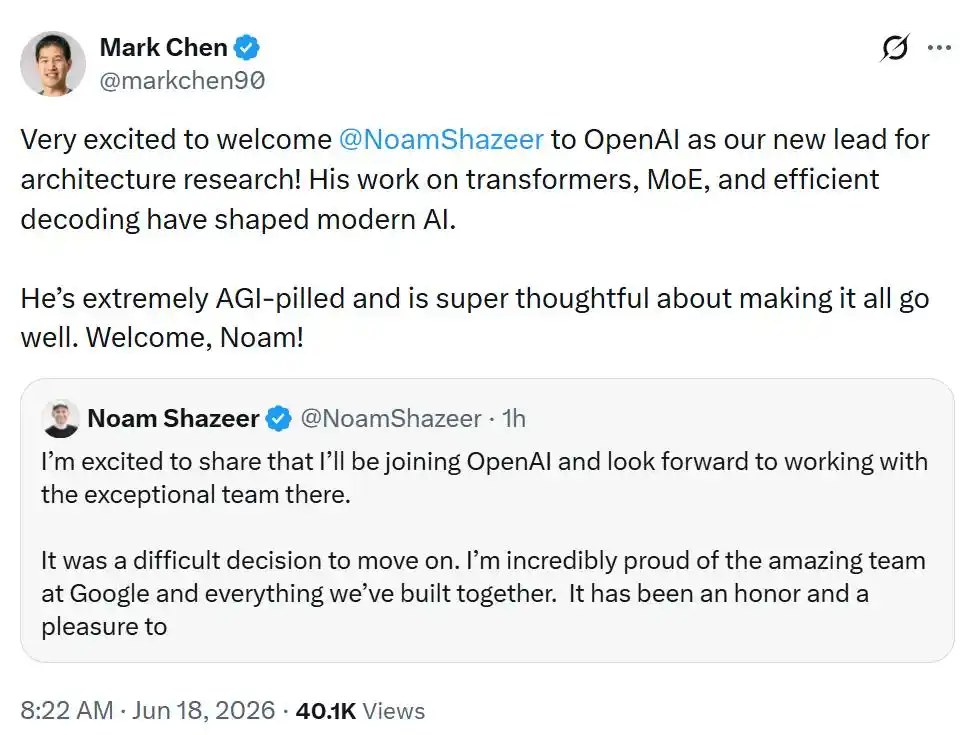
Noam Shazeer, the legendary AI figure whom Google brought back two years ago with a $2.7 billion deal, announced his departure from Google to join OpenAI.

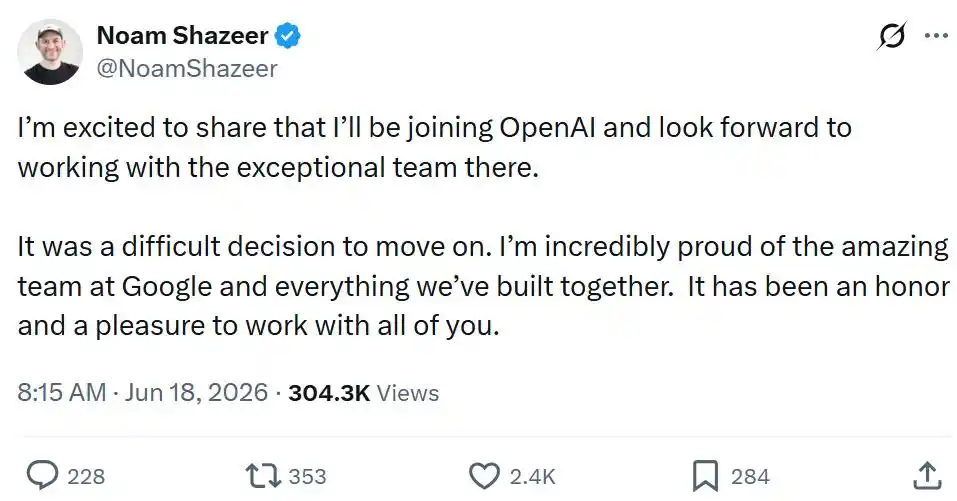
Just now, Noam Shazeer confirmed this news on X. He stated that he is joining OpenAI and looks forward to working with the excellent team there. He also expressed that leaving Google was not an easy decision; he is immensely proud of the Google team and everything they have built together, and it has been an honor and a pleasure to work alongside these colleagues.
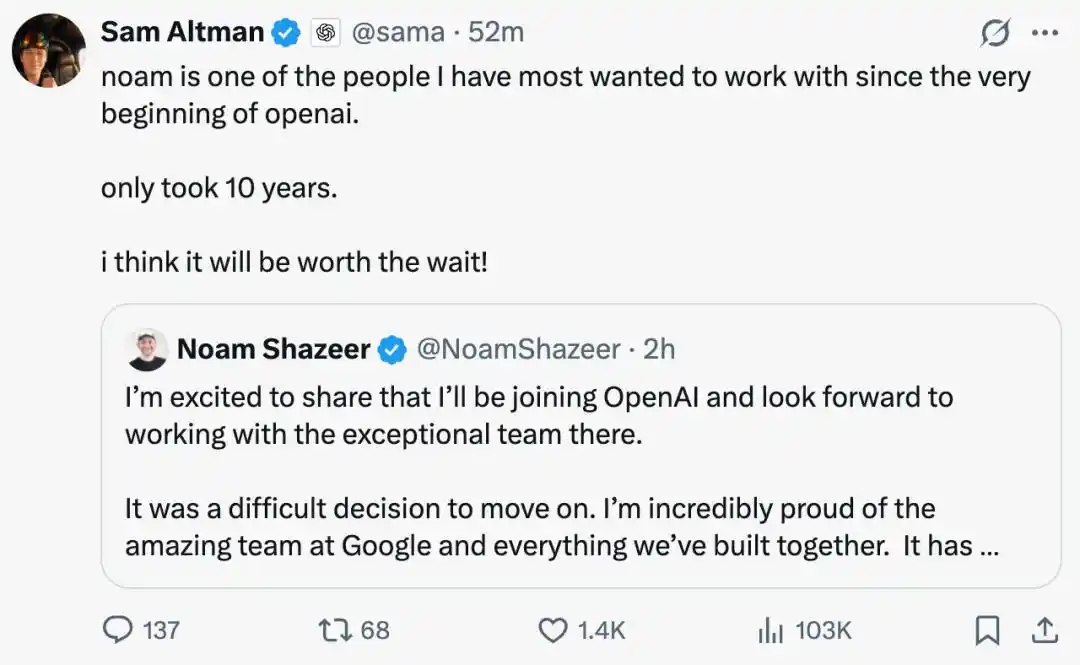
Subsequently, Sam Altman said, "From the very beginning of OpenAI's founding, Noam has been one of the people I most wanted to work with. It just took 10 years to finally get the chance. I believe the wait will be worth it!"
OpenAI research lead Mark Chen and others also responded on X: "A huge welcome to Noam Shazeer joining OpenAI as Head of Architecture Research! His research contributions in Transformer, MoE (Mixture of Experts), and efficient decoding have profoundly shaped the development of modern AI.

He not only holds a strong belief in achieving AGI but also has deeply considered insights on how to ensure its smooth development. Welcome, Noam!"
Noam Shazeer

Noam Shazeer is one of Google's most important early employees. He joined Google at the end of 2000, serving as a Principal Software Engineer responsible for early advertising systems.

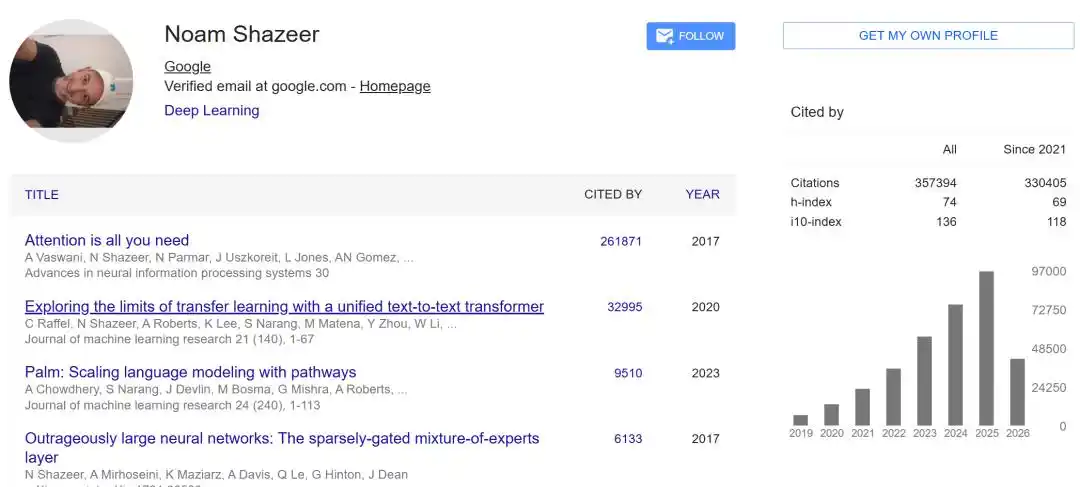
Noam Shazeer is no ordinary researcher. He is one of the co-authors of the seminal 2017 paper "Attention Is All You Need." The Transformer architecture proposed in this paper later became the most crucial technical foundation of the large language model era. From GPT and Gemini to Claude, and nearly all mainstream large models today, they all rely on the Transformer technical lineage.

More importantly, Shazeer's contributions extend beyond Transformer itself.

Long before large models truly entered the phase of scale competition, he had been focused on model scaling, sparse computation, and training of massive models. He co-proposed Sparsely-Gated Mixture-of-Experts, an important early foundation for the later MoE approach; Switch Transformer further pushed sparse expert models to the trillion-parameter scale. Today, MoE has become one of the key approaches for frontier models to increase parameter scale while controlling inference costs.
In 2021, Noam Shazeer left Google, disappointed by the bureaucracy at the search giant, and co-founded Character.AI with Daniel De Freitas. That company once became one of the most watched AI startups.

In 2024, Google reached a technology licensing deal with Character.AI and brought Shazeer and others back to Google DeepMind. Subsequently, he was appointed as co-head of Gemini technology, involved in Google's core large model project.
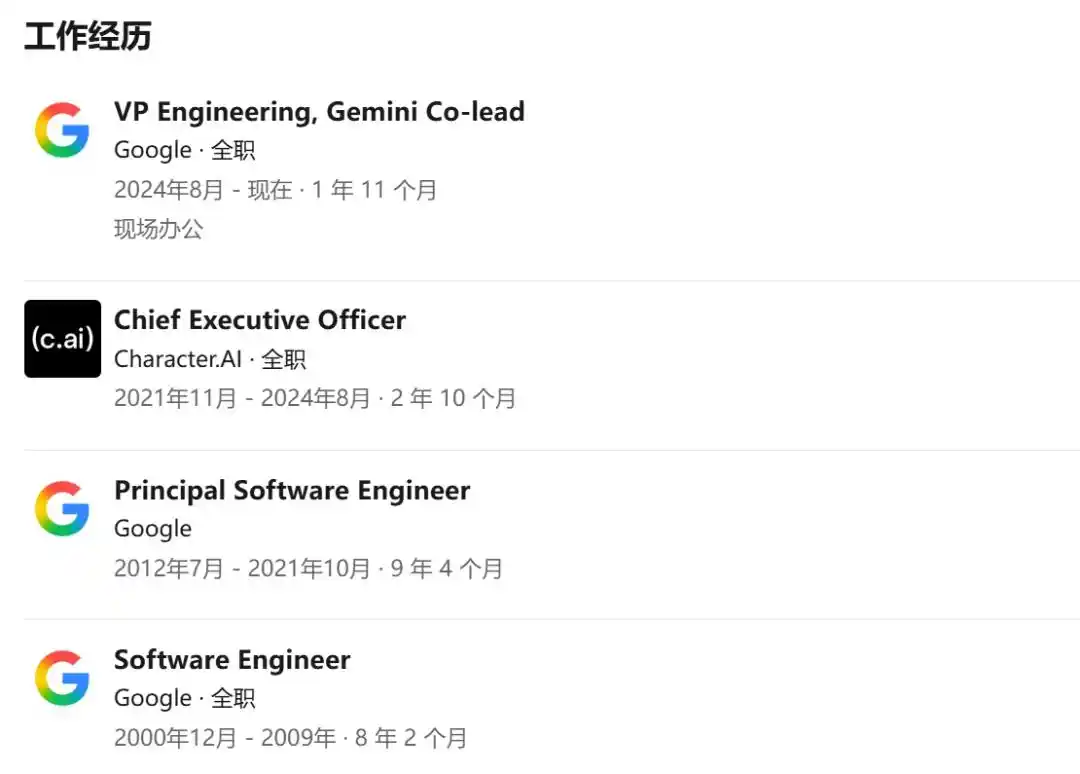
Now, in less than two years, he has turned to join OpenAI. This is truly harsh news for Gemini's development.

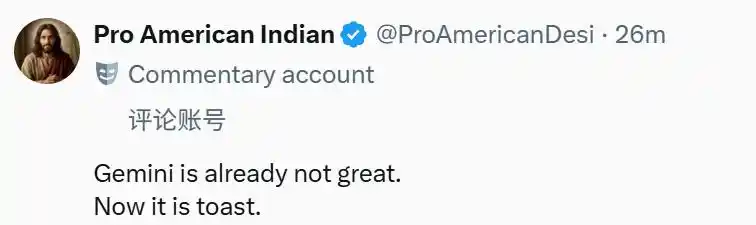
Many netizens believe that during the critical stage where Gemini still needs to continuously strengthen model capabilities and engineering systems, losing a figure like Shazeer will be a significant talent drain.

Others were more blunt in their jokes: Gemini wasn't that great to begin with; now with a core figure leaving, it's completely finished.
Another netizen joked: Google paid $2.7 billion for Shazeer's intellectual property. And OpenAI got these patents for free. This is the most favorable acquisition price in tech history.

In this AI talent war, Shazeer's addition is undoubtedly a significant victory for OpenAI.

This article is from the WeChat public account "Machine Heart" (ID: almosthuman2014), author: Focus on AI Big Shots.


Trending Cryptos

Related Questions

QWho is Noam Shazeer and what are his key contributions to AI?

ANoam Shazeer is a prominent AI researcher and a co-author of the seminal 2017 paper "Attention Is All You Need," which introduced the Transformer architecture. He is also known for his foundational work on Sparsely-Gated Mixture-of-Experts (MoE) and efficient decoding, technologies that are critical to modern large language models.

QWhy did Sam Altman say it took 10 years to get Noam Shazeer to join OpenAI?

ASam Altman stated that Noam Shazeer had been one of the people he most wanted to work with since OpenAI's founding. The wait of 10 years refers to the period from OpenAI's establishment to finally securing Shazeer's collaboration.

QWhat position did Noam Shazeer hold at Google before joining OpenAI, and why is his departure significant?

ABefore joining OpenAI, Noam Shazeer was a co-technical lead for the Gemini project at Google DeepMind. His departure is seen as a significant talent loss for Google, potentially impacting the Gemini project's development during a critical phase of strengthening its capabilities.

QWhat was the reported financial deal between Google and Character.AI involving Noam Shazeer?

AAccording to the article, Google reportedly struck a $2.7 billion deal for a technology license with Character.AI, the company co-founded by Shazeer, which also led to his return to Google in 2024.

QHow did the AI community react to Noam Shazeer's move to OpenAI?

AReactions were mixed. Some viewed it as a major win for OpenAI in the AI talent war. Others expressed concern for Google's Gemini project, with some joking that OpenAI got Shazeer's expertise 'for free' while Google had paid billions, and some even suggesting it was a devastating blow for Gemini.

Related Reads

Gate Research Institute: ETF Outflows Suppress Risk Appetite, Two-Way System Navigates Weak Market

Gate Institute Research Report: May 2026 Crypto Market Review & Strategy Analysis In May 2026, the crypto market shifted from an early-month rally to a mid-month correction, concluding with low-volatility consolidation. BTC, ETH, and SOL peaked in early May before declining. The primary market dynamic was a divergence between weakening spot ETF inflows and persistently high leverage-driven perpetual trading volume. A dual-direction moving average cluster breakout strategy outperformed, returning +2.11% for an equally-weighted BTC/ETH/SOL portfolio. This contrasted with a -6.09% return for buy-and-hold and -3.65% for a long-only version of the strategy. Profits were primarily generated from short positions on ETH and SOL during the mid-to-late May downtrend, demonstrating the month's suitability for two-way trend trading. Market structure evolved in three phases: an initial surge (May 1-6), a failure and reversal (starting May 7), and low-volatility compression (May 22 onward). While stablecoin supply remained stable, significant outflows from mainstream BTC and ETH ETFs created selling pressure. Concurrently, high correlation with the S&P 500 (~0.6) and stronger performance from AI equities like Nvidia highlighted crypto's position as a high-beta risk asset within a broader risk-budget framework, lacking independent momentum. The successful strategy employed a 4-hour chart system using a cluster of six moving averages (EMA6,12,24 & SMA6,12,24). A breakout signal was triggered after the cluster width compressed below 2.2%. Trades were managed with a 2.5% fixed stop-loss, a 3:1 Risk/Reward (7.5%) take-profit, and an EMA12-based exit rule to control losses from false breakouts. The strategy's low win rate but high payoff from a few large trend moves was effective in May's conditions. The report concludes that for June, a disciplined, bidirectional approach remains superior to subjective directional bets. The framework should adapt signal weighting based on BTC's position relative to key EMAs, ETF flow trends, and the relative strength of the Nasdaq, prioritizing risk management and trend preservation.

marsbit17m ago

Gate Research Institute: ETF Outflows Suppress Risk Appetite, Two-Way System Navigates Weak Market

marsbit17m ago

Anthropic CEO's Latest Interview: On Technological Explosion, Safety Red Lines, and the Civilization Contract

Interview with Anthropic CEO Dario Amodei covers the intense pressures and ethical dilemmas of leading AI development. He describes the experience as "exponential growth," feeling constant acceleration akin to relativistic time dilation. The discussion delves into his departure from OpenAI, rooted in a fundamental loss of trust and divergent values rather than mere technical disagreements. Amodei emphasizes Anthropic's enterprise-focused business model, arguing it aligns better with safety and responsible deployment than consumer-facing, ad-driven models. He addresses critical issues like AI's impact on employment, advocating for proactive macroeconomic policies and a shift towards "doing more with the same resources" to avoid widespread job displacement. On safety and governance, he details Anthropic's cautious approach, including delaying the release of the powerful "Mythos" model due to its advanced cyber capabilities. He stresses the need for "human-in-the-loop" principles in military applications, setting red lines against autonomous weapons and mass surveillance. Amodei calls for industry collaboration among trustworthy actors to establish standards and advocates for a balanced regulatory framework with checks and balances, such as Anthropic's Long-term Benefit Trust, rather than corporate or government monopoly over the technology. He expresses geopolitical concerns, particularly regarding China, and a belief that AI should bolster liberal democracies. While acknowledging a non-zero risk of civilizational catastrophe from advanced AI, he asserts Anthropic's actions are aimed at significantly reducing that probability. The interview concludes with Amodei arguing that trust must be earned through concrete actions, like sacrificing commercial gain for safety, to distinguish Anthropic in a Silicon Valley landscape he criticizes for eroded public trust.

marsbit20m ago

Anthropic CEO's Latest Interview: On Technological Explosion, Safety Red Lines, and the Civilization Contract

marsbit20m ago

The Brutal Truth Behind CARDS' $535M FDV: Only $43M in Net Revenue and Halved Profit Margins

The article titled "The Brutal Truth Behind CARDS' $535 Million FDV: Only $43 Million Net Revenue, Profit Margins Halved" provides a critical analysis of Collector Crypt (CC), a platform combining physical collectible cards with NFTs in a gacha-style system. Key findings include: * CC has generated $635 million in total user deposits. However, 90.6% ($576 million) is instantly returned to users via automatic card buybacks, resulting in only $43 million in net platform revenue (6.7% retention). * Activity is highly concentrated among dozens of high-frequency wallets, with an average of only ~420 daily active players. * There is minimal secondary market activity for the cards (under $5 million total), indicating the platform functions more as a gambling casino than a collector's marketplace. eBay sales as a percentage of gacha volume have declined for six consecutive quarters. * Despite a tripling in transaction volume, net profit margins have been halved from 11.2% to 5.8% as activity shifts to higher-priced card packs with lower margins. * Value captured by the CARDS token is minimal: only $140,000 (from burns and recent buybacks), representing just 3.4% of CC's cumulative net revenue. In contrast, wallets linked to operational infrastructure have off-ramped $45.7 million in USDC. * The token's ~$535 million Fully Diluted Valuation (FDV) represents a 7.3x multiple of annualized net revenue. Only 20.5% of the token supply is floating, with 72% allocated to insiders and locked until November 2027. The conclusion is that CC has found product-market fit as a high-speed gambling platform for a niche user base, not as a growing collector economy. The token currently captures a negligible share of the platform's revenue.

Foresight News45m ago

The Brutal Truth Behind CARDS' $535M FDV: Only $43M in Net Revenue and Halved Profit Margins

Foresight News45m ago

Trading

Spot
Futures

Hot Articles

Discussions

Welcome to the HTX Community. Here, you can stay informed about the latest platform developments and gain access to professional market insights. Users' opinions on the price of AI (AI) are presented below.

活动图片