AI Reshapes the Semiconductor "Smile Curve": The Rising Logic Behind the Global Distributed Bull Market

marsbitPublished on 2026-06-17Last updated on 2026-06-17

Abstract

The Philadelphia Semiconductor Index (SOX) has hit a historic high above 14,000 points, driven by a concentrated AI-fueled semiconductor rally. Key drivers are extreme scarcity and pricing power in critical bottlenecks of the AI data center supply chain. Unlike traditional models where manufacturing held lower profits, AI has reshaped the "Smile Curve." Highly complex manufacturing and advanced packaging nodes—like TSMC's CoWoS, SK Hynix's HBM, and ASML's EUV lithography—have become exceptionally scarce and high-margin, rivaling design-side profitability. The market rewards those controlling irreplaceable segments: U.S. firms lead in AI chip design and cloud services; Taiwan and Korea dominate advanced foundry/logic and memory/HBM respectively; Japan and the Netherlands supply vital materials and equipment. Storage, particularly HBM, is the tightest bottleneck, with severe shortages predicted through 2027. While bullish analysts project sustained AI infrastructure spending growth, notable bears like Michael Burry warn of bubble-like exuberance reminiscent of the dot-com era, citing overleveraged private financing for data centers. Key near-term catalysts include earnings guidance from Micron and Nvidia, while longer-term risks hinge on the 2027-2028 capacity expansion wave and persistent geopolitical tensions in concentrated supply chains.

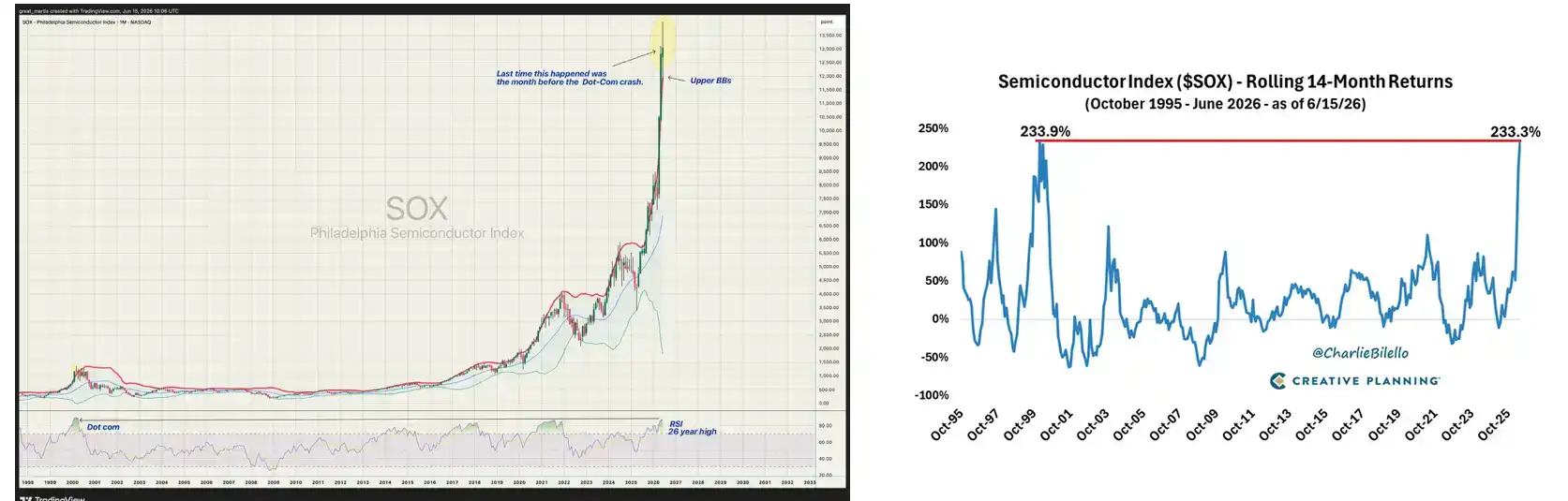
U.S. stocks closed overnight, with the Philadelphia Semiconductor Index (SOX) breaking through the 14,000-point mark for the first time, hitting a new all-time high.

Historically, there have only been two periods when the SOX rose over 230% within 14 months: from December 1998 to February 2000, and from April 2025 to the present.
The returns in this semiconductor bull market have been highly concentrated and significant. The year-to-date gains for the memory trio—Micron, SK Hynix, and Samsung—are approximately 141%, 186%, and 114%, respectively. TSMC's U.S. ADR has gained over 50% year-to-date.

Nvidia hit a new all-time high of $235.47 on May 14. Broadcom, Marvell, and ASML have either set new records or are approaching them in their respective market segments. The 52-week low for the entire SOXX ETF is $148, with the high near $369, representing a price swing of nearly 150%.

In April, Goldman Sachs revised its 2026 DRAM supply-demand deficit forecast from 3.3% to 4.9%, calling it the most severe memory shortage in 15 years. HBM prices are even more staggering: a single HBM3E stack costs about $300, and the upcoming HBM4 is estimated at $500 per stack. SK Hynix's 2026 HBM capacity has already been fully booked by Microsoft, Google, and Nvidia, with some customers even paying deposits in full upfront to secure capacity.

Clearly, the speed of AI data center construction is far outpacing the expansion of chip production capacity.

The 'Bottleneck' Bull Market

Scarcity is the most profitable product.

Understanding this phrase essentially captures the core logic of this semiconductor bull market. Whoever controls the bottleneck in AI infrastructure holds the most powerful pricing authority. Conversely, for segments that can be substituted or face price pressure, even with high demand, stock prices won't rise.

Optical modules are a typical example of the latter. A Photon Capital report in April pointed out that while Chinese optical module companies hold seven of the top ten global spots, they aren't making much profit; the profits are still with the chip companies. Zhongji Innolight and Sunsea are at a global first-tier level in terms of shipment volume and cost control for 800G and 1.6T optical modules, directly squeezing the margins of U.S. optical module companies like Coherent and Lumentum. Demand has doubled, yet profit margins have thinned. The reason is singular: the assembly stage of optical modules is not scarce enough.

Memory, meanwhile, has become the hardest theme in this U.S. semiconductor bull market. Essentially, it's because it controls a bottleneck, and that grip is tightening.

HBM is not ordinary DRAM. 3D stacking, TSV (Through-Silicon Via), specialized packaging processes—each layer of technological barrier is the result of over a decade of heavy capital investment. Globally, only three companies can mass-produce HBM, with SK Hynix taking roughly half the market share.

Interestingly, this logic holds true even when magnified to a macro, national level.

The true winners in AI data center infrastructure are not "all semiconductor countries," but those countries and regions that, over the past few years or even decades, have built scarce industrial clusters in some irreplaceable link of the chain. Scarcity is the key.

Every Region Has Its Own Main Track

It's quite interesting to see this perspective raised in U.S. stock forums.
The United States remains at the top of the value chain.

Nvidia, AMD, Broadcom's ASIC design; Synopsys and Cadence's EDA tools; Arista's AI networking; the three major cloud providers packaging computing power as services sold worldwide. Google, Amazon, and Microsoft are all accelerating in-house ASIC development. Broadcom and Marvell collectively hold about 95% of the custom ASIC design market. Google alone spends roughly $8 billion annually on TPU development with Broadcom.

The core nodes in manufacturing are in Taiwan and South Korea, but they are eating from completely different plates.

Taiwan's story revolves around TSMC and advanced packaging. 3nm and 2nm processes can only be mass-produced by TSMC globally. TSMC's three CoWoS backend factories are fully loaded, with lead times of 52 to 78 weeks. Nvidia alone has locked up 60% to 70% of CoWoS capacity. TSMC is expanding its monthly capacity from 35,000 wafers at the end of 2024 to 130,000 wafers by the end of 2026, nearly a fourfold increase. Even with this expansion, capacity remains tight. Taiwan's server OEM system, including Foxconn, Quanta, and Wistron, is also benefiting from the surge in AI server shipments.

South Korea's story is entirely centered on memory. SK Hynix captures about 50% to 55% of the global HBM market share, Samsung holds 19% to 35%, and Micron around 5% to 20%. HBM is not the same as ordinary memory; 3D stacking, TSV, specialized packaging—each layer of technological barrier is the result of decades of continuous heavy investment by South Korean companies.

Japan and the Netherlands also play crucial roles. Tokyo Electron makes semiconductor equipment; Shin-Etsu Chemical and SUMCO produce silicon wafers; Ajinomoto makes ABF substrate materials. Japan has long been out of the competition in finished chip products, but its position in materials and precision processing remains irreplaceable today.

The Netherlands is even more direct: ASML monopolizes EUV lithography machines. In January, Morgan Stanley significantly raised its target price for ASML to 1400 euros, predicting that 2027 will be the company's year of highest profit growth, with EPS growing 57% year-over-year. They base this judgment on three drivers: better-than-expected expansion of advanced logic foundry capacity, large-scale expansion in the DRAM memory sector, and overall demand performing better than expected. Dutch packaging equipment companies like BESI are also securing large orders amid the explosion in AI chip packaging demand.

China and Europe have different entry points, but the logic is similar: they have established cost advantages or delivery capabilities in specific links of AI infrastructure.

Zhongji Innolight and Sunsea are at a global first-tier level in shipment volume and price control for 800G and 1.6T optical modules. However, Photon Capital's analysis also warns of an important time window: the current high profit margins of optical module companies come from temporary pricing power due to the short-term shortage of 800G capacity. Once 1.6T ramps up in the second half of 2026 into 2027 and second- and third-tier manufacturers also fill their capacity, price pressure on the module end will arrive quickly.

In Europe, companies like Schneider Electric, ABB, and Vertiv, which focus on power distribution and thermal management, are receiving orders far exceeding expectations against the backdrop of soaring data center power consumption. Wedbush estimates that hyperscalers' AI infrastructure spending in 2026 will be about $725 billion, a 77% year-over-year increase, with power infrastructure being one of the fastest-growing subcategories.

AI Reshapes the Semiconductor "Smile Curve"

Using the smile curve to summarize this landscape: The left end, led by the U.S., is responsible for "definition and design." The mid-to-high segment, involving Taiwan (China), South Korea, the Netherlands, and Japan, is responsible for "manufacturing advanced chips." The mid-to-low segment, involving Taiwan (China), China, and Southeast Asia, handles "large-scale assembly." The right end, with the U.S. and China, handles "cloud platforms, models, and customer access."
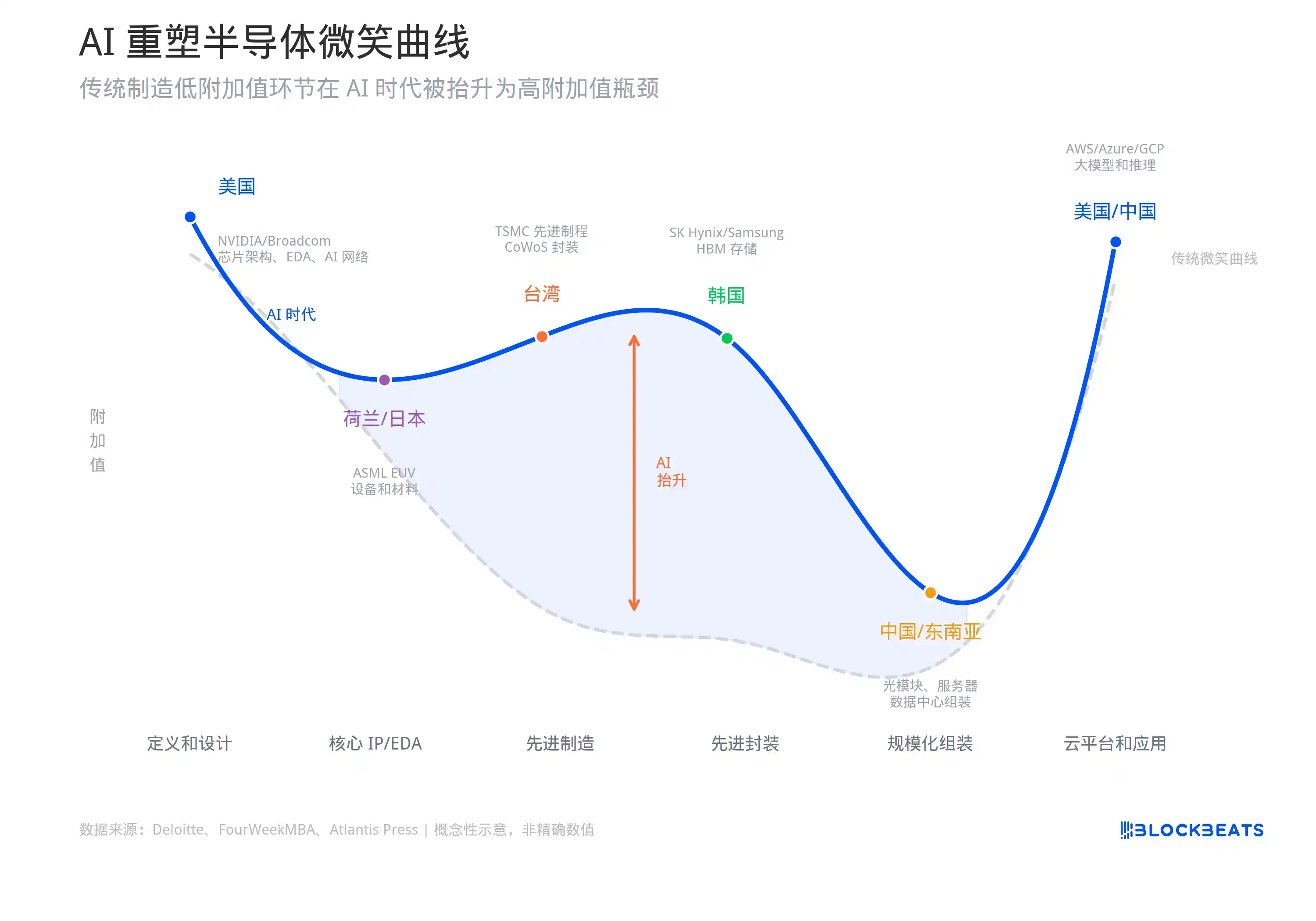
The original creator of this curve was Stan Shih, founder of Acer, who in 1992 used this model to explain why PC assembly had the thinnest profit margins.

But thirty years later, AI data centers are rewriting the shape of this curve.

Value chain analyses by FourWeekMBA and a paper published this year by Atlantis Press both point to the same conclusion: AI is re-elevating the middle segment of the traditional smile curve. TSMC's advanced CoWoS packaging, SK Hynix's HBM stacking, and ASML's EUV lithography machines—these segments, which in the traditional manufacturing smile curve belonged to the low-margin "middle manufacturing segment"—have become the most scarce resources in the AI era, with profit margins and pricing power not lower than those of the design or application ends.

Data from the paper shows that Nvidia's gross margin for 2023-2024 was 72.72%, with a net margin of 48.85%. However, TSMC's gross margin for Q1 2026 also reached 66.2%, with a net margin of 50.5%. The gap between design and manufacturing margins is narrowing, which is unprecedented in the history of the semiconductor industry.

The traditional smile curve posits that manufacturing has the thinnest margins. AI is turning the most difficult manufacturing links into the most scarce resources.

Morgan Stanley's March report on Asian semiconductors reached a similar conclusion: the 2023-2024 AI cycle was primarily focused on GPUs. From 2025 to 2026, demand is starting to diffuse across a broader industry chain, with memory, advanced packaging, custom ASICs, and data center networking taking the baton.

Every rotation of the bottleneck brings a new group of previously overlooked companies to the forefront, while those that gained the most in the previous phase enter a consolidation period.

How Much Further Can the Bull Run? Bull vs. Bear Views

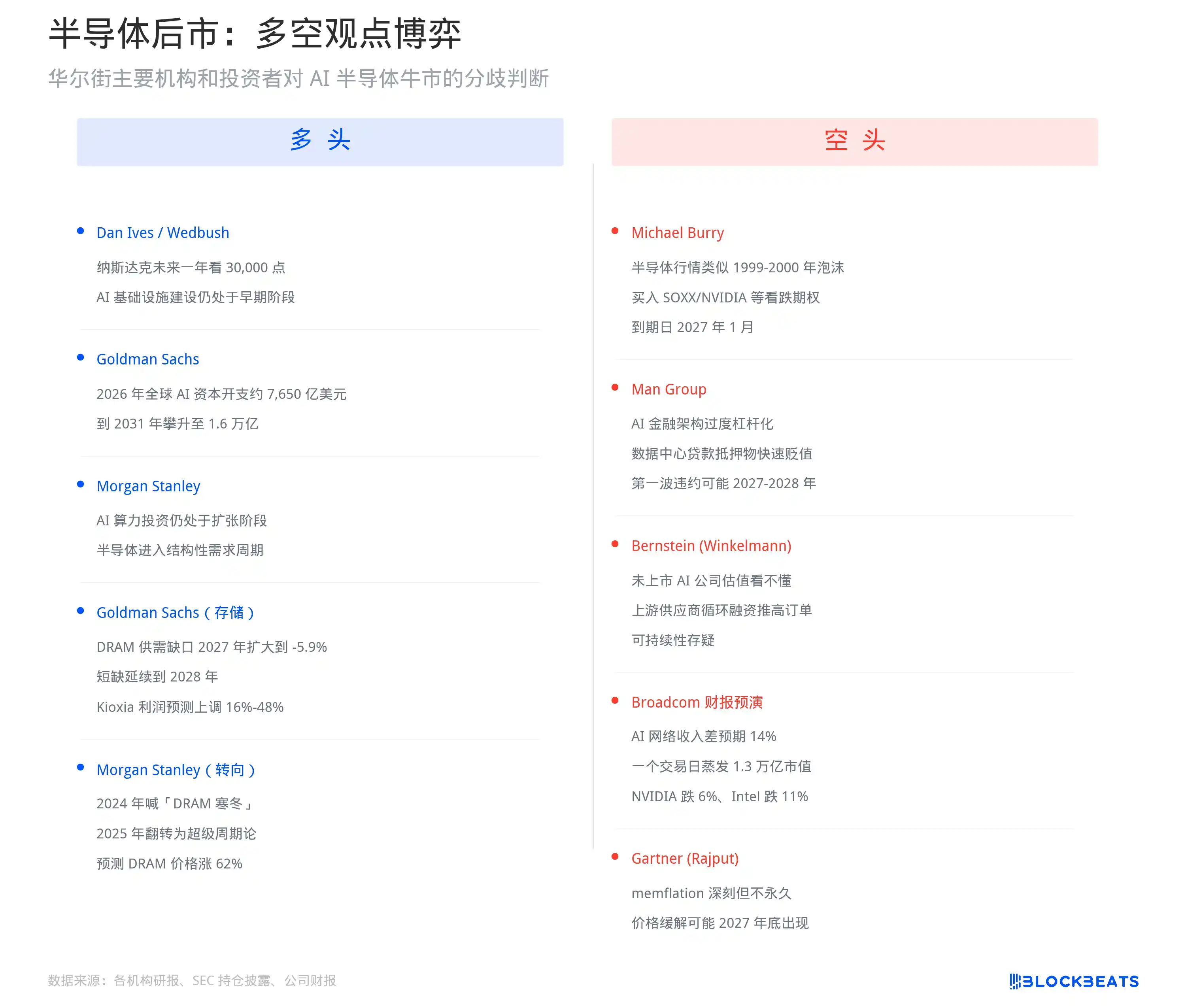
Let's first hear from the bulls. Wedbush's Dan Ives said on CNBC in May that he expects the Nasdaq to reach 30,000 points in the next year, citing that AI chip demand still far exceeds supply. Goldman Sachs provided more concrete numbers: global AI capital expenditure in 2026 is about $765 billion, climbing to $1.6 trillion by 2031.

Morgan Stanley's March report on Asian semiconductors explicitly stated: AI computing investment is still in an expansion phase, and the semiconductor industry is entering a new structural demand cycle.

Bullish calls on memory are even more aggressive. Goldman Sachs recently revised down its DRAM supply-demand deficit forecasts for 2026-2028 into deeper shortage territory, adjusting the 2027 deficit from -2.5% to -5.9%, almost double. Their judgment is that this memory cycle is different from past ones: AI server demand has higher visibility, supply growth is locked down by long-term contracts, and price increases will last longer than the market expects.

Goldman Sachs even significantly raised its operating profit forecasts for Kioxia for 2027-2029 by 16% to 48%, citing that this period of high profitability could last two to three years. For a company in the highly cyclical memory business, a "high profitability lasting three years" call is very rare on Wall Street.

Morgan Stanley's change in stance is even more interesting. In 2024, they were still calling for a "DRAM winter," predicting price declines for years starting in Q4 2024. By 2025, they completely flipped to a super-cycle thesis, forecasting a 62% DRAM price increase in 2026 and predicting that SK Hynix and Samsung's profits would exceed consensus expectations by 30% to 50%.

But the bearish voices are also loud and come from significant players.

Michael Burry publicly warned in May that this semiconductor rally closely resembles the final months of the 1999-2000 internet bubble. The SOX is up 65% year-to-date, gained 10% in a single week, and the SOXX ETF is 60% above its 200-day moving average—this level of technical stretch has rarely been sustainable historically. SEC filings show he purchased a large number of put options on SOXX, QQQ, Nvidia, Palantir, and Oracle, expiring in January 2027, with strike prices well below current levels.

Man Group (one of the world's largest listed hedge funds) published a lengthy article in June specifically dissecting AI bubble risks. Their core view is that the financial architecture built around AI has become too large, over-leveraged, and overly reliant on a few interconnected players.

They specifically mentioned that a significant portion of AI data center construction is financed through private credit, with these loans collateralized by "hardware that depreciates as quickly as mobile phones, not long-term assets like buildings." The first wave of defaults could emerge in 2027-2028, when initial leases expire and the gap between financing assumptions and reality becomes impossible to ignore.
Looking ahead, several time nodes are worth watching.

Micron's earnings report on June 24th will be crucial; forward guidance on HBM demand and capacity allocation will determine the direction of the entire memory sector for the summer. Nvidia's next earnings report is equally critical; if there is even a slight signal of deceleration in AI chip demand, the sentiment across the sector will be repriced once again.

Looking further out, the timeline for capacity ramp-up is the real watershed. SK Hynix's M15X fab is expected to ramp in mid-2027, with its Yongin new fab moved up to February 2027. Samsung's P5 fab will come online in 2028. Micron's Idaho Fab 1 is expected to contribute output in mid-2027.

Combined, industry capacity will increase by 20% to 30% in the second half of 2027 to the first half of 2028. The question is whether HBM demand, with a compound annual growth rate of over 40%, will be met. Whether supply can catch up with demand depends on whether AI capital expenditure slows down before then.

The final variable is geopolitics. The higher the concentration of the semiconductor supply chain, the greater the impact of a black swan event. TSMC alone accounts for over 90% of global advanced process foundry capacity—this number represents efficiency during a bull market but systemic risk in a conflict scenario. Factors like the Taiwan Strait situation, potential escalation of U.S. export controls on China, and the degree of cooperation from Japan and the Netherlands on equipment restrictions are topics no one wants to discuss when the market is good. But if something happens, repricing will happen faster than any fundamental change.

Trending Cryptos

Related Questions

QWhat is the core logic behind the current semiconductor bull market, according to the article?

AThe core logic is scarcity. The companies that 'choke' or control the bottleneck in AI infrastructure—the most difficult-to-replace and technologically intensive segments like HBM memory and advanced chip manufacturing—hold the hardest pricing power and reap the greatest profits.

QHow is AI reshaping the traditional semiconductor 'smile curve'?

AAI is elevating the middle segments of the traditional smile curve. Previously considered low-margin manufacturing processes, such as TSMC's CoWoS advanced packaging, SK Hynix's HBM stacking, and ASML's EUV lithography machines, have become the most scarce resources in the AI era. Their profit margins and pricing power are now comparable to, and sometimes even higher than, the design and application ends of the curve.

QWhat are the key regional strengths in the AI-driven semiconductor value chain as described in the article?

AThe key regional strengths are: The US leads in design, EDA tools, AI networks, and cloud platforms/services. Taiwan (China) and South Korea are central to manufacturing; Taiwan excels in advanced foundry/logic (TSMC) and packaging, while South Korea dominates in memory/HBM production. Japan and the Netherlands control critical materials and equipment (e.g., ASML's EUV monopoly). China has cost advantages in assembly-scale segments like optical modules. Europe is strong in power and cooling infrastructure for data centers.

QAccording to the article, what are the main bullish arguments for the semiconductor market's continued growth?

ABullish arguments include: AI chip demand still far outstrips supply (Wedbush). Global AI capital expenditure is projected to grow massively, from ~$765B in 2026 to $1.6T by 2031 (Goldman Sachs). The industry is in a new structural demand cycle (J.P. Morgan). The DRAM shortage, especially for HBM, is seen as more severe and persistent than past cycles due to high-visibility AI server demand and long-term supply lock-ins, potentially sustaining high profits for several years (Goldman Sachs, J.P. Morgan).

QWhat are the primary risks or bearish concerns cited regarding the AI/semiconductor boom?

APrimary risks include: A potential bubble, with technical indicators and rapid price appreciation reminiscent of the 1999-2000 dot-com bubble (Michael Burry). An over-leveraged financial architecture where AI data centers are financed by private credit secured against rapidly depreciating hardware, raising default risks when initial leases expire around 2027-2028 (Man Group). A potential supply-demand inflection point when major new HBM/manufacturing capacities come online in 2027-2028. Geopolitical risks, as the highly concentrated supply chain (e.g., TSMC's dominance) is vulnerable to disruptions from events like cross-strait tensions or export control escalations.

Related Reads

qinbaFrank: Review and Outlook of the AI Computing Power Wave — From the Three Debates on NVIDIA to Optical Interconnect and SpaceX IPO, How is Capital Rotating?

**Summary: Retrospective and Outlook on the AI Computing Wave - A Framework for Capital Rotation** Based on a presentation by investor qinbaFrank, this analysis reviews the AI computing market trajectory since 2023 and outlines a forward-looking framework. **Key Phases and Market Debates:** The AI bull market progressed through three major debates: 1) The necessity of massive capital expenditure (late 2023). 2) The sustainability of tech giants' spending (early 2024-early 2025). 3) Potential overestimation of compute needs (early 2025). Consensus solidified in late 2025 as model capabilities and utility demonstrably improved. **Core Thesis: Penetration Rate Drives Commercialization.** Unlike the 2000 dot-com bubble, the current AI wave benefits from mature digital infrastructure, enabling faster adoption. The critical threshold is 10% penetration; surpassing it (with recent enterprise intent surveys showing ~18%) indicates entry into a rapid growth "golden period" where user scale and willingness to pay increase simultaneously. **AI vs. Internet: A Fundamental Difference.** While the internet enhanced connection efficiency, AI directly substitutes human cognition and labor. Once AI performance exceeds the "societal average" human level, its commercial value scales exponentially as payment shifts from human labor costs to AI service fees. **Investment Logic Evolution in the Compute Chain.** The focus has expanded from GPUs to a systemic re-rating of the entire hardware stack: storage/HBM, CPUs, interconnects, power, and advanced packaging. The framework is: **short-term "scarcity pricing," mid-term "upgrade pricing" (e.g., optical interconnects, power networks), and long-term "Physical AI" pricing** (edge computing, robotics). **Market Focus Shift and Adjustment Framework.** The market is transitioning from "hardware scarcity" to "commercialization validation." The ultimate anchor for the narrative is sustained high growth in model providers' Annual Recurring Revenue (ARR) and cloud business revenue, which justifies continued capital expenditure. Adjustments are categorized into three levels: * **L1 (Minor):** Driven by valuation compression or macro noise (e.g., single CPI print). Fundamentals intact. * **L2 (Moderate):** Triggered by significant macro events requiring risk repricing. Requires new data for confidence restoration. * **L3 (Major):** Involves a reset of the core industrial narrative or macro regime (e.g., AI commercialization growth stalling). The **crucial dividing line** is whether AI commercialization growth slows. Without a slowdown, pullbacks are likely L1/L2 "repricing" events. A genuine growth deceleration would signal an L2/L3 narrative reset. **Conclusion: A Foundational Civilizational Leap.** AI represents a foundational upgrade to "intelligence" itself—akin to humanity mastering fire—rather than a single-point industrial revolution. This底层能力跃迁 (underlying capability leap) will spawn successive waves of innovation (Agent, robotics, industry workflow重构). The journey will be波浪式的 (wavelike), driven by cycles of scarcity, technological upgrades, and远期兑现 (long-term realization).

marsbit10m ago

qinbaFrank: Review and Outlook of the AI Computing Power Wave — From the Three Debates on NVIDIA to Optical Interconnect and SpaceX IPO, How is Capital Rotating?

marsbit10m ago

A Country That Mined Bitcoin for 8 Years Has Built Its Own Dedicated Crypto Bank

A country that has been mining Bitcoin for eight years has established its own dedicated crypto bank. DK Bank, located in Bhutan's newly developed GMC special administrative zone, aims to fill the significant banking service gap for the cryptocurrency industry. Its CEO, Zheng YD, explained that most banks avoid crypto businesses due to a lack of risk management frameworks for decentralized and anonymous protocols. Operating under a unique "one country, two systems" governance model separate from mainland Bhutan, GMC aspires to become a financial hub for South Asia. DK Bank differentiates itself by offering integrated multi-currency accounts where users can manage both fiat currencies and stablecoins like USDT and USDC in one place, alongside services like Bitcoin-backed loans. The bank faces technical challenges in merging traditional banking systems with 24/7 crypto markets and implements rigorous on-chain and off-chain transaction monitoring for risk control. GMC's regulatory framework draws from Singaporean common law and Abu Dhabi's ADGM rules, offering a fast-track licensing process for already licensed firms while maintaining high standards. The initiative is part of Bhutan's longer-term crypto strategy, which includes Bitcoin mining since 2018. The focus, however, is on building a diversified institutional-grade crypto ecosystem—including custody and asset management—rather than retail speculative tokens. Proponents argue such sovereign crypto infrastructure is necessary, and Bhutan's early, measured approach exemplifies the thoughtful integration needed in global finance.

Foresight News41m ago

A Country That Mined Bitcoin for 8 Years Has Built Its Own Dedicated Crypto Bank

Foresight News41m ago

Unveiling the Whales of the World Cup Prediction Market: Smart Money Stumbles on the Pitch, 'Buy No' Outperforms 'Buy Yes'

**Title: Unveiling the Whales of the World Cup Prediction Market: "Smart Money" Stumbles on the Pitch as "Buying No" Outperforms "Buying Yes"** An analysis of pre-match trades over $5,000 on Polymarket for 20 completed group stage matches reveals a counterintuitive finding: large "smart money" bets were not consistently accurate. Aggregated pre-match buying volume was $89.55 million, with a weighted hit rate of only 48.5%. Holding these positions would have resulted in an estimated net loss of about $1.76 million (ROI -2.0%), challenging the notion that big money reliably predicts outcomes. The data highlights several key dynamics. Draws proved to be a major risk, significantly impacting bets on favored teams, as seen in Belgium-Egypt and Spain-Cape Verde. Markets were more efficient for clear mismatches (e.g., Germany's big win) but became prone to bias when favorites were overvalued. Notably, buying "No" shares (betting against a specific outcome) significantly outperformed buying "Yes," with hit rates of 62.4% vs. 37.5%. This suggests the market often overprices popular narratives, creating value in contrarian positions. Individual trades showed extreme volatility. One wallet (mintblade) earned an estimated $6.77 million by betting against Iran, while another (LEEEROYJENKINS) lost roughly $8.39 million on a Belgium win. The market favors high-risk, high-reward information trading rather than steady arbitrage. For sustained insight, wallets with consistent performance across multiple matches (e.g., swisstony) are more telling than one-off big bets. Ultimately, the Polymarket acts less as a crystal ball and more as a mirror, reflecting crowd bias and the inherent unpredictability of football. True "smart money" may lie not in predicting the future, but in identifying and exploiting market mispricings while respecting risk.

marsbit1h ago

Unveiling the Whales of the World Cup Prediction Market: Smart Money Stumbles on the Pitch, 'Buy No' Outperforms 'Buy Yes'

marsbit1h ago

Bezos' Third Startup Still Can't Avoid Musk

Jeff Bezos Returns as CEO for Third Venture, Still Can't Avoid Musk After stepping down as Amazon CEO in 2021, Jeff Bezos has returned to the front lines as co-CEO of Prometheus, an AI startup he founded. In a recent CNBC interview, Bezos described the experience as "Type 2 fun"—exhausting but ultimately rewarding. Founded less than a year ago, Prometheus has already raised over $18 billion in two funding rounds, achieving a staggering $41 billion valuation. Prometheus aims to develop a "General Engineer AI" to accelerate the entire "invention loop"—design, simulation, testing, and manufacturing—for complex physical products like jet engines, spacecraft, and medical devices. This positions the company at the intersection of Bezos's past experiences: Amazon's platform-building scale and Blue Origin's rigorous physical engineering. This marks Bezos's third major venture, following Amazon and Blue Origin. His co-CEO is Vik Bajaj, bringing expertise from life sciences and hard tech. Bezos now dedicates most of his time to Prometheus, signaling his belief in its transformative potential. The move also comes as Bezos's space company, Blue Origin, faces challenges, including a recent test explosion delaying its New Glenn rocket. Meanwhile, Elon Musk's SpaceX achieved a record-breaking IPO, surpassing Amazon's market cap. While Musk focuses on AI for executing physical tasks (like Tesla's robots and SpaceX's engineering), Bezos is betting on AI to *invent* in the physical world. Prometheus enters a crowded industrial AI field with players like OpenAI, NVIDIA, and Tesla's Optimus. Its lofty valuation bets on the unproven but massive opportunity to become the foundational platform for engineering in the AI era—a "blue ocean" Bezos hopes to define before Musk does.

marsbit1h ago

Bezos' Third Startup Still Can't Avoid Musk

marsbit1h ago

Trading

Spot
Futures

Hot Articles

Discussions

Welcome to the HTX Community. Here, you can stay informed about the latest platform developments and gain access to professional market insights. Users' opinions on the price of AI (AI) are presented below.

活动图片