Lido Launches $16.5 Billion ETH Staking Migration, Marking the Era of LST Efficiency Restructuring

marsbitPublished on 2026-07-28Last updated on 2026-07-28

Abstract

Lido has initiated its largest protocol upgrade since V2 in 2023, migrating approximately 8 million stETH (worth ~$16.5 billion) to a new validator architecture in preparation for Ethereum's Pectra upgrade. This move focuses on optimizing validator efficiency, security, and reducing network load, rather than simply scaling up. A key change is the introduction of an ETH collateral requirement for node operators, making them share economic risk. The upgrade addresses structural challenges from Lido's rapid growth, including pressure on Ethereum's consensus layer from too many validators and decentralization concerns. By reducing its validator set by about one-third, Lido aims to lower network burden and improve operational efficiency. The new Curated Module v2 with its collateral mechanism shifts the industry focus from mere yield competition to a broader contest based on security, efficiency, and sustainable economic models. This transition signals that the ETH staking market is maturing, entering a phase of refined operations where infrastructure stability and long-term sustainability are becoming core competitive advantages over short-term returns.

Author: Flora, CryptoPulse Labs

Recently, Lido announced the launch of its largest protocol upgrade since the V2 update in 2023, migrating over 8 million stETH to a new validator architecture following the Ethereum Pectra upgrade. This ETH is valued at approximately $16.5 billion and involves structural adjustments to Lido's entire validator system.

This upgrade is not merely about expanding staking scale but focuses on optimizing validator efficiency, security mechanisms, and network load. For the first time, this Lido upgrade requires node operators to provide ETH staking collateral, meaning node service providers now bear not only technical operational responsibilities but also economic risk.

This signifies that Lido is pushing the liquid staking industry from past scale competition into a stage that prioritizes efficiency, security, and long-term sustainable development.

I. Behind the $16.5 Billion Migration: Structural Challenges from Growth in Scale

Over the past few years, the Ethereum staking market has developed rapidly. With the Shanghai upgrade enabling ETH withdrawals, more and more users have begun participating in network rewards through liquid staking protocols.

Lido, through stETH, lowered the barrier for ordinary users to participate in staking, allowing users to earn ETH staking rewards without running independent validator nodes, while maintaining asset liquidity.

This model has driven the growth of ETH staking scale and helped Ethereum establish a broader security foundation. However, as Lido's scale continues to expand, new challenges have gradually emerged.

First, the growth in the number of validators increases the pressure on the Ethereum consensus layer. Under the PoS mechanism, validators need to participate in block confirmation, voting, and network state synchronization. As the number of validators increases, the volume of data the consensus layer must process also rises.

More validators do not necessarily mean higher efficiency.

While an increase in the number of validators can enhance network decentralization, an excessive number of small-scale nodes may also lead to increased communication costs and greater network complexity. Therefore, Ethereum needs to find a balance between security, decentralization, and operational efficiency in the long term.

Lido's reduction of approximately one-third of its validators is essentially an optimization of the validator structure. By consolidating some validation resources and improving node operational efficiency, it can reduce the burden on the consensus layer while maintaining network security levels.

Secondly, Lido itself faces decentralization pressures. As one of the largest liquid staking protocols, Lido controls a substantial amount of ETH staked assets. The market has consistently been concerned about the potential impact large staking protocols might have on Ethereum's decentralization.

Therefore, in recent years, Lido has continuously promoted the diversification of its node operator system, aiming to reduce the risks associated with a single protocol and a single operator.

The Curated Module v2 upgrade is a significant step in this direction.

The new mechanism requires node operators to stake their own ETH as collateral, making node service providers bear more direct economic responsibility. If a node experiences severe operational issues, the operator's own interests will also be affected.

This design is similar to the risk-sharing mechanisms in traditional finance, enhancing system stability by raising the cost of participation for stakeholders.

II. Curated Module v2 Upgrade: Redefining the Liquid Staking Competition Model

The core of this upgrade is Lido's redesign of the node operation system. Previously, Lido primarily provided staking services to users by vetting professional node operators. However, with industry development, relying solely on technical capability is no longer sufficient to meet the demands of large-scale staking.

The most significant change in Curated Module v2 is the introduction of a node collateral mechanism.
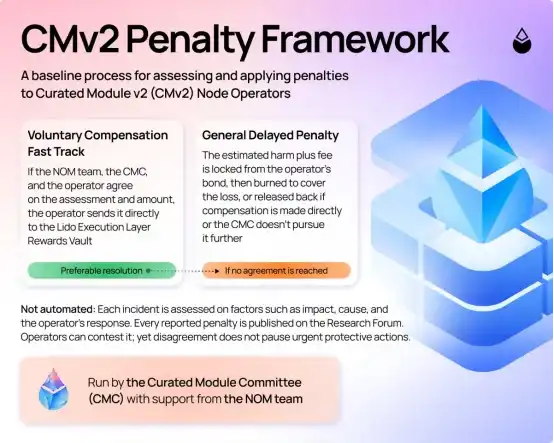
In the past, node operators relied more on reputation and technical capabilities to participate in the ecosystem. In the future, they will need to commit their own ETH capital. This means that node operators and the protocol will form a tighter interest alignment.

For the entire staking system, this can enhance node operators' motivation to maintain infrastructure, security protections, and stable operations.

At the same time, this also represents a shift in the liquid staking industry from "yield competition" to "comprehensive capability competition."

In the early days, when users chose staking services, the primary focus was on yield. However, as the market matures, security, degree of decentralization, asset liquidity, and protocol governance capabilities are becoming increasingly important competitive factors.

With this upgrade, Lido aims to establish long-term competitive advantages through infrastructure optimization.

On the other hand, this upgrade will also improve the operational efficiency of the underlying Ethereum network.

According to information released by Lido, after the migration is complete, the number of attestation messages per epoch on the Ethereum network is expected to decrease by approximately 29%.

While this change will not directly reduce gas fees or immediately increase transaction speed, it can alleviate pressure on the consensus layer, providing a more stable foundation for future Ethereum ecosystem expansion.

Simply put, the Ethereum network consists of the transaction execution layer and the consensus layer. The execution layer is responsible for processing user transactions, while the consensus layer is responsible for reaching global agreement on the network state among nodes.

With the continuous development of Layer 2, Rollup, and other ecosystems, the Ethereum mainnet requires more efficient infrastructure support. Therefore, reducing unnecessary network burden and improving the efficiency of the validation system is an important direction for future development.

Lido's current upgrade is not only an optimization of its own protocol but also part of the continuous evolution of Ethereum's infrastructure.

III. ETH Staking Enters a Mature Phase: Security, Efficiency, and Economic Models Become Core Competitiveness

Lido launching a migration at the $16.5 billion scale appears on the surface to be a technical upgrade, but at a deeper level, it reflects the changing development stage of the ETH staking market.

Over the past few years, the industry's main goal was to increase the ETH staking participation rate, enabling more users to participate in network security. In the future, the industry's focus will shift toward building a more efficient, secure, and sustainable staking system.
First, validation efficiency will become an important competitive direction.

As the Ethereum ecosystem continues to expand, the number of validators cannot grow indefinitely. How to reduce the network burden through technical optimization and improve the efficiency of individual validator nodes will become a key indicator in infrastructure competition.

Secondly, decentralization remains a long-term challenge. While large liquid staking protocols enhance user experience, they also need to avoid excessive concentration.

In the future, the staking market may develop toward a multi-protocol, multi-node, multi-module direction, achieving ecological balance through more open competition mechanisms.

Thirdly, economic incentive mechanisms will become increasingly important. A blockchain network is essentially an economic system. Whether node operators diligently maintain the network depends on whether the rewards match the risks.

Lido's requirement for node operators to provide ETH collateral leverages economic mechanisms to strengthen accountability.

It is worth noting that Lido expects this upgrade may lead to a slight decrease in the protocol's overall annualized staking yield by approximately 0.28%.

In the short term, this means a reduction in some yields.

However, in the long term, greater security and a more stable network structure may be more important than short-term yield increases. For infrastructure protocols, stability and security often hold more long-term value than maximum yield.

In the future, liquid staking protocols may no longer be merely simple yield tools but become crucial infrastructure connecting users, nodes, and the blockchain network.

The signal released by Lido's current upgrade is that the ETH staking industry is entering an era of refined operations.

Conclusion: Staking Infrastructure Competition Enters a New Cycle

Lido's launch of the $16.5 billion-scale ETH staking migration is a significant event in the development of the Ethereum staking ecosystem.

This upgrade involves the migration of 8 million stETH, structural adjustments to validators, and optimization of the node economic model. Its significance is not limited to Lido's own development but represents an ongoing infrastructure restructuring across the entire ETH staking industry.

This upgrade might be just a starting point in the long-term evolution of the ETH staking ecosystem. However, as more protocols and technical solutions enter the market, the Ethereum staking economy will also usher in a more mature stage of development.


Trending Cryptos

Related Questions

QWhat is the main purpose of Lido's recent protocol upgrade involving $16.5 billion worth of stETH?

AThe main purpose of Lido's recent upgrade is to migrate a large portion of its stETH to a new validator architecture optimized for the upcoming Ethereum Pectra upgrade. It focuses on enhancing validator efficiency, security mechanisms, and network load management, moving the industry from scale competition to a phase emphasizing efficiency, safety, and long-term sustainability.

QHow does Lido's Curated Module v2 change the requirements for node operators?

ALido's Curated Module v2 introduces a node operator deposit requirement. Node operators must now provide their own ETH as a security deposit, tying their economic stake directly to their performance. This means they bear not only technical operational responsibilities but also financial risks, aligning their incentives more closely with the protocol's stability and security.

QWhat structural challenge within Ethereum's PoS system is Lido's upgrade attempting to address?

ALido's upgrade aims to address the challenge of increasing pressure on Ethereum's consensus layer due to the growing number of validators. While more validators can enhance decentralization, they also increase communication costs and network complexity. By consolidating validator resources and reducing the total number of validators by about one-third, Lido seeks to optimize validator structure, improve node operational efficiency, and reduce the burden on the consensus layer.

QWhat positive impact on the Ethereum network is expected from Lido's migration and validator consolidation?

AThe migration and validator consolidation are expected to reduce the number of attestation messages per epoch on the Ethereum network by approximately 29%. This reduction alleviates pressure on the consensus layer, providing a more stable foundation for future ecosystem expansion, such as supporting more Layer 2 and Rollup solutions, although it does not directly lower Gas fees or increase transaction speed.

QWhat does the slight expected decrease in Lido's overall annual staking yield indicate about the industry's shift?

AThe expected slight decrease of about 0.28% in Lido's overall annual staking yield indicates a shift in the industry's priorities. It suggests that for infrastructure protocols like Lido, long-term stability, security, and network efficiency are becoming more critical competitive factors than simply offering the highest possible short-term returns to users.

Related Reads

Has the Crypto Utopia Collapsed? The Industry Reaches an Inflection Point After the Frenzy Subsides

Has the crypto utopia collapsed? The industry is at an inflection point as the hype fades. The prevailing view is that crypto has become an outlet for excess liquidity, with many participants leaving as financial returns have fallen short of past-decade expectations. The 2021 boom has been revealed as an illusion, placing the industry in the "trough of disillusionment" on Gartner's Hype Cycle. This forces a return to first principles: re-evaluating token value, securing DeFi protocols, and finding real-world applications. The core failure is a repetitive cycle of reflexive speculation, driven by the premature liquidity of tokens. The industry's incentives prioritized short-term gains over genuine innovation. While curiosity drives invention, recent DeFi hacks signal a need for engineering and iteration, including token models. The culture is shifting; the industry is no longer in its early stages. Positioned at a turning point on the technology adoption curve, crypto faces the immense challenge of rebuilding finance from scratch, a process of inevitable iteration and failure. Regarding crypto VC, claims of its death are overstated. The exceptional returns of 2016-2021 were an anomaly. The initial crypto-anarchist ethos has largely been co-opted by Wall Street and regulators. The utopian vision is over; the industry is being assimilated into the existing system, becoming a business. Current viable project categories include stablecoins, prediction markets, tokenized assets/RWA, perpetual contracts, and AI/agent integration. Crypto is converging with fintech, far from the envisioned DeFi revolution, and must find killer apps within regulatory boundaries. A reconciliation is possible: cryptocurrency may change value storage and transfer in subtle, imperceptible ways that integrate into existing systems, rather than through revolutionary fanfare. True creativity often emerges from adversity. There remains much to build for those driven by genuine curiosity.

marsbit5m ago

Has the Crypto Utopia Collapsed? The Industry Reaches an Inflection Point After the Frenzy Subsides

marsbit5m ago

Lei Jun Earns 7 Billion in One Day from CXMT's IPO? Xiaomi Executive Responds

On July 28th, Changxin Technology's stock price on the Sci-Tech Innovation Board experienced minor fluctuations. The company had made a historic market debut the previous day, becoming the first A-share stock to record a single-day trading volume exceeding 1 trillion yuan. This led to significant paper gains for its strategic investors. Among them, Xiaomi's wholly-owned subsidiary was allocated 18.24 million shares with an initial investment of approximately 158 million yuan. Reports estimated a paper profit of 717 million yuan for Xiaomi founder Lei Jun based on his shareholding structure. However, a Xiaomi executive clarified that this was a corporate investment and should not be conflated with personal wealth. Other major beneficiaries included Alibaba and Nio. Alibaba, an early investor, held nearly a 5% stake through two entities, with an estimated paper gain exceeding 160 billion yuan. Nio, participating in the strategic placement, also saw substantial paper returns. Additionally, state-owned banks and insurance institutions that invested in Changxin recorded potential gains in the hundreds of billions. Conversely, companies like Country Garden reportedly missed out on nearly 50 billion yuan in potential gains after divesting their stakes before the IPO due to liquidity pressures. The article notes that these are paper profits based on the listing price, as the allocated shares are subject to lock-up periods, and final realized gains will depend on future stock performance. An employee from Changxin Technology commented that ordinary staff remain focused on their salaries and benefits rather than the market hype.

marsbit14m ago

Lei Jun Earns 7 Billion in One Day from CXMT's IPO? Xiaomi Executive Responds

marsbit14m ago

Selling Tokens or Selling Outcomes: Several Paradoxes of the AI Business Model

"The Token vs. Outcome Sale: Key Paradoxes in the AI Business Model By mid-2026, the AI industry shows rapid growth in revenue and token usage, yet the underlying business models differ significantly. This article analyzes four structural paradoxes defining the current landscape, all pointing to the commoditization of intelligence and the concentration of profits in few segments. **The Cost Paradox: Cheaper Tokens, Heavier Bills** Despite a >95% price drop for equivalent AI capability since 2023, total spending has skyrocketed due to the Jevons Paradox: lower prices expand usage into previously uneconomical tasks. Furthermore, the shift to autonomous agents operating 24/7 multiplies consumption. However, efficiency gains often remain unrealized due to unchanged organizational workflows (the Solow Paradox). The focus is shifting from optimizing token price to optimizing the task itself. **The Hierarchy Paradox: The App is King vs. The App is Dead** While conventional wisdom holds that value accrues at the application layer, the AI stack is inverted. Infrastructure (chips) captures ~70% of industry revenue and ~80% of gross profit, while application-layer margins are thin (0-30%). Fast-evolving base models threaten "thin" apps. Sustainable applications are those that embed intelligence into specific contexts, possessing private data, workflows, or delivery capabilities that become more valuable as the base model improves. **The Responsibility Paradox: Profit Follows Accountability** Growth rates alone don't guarantee profit. A key differentiator is a company's willingness and ability to take responsibility for specific outcomes. Selling by the token competes for IT budgets; selling by the outcome (e.g., a resolved support ticket) taps into larger human labor budgets. Low-responsibility, high-volume tasks (e.g., generic客服) face commoditization. High-stakes, regulated domains (e.g., law, healthcare) where vendors assume heavier liability for results command higher margins, as seen with companies like Harvey in legal tech. **The Open-Source Paradox: Open Wins Traffic, Closed Wins Revenue** Open-source models dominate in usage share and developer adoption, often being 5-20x cheaper. However, closed-source models still capture the majority of enterprise spending (~89%). Enterprises pay a premium for closed-source reliability, support, compliance, and accountability. The total cost of ownership (TCO) is converging as closed-source prices fall faster than open-source builds trust, leading to hybrid deployments. Profit is migrating from the model layer itself to upstream (compute) and downstream (orchestration, data, services)."

marsbit15m ago

Selling Tokens or Selling Outcomes: Several Paradoxes of the AI Business Model

marsbit15m ago

Trading

Spot

Hot Articles

Discussions

Welcome to the HTX Community. Here, you can stay informed about the latest platform developments and gain access to professional market insights. Users' opinions on the price of ETH (ETH) are presented below.

活动图片