Has the Crypto Utopia Collapsed? The Industry Reaches an Inflection Point After the Frenzy Subsides

marsbitPublished on 2026-07-28Last updated on 2026-07-28

Abstract

Has the crypto utopia collapsed? The industry is at an inflection point as the hype fades. The prevailing view is that crypto has become an outlet for excess liquidity, with many participants leaving as financial returns have fallen short of past-decade expectations. The 2021 boom has been revealed as an illusion, placing the industry in the "trough of disillusionment" on Gartner's Hype Cycle. This forces a return to first principles: re-evaluating token value, securing DeFi protocols, and finding real-world applications. The core failure is a repetitive cycle of reflexive speculation, driven by the premature liquidity of tokens. The industry's incentives prioritized short-term gains over genuine innovation. While curiosity drives invention, recent DeFi hacks signal a need for engineering and iteration, including token models. The culture is shifting; the industry is no longer in its early stages. Positioned at a turning point on the technology adoption curve, crypto faces the immense challenge of rebuilding finance from scratch, a process of inevitable iteration and failure. Regarding crypto VC, claims of its death are overstated. The exceptional returns of 2016-2021 were an anomaly. The initial crypto-anarchist ethos has largely been co-opted by Wall Street and regulators. The utopian vision is over; the industry is being assimilated into the existing system, becoming a business. Current viable project categories include stablecoins, prediction markets, tokenized assets...

Author: Matti

Compiled by: Chopper, Foresight News

There is currently a widespread view in the market that the crypto industry has become an outlet for excess liquidity.

A large number of practitioners are leaving the field. The core reason is that the financial returns from the industry have fallen far short of the expectations established over the past decade. The market ultimately failed to deliver on the vision many once believed in.

This bear market truly marks the end of an era. We need to ask: what exactly are we lamenting?

Looking back, the prosperity of 2021 has been proven to be an illusion. If we apply Gartner's Hype Cycle, 2021 precisely coincided with the peak of inflated expectations.

Now we are facing a moment of clarity. This forces everyone to return to first principles, re-examine token value, strengthen the security of decentralized finance protocols, and explore new application scenarios where crypto technology can generate real value.

Ironically, it could be said that "the only clear fact we see is that uncertainty still prevails." The industry has consistently failed to identify the root causes of failure, thus perpetually repeating the same cyclical, self-reflexive hype loops.

As early as the market validation phases of 2017 and 2021, we fell into a mindset: when you have a hammer, everything looks like a nail. With a massive influx of capital, the crypto industry became a "solution" searching for problems everywhere.

History has long confirmed that "genius is always scarce, but as long as there are gullible people, there will be endless scams." This has also perhaps made crypto assets the most self-reflexive asset class in history.

The foundation of this financial frenzy is the characteristic that tokens can be circulated and traded early on. The excessive proliferation of this characteristic ultimately contributed to the bubble's collapse.

As early as 2024, it became evident that when faced with the choice between "exploring innovation" and "cashing out," the entire industry chose the latter. The industry's incentive mechanisms continuously drove participants to pursue short-term profit maximization. Two years later, we are now experiencing the corresponding consequences.

I have always believed that necessity is the mother of invention. But recently, I gained a new insight: curiosity gives birth to invention, while necessity gives birth to engineering. The frequent DeFi hacks recently are a signal that reality is demanding engineering improvements. Simultaneously, this is also an opportunity to refine first-generation solutions, iterate continuously, with token models being a crucial part of that.

However, curiosity cannot be forced from the outside. It stems from genuine passion, not profit motives. Rewards can complement curiosity, but they cannot be a prerequisite for frontier innovation.
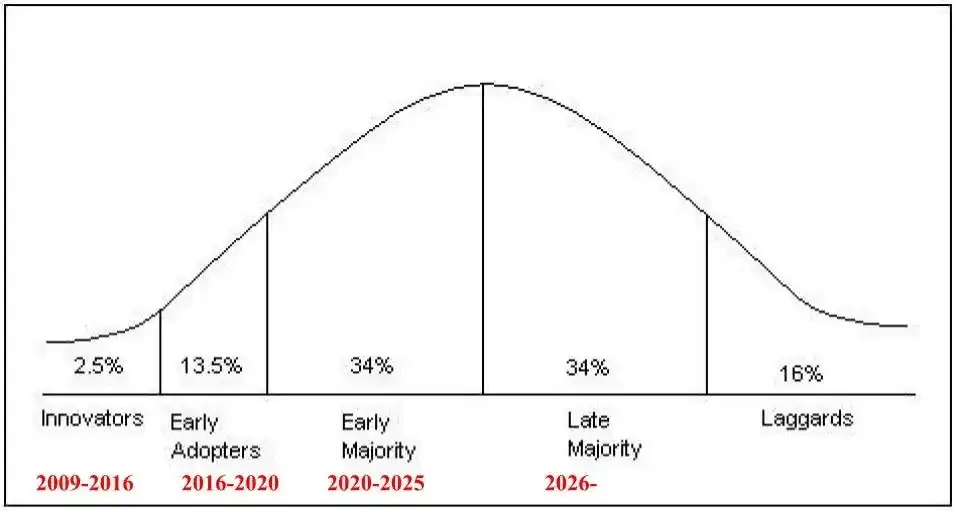
Behind the shattered illusions lies a shift in industry culture. People are gradually recognizing a key reality: we are no longer in the early days of the industry. But for excellent builders and investors, this is merely a challenge, not an insurmountable obstacle.

If we overlay the technology adoption curve with the hype cycle, the trough of disillusionment falls precisely in the middle of the curve. And this position is also the inflection point mentioned in Carlota Perez's theory.
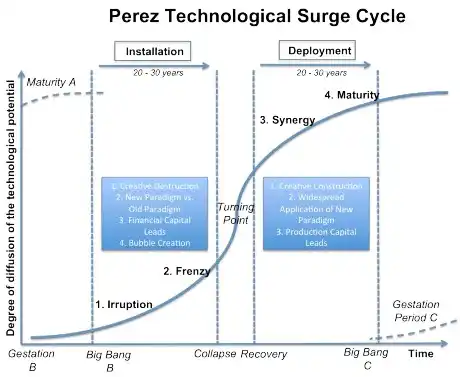
The core challenge remains unchanged: the crypto industry is attempting to reconstruct the financial industry from scratch. This is by no means easy; the process inevitably involves multiple iterations, continuous failures, and constantly facing the severe tests of reality.

In a sense, we are back to the starting point. But this does not mean all past efforts were worthless. Even if the industry temporarily stagnates, asymmetric investment opportunities still exist. At the individual level, there remains a chance to shape the future.

The real risk at present is discarding the essence for the dross, negating everything wholesale. Even the most steadfast believers and evangelists are now choosing to leave. Where the market once envisioned a trillion-dollar future, what has ultimately landed are merely a couple of hundred digital asset treasury enterprises.

On Crypto Venture Capital

Many viewpoints claim that "crypto VC is dead" or is about to die. I do not agree. Venture capital itself is facing an industry crisis: fund return multiples (DPI) are below expectations, and fundraising has become significantly more difficult.

Focusing on the crypto sector, limited partners (LPs) accustomed to "achieving high returns in four-year cycles" are leaving disappointed. But it is essential to clarify: the supernormal returns in the crypto industry from 2016 to 2021 were an exception in the venture capital field, not the norm.

During that period, cryptocurrency was packaged as a revolution, a new asset class. An immature market was flooded with capital, far exceeding the industry's effective capacity to absorb it. The frenzy peaked in 2021, followed by a prolonged clearing cycle where short-term speculation dominated. Until now, the industry has entered a consolidation phase.

The book "Manias and Imitations" discusses the nature of technology bubbles, stating: "The revolution may still land — Britain is still covered in a railway network. But the utopia imagined by the manic participants will never come true."

More noteworthy is the reversal of ideology. The original cypherpunk subculture that gave birth to Bitcoin is now actively aligning itself with Wall Street and regulators, with the industry's fate firmly tied to the hands of policymakers.

This is not merely ironic but a characteristic feature of bubble cycles. Consider the Google case: this company once publicly warned that advertising would harm search quality, yet ultimately built a vast commercial empire on advertising. Returning to the discussion in "Manias and Imitations":

"This is one of the most extreme cases of ideological reversal in history. To find similar phenomena, one can look back to Martin Luther, a devout Catholic priest who ultimately split the church; or Napoleon, who joined the movement against monarchical absolutism, only to become a dictator himself. Such cases are quite typical, not exceptions: if you are determined to destroy a powerful system, you often end up building an even stronger one. And this new system is also constrained by evolutionary laws, replicating many characteristics of the system it replaced."

It can be said with certainty that the industry has abandoned the crypto utopian fantasy. The revolution did not arrive as scheduled. Instead, the industry has been absorbed by the existing system (or, from a different standpoint, assimilated, corrupted). The industry has made many compromises, which was the only viable path after the industry devolved into a speculative casino post-2021.
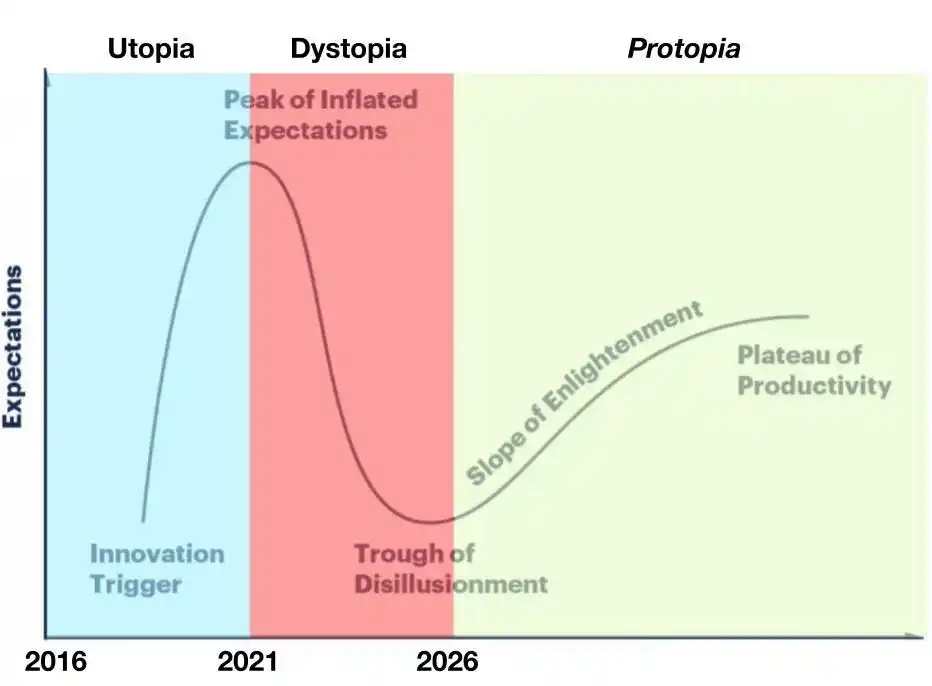
We can also use Carlota Perez's theory to understand this transformation: the utopian vision corresponds to the early deployment phase; the phase of disillusionment is the inflection point, after which we step into the rational deployment phase. Different phases call for entirely different investment strategies.

The crypto industry is no longer a frontier exploration sector; it is becoming a business. It's neither good nor bad, just the industry maturing. Current new crypto projects are broadly divided into five categories, each with different practical value:

  • Stablecoins
  • Prediction Markets
  • Tokenized Assets / RWA
  • Perpetual Contracts
  • Artificial Intelligence & Smart Agents

To some extent, cryptocurrency is eating fintech, or one could say fintech is assimilating cryptocurrency. This is far from the DeFi revolution people imagined. The crypto industry needs to find killer applications beyond stablecoins within the boundaries permitted by regulation.

Nevertheless, we believe that in the coming years, the crypto sector can still give birth to enterprises with long-term viability. We will continue to seek top founders to build quality products.

Reconciliation

Two seemingly contradictory views coexist in my mind. First, cryptocurrency is changing the fundamental ways value is stored and transferred. Second, cryptocurrency is evolving into a commercial sector that adheres to existing financial rules.

I try to reconcile them this way: cryptocurrency might permeate daily life in imperceptible ways. Transformative change often occurs quietly, only becoming clear in hindsight. The most profound shifts rarely arrive accompanied by grand slogans of "trillion-dollar market caps." They will simply embed themselves silently into the existing system, blending into public consciousness.

The crypto industry is often more creative in adversity; it's harder under the spotlight. Those truly driven by curiosity will rethink and rebuild everything. There is still much to build, and many goals worth persevering for. I still choose to believe.


Related Questions

QAccording to the article, what is the current state of the crypto industry and why are many participants leaving?

AThe article states that the crypto industry is in a downturn or 'bear market,' marking the end of an era where the market failed to deliver on the expected financial returns and vision. Many participants are leaving because the financial rewards no longer meet the expectations built up over the past decade. The industry is described as having moved past the initial hype phase and is now in a period of disillusionment and consolidation.

QWhat does the author identify as a key factor that fueled the crypto bubble and ultimately its collapse?

AThe author identifies the feature of tokens being able to trade early and its subsequent over-proliferation as a key factor that fueled the crypto bubble and ultimately led to its collapse.

QHow does the author characterize the ideological shift within the crypto industry?

AThe author characterizes it as a significant reversal. The original crypto-anarchist or cypherpunk subculture that gave birth to Bitcoin has now actively aligned itself with Wall Street and regulators, placing the industry's fate largely in the hands of policymakers, which the author describes as being absorbed by the existing system.

QWhat are the five main categories of new crypto projects with practical value mentioned in the article?

AThe five categories mentioned are: 1. Stablecoins, 2. Prediction Markets, 3. Tokenized Assets / RWA (Real World Assets), 4. Perpetual Swaps (Perpetual Contracts), and 5. AI & Smart Agents.

QHow does the author reconcile the two seemingly contradictory views about cryptocurrency's future?

AThe author reconciles them by suggesting that cryptocurrency may change the fundamental ways of storing and transferring value in a subtle, almost imperceptible manner. The deepest transformations often integrate quietly into existing systems and public consciousness rather than arriving with grand announcements like 'trillion-dollar market caps.' The industry is evolving into a commercial track that follows existing financial rules while potentially embedding itself into daily life.

Related Reads

Qualcomm Chip Price Hike Deals a Blow to Android Phones

Qualcomm has officially announced a new round of price increases for its entire chip portfolio, effective September 1. The hikes, reaching up to 18% for the flagship Snapdragon 8 Elite Gen 6 Pro, follow similar moves by MediaTek, intensifying cost pressures on the already strained smartphone industry. CEO Cristiano Amon confirmed the plan, citing the need to offset rising industry-wide costs and restore declining profit margins. Qualcomm's Q3 FY2026 results showed a 25% drop in net profit, with mobile revenue plunging 20% year-over-year, hitting its lowest level since 2021. The surge in AI computing demand has led memory manufacturers to prioritize HBM production, creating a shortage in general-purpose DRAM and NAND Flash chips. Their prices soared by 93%-98% and 55%-60% respectively in Q1 2026, causing the memory cost share in smartphones to jump from 10%-15% to over 30%. Coupled with the soaring cost of advanced nodes like TSMC's 2nm and packaging, overall chip costs have reached historic highs. These upstream pressures are forcing downstream smartphone brands like Xiaomi, OPPO, and vivo to cut orders for mid-to-low-end models by up to 20% and use cost-saving measures like older chipsets. Reportedly, the Snapdragon 8E5 will be repurposed as a "long-lasting" chip for sub-brand phones in H2 2026. Amid this cost crisis, the Android market remains sluggish. Q2 2026 smartphone shipments in China fell 4.3% year-over-year, marking five consecutive quarters of decline. Major Android brands saw market share drop, while Huawei and Apple, with their in-house chip advantages, gained share. Qualcomm is diversifying into automotive and IoT sectors to reduce reliance on smartphones, but these new segments cannot yet fill the mobile revenue gap. Industry observers warn that the full impact of component cost hikes will hit in the second half of 2026, likely leading to higher-than-expected price increases for Android flagships and a further contraction in the Chinese smartphone market.

marsbit11m ago

Qualcomm Chip Price Hike Deals a Blow to Android Phones

marsbit11m ago

Breaking: GPT-5.6 Prices Slashed Effective Today

OpenAI has announced significant price cuts for its GPT-5.6 model API, effective immediately. The entry-level **GPT-5.6 Luna** sees the most drastic reduction, with input prices dropping 80% to $0.20 per million tokens and output prices falling to $1.20 per million tokens. The mid-tier **GPT-5.6 Terra** is reduced by 20%, now costing $2.00 (input) and $12.00 (output) per million tokens. The flagship **GPT-5.6 Sol** maintains its original price but introduces a new **Fast mode**, offering speeds up to 2.5 times faster for double the cost. The company attributes these price reductions to efficiency gains achieved through **GPT-5.6 Sol's own involvement in optimizing its production systems**. The model assisted in rewriting GPU kernels and improving speculative decoding, leading to a 20% reduction in end-to-end service costs and over 15% improvement in token generation efficiency. OpenAI emphasizes this process remained human-led. A key focus of the降价 is to lower the barrier for running **AI agent workflows**. By making the capable, tool-calling Luna model significantly cheaper, OpenAI aims to enable more frequent use in cost-sensitive, high-volume tasks like code review and monitoring. This creates a potential feedback loop: model-assisted efficiency gains lead to lower costs, which enables broader agent deployment, which in turn drives further optimization. The new pricing and features will also apply to Codex and ChatGPT Work subscriptions. The changes intensify competition in the large language model market, with OpenAI directly challenging rivals like Anthropic to respond.

marsbit40m ago

Breaking: GPT-5.6 Prices Slashed Effective Today

marsbit40m ago

South Koreans' 'Gambling Nature' is Actually Forced by Life

This article explores how systemic pressures in South Korea, rather than inherent "gambling" tendencies, drive widespread speculative financial behavior. It begins by noting the high frequency of flights from South Korea to Macau, symbolizing the search for outlets beyond domestic restrictions. The core argument is that ordinary life goals—stable employment, home ownership, and financial security—have become increasingly tied to asset markets due to structural economic factors. South Korea's development model, historically reliant on corporate leverage (chaebols), has evolved into a society where household debt and personal leverage are normalized as pathways to social mobility. Key mechanisms discussed include: * **Housing Policy:** Government measures to improve affordability, like extending mortgage terms to 50 years and the unique *jeonse* (key money) rental system, embed high leverage into the housing market. * **Financial Products:** The recent approval and explosive popularity of single-stock 2x leveraged ETFs (e.g., on Samsung and SK Hynix), easily accessed via mobile apps, lowered barriers to high-risk trading. * **Social Pressure:** Media narratives around soaring corporate profits (e.g., SK Hynix) and employee bonuses create a fear of missing out, pushing individuals to use leverage to "catch up." The article concludes that this "leveraged life" is a product of institutional history and policy choices. When traditional paths to success feel constrained, and policy facilitates debt-based solutions for housing and investment, speculative behavior becomes a rational, if risky, strategy for many. The rapid cycle of regulatory approval for leveraged ETFs followed by a market crash and official apology in mid-2026 exemplifies the system's inherent contradictions. Ultimately, the "bet" is not just on assets, but on using future earnings to secure a place in the present society.

marsbit40m ago

South Koreans' 'Gambling Nature' is Actually Forced by Life

marsbit40m ago

Trading

Spot
活动图片