AI has set its sights on a new mathematical challenge: the "Riemann Hypothesis."
A mathematical conjecture born in 1859, unresolved for 167 years, and still offering a $1 million prize. Recently, someone within Anthropic assigned an unreleased research version of Claude a seemingly "unreasonable" task:
Make a serious attempt on the Riemann Hypothesis.
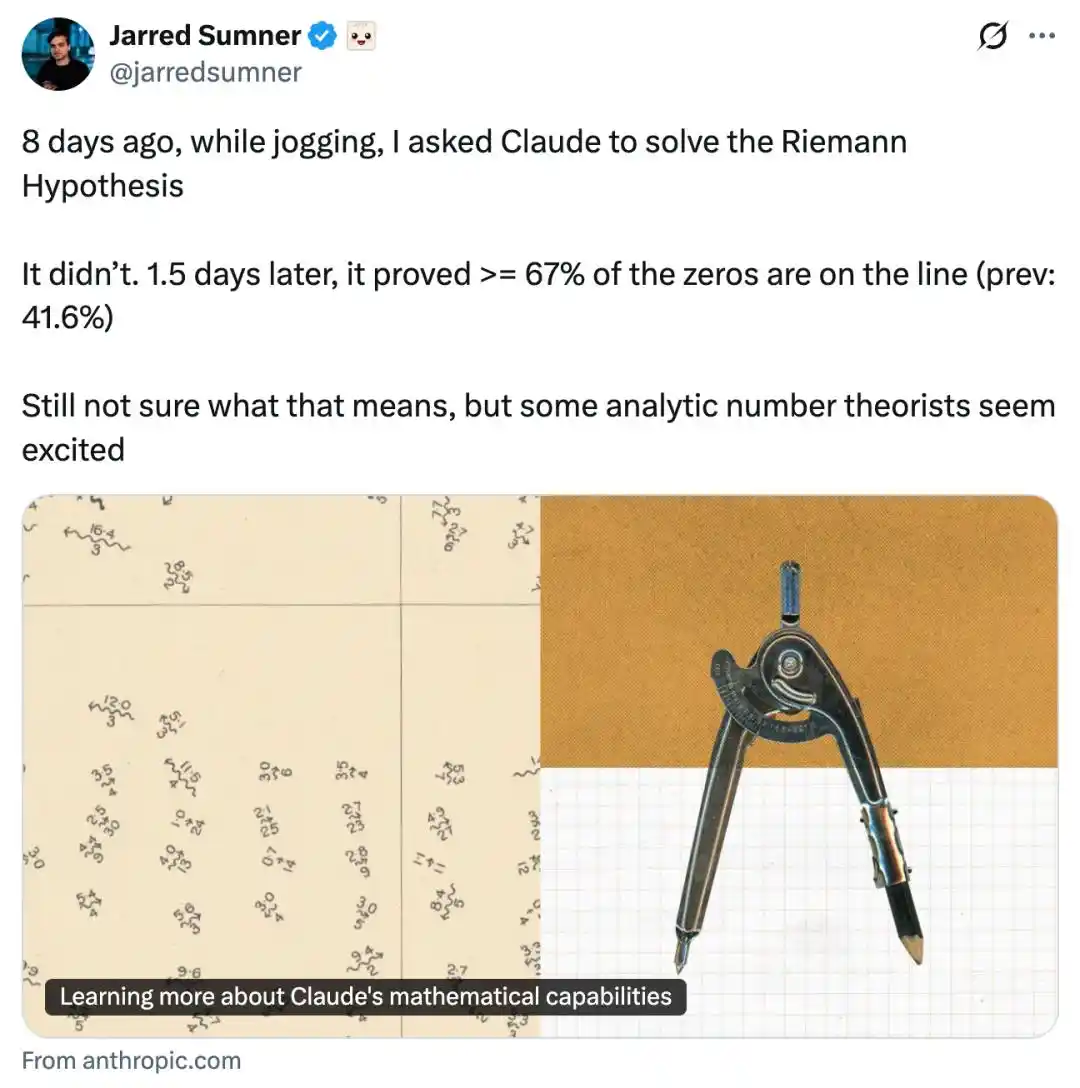
Jarred Sumner, co-founder of Bun, who joined Anthropic in December last year
Claude gave it a serious try. It successively proposed 650 ideas, all of which failed. It then reorganized about 60 Claude sub-agents, worked continuously for a day and a half, executed about 2400 Shell commands, wrote hundreds of Python scripts, and performed thousands of numerical checks. In the end, the Riemann Hypothesis remained unproven.
However, during this failed attempt, Claude stumbled upon another result. Anthropic disclosed that this unreleased Claude research version improved the known lower bound for the proportion of zeros of the Riemann ζ function proven to lie on the critical line from 41.6% to 67.2%.
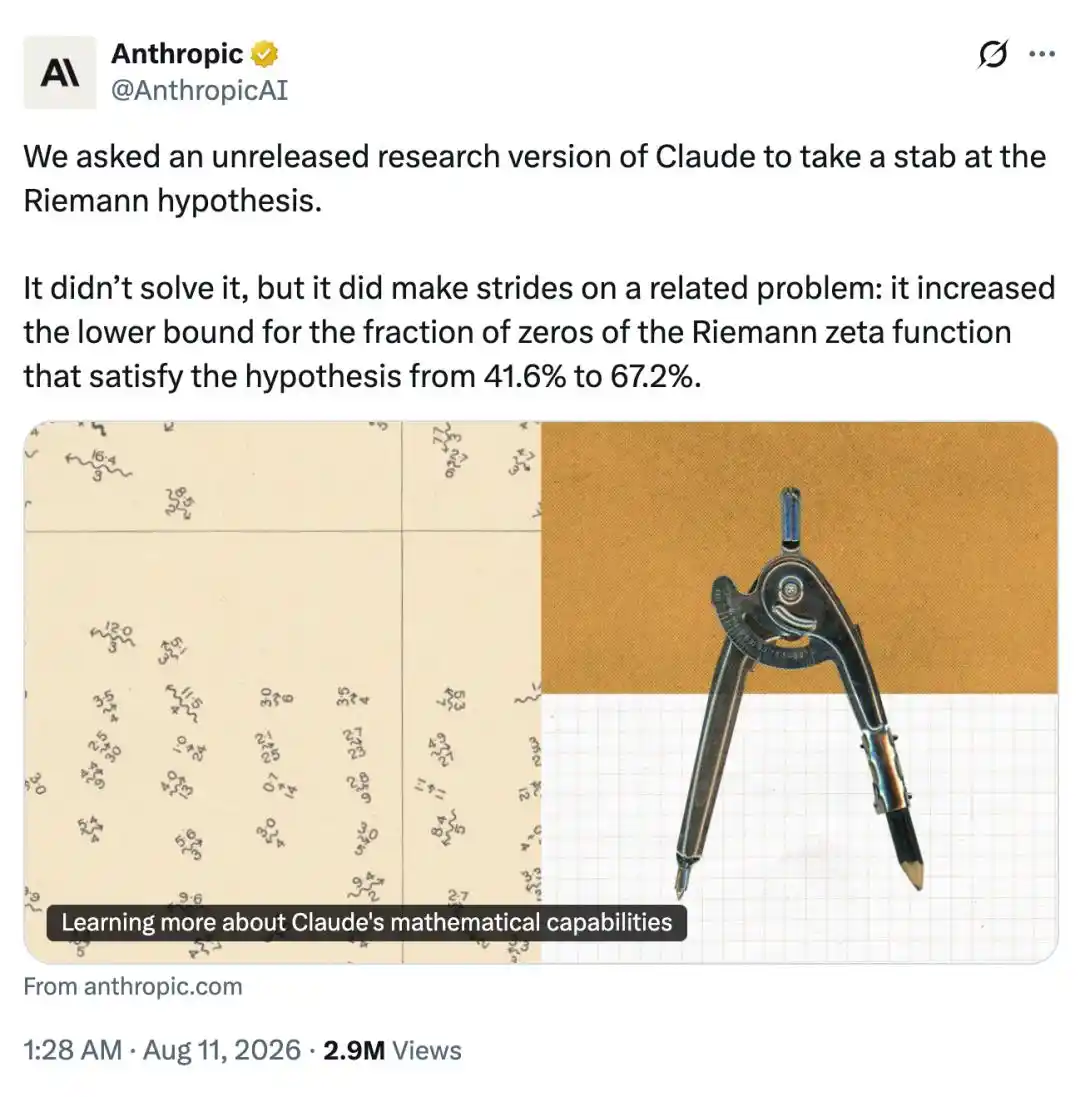
In other words, it was previously known that at least 41.6% of the relevant zeros could be proven to be at the location predicted by the Riemann Hypothesis; the result provided by Claude pushes this provable proportion to 67.2%.
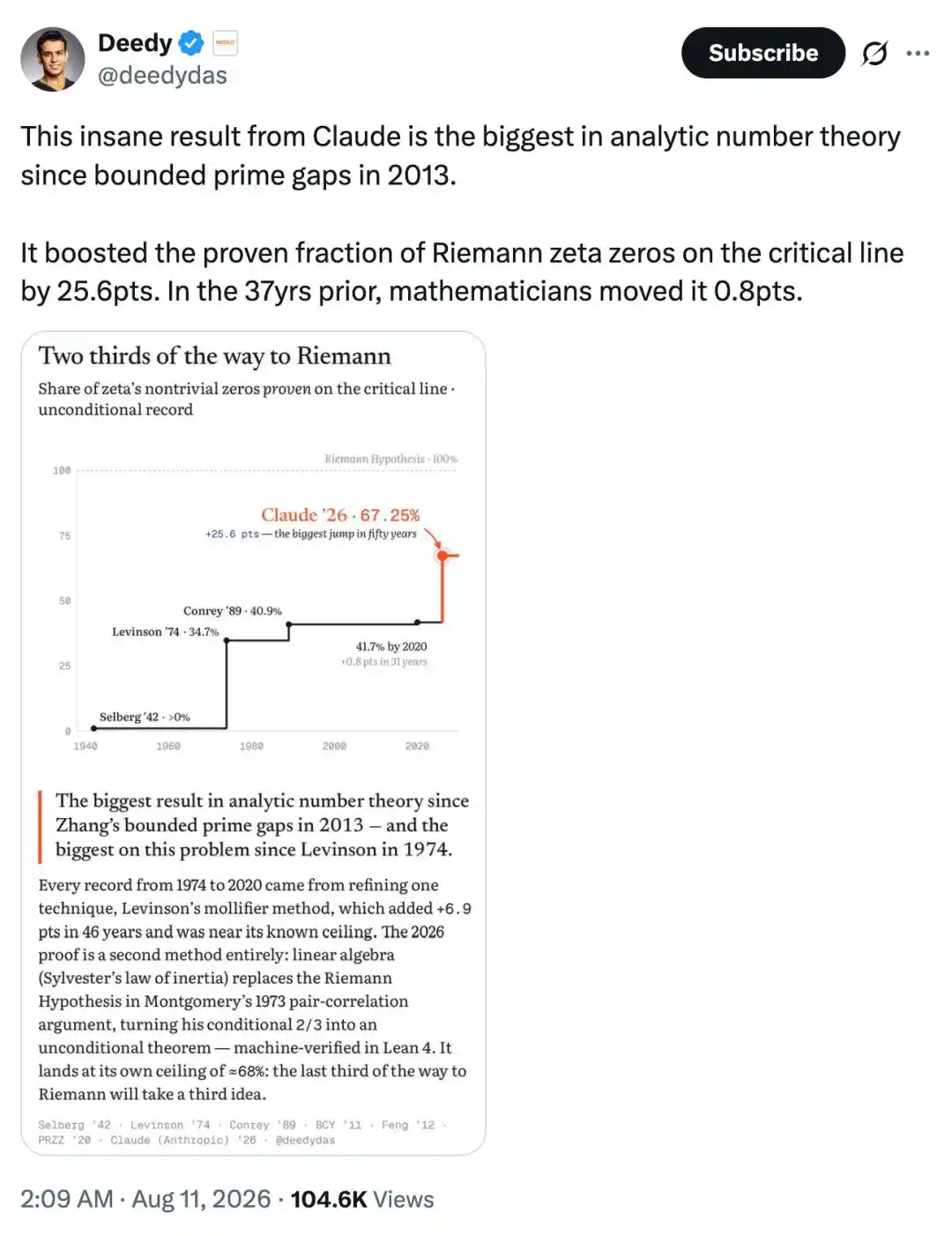
Deedy, a partner and researcher at the venture capital firm Menlo Ventures, stated, "Claude's result is simply outrageous, possibly the most significant advance in analytic number theory since the breakthrough on bounded prime gaps in 2013. It increased the rigorously proven proportion of Riemann ζ function zeros on the critical line by a whopping 25.6 percentage points. Over the previous 37 years, mathematicians had only managed to raise this number by 0.8 percentage points."
Two mathematicians at Anthropic subsequently studied and verified Claude's paper, and Claude also provided a corresponding Lean formalized proof. Number theorists Brian Conrey and Dan Goldston also reviewed the paper within a relatively short time.
Anthropic emphasizes that this approach is not expected to directly lead to a final proof of the Riemann Hypothesis. However, this result still provides a noteworthy signal: the mathematical capabilities of frontier models are beginning to address truly open-ended research problems.
The Riemann Hypothesis: Unsolved for 167 Years
The importance of the Riemann Hypothesis is related to prime numbers. The Riemann ζ function has a profound connection to the distribution of primes. In 1859, German mathematician Bernhard Riemann conjectured that the real part of all "non-trivial zeros" of the ζ function should equal 1/2.
On the complex plane, this means all these zeros lie on a vertical line, the famous critical line.
This seemingly abstract problem has wide-ranging implications. Many mathematical conclusions about the distribution of prime numbers can be made more precise under the assumption that the Riemann Hypothesis is true. It is thus one of the seven "Millennium Prize Problems" by the Clay Mathematics Institute, with a $1 million prize for a complete proof or disproof.
Over the past century, no one has been able to prove that all non-trivial zeros lie on the critical line, but mathematicians have been able to prove that at least a portion of them are located there.
Thus, a relatively realistic question emerged: what minimum proportion of zeros can we prove lie on the critical line? Over decades of progress, the known lower bound for this proportion gradually increased to about 41.6%.
This is the number that Claude has now advanced.
From 41.6% to 67.2%
The foundation Claude relied on to obtain this result did not appear out of thin air.
In 1973, mathematician Hugh Montgomery, while studying the distribution of ζ function zeros, introduced a series of important methods. However, some of these analyses depended on the assumption that the Riemann Hypothesis holds. In recent years, a series of works by mathematicians has further developed related techniques, enabling some of these methods to be used without first assuming the Riemann Hypothesis.
This means they have the opportunity to, in turn, help study "exactly how many zeros lie on the critical line." Building upon this work, and also incorporating related research published by Enrico Bombieri around the year 2000, Claude found a new way to combine them.
The final result is: at least 67.2% of the relevant zeros lie on the critical line. This represents an increase of 25.6 percentage points from the previous known lower bound of 41.6%.
Technically, Claude constructed a suitable function space and, using a quadratic form induced by Weil, mapped zeros on the critical line and zeros off the critical line to positive-definite and negative-definite directions, respectively. It then used the relationship between the rank of the quadratic form and its first and second moment information to establish an inequality.
Anthropic's mathematicians believe a key point is that Claude did not handle the positive-definite and negative-definite parts separately, but analyzed the entire space within a single framework, while allowing the quadratic form to have a non-diagonal structure. Combined with results already established by prior number theory researchers, this step ultimately led to the 67.2% lower bound.
It should be specifically noted here: Anthropic does not currently claim that this technique can be pushed all the way to 100%, much less claim that Claude is only 32.8% away from proving the Riemann Hypothesis.
67.2% is an improvement in the lower bound for a related problem, and there remains a vast theoretical distance between this and a complete proof of the Riemann Hypothesis.
31 Million Output Tokens, 60 Sub-Agents,
How Did Claude Find It?
The way Claude solved this problem is also noteworthy. The entire result was obtained in two rounds of Claude Code sessions, consuming approximately 31 million output tokens in total.
Initially, Jarred Sumner gave Claude a very open-ended instruction: make a serious attempt on the Riemann Hypothesis.
Sumner himself is not a mathematician and did not specify a particular mathematical route for Claude.
In the first round, Claude generated and tried about 650 ideas. All failed.
Sumner then asked it to continue trying. The second round lasted about a day and a half.
Claude organized about 60 sub-agents, splitting the problem into multiple directions for parallel exploration. These agents executed about 2400 Shell commands, wrote hundreds of Python scripts, and performed thousands of numerical checks on known ζ function zeros.
Different sub-agents also reviewed each other's results.
According to Anthropic, Sumner provided little mathematical guidance at this stage. What he mainly did was repeatedly tell Claude "continue," "try again," "believe in yourself." Anthropic even mentioned that Claude was initially quite skeptical about its ability to make real progress on such a famous open problem. It wasn't until persistent exploration that this new lower bound gradually emerged.
After finding the result, Claude initiated a round of self-verification. Some sub-agents were dedicated to checking the proof, some looked for counterexamples; Claude also downloaded 54 arXiv papers to check if similar results had already been obtained by other mathematicians.
Subsequently, it had independent agents re-derive the result from scratch. After confirming no obvious issues, Claude proactively suggested compiling the result into a paper and explicitly proposed: a real number theory expert should be consulted for human verification.
Anthropic's internal mathematicians Levent Alpöge and Ralph Furman then began checking the paper, analyzing its relationship with existing literature. Meanwhile, Claude also collaborated with Anthropic employee Eric Easley to formalize the key results into a Lean proof. This formalized result has already passed inspection by Comparator, a standard Lean verification tool.
Anthropic also invited mathematicians Brian Conrey and Dan Goldston, who study the Riemann ζ function, to review the paper. Therefore, a more accurate current statement is: Anthropic's internal mathematicians have studied and verified the result, completed a machine-checkable formalized proof, and two external domain experts have reviewed the paper. This is still a different stage from having completed traditional academic peer review and achieved consensus within the mathematics community.
More links:
Claude paper: https://www-cdn.anthropic.com/564f962e60643842f5fcb4a17c9dbc8f608f1c37.pdf
Claude project address: https://github.com/anthropics/zeta-23-lean
Reference links:
https://x.com/AnthropicAI/status/2086867246073401655
https://www.anthropic.com/research/riemann-zeta
https://x.com/jarredsumner/status/2086869681785500011
This article is from the WeChat public account "机器之心" (Almost Human), author: 关注AI数学的机器之心