Well-known Investor Targets Nvidia: AI Boom Overly Reliant on It

marsbitPublished on 2026-07-30Last updated on 2026-07-30

Abstract

Renowned investors Mark Cuban and Michael Burry have issued warnings about Nvidia's central role in the AI ecosystem, drawing parallels to the dot-com bubble. Cuban expressed concerns that Nvidia, by financing its clients' purchases of its GPUs for data centers, has positioned itself as a critical but vulnerable linchpin in the AI boom. He warned that a breakthrough from a competitor or a single misstep could trigger a widespread collapse. Similarly, Michael Burry pointed to the parabolic rise in the cost of insuring Nvidia's debt (CDS) as a sign of market fears over the company's overextension. He suggested Nvidia has pushed cyclical spending to an epic scale through numerous financing deals, creating significant risk. Both investors cautioned that overinvestment in AI infrastructure and potential oversupply could lead to a painful downturn, with Burry also revealing he has increased his short position and holds put options against Nvidia.

Two Wall Street heavyweights, Mark Cuban and Michael Burry, have just sounded warnings about Nvidia's vast artificial intelligence (AI) ecosystem network.

This comes after a user on social media platform X expressed concern that Nvidia, by funding its customers' purchases of its GPUs for data center construction, is acting as a "backstop," making itself vulnerable to a potential "bust" in the AI boom. Subsequently, American billionaire investor Mark Cuban voiced similar concerns.

He posted on X, writing: "This is very much like the dot com crash. But instead of a lot of IPOs, Nvidia is the 'IPO'. They are funding everyone."
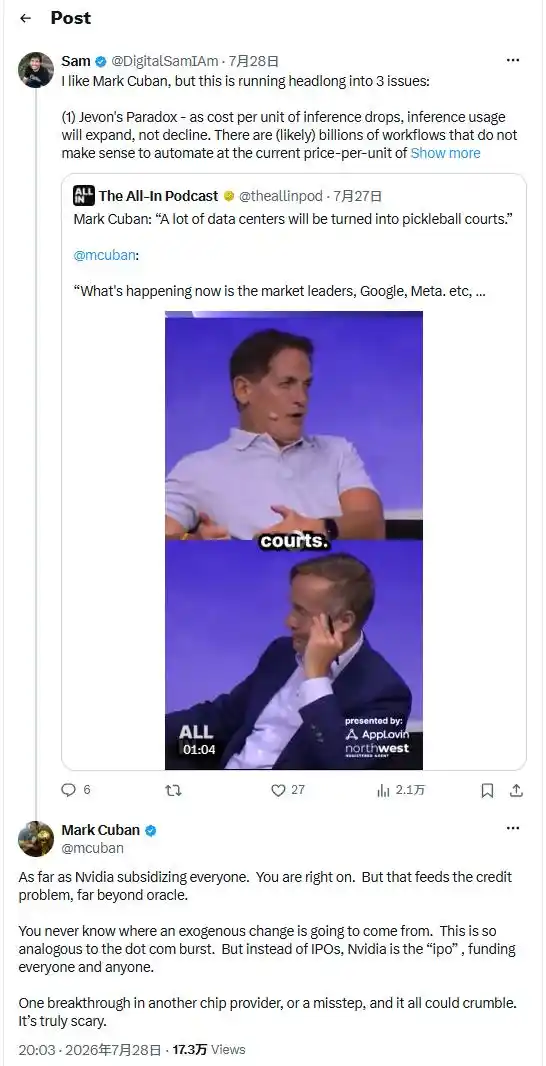
Cuban was referring to a common phenomenon during the dot-com bubble where startups raised capital and gained high valuations through public offerings. He further stated that during this tech boom, Nvidia has essentially replaced the stock market in playing this role.

"One breakthrough by other chip vendors, or one mistake, and the whole thing could come crashing down," he wrote on X. "It's really scary."

His comments came as Nvidia has struck deals worth hundreds of billions of dollars with numerous players in the AI ecosystem, including OpenAI, Microsoft, CoreWeave, and SK Hynix. Cuban worries that this chipmaker is so intertwined with its customers that if problems arise, the damage could spread quickly, causing painful and widespread consequences.

Nvidia CEO Jensen Huang himself acknowledged the company's pivotal role at a corporate event last November, noting the abundance of memes online about the company propping up the AI boom, the stock market, and the global economy.

"We're basically holding up the planet — and it's not even hyperbole," Huang said. Nvidia's stock fell more than 3% on Wednesday and is roughly flat year-to-date.

Coincidentally, renowned short-seller investor Michael Burry, famously known as the "Big Short," issued a similar warning.

"Nvidia 5yr CDS pricing parabolic for a reason," he wrote, attaching a chart showing the price of insuring against a default on Nvidia's debt has roughly doubled over the past two months.
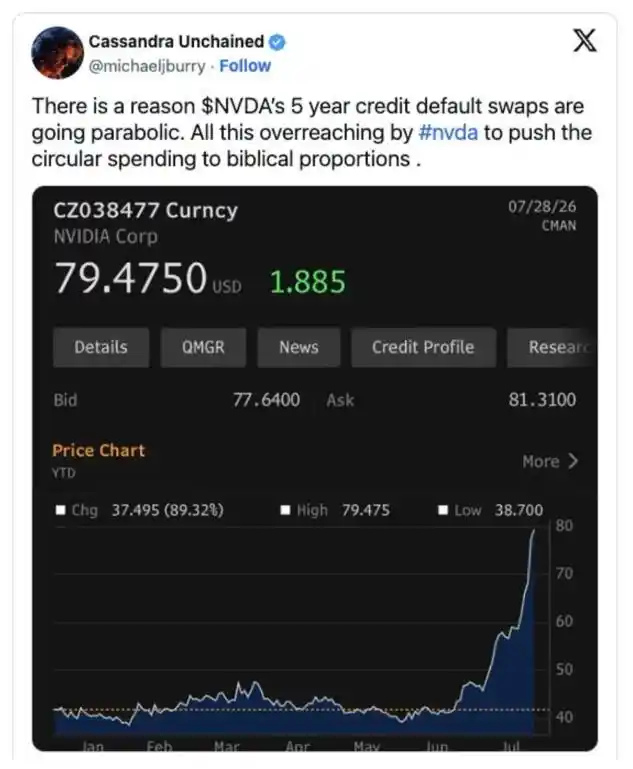
"Nvidia stretched this far, pushing the revolving spend to epic proportions," he added, implying the market is pricing in a greater risk that Nvidia cannot meet its financial commitments as it has overextended itself through too many deals.

In recent weeks, both Cuban and Burry have criticized certain aspects of the AI boom.

On a podcast, Cuban warned that companies are overbuilding AI infrastructure, which will become more efficient over time, leading to overcapacity. He joked that many such buildings would ultimately be converted into pickleball courts.

Similarly, Burry has argued that tech giants are over-investing in microchips and data centers that will soon become obsolete, stretching depreciation to inflate their earnings, and signing "mutually beneficial" deals to sustain the AI hype.

Burry also wrote in a July 24th post that he increased his short position in Nvidia and holds a "decent-sized" number of put options. He believes a significant portion of Nvidia's demand comes not from end customers but is facilitated through financing, not reflected on its balance sheet. "Much of the future revenue is obtained through revolving financing," he wrote.

This article is from the WeChat public account "Kechuangban Daily," author: Huang Junzhi

Trending Cryptos

Related Questions

QAccording to Mark Cuban, what does he compare the current AI boom to, and what role does Nvidia play in his comparison?

AMark Cuban compares the current AI boom to the dot-com bubble. He states that unlike during the dot-com era where there were numerous IPOs, 'Nvidia itself is the IPO' because it funds everyone by financing its customers to buy its GPUs for data centers.

QWhat specific financial instrument's price movement did Michael Burry cite as a warning sign for Nvidia, and what did it imply?

AMichael Burry cited the 'parabolic' rise in the price of Nvidia's five-year credit default swaps (CDS). This implied that the market was pricing in a greater risk of Nvidia defaulting on its debt, as the cost to insure against such an event had roughly doubled in two months.

QWhat is the core concern shared by both Mark Cuban and Michael Burry regarding Nvidia's business model and the AI ecosystem?

ATheir shared core concern is that Nvidia has become dangerously overextended and central to the AI boom. They warn that Nvidia's practice of financing its clients' purchases has created a tightly interconnected and fragile ecosystem, where a problem at Nvidia or a breakthrough by a competitor could trigger a widespread collapse.

QWhat criticism did Mark Cuban level against companies building AI infrastructure, and what humorous analogy did he use?

AMark Cuban criticized companies for overbuilding AI infrastructure that will become more efficient over time, leading to overcapacity. He humorously quipped that many such buildings would ultimately be converted into pickleball courts.

QWhat investment position did Michael Burry disclose regarding Nvidia, and what was his reasoning for it based on the article?

AMichael Burry disclosed that he had increased his short position in Nvidia and held a 'sizable' amount of put options (bearish bets). His reasoning was that a significant portion of Nvidia's demand is not from end-users but is fueled by its own financing to customers, creating a circular, self-reinforcing cycle of spending that he views as unsustainable.

Related Reads

The United States Officially Recognizes the Laboratory Origin of the Coronavirus

The White House has published a page titled "Lab Leak: The True Origin of Covid-19," presenting the laboratory leak from a Wuhan facility as the most likely cause of the pandemic. This conclusion is based on a report by a US House of Representatives subcommittee investigating the virus's origins. Key arguments cited include the virus's unique biological features not found in nature, a single suspected spillover event into humans, and the proximity of the Wuhan Institute of Virology, which conducted gain-of-function research on coronaviruses. The report also notes that WIV staff exhibited COVID-like symptoms in autumn 2019, prior to the official outbreak. It criticizes a prominent paper on the virus's natural origin, alleging it was promoted by Dr. Anthony Fauci. The congressional subcommittee's report led to the suspension and subsequent five-year debarment of the EcoHealth Alliance and its president, Peter Daszak, from US federal funding, following findings of grant violations related to the Wuhan research. A Department of Justice grand jury is also investigating. While this US government position is presented, the scientific community, including WHO working groups, continues to debate both natural zoonotic and laboratory origins. The investigation underscores the pandemic's immense human (nearly 15 million deaths per WHO) and economic toll (over $4 trillion), highlighting the geopolitical weight of assigning blame and the future need for robust global biosecurity protocols.

cryptonews.ru9m ago

The United States Officially Recognizes the Laboratory Origin of the Coronavirus

cryptonews.ru9m ago

Welcome to the New Crypto World: Only This Time, The Place Where You Lose Money Is Called the Stock Market

Welcome to the New Crypto World: Only This Time, the Place to Lose Money is Called the Stock Market. The article depicts a future (2026) where global stock markets, particularly tech stocks, are exhibiting behaviors and risks reminiscent of the cryptocurrency world. The narrative centers on a sharp crash in South Korea's KOSPI index and leading stocks like SK Hynix, highlighting widespread retail losses, leverage-induced liquidations, and extreme volatility. It argues that a significant shift in market dynamics is underway: pricing is increasingly driven by narratives (like the AI boom) over fundamental valuation, amplified by high leverage and the rapid, emotion-fueled consensus formed on social media. Former crypto traders, seeking new opportunities, brought their high-risk strategies—chasing narratives, using leverage—into equity markets, focusing on sectors like AI and semiconductors. Ironically, data suggests some major tech stocks have recently shown greater volatility and faster crashes than Bitcoin, which is becoming relatively more stable and "stock-like" through institutional adoption. The piece details how leveraged ETFs in Korea, particularly those tied to single stocks, created a vicious cycle of forced selling that exacerbated the market plunge. It concludes that while stocks retain underlying fundamentals, the *trading* of them has undergone a "de-rationalization": markets now prioritize themes, social media sentiment, and leveraged bets over traditional analysis. In a paradoxical twist, Bitcoin is striving to become more like a traditional asset, while a segment of the stock market is becoming more like crypto—a cycle of grand stories, crowded trades, easy leverage, and the pervasive, often misplaced, belief that one can exit before everyone else. The final, poignant wish from a Korean retail investor—to go back to life before trading and get their money back—underscores that markets offer no refunds.

marsbit28m ago

Welcome to the New Crypto World: Only This Time, The Place Where You Lose Money Is Called the Stock Market

marsbit28m ago

Trading

Spot

Hot Articles

Discussions

Welcome to the HTX Community. Here, you can stay informed about the latest platform developments and gain access to professional market insights. Users' opinions on the price of AI (AI) are presented below.

活动图片