Idle Macs Can Also Make Money? An Overview of Eigen Labs' Decentralized AI Inference Network Darkbloom

marsbitPublished on 2026-06-22Last updated on 2026-06-22

Abstract

AI inference is becoming a crucial layer of internet infrastructure, yet it remains largely dependent on costly, capacity-limited centralized systems with potential security risks. Meanwhile, millions of powerful computers sit idle globally. Eigen Labs' Darkbloom network aims to utilize this idle capacity by enabling distributed AI inference on Mac computers, specifically those with Apple Silicon chips. Darkbloom's architecture consists of three components: users who send inference requests, a coordinator (operated by Eigen Labs) that routes these requests, and providers (Mac owners) whose machines run the models and return outputs without being able to see the request content. The system prioritizes privacy through a hardened provider process, software integrity checks, and hardware-supported attestation based on Apple's security architecture to ensure verifiable privacy. Economically, Darkbloom differs from traditional models. It leverages existing hardware, with marginal costs primarily driven by electricity, allowing it to offer pricing roughly 50% lower than major API aggregators. Providers keep 100% of the inference revenue, and the project does not rely on token subsidies; earnings come solely from real AI inference demand. However, early-stage earnings are modest, with top providers currently earning under $6 per day, influenced by factors like hardware specs, uptime, and network demand. The network currently supports models like Google's Gemma 4 and OpenAI's GPT-OS...

Compiled by: Felix, PANews

AI inference is gradually becoming a critical layer of internet infrastructure. However, most inference currently still relies on a centralized architecture, which is costly, has limited capacity, involves multiple layers of stacking, and carries certain security risks. At the same time, there are millions of powerful computers worldwide that remain idle for most of the day.

Eigen Labs recently launched the AI inference network Darkbloom, which explores performing distributed AI inference on idle Mac computers. By combining verified nodes, hardware-level privacy protection, and superior economic efficiency, it transforms idle Apple Silicon chips into a more efficient, privacy-first computing network.

The project was launched as a research preview around April this year, upgraded to a public alpha version in May, and is now available on the OpenRouter platform. In the alpha version, the available models are Google's Gemma 4 and OpenAI's GPT-OSS.

Core Architecture and Verifiable Privacy

The Darkbloom network consists of three parts: users, coordinators, and providers.

  • Users can send inference requests through a chat interface or a compatible OpenAI API.
  • The coordinator (operated by Eigen Labs) routes these requests to eligible Macs in the network.
  • Providers (users who own these eligible Macs) run the models and return the output, but they cannot see the request content.
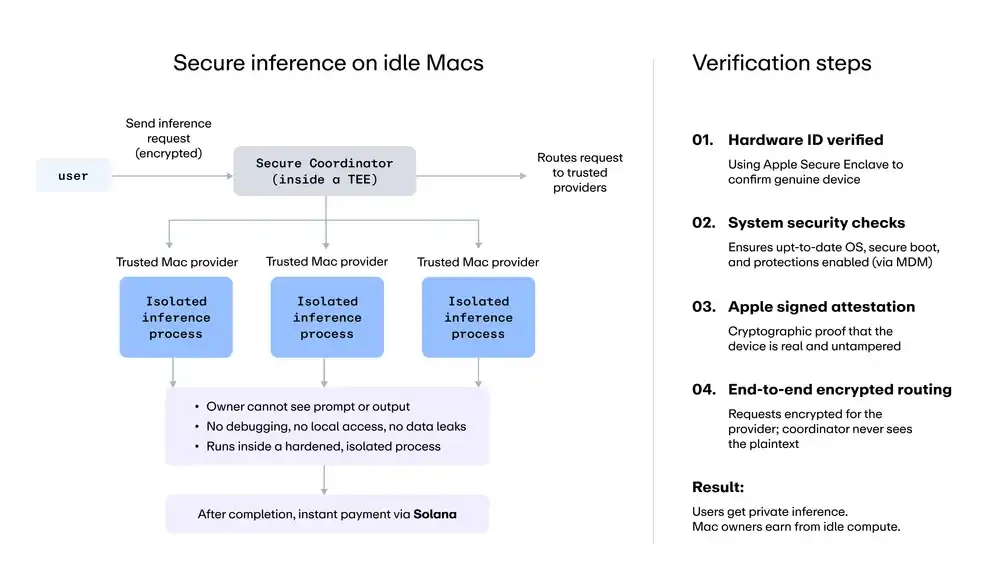
Darkbloom is built on a privacy-first distributed inference model. The provider process is hardened to resist common local inspection paths, including debugger attachment and external memory inspection. The integrity of the running binary is also part of the trust model, helping to ensure that the software serving requests conforms to network expectations.

The system also uses hardware-supported attestation based on Apple's security architecture. Secure Enclave keys, attestation signals, and periodic challenge-response checks are used to verify that participating nodes are running with the intended protections and software state, achieving truly verifiable privacy.

Economic Model and Daily Earnings

Darkbloom is fundamentally different in its business model compared to the vast majority of projects. In the traditional tech stack, costs include hardware, facilities, cooling, networking, operational overhead, and layers of profit margins. In Darkbloom's model, the hardware already exists, and the marginal cost is primarily driven by electricity. Darkbloom's benchmark pricing is only about 50% of current mainstream API aggregators. Providers (Mac hosts) can keep 100% of the inference revenue. Furthermore, Darkbloom has not taken the path of issuing tokens to subsidize early participants; node earnings come entirely from real AI inference demand.

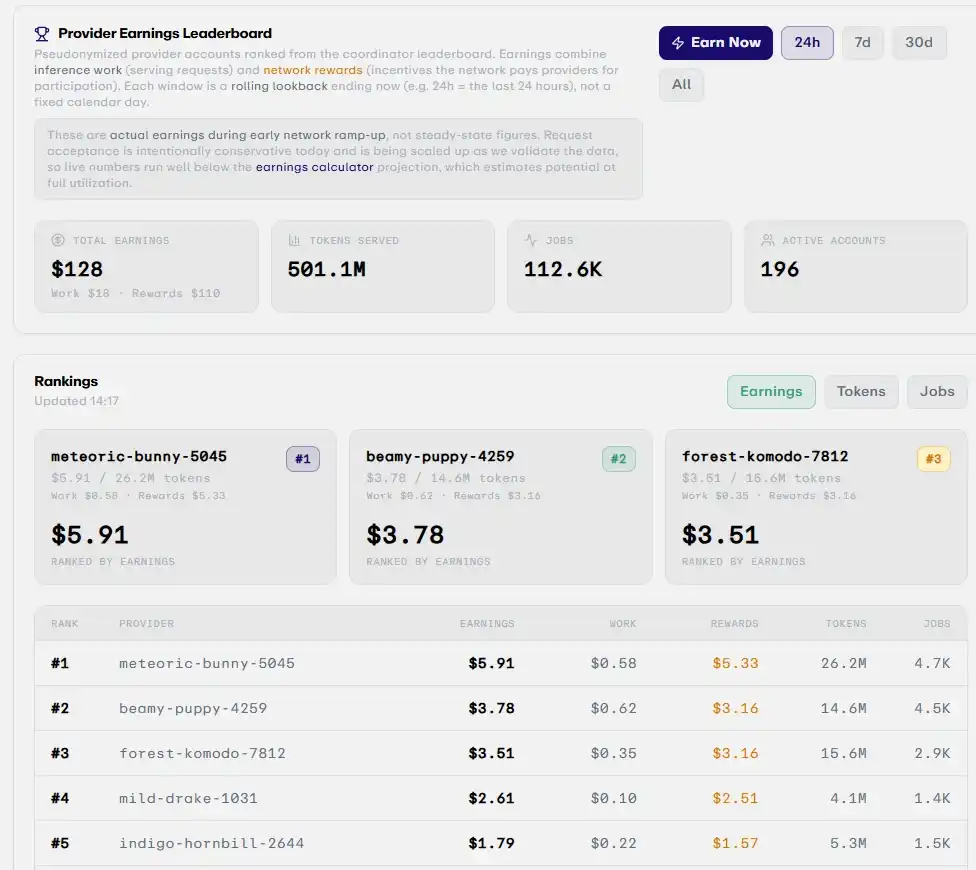
It is worth noting that, given the project's early stage of development, earnings are relatively modest. Factors such as memory and hardware configuration, uptime, model demand, node health, and network demand can all influence earnings to some extent.

Current leaderboard data shows that the top provider earns less than $6 per day, and the fifth-ranked provider earns even less than $2. However, as the network opens up to large language models with high memory requirements and real user usage increases, this situation is expected to improve.
Regarding how to set up an idle Mac, the steps are as follows:

  • Acquire a Mac with an Apple Silicon chip
  • Ensure it runs macOS 14 or higher
  • Install the Darkbloom provider
  • Keep the Mac online with a stable internet connection
  • Let the network route supported AI tasks

Related reading: A Roundup of Recent Stocks and Crypto Assets Worth Watching: AI, RWA, and Space Stocks...


Trending Cryptos

Related Questions

QWhat is the core concept of Eigen Labs' Darkbloom network, as described in the article?

ADarkbloom is a decentralized AI inference network that aims to utilize the idle computing power of Mac computers equipped with Apple Silicon chips. It distributes AI inference tasks across these devices, offering a more cost-effective and privacy-focused alternative to centralized infrastructure.

QHow does Darkbloom's architecture ensure privacy for user requests?

ADarkbloom ensures privacy through a hardware-supported verification model. It uses Apple's Secure Enclave keys, attestation signals, and periodic challenge-response checks to verify that provider nodes are running with the expected protections. Provider processes are hardened against local inspection, and providers cannot see the content of user requests.

QWhat is the current economic model for providers (Mac owners) participating in the Darkbloom network?

AProviders keep 100% of the inference revenue they generate. The model is based on real AI inference demand, not token subsidies. Currently, however, earnings are low; the top provider earns less than $6 per day, and the fifth earns under $2, with factors like hardware, uptime, and network demand influencing income.

QWhich AI models are available in Darkbloom's current alpha version, and where is it accessible?

AIn its current public alpha version, Darkbloom offers Google's Gemma 4 and OpenAI's GPT-OSS models for inference. The network is accessible on the OpenRouter platform.

QWhat are the basic requirements for a Mac to become a provider on the Darkbloom network?

ATo become a provider, a user needs a Mac with an Apple Silicon chip, running macOS 14 or a higher version. They must install the Darkbloom provider software and keep the Mac online with a stable internet connection to allow the network to route AI tasks to it.

Related Reads

Two Giants' Credit Expansion: Loan Balances of $9.9 Billion vs. $14.6 Billion, Brazil Emerges as the Main Battlefield

Title: Two Giants "Credit" Surge: Loan Balances of 99 Billion vs. 146 Billion USD, Brazil Emerges as Main Battlefield Summary: The article compares the rapid expansion of credit businesses by two major e-commerce and fintech players, Sea (via Monee) and Mercado Libre (via Mercado Pago), in overseas markets like Southeast Asia and Latin America, contrasting with a slowing domestic Chinese credit market. Using Q1 2026 financial data, it highlights their significant growth. Sea's Monee reached a loan balance of $99 billion, up 71% year-over-year (YoY), contributing 17.5% to Sea's total revenue. Mercado Pago's loan balance hit $146 billion, up 87% YoY, contributing 45% to its parent company's revenue. Both maintained stable risk metrics (e.g., Monee's 90+ day NPL at 1.1%) despite rapid scaling. Brazil is identified as a key and accelerating growth market for both. Sea's Brazilian operations saw loan volumes exceed $10 billion, growing 250% YoY, with SPayLater GMV penetration still low (~10%) indicating high potential. Sea also secured a key Brazilian financial credit license (SCFI). Mercado Libre's Brazil segment contributed over half (54%) of total group revenue, with its credit business there generating $11.24 billion in revenue, up 89% YoY and accounting for 12.7% of global revenue. Mercado Pago's credit portfolio, especially credit cards (46% of loans, +105% YoY), is a strategic focus, described as crucial as building logistics was a decade ago. Its net interest margin after loss (NIMAL) remains high at 17.8%. The article concludes that while Brazil presents immense opportunities, the success is largely driven by these integrated "e-commerce + fintech" giants with proprietary transaction data and ecosystems, making it challenging for standalone fintech players to compete effectively.

链捕手4m ago

Two Giants' Credit Expansion: Loan Balances of $9.9 Billion vs. $14.6 Billion, Brazil Emerges as the Main Battlefield

链捕手4m ago

Research Report Analysis: Is Intel Making a Comeback with Apple? Bernstein's Calculations Show the Right Direction, but the Price Is Already Overvalued

Bernstein analyst Stacy A. Rasgon published a report on June 18 regarding Intel, assessing the potential impact of recent political support for a US-based PC chip design and manufacturing collaboration between Apple and Intel. The report views this as a significant signal for the foundry landscape shift but concludes the initial financial contribution would be minimal. Key conclusions: 1) An Apple deal is seen as a small-scale "proof of concept." Even if Intel wins 40% of Apple's premium notebook chip orders (~5 million units/year), Bernstein estimates it would generate only about $500M in annual revenue and ~$0.03 EPS, negligible against Intel's ~$55B revenue. 2) Political encouragement is not equivalent to enforceable mandates. Winning orders ultimately depends on Intel demonstrating competitive technology (like its 18A node), cost, and reliable supply. 3) The path from validation to large-scale production involves significant challenges, capital investment, and time. Due to these uncertainties, Bernstein maintains a Market-Perform (Hold) rating with a $100 price target, implying potential downside from the ~$121.10 price at the report date. The analysis highlights the tension between near-term validation value—serving as a crucial trust signal for Intel's foundry ambitions and US supply chain resilience—and the long-term opportunity to attract larger cloud and AI chip customers. The investment thesis hinges on successful 18A execution and sustained policy support, not on immediate financial gains from Apple.

marsbit28m ago

Research Report Analysis: Is Intel Making a Comeback with Apple? Bernstein's Calculations Show the Right Direction, but the Price Is Already Overvalued

marsbit28m ago

27-Year Reign Ends: SK Hynix Market Cap Surpasses Samsung for First Time, an AI-Driven Reshuffle of Korean Chip Power

On June 22, 2026, SK Hynix made history by surpassing Samsung Electronics in market capitalization, ending Samsung's 27-year reign as South Korea's most valuable company. This dramatic reversal is powered by the AI boom and SK Hynix's dominant position in High Bandwidth Memory (HBM), a critical component for AI model training. Once a heavily indebted firm on the brink of bankruptcy, SK Hynix bet early on HBM, which has evolved from a niche product to essential AI infrastructure. It now commands a 59% share of the global HBM market. Its financial performance is staggering, with Q1 2026 net profit soaring nearly fourfold year-over-year to KRW 40.35 trillion, translating to over 2 billion RMB in daily net profit. HBM now drives roughly 40% of its revenue with exceptionally high margins. In contrast, Samsung, with its broad portfolio spanning memory chips, smartphones, and foundry services, has lagged in the HBM race while facing headwinds in other divisions. This shift signifies a deeper restructuring of South Korea's economy, moving from consumer electronics to AI-driven growth. However, the future remains competitive. With major capacity expansions planned industry-wide by 2028 and Samsung aiming to catch up in HBM technology, the new market leader cannot afford complacency. This event marks a pivotal moment in the global semiconductor industry's ongoing power realignment.

marsbit39m ago

27-Year Reign Ends: SK Hynix Market Cap Surpasses Samsung for First Time, an AI-Driven Reshuffle of Korean Chip Power

marsbit39m ago

Trading

Spot
Futures

Hot Articles

Discussions

Welcome to the HTX Community. Here, you can stay informed about the latest platform developments and gain access to professional market insights. Users' opinions on the price of AI (AI) are presented below.

活动图片