Compiled & Edited: Deep Tide TechFlow

Speakers: Josh Kale, Anthropic AI Marketing; Ejaaz Ahamadeen, Former Coinbase Product Manager
Podcast Source: Limitless Podcast
Original Title: Leopold Aschenbrenner says "No More Stocks!"
Broadcast Date: June 17, 2026
Key Takeaways
Considered one of the world's most aggressive AI investors, Leopold Aschenbrenner, while maintaining a nominal short position of approximately $9 billion in public markets against NVIDIA, ASML, and Oracle, is shifting capital toward deeper AI infrastructure and model assets like power, memory, data center networking, and Anthropic. The two hosts believe this does not signal an AI bubble burst, but rather a rotation signal in infrastructure trades shifting from "chip-first" to "energy, network, and physical data center construction first," especially as NVIDIA just completed a $25 billion bond financing and Anthropic's valuation has been pushed higher, amplifying the market implications of this judgment.
Highlights Summary
Leopold's Core Trading Logic
- "The classic 'selling shovels' trade in AI has become too crowded, and Leopold's recent position changes signal exactly that."
- "His judgment isn't that AI infrastructure has peaked, but that certain layers within the infrastructure stack, especially semiconductors and traditional hot stocks, have become overly crowded."
- "If the question becomes where the money will flow next, there are two answers. The first, most direct one, is flowing to the next real infrastructure bottlenecks: power, memory, and data center networking. The second answer is that mysterious investment exposed just weeks ago."
- "He's essentially always betting on highly infrastructure-oriented things, investing in both these optical companies and power-related companies."
- "If he's cautious on NVIDIA, then money will flow to power, memory, and such places; meanwhile, he also wants to invest directly in the 'mine' itself, rather than just buying more 'shovels.' Anthropic is his most favored 'mine.'"
Signals Released by NVIDIA's Financing
- "The question isn't whether NVIDIA will continue to make money, but why a company with extremely high profit margins and already massive cash reserves would borrow an additional $25 billion externally."
- "If a company simultaneously conducts massive stock buybacks and drastically increases dividends in the same month while also borrowing money, it's clearly not borrowing because it needs cash. A more reasonable explanation is that it's cheap capital, and the financing model for this AI rally is undergoing a subtle shift."
The Next Wave of AI Infrastructure Dividends
- "The real bottlenecks are no longer just GPUs, but power, memory, data center networking, and the ability to actually build these things."
- "You can't build data centers fast enough, expand memory chip capacity sufficiently, or instantly scale up power grids and related infrastructure, no matter how much money you raise. There aren't enough people on the ground, and regulations, approvals, and procedures are hindering progress."
- "Whoever can build data centers will take the profits."
Optical Modules, Copper, and Fiber Optics
- "As GPU scales grow larger, copper wires get hotter, energy loss increases, and efficiency deteriorates significantly. Fiber optics will become the next upgrade direction in this scenario."
- "In very high-bandwidth, short-distance transmission scenarios, copper is almost the only material everyone truly wants to use. Only when it becomes unsuitable, like when distances are too long or heat is too high, do you switch to fiber optics. So the market demand for a copper-fiber combination is very strong right now."
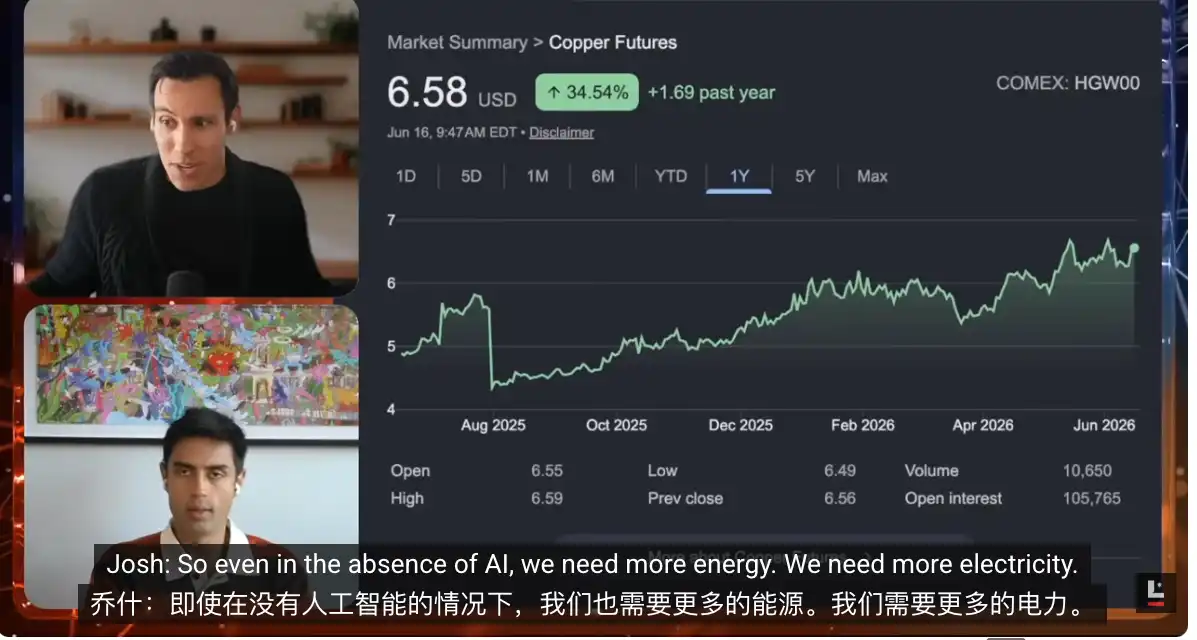
- "Copper futures have been performing strongly lately, essentially because everyone needs it. It's the most critical foundational material for short-distance, high-bandwidth transmission, and fiber optics is the next step."
- "Copper remains the most critical material for short-distance, high-bandwidth transmission, but once distances lengthen and heat becomes too high, a switch to fiber optics is mandatory."
- "The next wave of money will land on those infrastructure companies that don't sound particularly sexy."
Why Energy is the Safest Bet
- "I've always been bullish on energy because even if AI demand slows, energy itself remains a global necessity, and this demand will only increase."
- "The single trend that will continue to rise regardless of the scenario is our demand for energy, electricity, and power. These are the companies I'm most willing to go long on."
- "The companies I most want to follow are those that Jensen is investing in and that also intersect with Leopold's logic. So the stock I'm closest to following right now is Marvell."
- "The best long-term positions aren't necessarily the hottest chip companies, but the power infrastructure companies that are unavoidable under any macro scenario."
Leopold's AI Investment Portfolio
Josh Kale:
Leopold Aschenbrenner, this 24-year-old specializing in AI investments, is now almost regarded by the market as the world's strongest AI investor. Rumors suggest his fund's nominal position size now exceeds $20 billion. When we looked at Ejaaz's post a month ago, the fund size was only $13.7 billion, essentially doubling every quarter.
This time we've obtained several significant new changes in his recent investment moves. Last episode we discussed his portfolio, and the most surprising point then was that he was actually shorting a company almost everyone knows: NVIDIA, the world's highest market cap, hottest AI stock. Many couldn't understand why he established a short position exceeding $9 billion against such a company.
Now we have a new clue that might explain this. NVIDIA is actually raising capital, and through debt issuance. On the surface, this seems illogical. Why would a company as massive and highly profitable as NVIDIA need an additional $25 billion in cash it just completed raising? Today, we want to discuss, in conjunction with Leopold's portfolio, why he's making so much money, what he's looking at next, and what NVIDIA's financing really means.
Ejaaz Ahamadeen:
First, some background. Leopold Aschenbrenner was a former OpenAI researcher who raised a fund about a year and a half to two years ago. The initial size wasn't large; I recall it was around $200 million. But from his latest 13F, the fund's public holdings are now valued at $13.7 billion.
Naturally, the market wants to know which positions he's holding, what his core investment logic is, and where his next big trade will land. To understand this, we must know that until about a month ago, Leopold was very bullish on the entire AI sector, especially the "selling shovels" logic, meaning GPU and upstream hardware suppliers like NVIDIA.
But about a month ago, the market discovered he wasn't that bullish on the semiconductor line. He's still bullish on real bottleneck areas like memory and power, and probably also on new-style cloud providers, but he's surprisingly not bullish on the world's most valuable company, NVIDIA. More specifically, he has a total bearish position of about $9 billion against companies seen as core AI infrastructure beneficiaries: NVIDIA, ASML, Oracle, and others.
The Logic Behind Shorting NVIDIA
Ejaaz Ahamadeen:
When this came out, many people started worrying, thinking the AI bubble might be about to burst. On the surface, NVIDIA's GPUs are still selling like hotcakes, demand shows no clear sign of weakening, so what's the real issue?
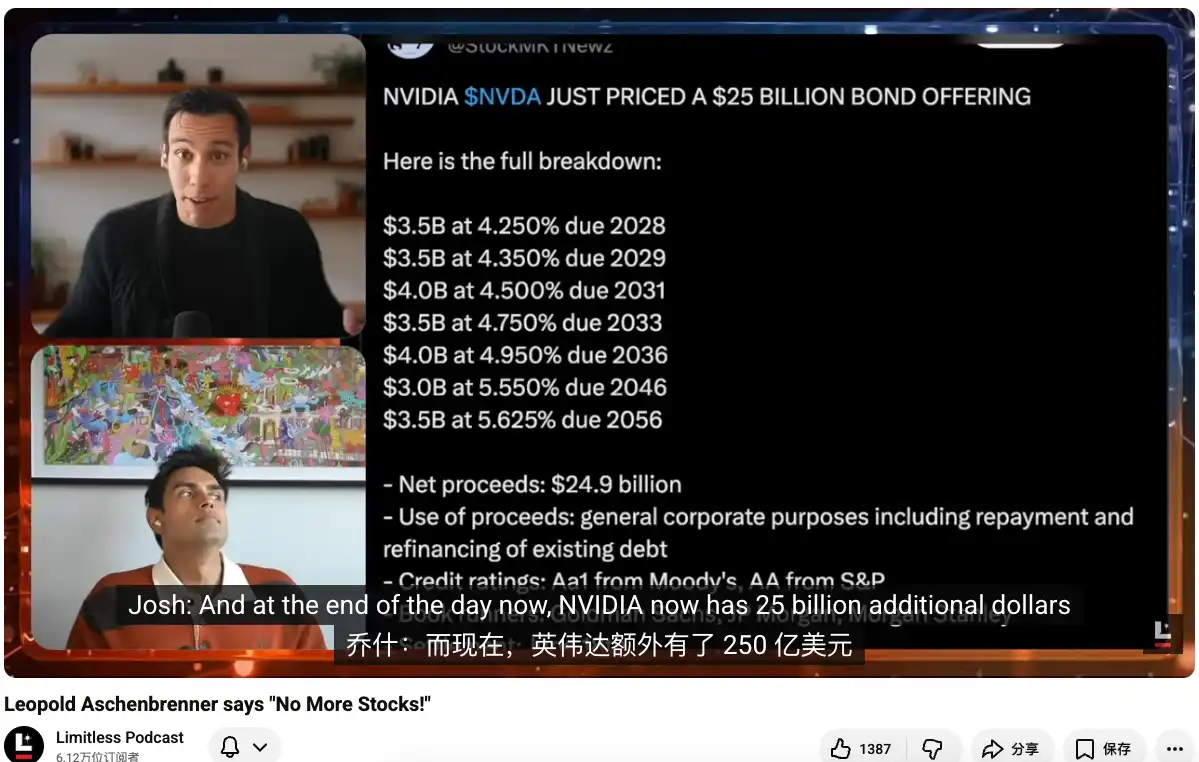
Later, we uncovered several new clues, the most important being that NVIDIA just raised $25 billion externally through a bond offering. This means it's not just using its own cash but adding external leverage. So the question arises: Why would the world's most profitable, highest-margin, strongest-cash-flow company borrow an additional $25 billion from outside?
Josh Kale:
And they initially planned to raise only $20 billion but ended up expanding to $25 billion, with subscriptions over three times oversubscribed. Last episode when discussing this portfolio, we said not to worry about a bubble yet because these companies, despite huge capital expenditures, have high enough revenues to theoretically support expansion with their own balance sheets.
But this is NVIDIA's first significant off-balance-sheet financing since 2021, instead of directly using its cash reserves. I recall it has about $12+ billion in cash on hand. Putting all this together creates a strange tension: on one side, Leopold is shorting, and on the other, NVIDIA appears to have infinite cash and profits yet still issues debt. What's really happening?
Breaking Down NVIDIA's Bond Financing
Josh Kale: Ejaaz, could you break down this deal itself? Because this isn't ordinary financing; it's a bond issuance. Essentially, NVIDIA's balance sheet now has an additional $25 billion, and the interest rates appear to be very low.
Ejaaz Ahamadeen:
I'll present both explanations. NVIDIA originally had about $13.7 billion in cash, meaning it could have simply spent its own money. So why raise external capital? The simplest analogy is buying a house. Many people choose a mortgage even if they have the full amount in cash because they can use their own capital elsewhere, and if the borrowing cost is low enough, it's more economical.
The interest rate environment hasn't been friendly in recent years, but if you're NVIDIA, one of the world's most valuable and sought-after companies, you can borrow under very favorable terms. This $25 billion bond offering has maturities ranging from 2 to 30 years and can be considered very cheap money, with rates close to US Treasury yields.
Moreover, the offering was oversubscribed by about 4 times. In other words, there was $85 billion in market demand for this $25 billion offering. NVIDIA could practically pick its investors. If we look solely at the official explanation, NVIDIA stated it's primarily for financial management, to repay and refinance some existing debt. Google did something very similar weeks ago and also in February this year. So you can certainly accept this explanation as financial optimization.
But another side is hard to ignore: Over the past month and a half, NVIDIA, Amazon, Google, and several other hyperscale cloud providers have all been adding external financing. Some through debt, others through equity sales. Leopold's view might not be entirely baseless. Could this be a sign of the bubble starting to soften, the house of cards beginning to wobble? However, if you look solely at the financial structure, it doesn't clearly point to danger yet.
Josh Kale:
I see it similarly. Shorting NVIDIA with $9 billion is a massive position. But during our research, we noticed something else: on May 18, NVIDIA's board authorized an additional $80 billion in share buybacks and increased the dividend from $0.01 to $0.25 per share, a 25x increase.
If a company simultaneously conducts massive stock buybacks and drastically increases dividends in the same month while also borrowing money, it's clearly not borrowing because it needs cash. A more reasonable explanation is that it's cheap capital, and the financing model for this AI rally is undergoing a subtle shift. Everyone wants to participate in these capital operations, and NVIDIA also realizes that raising debt is even cheaper than other financing methods, so they simply did it. At least for now, NVIDIA itself is still doing very well.
Why He Adjusted His Portfolio
Josh Kale: This leads back to another question. What exactly is Leopold thinking? Why has his judgment changed? The stock chart you showed earlier also indicates NVIDIA's recent performance hasn't been particularly strong, but it's not terrible either. It's still the world's largest company nearing a $5 trillion market cap, down only about 7% in a month, which is nothing amid the surge in other AI stocks.

Ejaaz Ahamadeen:
I don't think NVIDIA will disappear. Its GPUs, including the CPU product line launched weeks ago, I believe will perform very well. AI product demand is currently exponentially oversupplied, and the primary machine supplier capable of meeting this demand is still mainly NVIDIA.
But I do believe the classic 'selling shovels' trade in AI has become too crowded, and Leopold's recent position changes signal exactly that. Looking at his recent 13F, his bearish positions are clearly skewed against the semiconductor line, like NVIDIA, ASML, Oracle, and other infrastructure-level companies.
Yet simultaneously, he holds heavy positions in memory, power, and new-style cloud directions. This indicates his judgment isn't that AI infrastructure has peaked, but that certain layers within the infrastructure stack, especially semiconductors and traditional hot stocks, have become overly crowded.
If the question becomes where the money will flow next, there are two answers. The first is most direct: flowing to the next real infrastructure bottlenecks: power, memory, data center networking. The second answer is that mysterious investment exposed just weeks ago.
The Unexpectedly Exposed Anthropic Position
Josh Kale:
This is what surprised me the most. I only learned about it from you yesterday, and my first reaction was disbelief. Could it be that Leopold's fund, 'Situational Awareness,' actually has 20% allocated to Anthropic equity? Current rumors suggest this company accounts for about one-fifth of Leopold's fund. The Wall Street Journal and several other media outlets report this, and sources very close to the transaction have confirmed it.
This became a completely unexpected card in his portfolio. Because 13F only discloses public market holdings, not private equity, and Anthropic is precisely a large chunk of non-public equity. This is also why people started understanding why outsiders estimate his portfolio valuation at $20 billion.
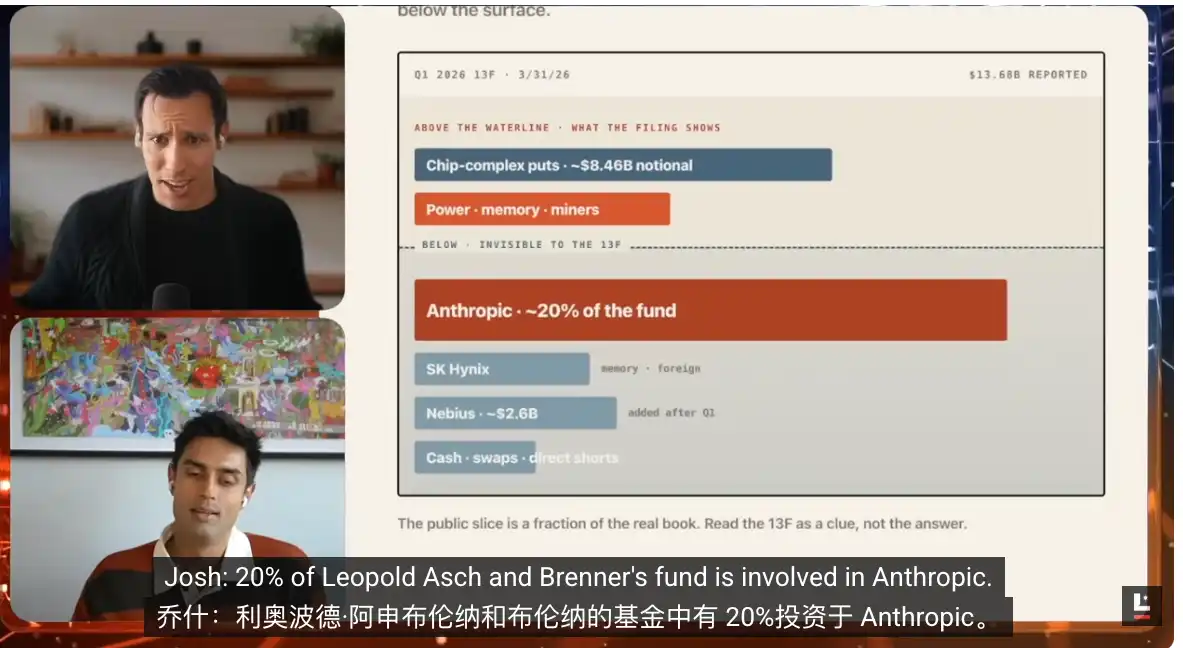
If 20% of the fund is in Anthropic, and he likely invested in early 2025, the return on Anthropic over that year has felt like seven years. This change significantly revises our understanding of his entire investment portfolio.
Ejaaz Ahamadeen:
Yes. His initial investment in Anthropic via private channels or the fund was around March 2025, when Anthropic was valued at about $60 billion. Now, according to the latest valuation round, it's been priced at $96.5 billion.
That's nearly a 15x gain. Using the calculation shown in today's episode, his latest 13F disclosed liquid portfolio value is $13.7 billion. If we add the Anthropic portion reported by the Wall Street Journal, roughly an additional $7 billion, the total fund management size reaches $20 billion.
How exaggerated is this? Bill Ackman, a top investor with three to four decades in the market, his Pershing Capital is also around $20 billion. Leopold has been in this game for only a year and a half, he's 24 years old, and has virtually no real investment experience to speak of.
Yet he's made some astonishingly accurate calls. The crazy part is he wrote it all down in advance. When he launched the fund a year and a half ago, he published a 65-page AI essay, 'Situational Awareness,' almost completely laying out the entire logic, including how capital would rotate from semiconductors and certain infrastructure layers to other bottleneck constraints. The market is now playing out along this line. It's truly remarkable.
The Next Wave of Infrastructure Rally
Ejaaz Ahamadeen:
So this also tells me where the next money will flow. If he's cautious on NVIDIA, then money will go to power, memory, and such places; meanwhile, he also wants to invest directly in the 'mine' itself, rather than just buying more 'shovels.' Anthropic is his most favored 'mine.'
Josh Kale:
This indeed looks like a new trend, and again, he's ahead of the curve. Over the past 12 months, everyone has been searching for AI's bottlenecks: rare earth metals, memory, RAM, etc., the market chased all these themes. Those judgments weren't wrong because that wave did happen.
But now, valuations for areas seen as bottlenecks are gradually rationalizing. The market has a better understanding of these companies' business models, market sizes, and future revenues, so much of the value is already priced in. In the next round, we're more concerned about where the subsequent money will continue to flow.
The direction you mentioned—land, power, server racks, physical infrastructure—seems correct. Because if we think about what's truly most important for AI, the answer increasingly seems to be physical construction capability. Look at xAI, or more accurately, SpaceX, which is now public. Its core revenue isn't rockets themselves but AI infrastructure construction.
Look at its recent deals with Anthropic and Google; the value brought surpasses the sum of Starlink, Starship, and the entire satellite business. There's clearly immense demand and value here. So the question becomes, who can actually build these things?
SpaceX is clearly one answer. Last night after-hours, its stock price reached $230, corresponding to roughly a $3.1 trillion valuation. We'll do a dedicated episode on SpaceX this week because its recent move is insane. It just completed the acquisition of Cursor, now valued at $3 trillion. Elon Musk earned more in a single day than Warren Buffett did in his entire career.
Who Will Capture the Next Round of Dividends
Josh Kale: Our concern is which companies are best at this hardware infrastructure, at developing 'machines that make machines.' Combining Leopold's direction with the broader trend, we think money will flow here next. So Ejaaz, in reality, which companies will this rotation land on?
Ejaaz Ahamadeen:
Many will be those infrastructure companies that don't sound particularly sexy. A name frequently mentioned recently is Marvell. Weeks ago at the Computex conference in Taiwan, Jensen Huang directly stated on stage that this would be the next trillion-dollar company.
And just three months before he made that statement, NVIDIA had invested $1.5 billion in Marvell. I'm starting to lose track of whether this counts as insider trading or market manipulation because after he said that, the stock rose another 70%.
I think it's easy now to directly conclude that AI infrastructure has peaked. But if you compare it to historical financial crises, like 2008, that smell of high leverage, financial engineering, and systemic manipulation hasn't fully appeared this round.
Two key differences exist. First, the products these companies make today are truly being bought by someone. Neither the dot-com bubble nor the financial crisis had such solid real demand. Second, constrained by physical laws, we can't infinitely add leverage now because the entire system is bottlenecked by human labor and construction capacity.
You can't build data centers fast enough, expand memory chip capacity sufficiently, or instantly scale up power grids and related infrastructure, no matter how much money you raise. There aren't enough people on the ground, and regulations, approvals, and procedures are hindering progress.
So I actually think this gives investors an advantage. Since you already know the hottest chip and shovel-selling trades are too crowded, then money will next flow to power, data networking (companies like Astera Labs), and other related areas. What you really need to think about is when these contracts will materialize, when these fabs will actually be built, when SpaceX rockets will launch AI satellites, even when we can start using solar power to train AI models.
The timeline determines the betting rhythm. At least that's the framework I'm using for my own investments (not investment advice). I see it this way because over the past year and a half, we've witnessed how money flowed from broad AI stocks to semiconductor and infrastructure trades.
Josh Kale:
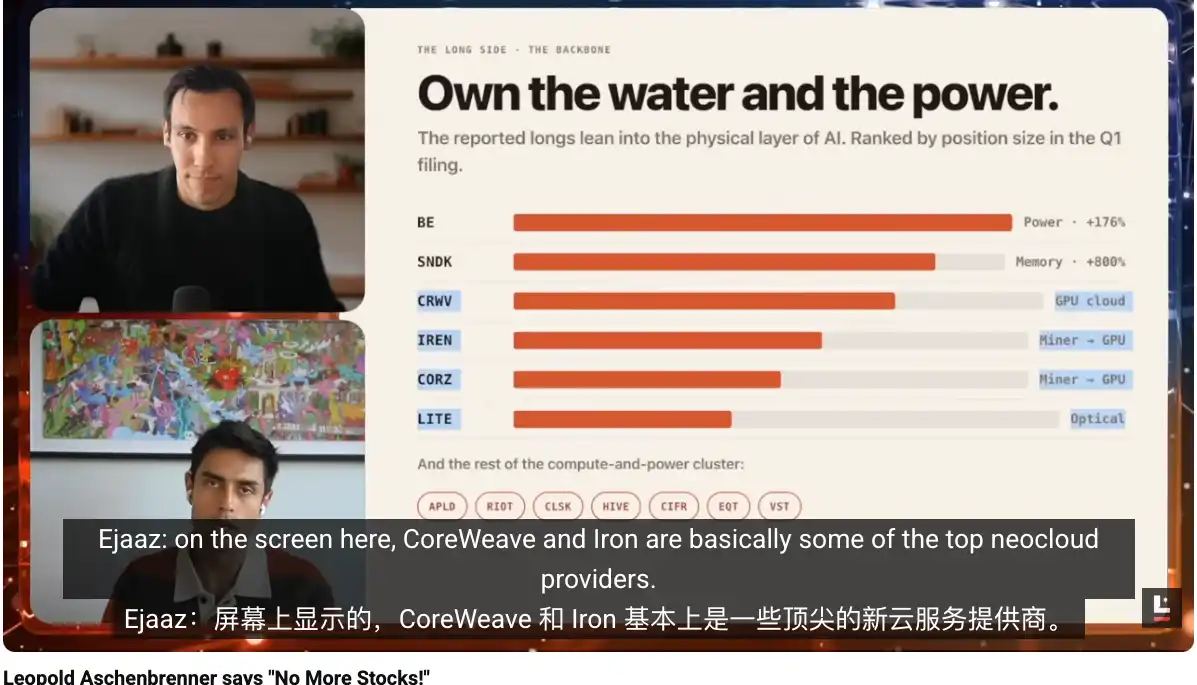
If you continue looking at this portfolio chart, you'll see this story is clearly written into his holding structure. By category, what's his largest allocation? Power and energy. Followed by memory, then cloud and GPU miners—the most tangible infrastructure.
He wants to hold new-style cloud providers like CoreWeave and also those miners who've pivoted to cloud compute. What he wants to own is this physical infrastructure because he believes this is the real bottleneck. As you mentioned, there are many finer details, like actual construction, hardware manufacturing, and data center building itself, all extremely difficult.
If we ask where the biggest bottleneck is, even permitting and approvals might be part of it. Who's solving these problems? SpaceX wants to move data centers to space; Tesla wants to use humanoid robots to solve labor issues. But both are far off. In the short to medium term, there are vast white-space opportunities, and this is precisely what Leopold is betting on.
The Advantages of Optical Modules and Fiber Optics
Josh Kale: I also want to add a detail we didn't elaborate on before. For those who want to dig deeper and find more alpha, many of his clues lie within optics and lower-level tech stacks. Ejaaz, you've been researching this lately; could you explain his thinking?
Ejaaz Ahamadeen:
If you look at the positions on his screen, CoreWeave and Iron are essentially top-tier new-style cloud service providers. Simply put, they're somewhat like Amazon Web Services, but AWS provides cloud services to internet companies, whereas these companies provide ready-made GPU infrastructure to AI companies.
They handle setting up GPUs, networking, deployment, so AI companies don't need to worry about underlying infrastructure and can directly train models and access compute. CoreWeave and Iron have been among his largest concentrated positions since he established them and have delivered the highest returns.
Notably, he still holds these two companies as major positions today. This also indicates another point: in his view, this trade is far from over. Furthermore, he privately invested in Core Scientific, a company that can help unlock CoreWeave's infrastructure supply capacity. In a sense, he added another layer of leverage to CoreWeave.
Beyond these, look at companies like Coherent and Lumentum; they are essentially fiber optic and optical connectivity suppliers. To explain in the simplest terms, semiconductors and GPUs need to communicate with each other. Traditionally, this relied heavily on copper wires. The problem is, as GPU scales grow larger, copper wires get hotter, energy loss increases, and efficiency deteriorates significantly. Fiber optics become the next upgrade direction in this scenario. It enables faster data transmission, higher cost efficiency, and allows companies providing inference and training compute to earn more. So you'll notice he's always betting on highly infrastructure-oriented things, investing in both these optical companies and power-related companies. It might not sound sexy, but in my view, this is where money is genuinely flowing now.
Josh Kale:
The copper aspect is also interesting to me because I recently realized how crucial it is for short-distance data transmission. In many high-bandwidth, short-distance transmission scenarios, copper is almost the only material everyone truly wants to use. Only when it becomes unsuitable, like when distances are too long or heat is too high, do you switch to fiber optics. So market demand for a copper-fiber combination is very strong right now, which is why observing the copper trade is interesting. Copper futures have been performing strongly lately, essentially because everyone needs it. It's the most critical foundational material for short-distance, high-bandwidth transmission, and fiber optics is the next step.
Thinking at an even more fundamental level, the materials theme has always been interesting. The most foundational layer beneath all layers is essentially what raw materials are most core for achieving intelligence. Copper is one, lithium is another, and many more. We really should do a dedicated episode on materials. Perhaps Leopold hasn't reached that layer yet, and we might spot the next rotation first.
Josh Kale:
If we go all the way down the stack, we could even look at copper mines to see how these things are made. But returning to the core judgment, I believe the next rotation indeed shifts from what seem like smaller bottlenecks to the truly hard things: hardware and large-scale data center construction.
Whoever can build data centers will take the profits. We've already seen how much money SpaceX makes due to massive data center demand. Whoever can deploy more data centers faster, provide sufficient power and GPUs, will earn the most money. This is essentially what Leopold is betting on now.
Is a Bubble Emerging?
Josh Kale: The summary is we don't think we've entered the bubble-bursting phase yet. Leopold's positions resemble rotation more than a full-scale retreat. So, should we still follow his lead?
Ejaaz Ahamadeen:
I admit, when I first saw his 13F, my initial reaction was disbelief that this guy was shorting the world's most valuable company with demand booked until 2029. But now, seeing this financing, I'm starting to think if NVIDIA continues adding external debt, or possibly even sells equity in the future, if this trend persists, then Leopold might be right again.
If that's the case, his fund could eventually surpass the world's top traders and best investment funds. He's been winning consistently; it's hard not to be impressed.
Josh Kale:
However, another important point: his life experience has almost always been about going long; he's never truly been tested by a large-scale sell-off. We mentioned Bill Ackman earlier; achieving 30x returns and surviving 30 years in the market are two different things.
If he can sustain this growth and also learn when to hit the sell button, manage risk, use hedging to protect himself, that would be even more formidable. We're already seeing glimpses of this capability. That $9 billion short position isn't $9 billion in cash directly shorting; it's achieved through options and leverage, not a one-to-one naked short. Regardless, this is very worth observing.
Energy is the Core Bet
Josh Kale: If you had to pick one stock from his entire portfolio you'd most want to buy, which would it be?
My own answer is energy stocks. I've always been bullish on energy because even if AI demand slows, energy itself remains a global necessity, and this demand will only increase. Even completely ignoring AI, we need more energy, more electricity. Companies like Bloom Energy, which can enhance power supply and delivery, excite me most because they're the most hedge-like bets. The single trend that will continue to rise regardless of the scenario is our demand for energy, electricity, and power. These are the companies I'm most willing to go long on.
Ejaaz Ahamadeen:
My answer is a bit of a cheat. The companies I most want to follow are those that Jensen is investing in and that also intersect with Leopold's logic. The stock I'm closest to following right now is Marvell. It's not a publicly disclosed holding of Leopold's, but it aligns very well with his bets on fiber optics and power, and Jensen has already invested $1.5 billion in it.
I've observed a phenomenon: whenever Jensen invests in a company through NVIDIA, whether it's Intel, CoreWeave, or others, they've basically kept rising afterward. So my current position is roughly here. I also hold some CoreWeave myself because both Jensen and Leopold are extremely bullish on it.
Josh Kale:
Marvell is up 270% over the past 6 months. This might truly be a good rule of thumb: when influential people like Jensen, or even figures with massive influence like Trump, publicly say to buy a certain stock, often you should really take a serious look.
History has repeatedly proven that such signals often have significant realization potential. Whether Intel or Marvell, these cases show that, on one hand, they indeed understand what they're talking about, and on the other, they have the ability to influence these companies' outcomes. So this rally has been truly insane.
I hope it continues. From the current perspective, it likely will. At least we're still leaning bullish, still optimistic, and will continue making judgments daily as things evolve.
Josh Kale: Any final thoughts you'd like to add regarding the update on Leopold's investment portfolio?
Ejaaz Ahamadeen:
I'd actually like to hear from those who are skeptical. If after listening to our analysis, you think we're completely wrong or have misunderstood something, please point it out directly.
Yesterday, I stared at NVIDIA's $25 billion financing news for a long time, initially looking to criticize it. But if we look solely at the financial logic, it does make sense. Why not borrow this almost risk-free cheap money? Using others' money for expansion is clearly more rational than selling your own equity because you retain more future profits.