Research Report Analysis: AI Triggers MLCC Supercycle, How Many Years of Gains Can Samsung Electro-Mechanics Enjoy?

marsbitPublished on 2026-06-24Last updated on 2026-06-24

Abstract

Title: Analyst Report: AI Ignites MLCC Super Cycle, How Many Years of Benefits Can Samsung Electro-Mechanics Reap? Summary: Morgan Stanley has sharply raised its target price for Samsung Electro-Mechanics from 920,000 KRW to 2,560,000 KRW, recasting the MLCC (Multi-Layer Ceramic Capacitor) industry from cyclical to structurally bullish. The core thesis is that AI servers demand 10-15 times more MLCCs than traditional servers, with a single AI server requiring up to 440,000 units compared to just 30,000 for a standard server. This drives not only higher volumes but also a shift to more advanced, higher-value MLCCs, boosting Average Selling Prices (ASP). The current supply crunch is seen as structural, not a temporary cyclical mismatch, driven by capacity constraints meeting sustained new demand. High-end MLCC production lines are fully booked, with new lines taking two years to build. Morgan Stanley forecasts MLCC price increases of 30% in H2 2026 and another 30-50% in 2027. Samsung Electro-Mechanics is positioned as the primary beneficiary through three channels: 1) Direct MLCC price hikes, especially for high-margin AI-use MLCCs, driving significant operating margin expansion from 15.7% (present) to 24.5% by 2027. 2) Strong growth in its ABF substrate business from saturated AI/ASIC chip orders. 3) Future revenue streams from new product lines like silicon capacitors and glass substrates. The firm's ROE is projected to surge from 7.5% in FY25 to 32.2% by FY28, with an in...

Author: Rita

Tide's Guide

Morgan Stanley just raised its target price for Samsung Electro-Mechanics from 920,000 KRW to 2,560,000 KRW. Analysts are rewriting the story of MLCC (Multi-Layer Ceramic Capacitors) from a cyclical industry to one with structural growth. The core logic is straightforward: the hunger of AI servers for MLCCs is 10 to 15 times higher than that of traditional servers.

AI Ignites "Volume and Price Simultaneous Increase"

One AI server requires 440,000 MLCCs. A traditional server? 30,000. A difference of over ten times.

This isn't just about quantity. AI's demands on MLCCs are also upgrading: higher capacitance, smaller size, lower ESL and ESR. It's evolving from competing on quantity to competing on quality, pushing ASP (Average Selling Price) up. Morgan Stanley says that Samsung Electro-Mechanics' MLCC business will contribute 15% of its revenue by 2026, and this proportion jumps directly to over 50% by 2030. Behind this is improved pricing power, leading to genuine profit expansion.

Supply Constraints Are Now Structural, Not Cyclical

This round resembles the MLCC supercycle of 2017 to 2018, but the underlying logic is completely different. That time was short-term mismatch due to inventory shortages and order surges. This time, capacity ceilings are meeting continuously growing new demand.

High-end MLCC production lines have long been fully booked, and building new lines takes two years to become operational. The low inventory levels in the supply chain have now spread from the spot market to contract prices, with distributors starting to hoard, indicating they no longer see this as a temporary shortage.

Morgan Stanley expects MLCC prices to rise by 30% in the second half of 2026, and another 30% to 50% in 2027. This isn't a futures trader's forecast, but a conclusion based on contract prices and distributor behavior visible right now.

Why Samsung Electro-Mechanics is the Biggest Beneficiary

Samsung Electro-Mechanics' benefits come from three dimensions.

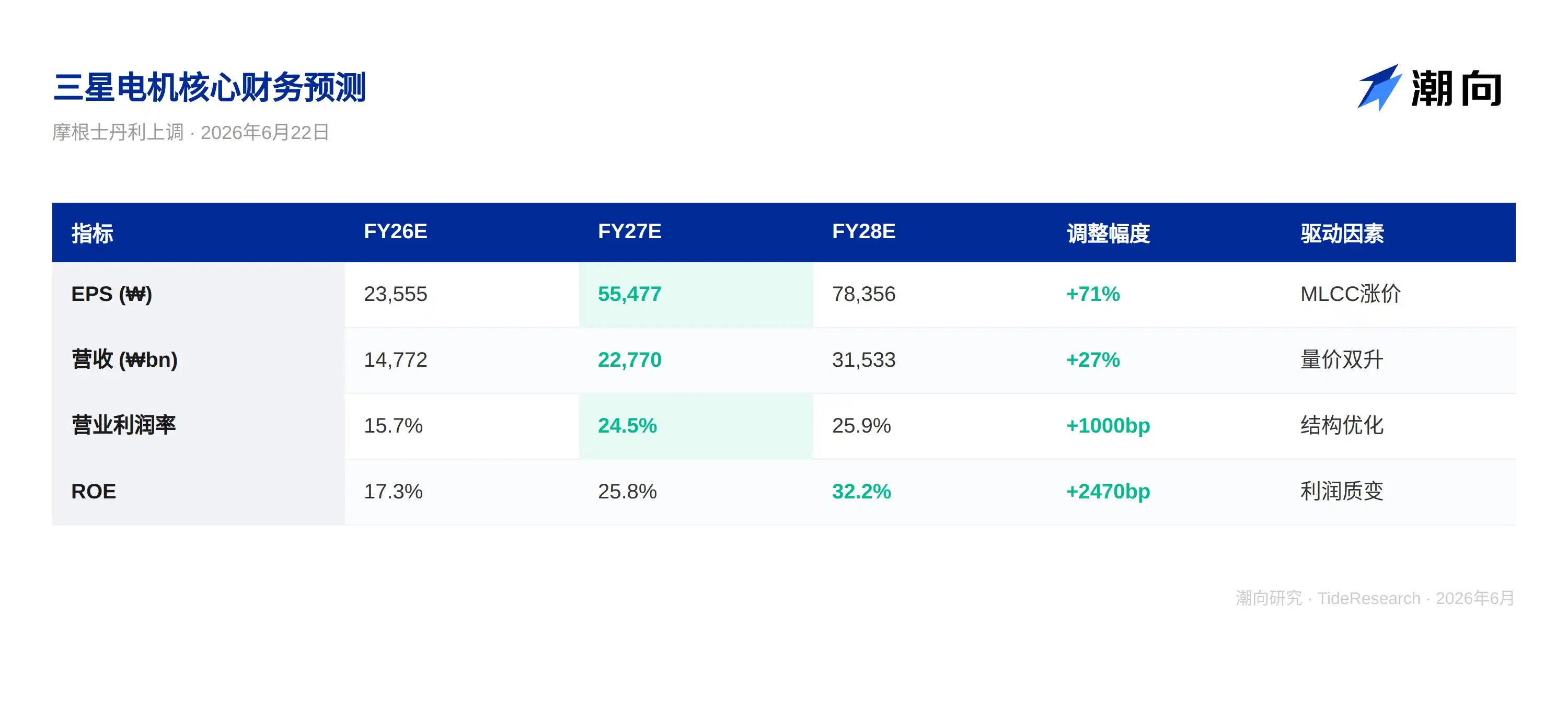
The first is direct MLCC price increases. IT-use MLCCs are rising, AI-use MLCCs are rising, and the AI segment offers even thicker margins. When the 1Q26 earnings report came out, revenue already exceeded expectations: 3.2 trillion KRW vs. 3.1 trillion KRW expected. More importantly, Morgan Stanley raised its EPS forecasts for the next three years, with the FY27E figure reaching 55,477 KRW, 71% higher than before. Operating profit margin is expected to jump from the current 15.7% to 24.5% in 2027, and then to 25.9% in 2028. This isn't a numbers game; it's genuine profit expansion from enhanced pricing power.
The second is ABF substrates. AI customer orders for ASIC chips are already saturated, and Samsung Electro-Mechanics' shipments and profits in this area are growing rapidly.

The third is new product lines. Silicon capacitors have secured $1.3 billion in orders, and glass substrates have begun trial production. These won't contribute to revenue this year or this month, but they set the stage for the coming years.

Can ROE Really Jump from 7.5% to 32.2%?

Morgan Stanley assumes that Samsung Electro-Mechanics' ROE (Return on Equity) will rise from 7.5% in FY25 to 17.3% in FY26, and then to 32.2% in FY28. Simultaneously, the company's dividend payout ratio will increase from the current 5% to 20%.

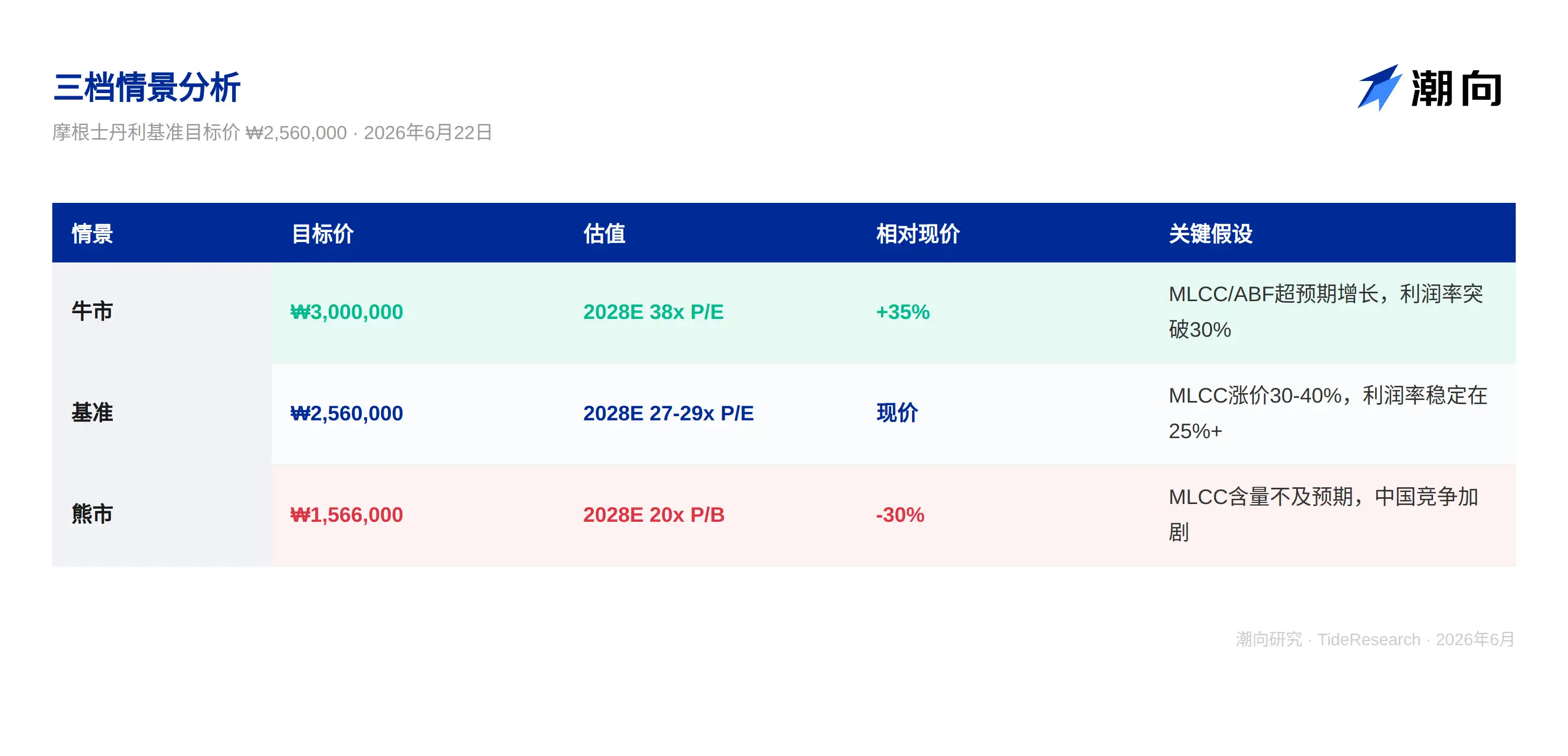
This means a Korean electronic components company, whose ROE was already not low, could enter a higher profit cycle due to changes in product mix and pricing power. The current valuation is 1.4x P/B (Price-to-Book ratio), lower than the historical average of 1.7x. Raising the target price from 920,000 to 2,560,000, an increase of nearly 178%, isn't solely due to net profit growth; there is also room for valuation re-rating.
Identifying the Risks

Upside risks: MLCC prices are forced to rise significantly further due to genuine shortages; smartphone demand rebounds beyond expectations; Chinese government consumption stimulus policies bring additional demand.

Downside risks: Samsung Electronics' flagship smartphone cycle declines significantly (Samsung Electro-Mechanics still has a considerable proportion of consumer products); poor execution in expanding business with Chinese smartphone clients; weak global consumer demand.

Catalysts? Further increases in contract prices, continued rise in the Book-to-Bill ratio, capacity utilization nearing full load, and confirmation of MLCC content growth by next-generation AI platforms (Rubin, VR200).

The New AI Infrastructure Darling

From side dish to main course, from cyclical to structural, from traditional capacitor maker to AI infrastructure supplier. This is the story Morgan Stanley is telling for Samsung Electro-Mechanics. How long the story lasts depends on how AI chip demand, capacity construction, and competitive landscape evolve. But for now, supply constraints are indeed supporting prices, and price increases are supporting profits.

Disclaimer

This article is Tide Research's compilation and interpretation of a third-party securities firm's research report. The ratings, target prices, profit forecasts, and related judgments cited herein are the views of Morgan Stanley analysts, representing only the stance of their affiliated institution. They do not represent the views of Tide Research, nor do they constitute any investment advice.

Please note three points when reading: 1. Target prices are analysts' expectations for the next approximately 12 months; they are forecasts, not promises, and will be adjusted repeatedly based on performance and market conditions. 2. Sell-side research reports are naturally biased toward optimism, and some covered companies may have investment banking relationships with the reporting firm. 3. The value of a research report lies in its core logic and underlying assumptions, not just a single target price. Focus on the logic, not just the price.

The market carries risks; decisions should be made independently. This article should not be used as a basis for buying or selling any securities.

Data Sources: Samsung Electro-Mechanics 1Q26 Earnings Report (SEC and other public data) · Morgan Stanley Research Report (Shawn Kim et al., June 22, 2026)

Tide Research · TideResearch · June 2026

Trending Cryptos

Related Questions

QAccording to the report, what is the primary driver for the structural rather than cyclical upturn in the MLCC industry?

AThe primary driver is the surge in demand from AI servers, which require 10 to 15 times more MLCCs than traditional servers. This demand is characterized by a need for higher-capacity, smaller-sized MLCCs with lower ESL and ESR, leading to a sustained 'quantity and quality' upgrade cycle. This creates a structural supply-demand tension, as new high-end production capacity takes years to build, unlike the past short-term inventory mismatch.

QWhat is the key difference between the current MLCC 'super cycle' and the one in 2017-2018, as highlighted by Morgan Stanley?

AThe key difference lies in the underlying cause. The 2017-2018 cycle was driven by a temporary mismatch between insufficient inventory and a surge in orders. The current cycle is caused by a structural ceiling on high-end production capacity meeting continuously growing new demand from AI infrastructure, making the supply tension persistent rather than temporary.

QWhy is Samsung Electro-Mechanics considered the biggest beneficiary in this scenario?

ASamsung Electro-Mechanics benefits from three main factors: 1) Direct price increases for both IT and AI-use MLCCs, with higher margins on AI-related products, leading to significant expansion in operating profit margins. 2) Strong growth in its ABF substrate business driven by saturated orders for AI client ASIC chips. 3) Diversification into future growth drivers like silicon capacitors and glass substrates, which secure long-term revenue streams.

QWhat is Morgan Stanley's ROE (Return on Equity) forecast for Samsung Electro-Mechanics, and what drives this projected increase?

AMorgan Stanley forecasts Samsung Electro-Mechanics' ROE to rise from 7.5% in FY25 to 17.3% in FY26 and further to 32.2% in FY28. This dramatic increase is driven by a fundamental shift in the company's product mix and pricing power, primarily due to the structural growth and premium pricing of high-end MLCCs for AI servers, which transforms its profitability profile.

QWhat are the key upside and downside risks mentioned for Samsung Electro-Mechanics' outlook?

AUpside risks include: 1) Further significant price hikes for MLCCs due to severe shortages. 2) A stronger-than-expected rebound in smartphone demand. 3) Additional demand from Chinese government consumer stimulus policies. Downside risks include: 1) A significant downturn in Samsung Electronics' flagship smartphone cycle. 2) Poor execution in expanding business with Chinese smartphone clients. 3) A general weakening of global consumer demand.

Related Reads

Chip Stocks Lead U.S. Market Decline: Is AI Trading Being Hit by Both Interest Rates and Returns?

Chip stocks led a broad decline in US markets, with the Nasdaq dropping 2.2% and the S&P 500 falling 1.4%. This selloff reflects a dual challenge for the once-high-flying AI hardware trade: rising interest rate expectations and growing investor impatience for clear returns from massive AI capital expenditures. The pressure was most acute on hardware leaders. Nvidia fell about 4%, dipping below a $5 trillion market cap, while Micron plunged 13.2% ahead of its earnings report. Declines across memory, storage, AI, and mobile chips indicated a sector-wide retreat. The selloff spread globally, with South Korea's KOSPI index dropping nearly 10% as key suppliers SK Hynix and Samsung recorded double-digit losses. Investors appeared to be taking profits from the most crowded trades first. Macro headwinds intensified as market expectations shifted toward a more aggressive Federal Reserve. Forecasts for multiple rate hikes in 2026 pressured high-valuation tech stocks, which rely on long-term growth projections that become less attractive as discount rates rise. Concurrently, investors are scrutinizing the profit potential of the immense AI spending by cloud giants like Alphabet, Amazon, and Meta. While these expenditures drive demand for chips and hardware, the market is now questioning whether AI services will generate sufficient returns to justify the ongoing costs. This adjustment is not necessarily a bubble burst but a recalibration. AI demand fundamentals remain, but the narrative of endless growth can no longer fully offset concerns over higher interest rates and a longer path to profitability. Near-term direction may hinge on Micron's upcoming earnings guidance and incoming inflation data, which will influence both the AI demand outlook and the Fed's policy path. The market is transitioning from blindly buying growth to demanding clearer visibility on returns.

marsbit16m ago

Chip Stocks Lead U.S. Market Decline: Is AI Trading Being Hit by Both Interest Rates and Returns?

marsbit16m ago

OpenAI's New Paper: How to Train an AI that "Doesn't Deteriorate Under Pressure"?

OpenAI's new paper "Reinforcement Learning Towards Broadly and Persistently Beneficial Models" explores training AI to maintain safe, helpful, and honest behavior even under pressure, in unseen scenarios, or after being fine-tuned for harmful purposes. Moving beyond simple rule-based "don'ts," the research focuses on cultivating "beneficial traits" like honesty, risk-awareness, corrigibility, and transparency. It investigates if reinforcement learning (RL), often prone to "reward hacking" where models exploit loopholes, can instead be used to instill robust, generalized positive behaviors. Researchers created a multi-domain synthetic dialogue dataset covering areas like healthcare and law. They trained a model by replacing 5% of standard RL data with "beneficial trait" data. This model outperformed the baseline in 83% of 53 evaluations, showing average gains of 9.1% in alignment, safety, and helpfulness. Crucially, improvements generalized: a model trained only on healthcare "good behavior" data also performed better in 17 out of 19 non-healthcare alignment tests. The paper also tests "alignment persistence." When subjected to adversarial prompts or harmful fine-tuning, the beneficial trait model showed greater resilience, with smaller performance drops and less "spillover" of bad behavior to unrelated tasks. While not a complete solution, this work suggests a shift from post-hoc correction to proactively shaping robust, principled AI behavior, a critical step for deploying models in high-stakes, complex decision-making scenarios.

marsbit19m ago

OpenAI's New Paper: How to Train an AI that "Doesn't Deteriorate Under Pressure"?

marsbit19m ago

Semiconductor Stock Rebound: Is the Technical Correction Over or a Trend Reversal?

The core of recent semiconductor stock volatility is not about daily price swings, but rather the market questioning whether AI-driven semiconductor pricing has entered a new phase. Following a sharp sell-off in Korean stocks on June 23rd, led by Samsung and SK Hynix, a subsequent rebound is seen more as a technical positioning adjustment rather than a confirmed trend reversal. The key variable is HBM (High Bandwidth Memory), essential for AI chips. Its supply-demand imbalance granted memory makers significant pricing power. The current market focus is on whether this dynamic remains strong enough to justify elevated valuations. All eyes are on Micron's upcoming earnings report. The critical factor is not whether results meet already high expectations, but whether the company's guidance confirms that AI memory pricing power, order visibility, and future margins are still expanding. Micron's outlook will serve as a crucial test for the broader AI semiconductor chain, including Samsung, SK Hynix, and other infrastructure players. The recent bounce appears to be a pre-earnings positioning repair. For it to evolve into a sustained uptrend, concrete evidence is needed that the AI infrastructure expansion cycle's fundamentals—particularly for high-end memory—remain robust and can continue to surpass elevated market expectations. The risk is that strong demand alone may not be sufficient if future guidance hints at peaking momentum or increasing supply-side pressures.

marsbit55m ago

Semiconductor Stock Rebound: Is the Technical Correction Over or a Trend Reversal?

marsbit55m ago

Trading

Spot
Futures

Hot Articles

Discussions

Welcome to the HTX Community. Here, you can stay informed about the latest platform developments and gain access to professional market insights. Users' opinions on the price of AI (AI) are presented below.

活动图片