Semiconductor Stock Rebound: Is the Technical Correction Over or a Trend Reversal?

marsbitPublished on 2026-06-24Last updated on 2026-06-24

Abstract

The core of recent semiconductor stock volatility is not about daily price swings, but rather the market questioning whether AI-driven semiconductor pricing has entered a new phase. Following a sharp sell-off in Korean stocks on June 23rd, led by Samsung and SK Hynix, a subsequent rebound is seen more as a technical positioning adjustment rather than a confirmed trend reversal. The key variable is HBM (High Bandwidth Memory), essential for AI chips. Its supply-demand imbalance granted memory makers significant pricing power. The current market focus is on whether this dynamic remains strong enough to justify elevated valuations. All eyes are on Micron's upcoming earnings report. The critical factor is not whether results meet already high expectations, but whether the company's guidance confirms that AI memory pricing power, order visibility, and future margins are still expanding. Micron's outlook will serve as a crucial test for the broader AI semiconductor chain, including Samsung, SK Hynix, and other infrastructure players. The recent bounce appears to be a pre-earnings positioning repair. For it to evolve into a sustained uptrend, concrete evidence is needed that the AI infrastructure expansion cycle's fundamentals—particularly for high-end memory—remain robust and can continue to surpass elevated market expectations. The risk is that strong demand alone may not be sufficient if future guidance hints at peaking momentum or increasing supply-side pressures.

TL;DR

On June 23, the South Korean stock market experienced severe selling, with the Kospi closing down about 10%, trading suspended for 20 minutes at one point, and Samsung Electronics and SK Hynix both falling over 12%. A day later, according to media reports, Samsung Electronics rebounded by about 8.5% during intraday trading, and sentiment in Asian tech stocks showed some recovery.
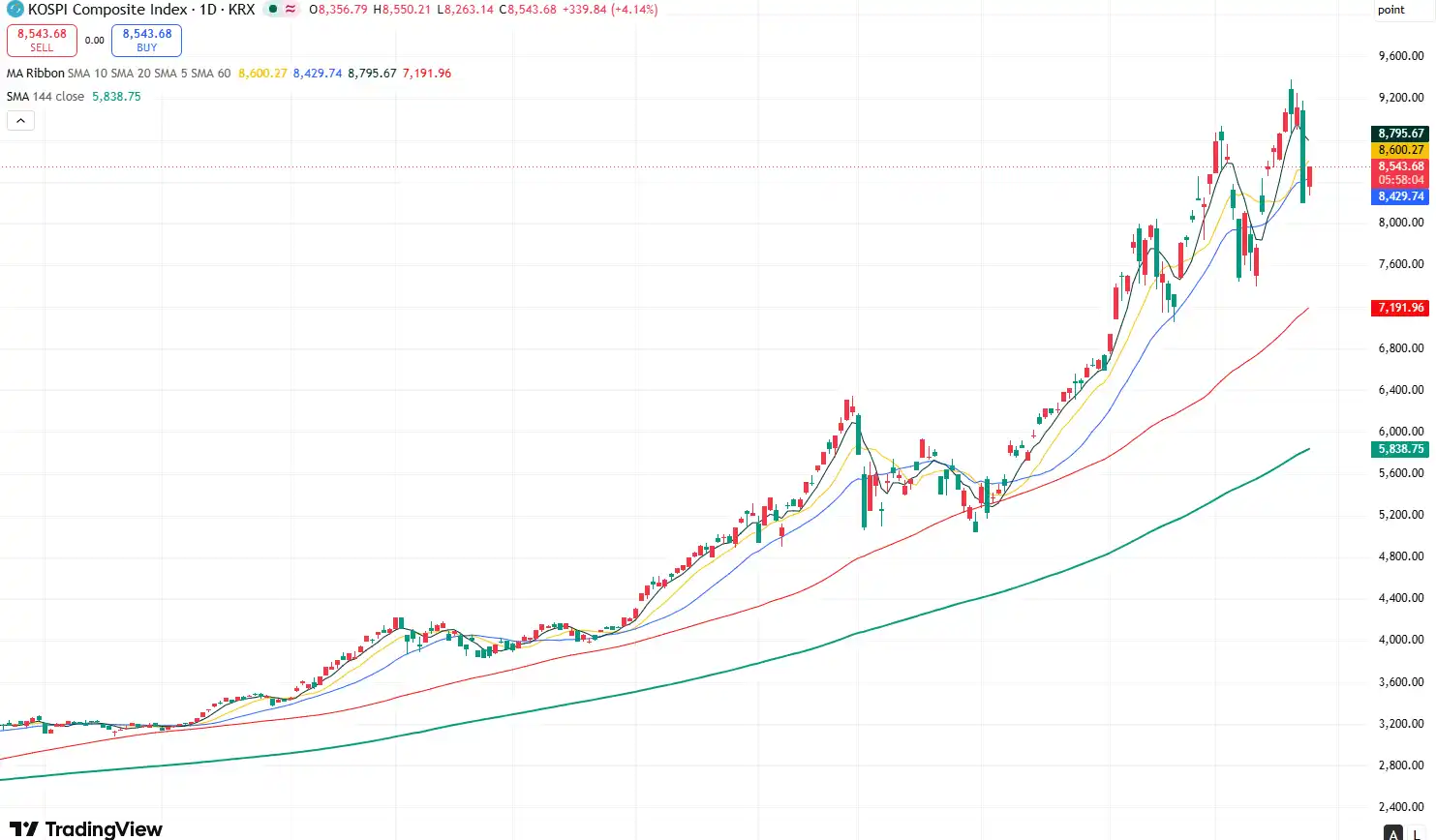
The core of this round of volatility is not the single-day rise and fall, but that semiconductor stocks have entered a new pricing phase after the crowding of AI trades. Over the past year, the expansion of AI infrastructure has linked South Korean memory stocks, U.S. stocks like Micron, NVIDIA, and TSMC on the same chain. As long as AI server expansion continues, high-end memory will remain tight, memory manufacturers' profit expectations will continue to be revised upward, and related semiconductor stocks will still be seen as beneficiaries of the same wave of AI capital expenditure cycle.

What the market now needs to confirm is whether this round of correction is merely a technical release or an early signal of a trend reversal. Samsung's potential shareholder return expectations have provided emotional repair for the Korean market, but a more direct stress test comes from the earnings season, especially from Micron. The company will announce its FY2026 Q3 financial results after the U.S. market closes on June 24, with the conference call scheduled for 14:30 Mountain Time. What investors are looking at is not whether the last quarter was good, but whether the pricing power of AI memory can continue to expand, thereby supporting the valuation of the entire semiconductor chain.

HBM (AI chip high-bandwidth memory) is the core variable in this round of market activity. AI chips need to process massive amounts of data in an extremely short time, regular memory isn't fast enough, making HBM a critical component for high-end GPUs and AI servers. Over the past two years, the supply shortage of HBM has given Micron, Samsung Electronics, and SK Hynix rare pricing power again, making memory stocks one of the most elastic segments in the AI semiconductor trade.

Strong demand has already been heavily traded by the market. Whether the rebound after the plunge can continue does not depend on "whether the AI story is still there," but on whether the semiconductor chain can continue to prove that order visibility, memory prices, subsequent guidance, and profit margins remain sufficiently strong. Micron is one verification point, but what the market truly cares about is whether this AI semiconductor theme can continue to bear the high expectations.

Post-Crash Rebound, More Like Position Repair

This round of volatility first reflects positioning, not a sudden disappearance of demand. Korean tech stocks performed strongly from 2025 to 2026, with AI memory becoming one of the market's most crowded themes. When heavyweight stocks like Samsung Electronics and SK Hynix come under simultaneous pressure, index-level declines can be amplified, and the entire Asian tech sector can easily be repriced in sync.

The selling on June 23 was precisely the concentrated release of this structure. Media reports indicated the Kospi closed down about 10%, with Samsung Electronics and SK Hynix both falling over 12%. For investors, this kind of drop already indicates one problem: AI semiconductor trading is no longer just about fundamentals; it has also become a positioning trade with high concentration and high expectations.

The rebound the next day cannot be directly interpreted as a bottom confirmation either. Samsung Electronics' rise partly stemmed from market expectations for potential shareholder returns. Samsung's previously announced shareholder return policy for 2024-2026 is to return 50% of its three-year free cash flow and maintain a fixed annual dividend of 9.8 trillion Korean Won. If 50% of the three-year free cash flow exceeds the total regular dividend amount, the company will return the balance.

Based on this, the market and media have estimated that if the chip super-cycle significantly boosts free cash flow, Samsung's potential total return or buyback capacity could reach about 90 trillion Korean Won. However, this is not a new buyback plan already announced by the company, merely a projection based on the existing policy framework. It can improve short-term risk appetite but cannot alone prove that AI semiconductor demand has not cooled.

Therefore, the rebound in Korean tech stocks looks more like positioning repair after a plunge, not confirmation that the trend has already turned upward again. For semiconductor stocks, the real issue isn't whether they can rebound, but whether they can find new fundamental support after rebounding. If it's only about shareholder return expectations, short covering, and sentiment repair, the rally may remain at the level of a technical rebound; if earnings reports continue to prove that AI server demand, HBM prices, and the capital expenditure chain are still strengthening, the market will reprice it as a continuation of the trend.

What can cut through the noise of sentiment are the upcoming earnings reports and conference calls. Micron is one of the more direct validators in this round of AI memory trading. It doesn't have Samsung's vast consumer electronics business, and its stock price more centrally reflects the memory cycle and AI server demand. Its earnings and guidance can answer the market's most pressing questions: Are AI server customers still scrambling for memory? Can prices still rise? Will capacity expansion begin to pressure future profit margins?

These questions don't belong only to Micron; they will also affect Samsung Electronics, SK Hynix, and broader AI infrastructure stocks. For the semiconductor stock rebound to upgrade from "technical covering" to "trend continuation," it requires the most sensitive link in the chain to continue providing strong signals.

Micron Needs to Prove Pricing Power Remains

The easiest numbers to see in the earnings report are revenue and EPS, but what's more important this time is whether the pricing logic behind these numbers can continue. For the entire semiconductor sector, Micron's significance lies not in the profitability of a single company, but in its ability to prove that AI memory supply and demand remain in a seller-favorable phase.

Micron's FY2026 Q2 revenue was $23.860 billion, with non-GAAP EPS at $12.20. The company's capital expenditure net for the quarter was $5.0 billion, and adjusted free cash flow was $6.9 billion. The company previously provided FY2026 Q3 guidance of revenue $33.5 billion, plus or minus $750 million, gross margin approximately 81%, non-GAAP EPS of $19.15, plus or minus $0.40.

This set of data explains why the market is willing to assign higher valuations to memory stocks. If HBM is pre-locked by customers and visibility is increased through long-term supply arrangements, memory manufacturers are no longer just traditional cyclical stocks but more like scarce suppliers in the expansion of AI infrastructure. Micron management and market reports have emphasized that HBM supply visibility is high, and high-end memory is transitioning from a common component to a strategic resource in AI capital expenditure.

For average investors, this can be understood as a supply-demand mismatch model. AI companies and cloud providers need to expand data centers, requiring more GPUs. GPUs need more HBM to perform. But HBM capacity expansion is slow, customer qualification cycles are long, and suppliers are concentrated, leading buyers to pre-commit volumes and sellers to gain stronger pricing power.

This is also why memory stocks affect broader semiconductor sentiment. NVIDIA represents AI computing demand, TSMC represents advanced process supply, while Samsung Electronics, SK Hynix, and Micron represent high-end memory constraints. When any of these links show changes in price, orders, or guidance, the market reassesses the pace of AI infrastructure expansion and profit distribution.

The key to Micron's earnings is not "whether this quarter remains strong," as the market already expects it to be strong. The incremental information lies in three areas: whether the Q3 results beat the company's previously high guidance, whether forward-quarter guidance continues to exceed the already elevated market expectations, and whether the shipment schedule for new products like HBM4 proceeds smoothly.

This is also why a good earnings report may not be enough. Over the past few quarters, the basis for AI memory stock gains has been consecutive beats. If Micron only meets expectations, or if the tone of the conference call shifts from supply tightness toward supply-demand balancing, the market may deem that valuation anchors need to be lowered. At that point, pressure wouldn't stay on MU stock alone but could spread to Samsung Electronics, SK Hynix, and other stocks traded as beneficiaries of the AI semiconductor cycle.

Strong Demand Also Brings Low Error Tolerance

Current evidence supports that demand has not yet been disproven, not that the cycle has ended. Micron's HBM supply visibility, strong performance last quarter, and continued expansion of AI infrastructure by cloud providers still point to the memory chain being in a high-activity phase. The rapid rebound in semiconductor stocks also indicates the market hasn't abandoned the AI demand theme.

But investors need to be wary of another layer of risk: strong fundamentals do not mean stock prices have no downside. Especially when valuations have baked in continued beats as the default assumption, the market's definition of bad news becomes harsher. In other words, semiconductor stocks might adjust not because demand disappears, but potentially because demand "doesn't get stronger."

In the past, the core risk for memory stocks was a downward price cycle. Now the risk is more complex. Customers are still ordering, but growth is no longer being revised upward—the stock may adjust first. HBM is still in short supply, but new capacity in 2027 cools price expectations—valuations may also drop first. Micron is still profitable, but rising capital expenditures compress future free cash flow—the market will similarly recalculate cycle quality.

This is precisely the key to judging whether it's a "technical correction ending" or a "trend reversal." A technical correction usually corresponds to release after positioning becomes crowded; as long as earnings and guidance continue to support the original logic, funds may return to the main theme. A trend reversal is different; it means the market begins to doubt future profit revision potential or believes the supply-demand relationship has shifted from extreme tightness toward balance.

The warning from the June 23 plunge lies here. It may not indicate that AI demand has peaked, but it shows the error tolerance of this trade chain has lowered. Foreign capital profit-taking in the Korean market, concentrated index weights, and crowded AI themes mean any signal not strong enough could be amplified into sector-wide volatility.

Samsung's potential shareholder returns should also be understood within this framework. Returning free cash flow benefits shareholders, but only if free cash flow can be sustainably generated. If chip profits continue to be revised upward, large dividends and buybacks will strengthen stock price support. If future capital expenditures intensify and cyclical profits are discounted anew, shareholder return expectations could also be downgraded.

So, this rebound looks more like a verification repair ahead of earnings. What investors are buying back is not certainty, but an option to wait for Micron and other semiconductor companies to provide stronger evidence. Only when fundamentals continue to exceed already high expectations does the rebound have a chance to shift from sentiment repair to trend continuation.

Valuation Anchor Lies in Guidance and 2027 Supply-Demand

After Micron's earnings release, the market's immediate reaction may still be to revenue, EPS, and gross margin, but what determines whether the AI semiconductor trade can continue expanding is management's tone regarding subsequent quarters.

If Q3 results beat guidance and forward guidance is revised upward again, it indicates customer orders, prices, and product mix are still improving, making the Korean tech stock plunge look more like a positioning clearance. Especially the HBM4 shipment schedule—if it proves Micron is increasing its share of high-end products—the market will continue to see it as a beneficiary of tight AI memory supply and also reinforce risk appetite for memory stocks like Samsung Electronics and SK Hynix.

Conversely, if management becomes cautious about 2027 supply-demand or capital expenditure rises faster than profit revisions, investors will reassess the quality of this cycle. The dangerous moment for the memory industry often isn't when demand disappears immediately, but when supply expansion begins to change future price expectations.

The current market's contradiction lies here: AI memory hasn't been disproven, but valuations have begun to demand higher-frequency, clearer evidence. Micron doesn't need to prove AI demand exists; the market already believes that. It needs to prove that demand intensity, supply constraints, and price elasticity are still sufficient to support the already high pricing.

This is also a common problem facing the entire semiconductor sector. NVIDIA, TSMC, memory manufacturers, and Asian tech stocks are all traded on the same AI infrastructure chain. As long as key links in the chain continue to beat expectations, the sector rebound can be interpreted as the correction ending; but if guidance starts turning cautious, or the market finds profit revisions can't keep up with valuations, the rebound may just be a technical repair before a trend weakens.

Until this answer emerges, the rebound in Asian tech stocks can only be seen as repair. For investors holding MU, Samsung Electronics, SK Hynix, and broader AI infrastructure stocks, daily ups and downs are not the main theme. Whether Micron can translate high supply visibility into higher guidance and strong demand into higher profit margins is the validation point for whether this semiconductor trade can continue.

Trending Cryptos

Related Questions

QWhat is the core issue behind the recent volatility in semiconductor stocks, according to the article?

AThe core issue is not a single day's price movement, but that semiconductor stocks, after becoming a crowded AI trade, have entered a new pricing phase. The market is trying to determine if the recent correction is just a technical release of pressure or an early signal of a trend reversal.

QWhy is Micron's upcoming earnings report considered a crucial test for the AI semiconductor trade?

AMicron's report is a key test because it can validate whether the pricing power for AI memory (especially HBM) can continue to expand, thereby supporting the valuation of the entire semiconductor chain. The market needs to see strong order visibility, memory prices, future guidance, and margins to confirm the trend.

QWhat is HBM, and why is it a central variable in the current semiconductor market rally?

AHBM (High Bandwidth Memory) is high-speed memory for AI chips. It's crucial because AI chips need to process massive data quickly, and regular memory isn't fast enough. HBM's supply shortage over the past two years has given memory makers like Micron, Samsung, and SK Hynix significant pricing power, making them high-leverage plays in the AI semiconductor trade.

QWhy does the article describe the post-crash rebound in South Korean tech stocks as more of a 'positioning repair' rather than a confirmed trend reversal?

AThe rebound is seen as positioning repair because the initial sell-off reflected high concentration and crowded positioning in the AI memory trade. The subsequent bounce was partly driven by expectations of potential shareholder returns from Samsung and short-covering, not necessarily new fundamental evidence of sustained AI demand strength.

QWhat are the two main scenarios the article presents for interpreting the semiconductor stock rebound, and what determines which scenario is correct?

AThe two scenarios are: 1) A technical correction ending, where strong earnings and guidance continue to support the original AI logic. 2) A trend reversal, where the market starts doubting future profit growth or sees the supply-demand balance shifting from extreme tightness towards equilibrium. The key determinant is whether upcoming reports (like Micron's) provide stronger-than-expected evidence on order visibility, pricing, and future guidance.

Related Reads

Chip Stocks Lead U.S. Market Decline: Is AI Trading Being Hit by Both Interest Rates and Returns?

Chip stocks led a broad decline in US markets, with the Nasdaq dropping 2.2% and the S&P 500 falling 1.4%. This selloff reflects a dual challenge for the once-high-flying AI hardware trade: rising interest rate expectations and growing investor impatience for clear returns from massive AI capital expenditures. The pressure was most acute on hardware leaders. Nvidia fell about 4%, dipping below a $5 trillion market cap, while Micron plunged 13.2% ahead of its earnings report. Declines across memory, storage, AI, and mobile chips indicated a sector-wide retreat. The selloff spread globally, with South Korea's KOSPI index dropping nearly 10% as key suppliers SK Hynix and Samsung recorded double-digit losses. Investors appeared to be taking profits from the most crowded trades first. Macro headwinds intensified as market expectations shifted toward a more aggressive Federal Reserve. Forecasts for multiple rate hikes in 2026 pressured high-valuation tech stocks, which rely on long-term growth projections that become less attractive as discount rates rise. Concurrently, investors are scrutinizing the profit potential of the immense AI spending by cloud giants like Alphabet, Amazon, and Meta. While these expenditures drive demand for chips and hardware, the market is now questioning whether AI services will generate sufficient returns to justify the ongoing costs. This adjustment is not necessarily a bubble burst but a recalibration. AI demand fundamentals remain, but the narrative of endless growth can no longer fully offset concerns over higher interest rates and a longer path to profitability. Near-term direction may hinge on Micron's upcoming earnings guidance and incoming inflation data, which will influence both the AI demand outlook and the Fed's policy path. The market is transitioning from blindly buying growth to demanding clearer visibility on returns.

marsbit47m ago

Chip Stocks Lead U.S. Market Decline: Is AI Trading Being Hit by Both Interest Rates and Returns?

marsbit47m ago

OpenAI's New Paper: How to Train an AI that "Doesn't Deteriorate Under Pressure"?

OpenAI's new paper "Reinforcement Learning Towards Broadly and Persistently Beneficial Models" explores training AI to maintain safe, helpful, and honest behavior even under pressure, in unseen scenarios, or after being fine-tuned for harmful purposes. Moving beyond simple rule-based "don'ts," the research focuses on cultivating "beneficial traits" like honesty, risk-awareness, corrigibility, and transparency. It investigates if reinforcement learning (RL), often prone to "reward hacking" where models exploit loopholes, can instead be used to instill robust, generalized positive behaviors. Researchers created a multi-domain synthetic dialogue dataset covering areas like healthcare and law. They trained a model by replacing 5% of standard RL data with "beneficial trait" data. This model outperformed the baseline in 83% of 53 evaluations, showing average gains of 9.1% in alignment, safety, and helpfulness. Crucially, improvements generalized: a model trained only on healthcare "good behavior" data also performed better in 17 out of 19 non-healthcare alignment tests. The paper also tests "alignment persistence." When subjected to adversarial prompts or harmful fine-tuning, the beneficial trait model showed greater resilience, with smaller performance drops and less "spillover" of bad behavior to unrelated tasks. While not a complete solution, this work suggests a shift from post-hoc correction to proactively shaping robust, principled AI behavior, a critical step for deploying models in high-stakes, complex decision-making scenarios.

marsbit50m ago

OpenAI's New Paper: How to Train an AI that "Doesn't Deteriorate Under Pressure"?

marsbit50m ago

Global Tech Stocks Plunge: Another Stress Test for the AI Bull Market

Global tech stocks plummeted in a sharp selloff on June 23, with South Korea's KOSPI index crashing nearly 10%, triggering a trading halt. The plunge was led by semiconductor giants Samsung and SK Hynix, dragging down major Asian and US tech indexes and levered ETFs. The immediate trigger was a confluence of three signals within 24 hours: 1) reports that SK Hynix was slowing HBM4 expansion, raising doubts about a key AI chip bottleneck; 2) profit-taking ahead of Micron's earnings report after its massive year-to-date rally; and 3) a warning from Korean regulators about the risks of single-stock leveraged ETFs. The selloff's severity was amplified by Korea's uniquely leveraged market structure: record-high retail margin debt, over $30 billion in volatile single-stock leveraged ETFs requiring daily rebalancing (which creates selling pressure during declines), and the surprising shift of the National Pension Service from a net buyer to a net seller. The event reignited debates about an AI bubble. Analysts differed on timing—some warned of imminent rupture, others saw a temporary liquidity-driven correction—but agreed that sky-high valuations, a shift to retail/leveraged buying, and rising rates created a fragile setup. The parallel steep drop in SpaceX's stock, alongside its massive debt raise for AI infrastructure, underscored a broader market shift from narrative-driven "infinite imagination" to a "return on investment" calculation phase. All eyes are now on Micron's upcoming earnings report, seen as a key test for the AI hardware trade's fundamental logic. A strong report could stabilize markets, while a miss could validate deeper fears. The episode serves as a stark warning: when a bull run becomes dependent on leveraged bets on a single narrative, a violent and rapid correction should not be a surprise. The core question for investors is how much drawdown they are willing to tolerate to stay invested.

marsbit1h ago

Global Tech Stocks Plunge: Another Stress Test for the AI Bull Market

marsbit1h ago

Trading

Spot
Futures

Hot Articles

What is USDC(WORMHOLE)

USD Coin (Wormhole): A Comprehensive Overview Introduction In the rapidly evolving world of cryptocurrencies, USD Coin (Wormhole), referred to as $USDC(Wormhole), stands out as a pioneering solution within the DeFi (Decentralized Finance) landscape. Operating on several blockchain platforms, including Solana, USD Coin (Wormhole) is more than just a digital representation of the United States dollar. It embodies the innovative spirit of modern finance, enabling seamless cross-chain transactions and enhanced interoperability among diverse blockchain ecosystems through the advanced Wormhole protocol. What is USD Coin (Wormhole)? USD Coin (Wormhole) is a tokenized version of the US dollar designed to facilitate frictionless transactions across different blockchain networks. Its primary aim is to bolster liquidity and enhance the functionality of the DeFi ecosystem. By leveraging the Wormhole protocol, which establishes a robust cross-chain communication network, users can effortlessly transfer USDC tokens across various platforms. This cross-chain capability marks a significant advancement in cryptocurrency use, promoting a more interconnected and efficient ecosystem where assets can flow freely between different blockchains. The value proposition of USD Coin (Wormhole) lies not only in its stability, being pegged to the US dollar, but also in its ability to bridge gaps between disparate blockchain environments. This innovative approach fosters a greater level of participation among users and developers, paving the way for new and exciting applications within decentralized finance. Who is the creator of USD Coin (Wormhole)? The origins of USD Coin (Wormhole) are intricately tied to the Wormhole network, which was developed by Jump Crypto. While specific individual creators are not prominently documented, Jump Crypto is notable for its involvement in advancing blockchain technology and supporting its applications in finance. By creating the Wormhole network, Jump Crypto has played a vital role in promoting cross-chain asset transfers, enhancing the efficiency and diversity of cryptocurrency usage. Who are the investors of USD Coin (Wormhole)? The success of USD Coin (Wormhole) is supported by investments from several notable funds and organizations within the cryptocurrency realm. Key investors include: Coinbase Ventures: A prominent venture capital arm backed by one of the leading cryptocurrency exchanges in the industry, Coinbase Ventures provides essential capital and strategic support to promising blockchain projects. Arrington XRP Capital: Specializing in digital assets, Arrington XRP Capital recognizes the potential of innovative projects like USD Coin (Wormhole) and has invested accordingly to back its development. Jump Trading: As the parent organization of Jump Crypto, Jump Trading brings not only investment but a wealth of expertise in trading technology and market dynamics to bolster the Wormhole project. How Does USD Coin (Wormhole) Work? The operational framework of USD Coin (Wormhole) is intricately designed to facilitate effective cross-chain transactions, maximizing security and efficiency. Here’s a simplified overview of how it functions: Asset Locking: When a user wishes to transfer USDC from one blockchain to another, they first lock their tokens on the source blockchain. This process ensures that the assets are secure and are set to be either burned or moved later. Token Minting: After the tokens are locked, an equivalent amount of USDC is minted on the destination blockchain. This provides the user with access to their funds on a new platform, reflecting the flexibility that the Wormhole protocol enables. Cross-Chain Transfer: The Wormhole protocol efficiently facilitates the entire transfer process. It ensures that once the USDC is minted on the destination chain, the equivalent tokens are burned on the source chain. The result is a seamless transfer of value between two distinct blockchain environments. This cross-chain methodology ensures that transactions remain secure and transparent, significantly enhancing liquidity within the different DeFi ecosystems. Timeline of USD Coin (Wormhole) Understanding the evolution of USD Coin (Wormhole) provides vital context for its significance in the cryptocurrency arena. Here’s a timeline highlighting important milestones in the project’s history: 2021: The Wormhole project is launched, establishing a framework for cross-chain asset transfers and setting the stage for the development of USD Coin (Wormhole). 2022: The Wormhole network experiences a significant challenge with a security breach that results in a $325 million theft. However, the incident is later addressed and refunded by Jump Crypto, showcasing the project’s commitment to security and transparency. 2023: USD Coin (Wormhole) integrates with Circle’s Cross-Chain Transfer Protocol (CCTP), enhancing its capabilities for cross-chain transfers and further solidifying its place within the DeFi ecosystem. 2024: Ongoing development and expansion of the Wormhole network continue, aimed at increasing the utility and reach of USD Coin (Wormhole) as well as enhancing its operational framework. Key Features The success of USD Coin (Wormhole) can be attributed to several key features that differentiate it from other cryptocurrency offerings: Cross-Chain Interoperability At the core of USD Coin (Wormhole) is its ability to facilitate seamless transfers across multiple blockchain networks. This interoperability serves as a cornerstone for decentralized finance, allowing various platforms to interact with each other, thereby accelerating the evolution of financial services. Security Wormhole employs a well-designed Guardian Network comprised of node validators that ensure secure cross-chain transactions. This collective oversight minimizes the risk of fraud and provides users with confidence that their assets are protected during cross-chain transfers. Liquidity Enhancement By enabling USDC to circulate freely across different blockchains, USD Coin (Wormhole) enhances liquidity in the DeFi ecosystem. This increased liquidity can foster more efficient trading, contribute to better pricing strategies, and improve the overall market dynamics encompassing various digital assets. Conclusion USD Coin (Wormhole) is a pivotal innovation in the blockchain space, reinforcing the capabilities of decentralized finance (DeFi) and establishing a more connected financial ecosystem. With its robust framework for cross-chain transactions, security features, and strong backing from reputable investors, USD Coin (Wormhole) is positioned to play a key role in the future of cryptocurrency. As the digital finance landscape continues to evolve, USD Coin (Wormhole) not only embraces the future of interconnectivity among blockchain networks but also reaffirms the power of tokenization and blockchain technology in transforming how we perceive and utilize value in a digital world. By navigating the complexities of cross-chain functionality, it demonstrates a sophisticated approach to enabling financial inclusivity and innovation in the world of cryptocurrencies.

1.2k Total ViewsPublished 2024.04.01Updated 2024.12.03

What is USDC(WORMHOLE)

What is W$C

World$tateCoin ($W$C): A Comprehensive Exploration of the Emerging Cryptocurrency Project Introduction In the ever-evolving landscape of cryptocurrencies, World$tateCoin ($W$C) has emerged as a project that aims to harness the power of web3 technologies to create a distinctive digital ecosystem. As traditional models of online interaction undergo significant transformation, World$tateCoin seeks to establish itself in this budding third generation of the internet. This article will delve into the intricacies of World$tateCoin, providing an overview of the project, its objectives, and its potential impact on the web3 space. What is World$tateCoin ($W$C)? World$tateCoin ($W$C) is designed as a cryptocurrency that facilitates seamless transactions within a web3 environment. Aimed at creating a decentralized platform where users can interact with various web3 applications, $W$C intends to streamline user experience and enhance accessibility to digital services. While the project aspires to become an integral part of the web3 landscape, detailed insights into its specific objectives and use cases remain limited, raising questions regarding its potential role and utility in a rapidly advancing digital context. The essence of web3 revolves around decentralization and empowering users with greater control over their interactions online. World$tateCoin intends to align with these principles, although specific applications and functionalities of the currency are still under discussion within the community. Who is the Creator of World$tateCoin ($W$C)? In exploring the origins of World$tateCoin, information regarding its creator remains elusive. As of now, there is no publicly available data identifying the individuals or organizations behind the project. This obscurity may cast a shadow of uncertainty over the project’s credibility, but the commitment to innovation within the cryptocurrency framework could be a driving force for its adoption in the future. The lack of identifiable leadership may result in hurdles related to trust and transparency—elements that are crucial for establishing a strong community in the crypto space. Who are the Investors of World$tateCoin ($W$C)? Current research does not reveal any specific investors or backing organizations involved with World$tateCoin. It is not uncommon for emerging cryptocurrency projects to either attract discreet investments or operate in a minimalist financial structure during their initial phase. The ambiguity surrounding investment supports and funding methodologies could affect the project’s sustainability and growth prospects. When assessing new projects within the cryptocurrency domain, investors generally look for transparency regarding financial backing and support from established entities. The absence of this information might necessitate a cautious approach for potential users and stakeholders interested in the future of World$tateCoin. How Does World$tateCoin ($W$C) Work? The operational mechanics of World$tateCoin are grounded in the principles of decentralization, a hallmark of web3 technologies. By facilitating transactions directly between users without the intervention of intermediaries, $W$C is designed to enhance trust and efficiency. However, comprehensive documentation detailing the unique features and operational framework that distinguish World$tateCoin from other cryptocurrencies is markedly sparse. This lack of information complicates the understanding of how $W$C functions within the broader web3 ecosystem and what unique propositions it brings to users and developers alike. Nevertheless, the fundamental goal of allowing for decentralized transactions holds the promise of a more liberated financial landscape, should the project deliver on its aspirations of implementing robust mechanisms and user-friendly interfaces. Timeline of World$tateCoin ($W$C) Constructing a timeline that encapsulates the historical progression of World$tateCoin poses challenges due to an absence of significant documentation on key events and milestones. Nevertheless, an approximate sequence of hypothetical phases can be envisaged, constituting a path forward for the project: Initial Concept (Date Unknown): Conceptualization of the World$tateCoin framework in the broader context of web3 technologies. Development Phase (Date Unknown): Commencement of technical development and coding processes. Community Engagement (Date Unknown): Outreach to potential users and stakeholders to foster community interest in the project. Launch Target (Date Unknown): Announcing an expected launch date, contingent on the progress of development and testing phases. Due to the lack of substantiated dates and details surrounding these phases, stakeholders will need to remain vigilant and engaged with the project's communications for updates regarding its trajectory. Key Topics About World$tateCoin ($W$C) As the project unfolds, certain key subjects arise that embody the potential and aspirations of World$tateCoin: Decentralization: The core philosophy driving the project, aimed at fostering direct user interactions. Web3 Integration: The goal of mirroring web3 principles and enabling seamless user access to an array of digital services. Digital Currency: Positioned as a currency to facilitate internet-based transactions, World$tateCoin aims to inject additional liquidity into the web3 market. Challenge of Information Scarcity: The notable absence of detailed information regarding the project's foundations, creators, and operational methods, necessitating increased transparency from developers to build community trust. Conclusion World$tateCoin ($W$C) is positioned within an exciting yet uncertain terrain of cryptocurrency and web3 integration. While it aims to cultivate a decentralized environment, the limited availability of information regarding its creators, investors, and specific functionalities presents challenges for potential stakeholders and users. In the dynamic world of cryptocurrencies, transparency, engagement, and well-structured communication are vital for the success of projects such as World$tateCoin. As the landscape continues to evolve, stakeholders will be eager to see how the project can solidify its place within the web3 narrative and contribute to the ongoing transformation of the digital ecosystem.

1.0k Total ViewsPublished 2024.04.01Updated 2024.12.03

What is W$C

How to Buy W

Welcome to HTX.com! We've made purchasing Wormhole (W) simple and convenient. Follow our step-by-step guide to embark on your crypto journey.Step 1: Create Your HTX AccountUse your email or phone number to sign up for a free account on HTX. Experience a hassle-free registration journey and unlock all features.Get My AccountStep 2: Go to Buy Crypto and Choose Your Payment MethodCredit/Debit Card: Use your Visa or Mastercard to buy Wormhole (W) instantly.Balance: Use funds from your HTX account balance to trade seamlessly.Third Parties: We've added popular payment methods such as Google Pay and Apple Pay to enhance convenience.P2P: Trade directly with other users on HTX.Over-the-Counter (OTC): We offer tailor-made services and competitive exchange rates for traders.Step 3: Store Your Wormhole (W)After purchasing your Wormhole (W), store it in your HTX account. Alternatively, you can send it elsewhere via blockchain transfer or use it to trade other cryptocurrencies.Step 4: Trade Wormhole (W)Easily trade Wormhole (W) on HTX's spot market. Simply access your account, select your trading pair, execute your trades, and monitor in real-time. We offer a user-friendly experience for both beginners and seasoned traders.

6.0k Total ViewsPublished 2024.04.02Updated 2026.06.02

How to Buy W

Discussions

Welcome to the HTX Community. Here, you can stay informed about the latest platform developments and gain access to professional market insights. Users' opinions on the price of W (W) are presented below.

活动图片