Claude Invades American Classrooms: Teachers Working 49-Hour Weeks Finally Get a Free AI Teaching Assistant

marsbitPublished on 2026-07-20Last updated on 2026-07-20

Abstract

Claude has launched "Claude for Teachers," a free AI assistant for verified K-12 educators across the United States. The initiative aims to alleviate the heavy workload of teachers, who average 49 work hours per week, by automating repetitive administrative tasks. Key features include lesson planning aligned with all 50 state academic standards, creating differentiated learning materials for students at various levels, and analyzing student performance data from assessments and notes. Integrated with tools like ASSISTments and Canva, it connects to a teacher's existing workflow and can perform scheduled, recurring tasks. A critical distinction is that the tool is designed strictly for teacher use; students themselves do not have access to Claude, as the service is limited to users 18 and older. Anthropic emphasizes data privacy, stating that student information is not used for model training and that the system complies with FERPA regulations. The launch follows similar efforts by competitors like OpenAI and seeks to build trust through partnerships with teacher unions. However, it raises broader questions about how to prepare students for a future saturated with AI when their direct interaction with such technology in educational settings remains limited and controversial.

You drive home, AI prepares your lesson.

4:00 PM, after the school bell rings, an American middle school teacher packs up and drives home.

While still on the road, Claude is already working on the tasks she assigned the day before:

Review each student's "exit ticket" from that day to see who has mastered the material and who is still struggling, then adjust tomorrow's lesson plan accordingly.

When she arrives at school the next morning, the revised plan is already on her desk.

She only needs to tell it once, and the AI runs automatically every day afterwards.

All American teachers are about to welcome such a free AI teaching assistant.

On July 14th, Anthropic officially launched Claude for Teachers, offering free access to Claude's advanced capabilities, a comprehensive teaching skill library, direct integration with the academic standards of all 50 states, and a batch of research-verified, ready-to-use lessons to verified K-12 (Kindergarten to 12th grade) teachers across the United States.
This time, Anthropic is targeting the entire K-12 teacher workflow.

Why would they give their model for free to teachers, and what does this really mean for teachers and children in the classroom?

A Teacher's Week

What Eats It Up?

How much work does an average American K-12 public school teacher do in a week? 49 hours on average.
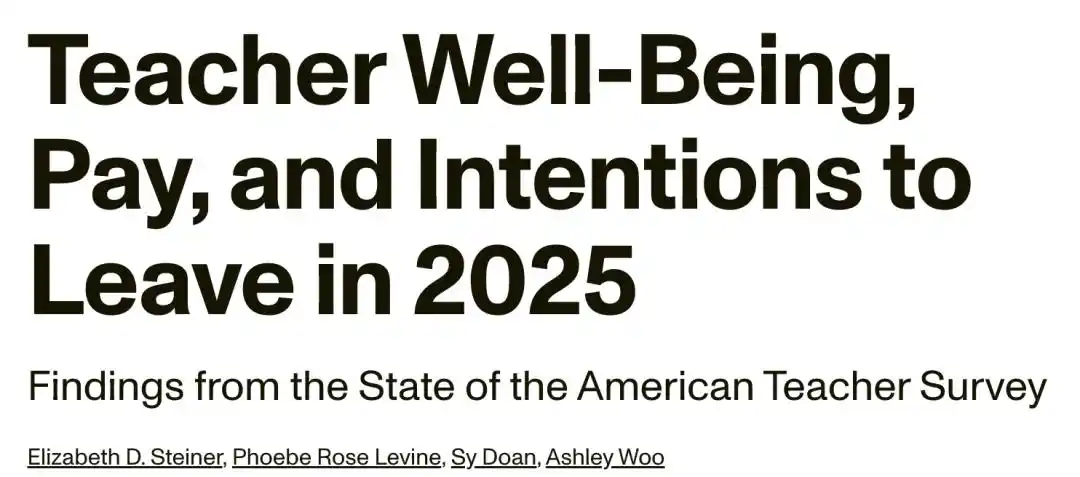
RAND's 2025 "The State of the American Teacher" survey: Teachers work an average of 49 hours per week, a full 10 hours more than their contracted time. (Source: RAND)

Lesson planning, teaching, grading, filling out forms, meetings—more than half spills over into nights and weekends.

Over the past few years, teachers using AI to generate teaching materials have almost all stepped into the same trap: it looks pretty, but it's hollow to teach.

The grade level is off, it skips a key step in the curriculum, or the teaching approach doesn't align with the school's chosen textbooks.

The result? The time saved by the AI is ultimately spent checking and redoing the work.

As Forbes pointed out, the paradox is this: alignment should happen before the teacher receives the materials, not after.

To put it bluntly, teachers don't want AI that "can generate," but AI that "generates something usable right away."

The gap in between is precisely the most draining step.

Claude Puts All 50 States' Standards

Into Its Brain

Claude for Teachers aims to bridge precisely that gap.

It integrated with a system called Learning Commons, gaining access to the academic standards of all 50 states, along with more granular competency points and typical student learning progressions under each standard.

What it can do for teachers roughly falls into three categories.

First, alignment in lesson preparation.

Ask it to create a lesson, and what comes out is not a flashy but disconnected PowerPoint, but a lesson plan already aligned to your state's standards, built step-by-step according to the learning progression.

Anthropic's Head of Education, Drew Bent, gave an example: ask it to teach "how to construct a linear function," it first pulls up the corresponding standard, marks the mistakes students are most likely to make in this area, and then builds the lesson around those errors.

When teachers receive it, they don't have to spend 20 minutes verifying "does this actually align with our standards?"
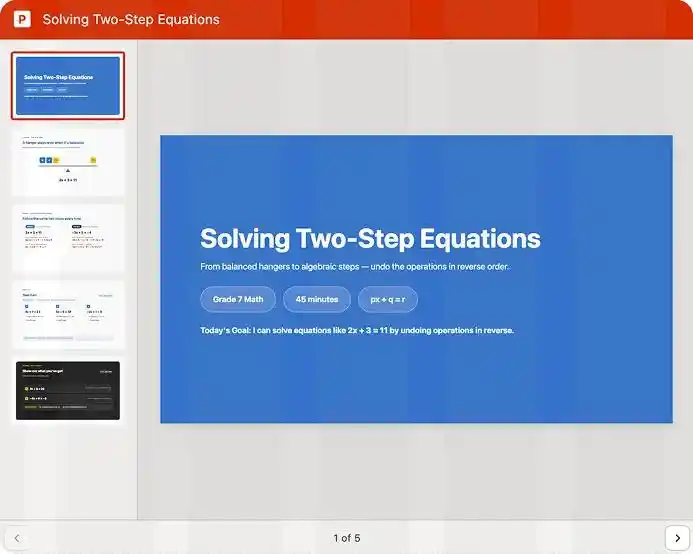
After integrating with Learning Commons, Claude automatically generates lesson plans and student materials aligned to state standards and learning progressions. (Source: Anthropic official)

Second, differentiated instruction/tiering.

In the same classroom, with students at varying levels, a teacher's biggest headache is preparing appropriate instruction for each. Ask Claude to adapt the same lesson for different levels, and it can produce a set of tiered plans:

For struggling students, provide "sentence starters" and scaffolding to make it accessible; for advanced students, add enrichment; for children whose first language isn't English, add a language transition layer.
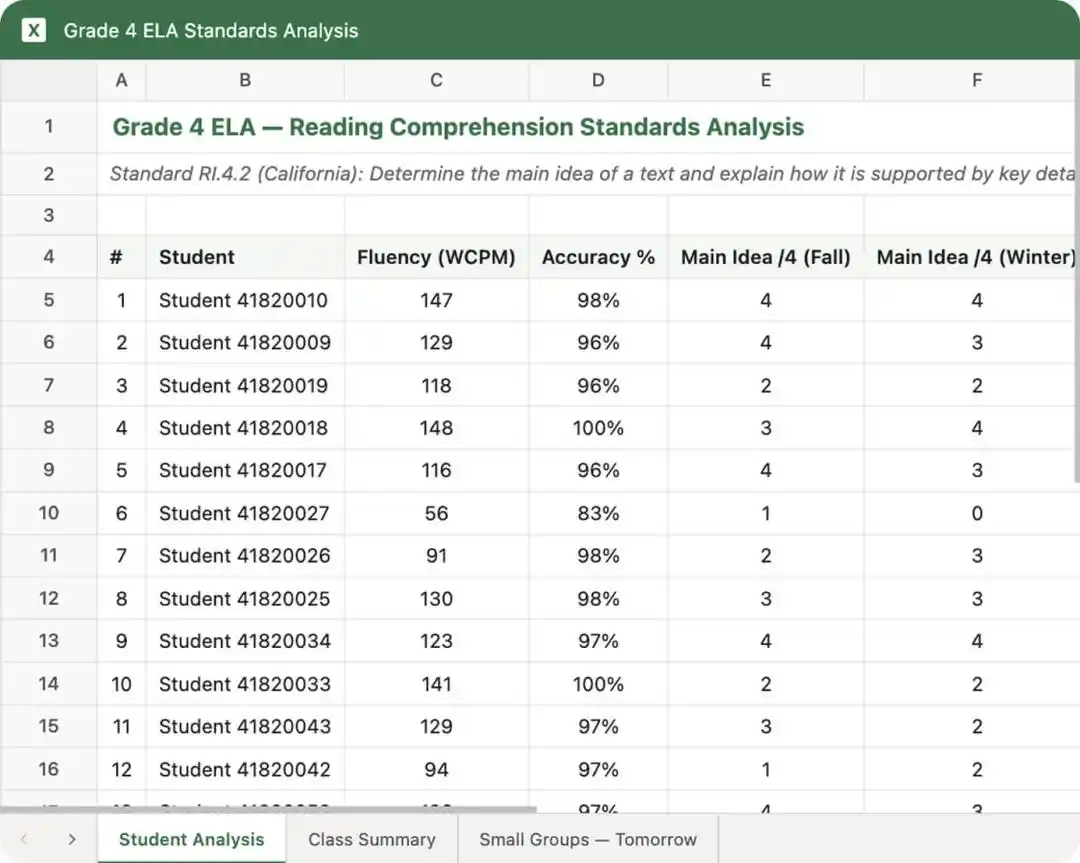
Automatic differentiation of the same lesson based on student level. (Source: Anthropic official)

Third, data analysis.

Throw your roster, diagnostic scores, attendance, and casually noted observations at it, and it pieces together where each student stands now: who's falling behind, which concept the whole class hasn't grasped.

You decide what data to give and how much; what's submitted doesn't go into model training.

Beyond these three areas, it's also connected to 9 K-12 ecosystem connectors:

ASSISTments generates math problems aligned to standards with auto-grading; Canva transforms teaching materials into designs ready for the classroom; plus Brisk, Diffit, MagicSchool, TeachFX, etc.

The tools teachers are already familiar with are now strung together in Claude.

More crucially, it also includes Claude Code and Cowork.
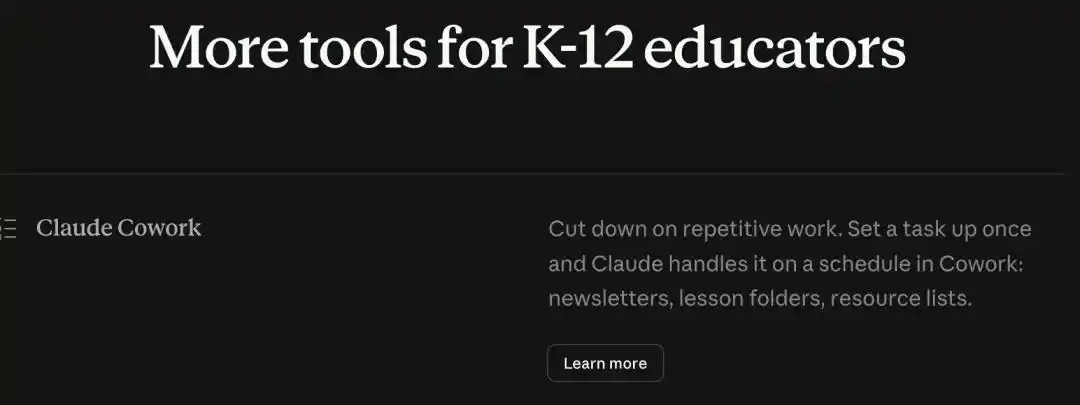
This means it's no longer just "answer a question when asked," but can proactively push work forward, even set up scheduled daily tasks.

A teacher hands off a repetitive task once, and it can run it for them every school day thereafter.

Students Don't Touch Claude

We've talked a lot about teachers, but what about students?

Theoretically, they are the ultimate beneficiaries.

In traditional education, truly providing personalized instruction tailored to each student is nearly an impossible luxury for a teacher facing dozens of students.

Now, Claude can create personalized teaching plans for teachers. On Reddit, teachers are already using it to build tools for special education scenarios, like helping their special education partner organize IEPs (Individualized Education Programs).

This sounds beautiful, but one point must be made clear: the students themselves do not have access to Claude.

Anthropic has a hard rule: Claude is only for users 18 and older. Therefore, the vast majority of K-12 students don't even have an account. Whether they benefit depends entirely on how well the teacher translates that help.

The official positioning of this product is also clear: Claude for Teachers is a tool for teachers, not to replace teachers, and certainly not to be fed directly to students.

Why so cautious? Because AI on the student side is already a major controversy.

Cheating, cognitive offloading (the brain gets lazy, dumping everything on AI), whether generative AI should be touched in early education... the debates are getting bigger.

Norway this year issued a near-ban for grades 1-7: generative AI is not allowed during school hours.
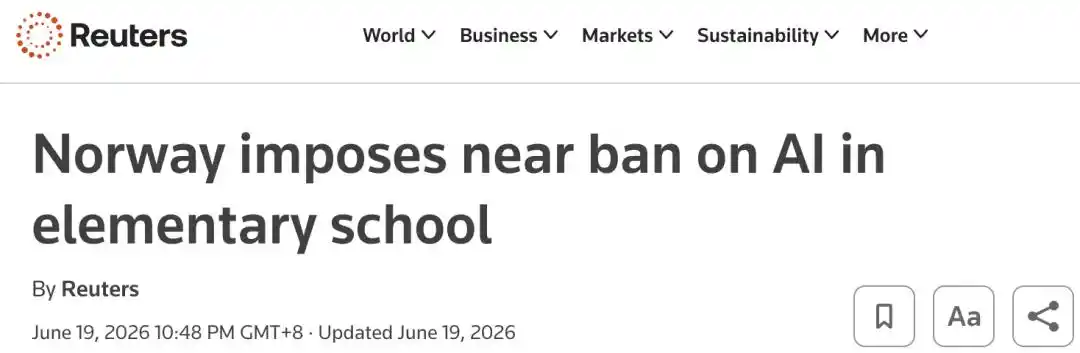
On June 19th, Norwegian Prime Minister Støre announced a near-ban on generative AI for students in grades 1-7, not allowed during class time, effective from the new school year starting late August.

Anthropic clearly wants to avoid this minefield: We're not touching students, we're just empowering teachers.

Not Replacing Teachers

But Giving Teachers Back to Students

Let's be clear about one thing:

What Claude takes over are repetitive tasks like reviewing exit tickets and adjusting tomorrow's lesson plan, not "grading all homework automatically every day." Automatic scoring is only for practice problems.

Anthropic's positioning for it is very clear: reduce teacher workload, give the saved time back to teaching, back to those genuine human connections that can't be automated.

This isn't Anthropic's first foray into education either.

From integrating Claude into US university teaching systems, rolling out student ambassadors and AI clubs, to today's K-12 teachers, it's a step-by-step progression.

This time, it also open-sourced the entire teaching skill set and paired it with an AI literacy course for K-12 teachers.

So what's in it for them? The answer isn't complicated: teachers are the gateway into schools and school districts.

This playbook feels familiar.

Eight months ago, OpenAI launched ChatGPT for Teachers: also free, also targeting US K-12 teachers, also free until 2027, also partnering with the American Federation of Teachers (AFT).

The playbook can be copied, but in the field of education, what ultimately determines success isn't which model is smarter, but trust.

That's why Anthropic is playing the trust card heavily: "Data not used for training," "FERPA compliant," "specific K-12 data processing terms," and co-creating a privacy Gold Standard with the AFT, with union president Randi Weingarten personally endorsing it.

The other side of the coin is lingering community skepticism.

Some worry about student data privacy, others about the over-automation of education, and some bring up old arguments: Silicon Valley executives send their own kids to schools devoid of tech products.
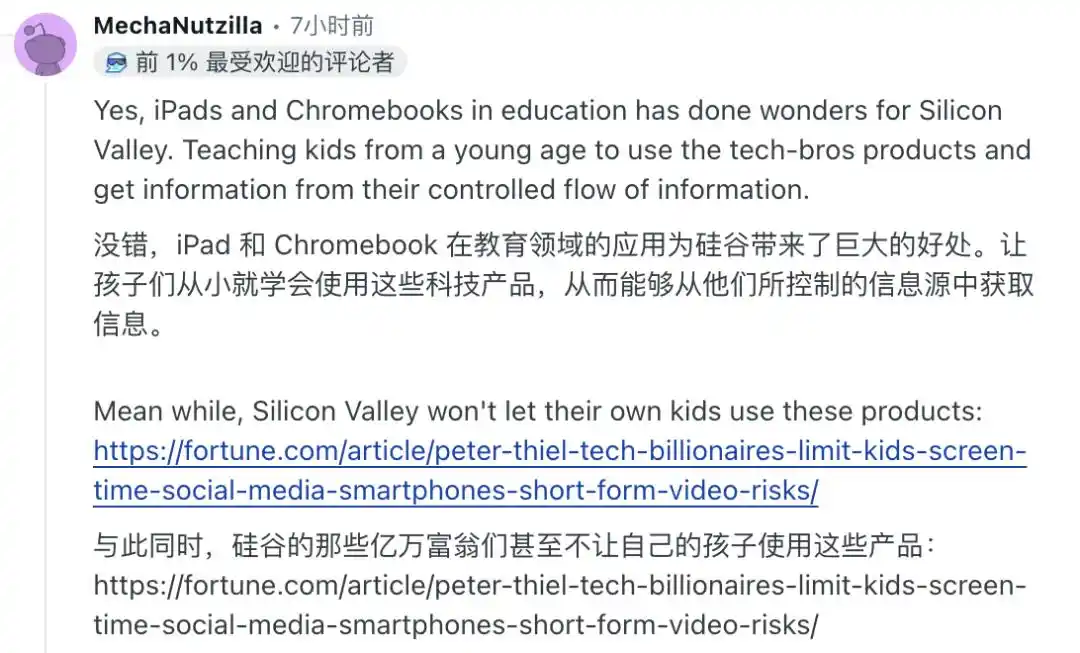
Some netizens say Norway's near-ban on generative AI for grades 1-7 is the wise move.

So, model capability is just the entry ticket; FERPA compliance, data isolation, teacher union backing are the real thresholds for actual implementation.

But the story isn't over; it raises a bigger question:

When this generation of children grows up, AI will already be as ubiquitous as air. Can a child who was only "taught by a teacher using AI" but never truly used AI hands-on themselves ever be truly prepared?

Claude for Teachers isn't ready to answer that question yet.

References:

https://www.anthropic.com/news/claude-for-teachers

https://www.reuters.com/technology/norway-imposes-near-ban-ai-elementary-school-2026-06-19/

https://www.reddit.com/r/ClaudeAI/comments/1uwbic2/new_launch_claude_for_teachers/?utm_source=chatgpt.com

https://www.rand.org/pubs/research_reports/RRA1108-16.html

This article is from the WeChat public account "New Zhiyuan," author: ASI Apocalypse, edited by: Yuan Yu


Trending Cryptos

Related Questions

QWhat is Claude for Teachers and who is it designed for?

AClaude for Teachers is a free AI assistant platform launched by Anthropic. It is designed specifically for verified K-12 teachers in the United States to help them with various teaching tasks.

QWhat are the main functionalities that Claude for Teachers offers to educators?

AClaude for Teachers offers three main functionalities: 1) Lesson planning aligned with specific U.S. state standards, 2) Creating differentiated lesson materials for students at various levels, and 3) Analyzing student data to identify learning gaps and progress.

QWhy does Claude for Teachers not allow direct student access?

AAnthropic has a strict rule that Claude is only available to users over 18 years old. Most K-12 students cannot create an account. Therefore, the platform is designed as a tool for teachers only, and student benefits depend entirely on how well teachers utilize it to create personalized instruction.

QWhat concern is mentioned in the article regarding AI in education for younger students?

AThe article mentions significant controversies around AI for students, including cheating, cognitive offloading (relying too heavily on AI), and debates about whether young children should use generative AI. It cites Norway's example of imposing a near-ban on generative AI for grades 1-7 during school hours.

QAccording to the article, what is a key factor for the success of AI tools like Claude for Teachers in education, beyond model capability?

ABeyond model capability, a key factor for success is building trust. This involves ensuring data privacy (e.g., stating that data is not used for training, complying with FERPA), having specific K-12 data handling terms, and gaining endorsements from organizations like teachers' unions.

Related Reads

Base Under Pressure

**Title: The Pressure Mounts for Base** Base, the Ethereum Layer 2 scaling solution backed by Coinbase, is facing significant pressure and public scrutiny from its leadership following the launch of Robinhood Chain. Base co-founder Jesse Pollak recently acknowledged strategic missteps, admitting that the chain's past focus on social and creator tokens (e.g., through Farcaster, Zora) failed to deliver sustainable adoption. He has refocused on core infrastructure, handing leadership of the Base App back to Coinbase's Cobie. While Base remains a top L2 contender alongside OP Mainnet and Arbitrum, and boasts the highest TVL (nearly $12B), its weaknesses are being highlighted by the new competitor. Key criticisms include its slow progress on decentralization. Base has faced issues with its single sequencer causing block production halts, and L2BEAT is reportedly considering downgrading its decentralization rating from Stage 1 to Stage 0. This contrasts sharply with the rapid initial success of Robinhood Chain, whose DEX quickly entered the top five by volume. The leadership styles of the parent companies are also being compared: Robinhood's CEO actively engages with new projects, while a recent incident where Coinbase's Brian Armstrong briefly changed his profile picture—sparking and then crashing a related meme token—drew community ire and mockery. Pollak stated Base is working with Coinbase on tokenized stocks backed 1:1 by real equity, differentiating it from Robinhood's derivatives model. However, the article argues that Base's most urgent task is to address its long-standing technical and trust issues. With more traditional finance players likely to emulate Robinhood's path, Base must use this competitive pressure to solidify its position as long-term financial infrastructure.

Foresight News9m ago

Base Under Pressure

Foresight News9m ago

White House Concession Removes Ethical Hurdle, Clarity Act Races Against Final Window Before Recess?

On July 21st, industry sources reported that the Trump administration has agreed to include an ethics provision in the "Clarity Act" (Digital Asset Market Clarity Act of 2025). This concession addresses the long-standing conflict-of-interest concerns regarding government officials and the crypto industry, potentially removing the final major obstacle to the bill's progress. Additionally, Patrick Witt, the executive director of the White House's Digital Asset Advisory Committee, confirmed he will remain in his role to help finalize the bill, alleviating previous concerns about his potential departure. The Clarity Act aims to establish a unified federal regulatory framework for the U.S. digital asset market. Its core objective is to resolve regulatory ambiguity by defining different types of digital assets (digital commodities, investment contract assets, and permitted payment stablecoins) and clarifying the respective oversight roles of the SEC and CFTC. This would end the long-running jurisdictional dispute between the two agencies and provide clearer compliance paths for the industry. With the ethics issue moving toward resolution, the most urgent challenge now is time. The U.S. Congress is set to begin its August recess in mid-August, leaving only a few working weeks to finalize the text and advance the bill through the Senate. Industry advocates, like the Blockchain Association's Kristin Smith, stress that this is a critical moment. If negotiations conclude successfully in the coming weeks, the Clarity Act could pass a key hurdle before the recess; otherwise, it may face significant delays. If enacted, the Clarity Act could mark a historic turning point in crypto regulation. By providing a clearer and more predictable legal framework, it aims to reduce uncertainty for businesses, developers, and traditional financial institutions looking to enter the digital asset space, potentially setting a global benchmark for market structure regulation.

Odaily星球日报15m ago

White House Concession Removes Ethical Hurdle, Clarity Act Races Against Final Window Before Recess?

Odaily星球日报15m ago

AI Era, Industrial Revolution, and Future Civilization Interview — Zhang Dingwen: The Future Does Not Belong to Chasers

"AI Era, Industrial Revolution and Future Civilization: An Interview with Zhang Dingwen – The Future Does Not Belong to Those Who Chase" In this interview, entrepreneur Zhang Dingwen reflects on his entrepreneurial journey and philosophy, moving beyond discussions of financing or success to emphasize understanding the "era" itself. He argues that true entrepreneurs should not chase short-term trends ("winds"), but position themselves in the direction of long-term technological and societal evolution. Zhang shares key lessons from his early days, including the realization that user value does not automatically translate to commercial value. For him, the core of entrepreneurship is not building a company but constantly upgrading one's own "cognition" – the ability to interpret information, ask the right questions, and understand the underlying "causes" behind business outcomes, not just the effects. His thinking has evolved from a focus on creating good products to a strategic focus on building "entrances" – platforms that naturally connect users to digital services. He sees smart wearables, like watches, not merely as hardware but as potential future gateways combining technological, financial, social, and even fashion attributes to create sustained user relationships and ecosystems. Ultimately, Zhang's vision transcends individual products or companies. He discusses business competition in three stages: product, platform, and finally, "civilization" – where the greatest companies influence how society operates by defining new rules and ways of life. He believes the mission of a truly great enterprise is to solve problems of its time, build enduring trust, and contribute lasting value, leaving behind not just wealth but a positive impact on how the world works. The future, he concludes, belongs not to the fastest, but to those with the correct long-term direction and a commitment to continuous learning and evolution.

marsbit26m ago

AI Era, Industrial Revolution, and Future Civilization Interview — Zhang Dingwen: The Future Does Not Belong to Chasers

marsbit26m ago

Cryptocurrency & Stock Market Barometer丨Strategy Cash Reserves Increase to $3.23 Billion, Halting BTC Purchases; Vanguard and Other Asset Managers Increase Holdings in Strategy Stock (July 21)

Market Overview & Warnings: The article warns of high volatility in South Korean stocks and continued dependence on U.S. stocks on geopolitics. Chinese A-shares remain under pressure. It advises against using leverage in current equity markets. For crypto-linked stocks, most have limited growth except Robinhood, with caution advised. U.S. Stock Market: Bearish bets on U.S. stocks, particularly targeting AI-related companies, have reached record highs since 2010, signaling deep skepticism about the sustainability of the AI-driven rally. Tech and chip stocks led a market decline, with the Philadelphia Semiconductor Index potentially entering a bear market. Increased expectations for Federal Reserve interest rate hikes and geopolitical tensions contributed to the negative sentiment. Bitcoin Treasury Company Updates: * Strategy: Increased its cash reserves to $3.23 billion and paused Bitcoin purchases. Several major asset managers, including Vanguard Group and Capital Group, increased their holdings of Strategy (MSTR) stock. * Global corporate Bitcoin buying slowed significantly to just $1.33 million last week. * Other notable activity: Strive purchased 21 BTC; ORANGE JUICE raised $40 million for Bitcoin acquisitions; Bitcoin Japan Corp. raised $60 million, allocating $4.08 million for its first BTC purchase. Other Crypto Treasury Holdings: * Ethereum: BitMine increased its ETH holdings to 5.78 million, nearing its 5% of supply goal. Its total crypto assets, cash, and securities are valued at $11.5 billion. * Solana: No significant corporate treasury activity reported. * Altcoins: HypeStrat made no adjustments to its treasury; its mNAV ratio fell to a long-term low. (Note: This summary is for informational purposes only and does not constitute investment advice.)

marsbit27m ago

Cryptocurrency & Stock Market Barometer丨Strategy Cash Reserves Increase to $3.23 Billion, Halting BTC Purchases; Vanguard and Other Asset Managers Increase Holdings in Strategy Stock (July 21)

marsbit27m ago

Trading

Spot

Hot Articles

Discussions

Welcome to the HTX Community. Here, you can stay informed about the latest platform developments and gain access to professional market insights. Users' opinions on the price of AI (AI) are presented below.

活动图片