OriginTrail surges 32% as the AI narrative takes over – Can TRAC target $0.4?

ambcryptoPublished on 2026-07-19Last updated on 2026-07-19

Abstract

OriginTrail (TRAC) surged 32% to a monthly high near $0.38, fueled by strong speculative demand driven by its AI narrative, with the crypto community comparing it to a decentralized Palantir. Trading volume jumped 300% to $30 million. Futures data showed significant buying pressure, with a positive buy-sell delta. However, profit-taking increased, indicated by a spike in exchange inflows, which could threaten the rally. Technical indicators like the RSI at 65 and a strong DMI suggest bullish momentum remains. The key for TRAC is sustaining demand to break the $0.40 resistance; failure could see a drop toward $0.26 support.

After holding around $0.28 since failing to hold $0.30 three days ago and falling to $0.25, OriginTrail [TRAC] rebounded with strength.

In doing so, TRAC made a major price swing, breaking out of the range to hit a monthly high of $0.38.

As of this writing, OriginTrail was trading around $0.35, marking a 32% pump on the price charts. Over the same window, TRAC’s trading volume climbed 300% to $30 million while the market cap climbed 34% to $171 million.

The volume and market cap rising together signals strong market activity backed by steady capital inflows.

OriginTrail rides on AI narrative and Palantir comparison

OriginTrail is seeing renewed market attention largely driven by the AI narrative. The crypto community has called OriginTrail a decentralized Palantir.

According to Chain Ink, OriginTrail stands out among other AI agents for its ability to remember. The decentralized knowledge graph provides AI agents with shared memory and built-in provenance.

Thus, OriginTrail solves the problems affecting other AI agents over truthfulness and verifiability. These traits have made it especially attractive for many market players eyeing to ride on the AI wave.

Cryptoguku remarked,

OriginTrail is a decentralised Palantir.

With the community amazed by its AI narrative prospects, speculative demand for the native token TRAC has skyrocketed.

Speculative demand dominates the market

With the crypto market eyeing OriginTrail’s potential in the AI space, traders have jumped in to take strategic positions. As demand strengthened, the altcoin rebounded, and speculators returned, attempting to capitalize on the gains.

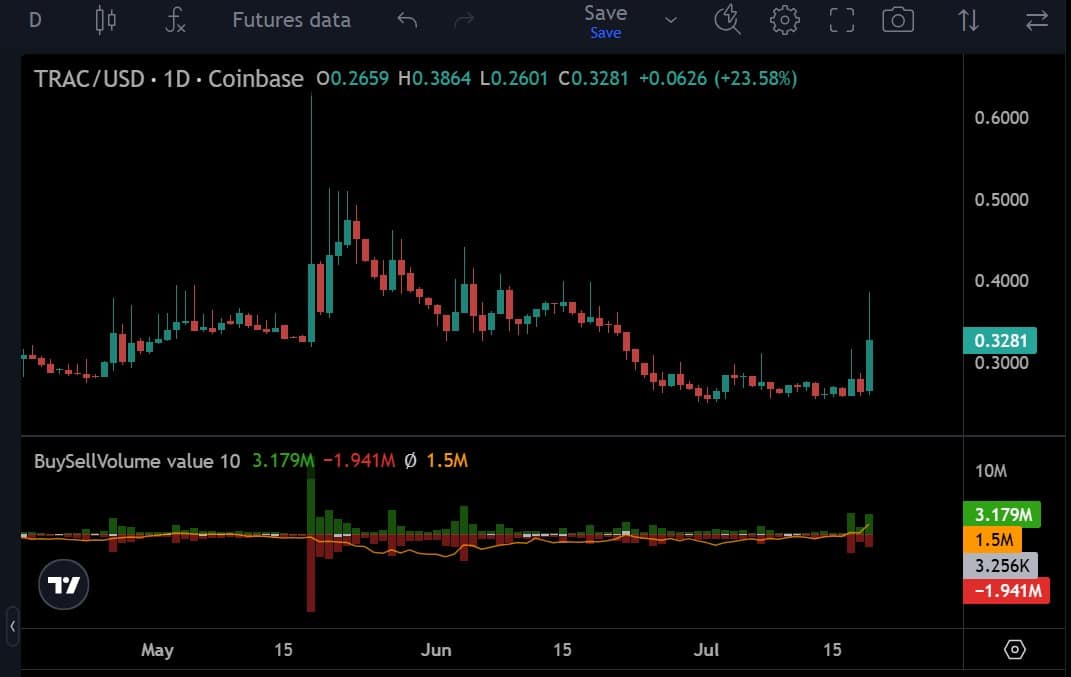
According to Coinalyze data, Futures Buy Volume climbed to 3.17 million, while the sell volume declined to 1.94 million.
Source: Coinalyze

As a result, the Futures market recorded a positive buy-sell delta of 1.23 million, a clear sign of strong buying pressure. Historically strong speculative demand has strengthened short-term price performance, leading to more gains on price charts.

Profit realization spikes, threatening the rally

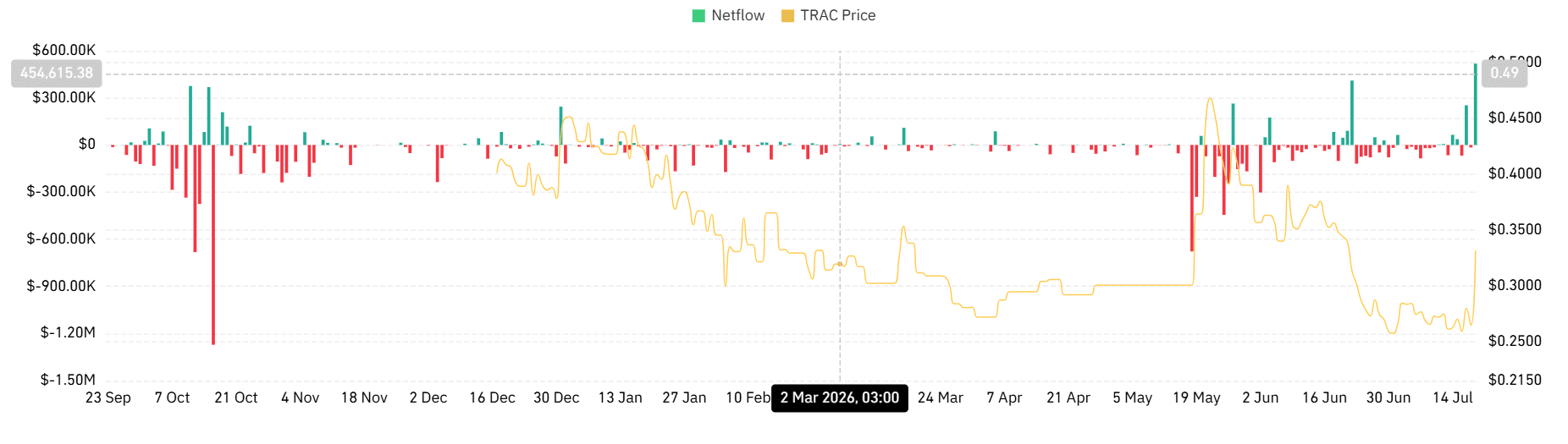
As expected after OriginTrail rebounded from $0.25, holders who had been underwater rushed to cash out. According to CoinGlass, Spot Netflow skyrocketed to a record high of $518k, marking a massive jump from -$15k the previous day.
Source: CoinGlass

A positive Netflow indicates more TRAC flowed into exchanges than out of them. Historically, higher exchange inflows have increased supply available for selling, thus raising market pressure.

Can TRAC hold the momentum?

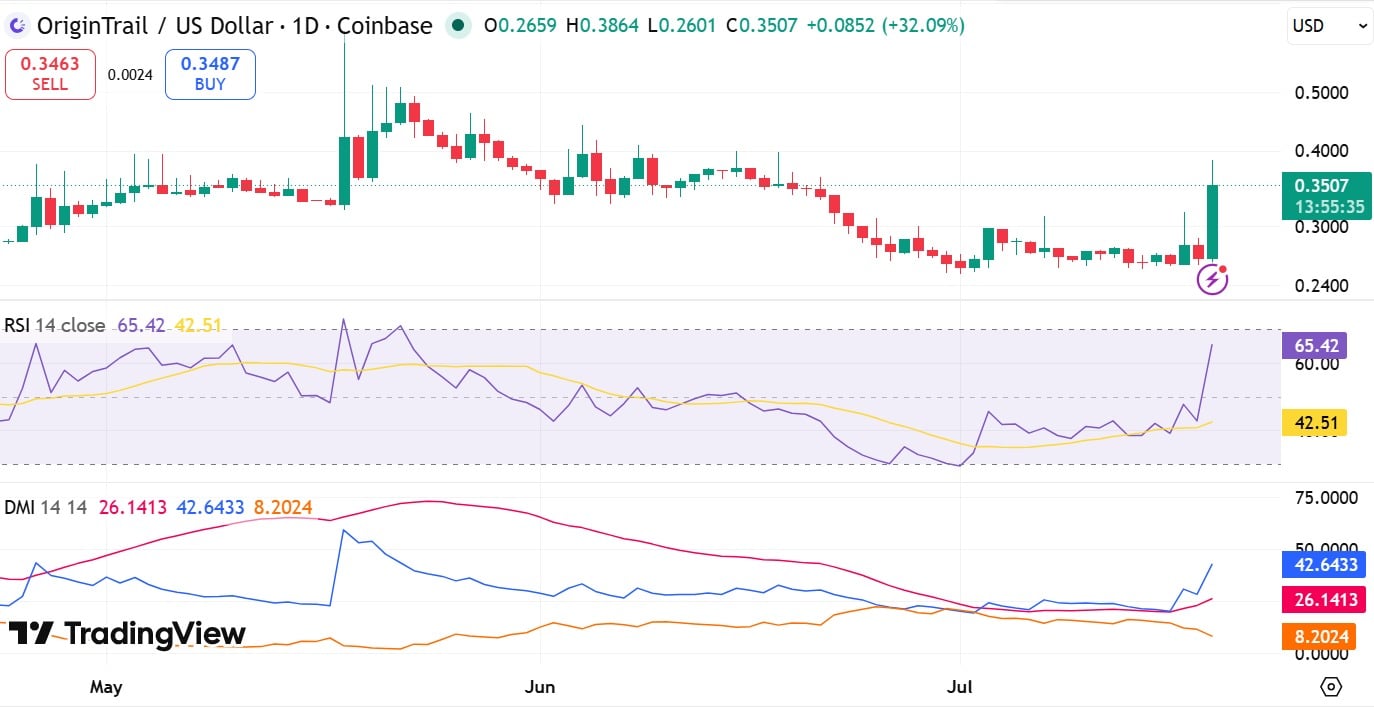
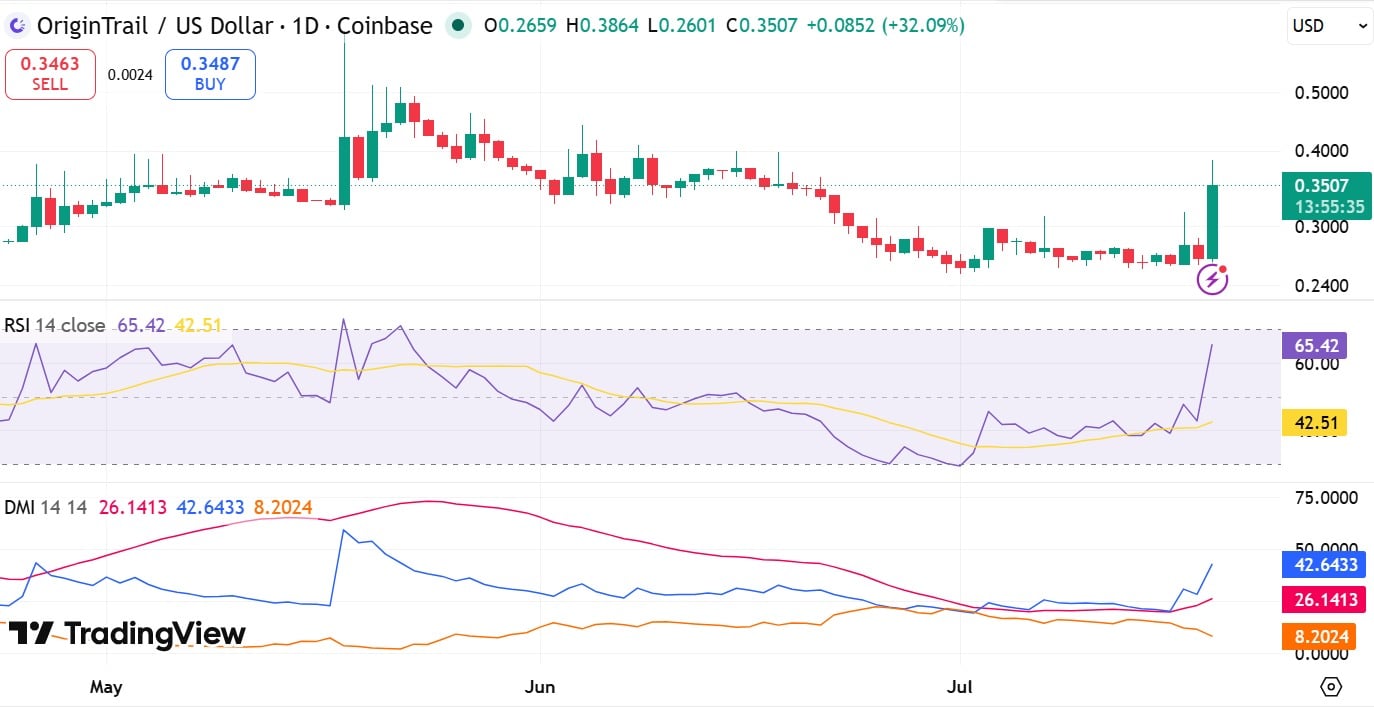
OriginTrail is currently under strong bullish pressure despite the rising profit realization. In fact, the altcoin’s Relative Strength Index (RSI) climbed from 42 to 65, reaching deep into the bullish zone.

At such elevated levels, the RSI suggested that buyers have significant control over the market, driving momentum.
Source: TradingView

At the same time, the Directional Movement Index (DMI) further confirms this trend’s strength. The positive index rose to 42 while the negative index dropped to 8, confirming the upside strength.

These indicators suggest the prevailing trend will continue. If demand holds, TRAC will flip the $0.4 resistance, but if profit-taking continues, OriginTrail will drop below $0.3, with $0.26 as support.


Final Summary

  • TRAC surged 32%, hitting a monthly high of $0.39, before retracing amid rising speculative demand
  • OriginTrail has captured market attention over the AI narrative, as crypto traders compare the AI token with Palantir


Trending Cryptos

Related Questions

QWhat is the main reason for OriginTrail's recent 32% price surge according to the article?

AThe main reason is the renewed market attention driven by the AI narrative, with the crypto community comparing OriginTrail to a decentralized Palantir.

QWhat two key technical indicators are mentioned as confirming the strength of the bullish trend for TRAC?

AThe Relative Strength Index (RSI) climbing to 65 and the positive Directional Movement Index (DMI) rising to 42 (with the negative DMI dropping to 8) confirm the trend's strength.

QWhat does the sharp rise in Spot Netflow to $518k signify, and what is its typical market impact?

AA positive Spot Netflow of $518k signifies that more TRAC tokens flowed into exchanges than out. Historically, this increases the supply available for selling, raising selling pressure on the market.

QWhat are the identified key price levels for TRAC's potential next moves if the current trend does not hold?

AIf profit-taking continues and the rally fails, the article suggests TRAC could drop below $0.30, with $0.26 acting as a support level.

QHow did trading volume and market capitalization change during TRAC's price increase?

ATRAC's trading volume climbed 300% to $30 million, and its market capitalization increased by 34% to $171 million.

Related Reads

Dialogue with Jia Hang | Looking Back at Two Decades of Chinese Payment Going Global

**Summary: A Conversation with Jia Hang on Two Decades of China's Payment Globalization** Jia Hang, a veteran with over twenty years in payments, reflects on China's attempts to build a global payment network through three key phases: UnionPay (card networks), Alipay+ (digital wallets), and now, stablecoins. His journey began at UnionPay International, aiming to establish China's card network abroad. While successful in following Chinese tourists ("where Chinese go, UnionPay goes"), it struggled to achieve true global scale. The core lesson: card networks like Visa/Mastercard's unassailable advantage isn't just technical standards, but their deeply entrenched **governance and profit-sharing models** that create powerful network effects. Competing as the "same species" is nearly impossible. At Ant Group, he led Alipay+, a strategy to bypass card networks by interconnecting local e-wallets worldwide. While innovative, it faced a similar ceiling. Mobile QR payments and card swipes were essentially **the same species competing for the same pie**, lacking a disruptive value proposition for users or a sustainable new incentive model to replace the card networks' established flywheel. Today, at Singapore's DCS, Jia focuses on stablecoin-based payments. He argues stablecoins represent a fundamental shift. They are not competing with Visa for consumer payments but challenging the **traditional banking and account system for value movement**. Products like "U Cards" (stablecoin-linked payment cards) are transitional, leveraging existing card networks for acceptance while building new rails. The real potential lies in stablecoins enabling seamless, low-cost global value transfer, potentially reorganizing the financial infrastructure around **accounts rather than cards**. Jia believes stablecoin adoption for local retail payments, cross-border transactions, and as high-yield savings vehicles is becoming irreversible. This could gradually reduce reliance on traditional fiat channels, especially in regions with weak currencies or capital controls. The quest for the "next global payment network" continues, now centered on whether stablecoins can successfully bridge Web2 and Web3, establish new governance, and create compelling user value beyond mere cost reduction.

marsbit4m ago

Dialogue with Jia Hang | Looking Back at Two Decades of Chinese Payment Going Global

marsbit4m ago

Circle's Stock Price Plunges 76%, Hong Kong Dollar Stablecoin Set to Launch Within Two Weeks

Circle's stock price has plunged approximately 76% from its 2023 peak, reflecting a major market revaluation. Despite this, Circle President Heath Tarbert emphasized the company's focus on long-term execution and its dominant position with USDC's $73 billion circulation across 34 blockchains. The competitive landscape is intensifying. A new consortium-backed stablecoin, Open USD, is attempting to challenge incumbents by sharing reserve yields with partners. More significantly, Visa's new stablecoin platform, initially supporting Open USD while also being compatible with USDC, could erode Circle's network effects. In response, Circle is expanding into real-world payments through partnerships like the one with Japan's JCB. Separately, Tether (USDT) faces a two-year compliance window under new U.S. regulations, requiring it to adjust its reserve composition away from assets like Bitcoin and loans towards cash and U.S. Treasuries. Meanwhile, in Hong Kong, Standard Chartered-backed fintech firm Dian Dian is poised to launch a licensed HKD-pegged stablecoin (HKDAP), moving the industry into a phase where the real test is integrating licensed stablecoins into actual payment flows and corporate treasury systems. The sharp decline in Circle's stock underscores a broader shift: the stablecoin market is moving from a winner-takes-all dynamic to a multi-player competitive arena where execution, compliance, and real-world utility are becoming paramount.

marsbit4m ago

Circle's Stock Price Plunges 76%, Hong Kong Dollar Stablecoin Set to Launch Within Two Weeks

marsbit4m ago

Amidst Capital's Encirclement, Decentralization is the Sole Defense for Public Blockchains

In a landscape dominated by power and profit motives, the author argues that decentralization is not merely one desirable feature among many in blockchain design—it is the singular, non-negotiable defense against corporate and capital capture. The article adopts a Machiavellian, realist perspective on human institutions, positing that businesses will inevitably attempt to co-opt any valuable network to protect their profits and dominance. While external attacks like 51% forks are often discussed, the greater existential risk is internal capture—the gradual erosion of a protocol’s neutrality by vested interests, as seen historically with platforms like Visa and Google. The piece critiques permissioned chains, highly centralized “permissionless” layer-1s, and layer-2s without sufficient decentralization (e.g., single sequencers) as inherently vulnerable. These compromised systems, promoted by established financial players, are framed as delaying tactics to stifle truly open networks that threaten existing high-fee, inefficient business models. Real-world examples, such as closed enterprise consortiums that exclude competitors, illustrate how such systems cement oligopolies rather than foster innovation. The author concludes that while decentralized protocols like Ethereum are imperfect and costly to operate, they represent the only viable long-term equilibrium. In a market where value naturally flows to the most secure and neutral settlement layer, only maximally decentralized public blockchains can resist being subsumed by capital and powerful incumbents.

Foresight News15m ago

Amidst Capital's Encirclement, Decentralization is the Sole Defense for Public Blockchains

Foresight News15m ago

Who Decides the Rules of Bitcoin? BIP-110 Ignites Governance Debate

Bitcoin's governance is once again at the center of a heated debate, this time ignited by BIP-110, the "Reduced Data Temporary Softfork." This proposal aims to curb non-monetary data (like inscriptions and Runes) by introducing seven new consensus-layer restrictions over a year, such as limiting new output scripts to 34 bytes and restoring the OP_RETURN cap to 83 bytes. The controversy stems from BIP-110's fundamental shift: it moves the battle against "spam" from node relay and miner policies to the consensus layer, rendering currently valid transactions invalid. Supporters, arguing that default policy governance has failed (highlighted by Bitcoin Core v30's relaxation of OP_RETURN limits), see this as necessary to protect node resources and Bitcoin's monetary focus. Opponents, led by figures like Michael Saylor and Adam Back, warn it dangerously centralizes governance. Saylor listed 110 reasons against it, criticizing its low 55% miner activation threshold and potential for chain splits. Back emphasized Bitcoin's "permissionless" ethos, arguing no single group should impose value judgments via consensus rules. Further complicating matters, technical critiques suggest BIP-110 may be technically circumventable, and a "BlockSlop" vulnerability in its upgrade path poses a consensus risk. The debate has drawn in diverse stakeholders: miners (with pools like Ocean signaling support and Foundry polling clients), node operators (like Bitcoin Knots), and new players like corporate treasury holder MicroStrategy (Saylor), whose market influence adds a novel dimension. Ultimately, BIP-110 acts as a governance stress test, exposing the unresolved question: who decides Bitcoin's rules? It pits the authority of miners, node operators, developers, and capital holders against each other, with each side claiming to defend Bitcoin's core principles of neutrality and security.

marsbit31m ago

Who Decides the Rules of Bitcoin? BIP-110 Ignites Governance Debate

marsbit31m ago

Who Decides Bitcoin's Rules? BIP-110 Ignites Governance Debate

Title: Who Decides Bitcoin's Rules? BIP-110 Ignites Governance Debate A new technical proposal, BIP-110 (Reduced Data Temporary Softfork), has sparked a fundamental governance debate within the Bitcoin community. It aims to impose new consensus rules for one year to limit non-financial data (like inscriptions and Runes) on-chain, moving beyond simple node and miner policy filters to invalidate currently valid transactions. Supporters argue that default policies have failed due to workarounds, necessitating consensus-layer changes to protect Bitcoin's core monetary function from data spam. Critics, including Michael Saylor and Adam Back, contend this dangerously centralizes judgment, undermines permissionlessness, and sets a risky governance precedent. They advocate for market-based solutions like fees or Layer 2s instead. The debate exposes deeper tensions: miners are divided on activation; node operators assert their sovereignty; Bitcoin Core developers influence defaults without direct accountability; and large corporate holders like MicroStrategy now wield narrative influence. Technically, BIP-110 may not fully block data and carries a disclosed consensus bug risk. Ultimately, BIP-110 acts as a stress test, forcing the community to confront the unresolved question: who legitimately decides what Bitcoin is and how it evolves, amidst competing claims from miners, nodes, developers, and capital holders.

链捕手43m ago

Who Decides Bitcoin's Rules? BIP-110 Ignites Governance Debate

链捕手43m ago

Trading

Spot

Hot Articles

Discussions

Welcome to the HTX Community. Here, you can stay informed about the latest platform developments and gain access to professional market insights. Users' opinions on the price of AI (AI) are presented below.

活动图片