Perhaps currently the 'most grounded' e-commerce platform in China—Jingdong (JD.US)—announced its Q2 2026 results on the evening of August 13. Overall, they could be described as 'steady' or perhaps 'flat.' In terms of variance from expectations, both revenue and overall profit slightly exceeded Bloomberg's estimates, but only matched or slightly fell short of some major banks' expectations.
In terms of trends, due to the overall weakening of domestic consumption in Q2, total revenue for the quarter declined. However, soft retail sales figures had already set expectations, so this was not a surprise. Although profits from the Mall segment declined year-over-year, compared to last year when profits were nearly exhausted due to the food delivery war, the group's overall profit showed a significant recovery on a year-over-year basis.
Looking at the specifics:
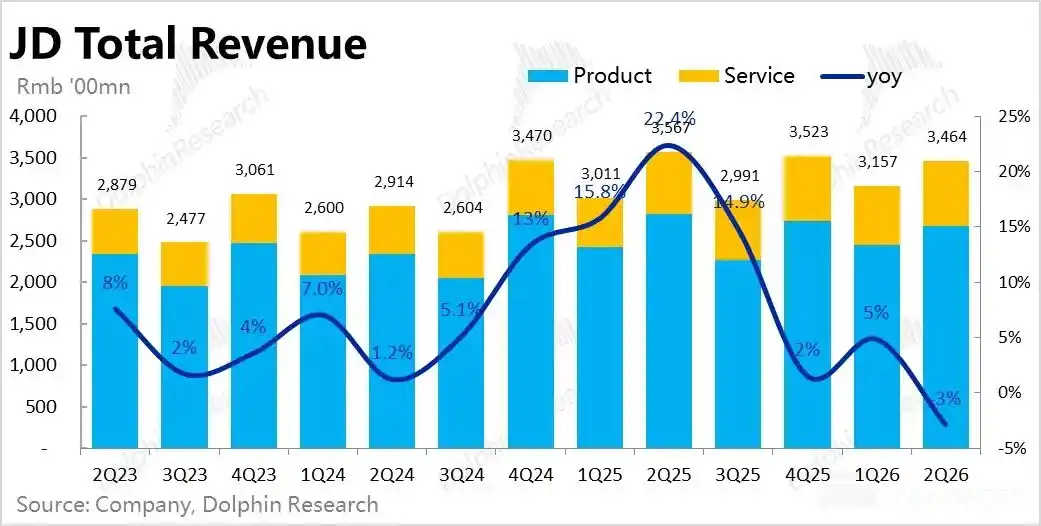
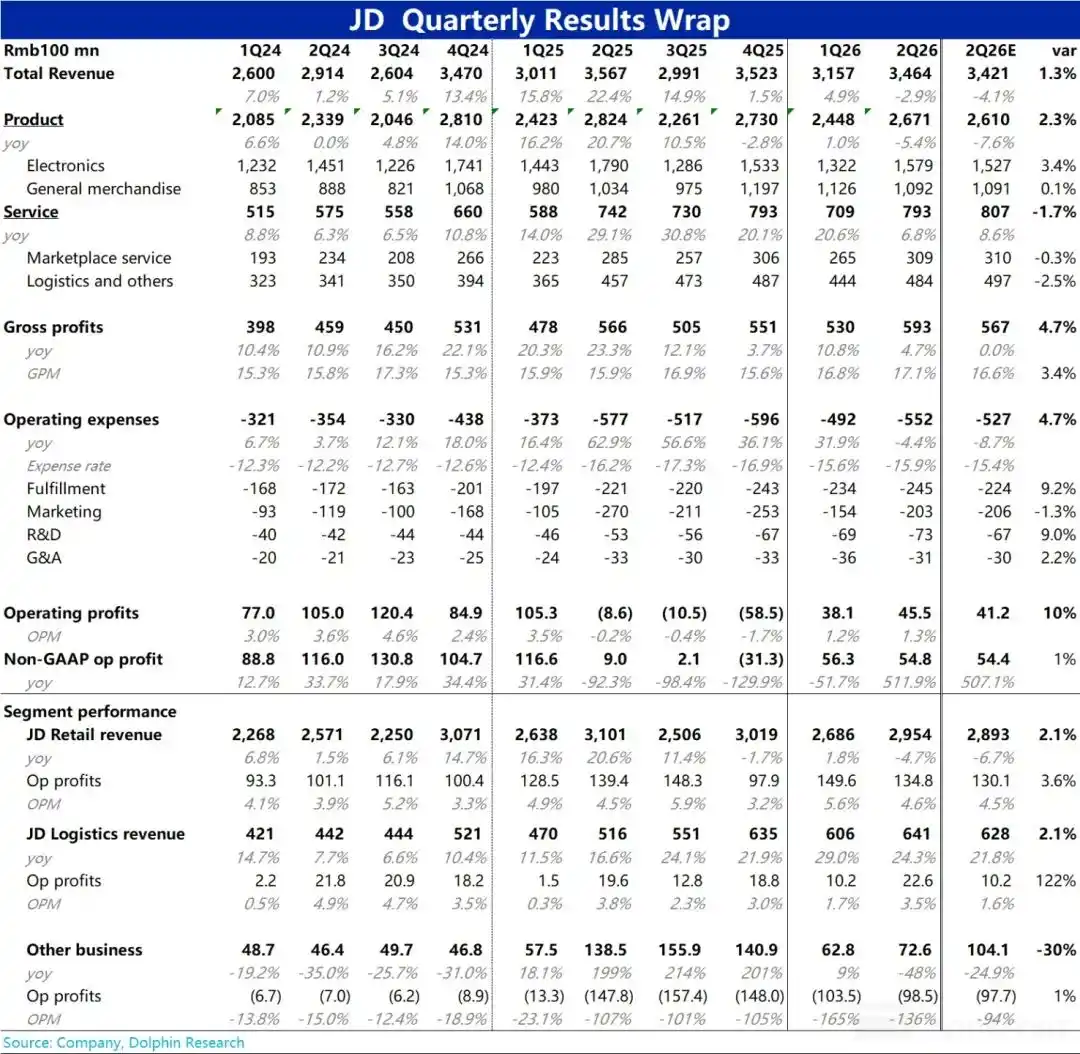
1. Both revenue and profit declined, but without major shocks: Jingdong's total revenue this quarter was approximately 346.4 billion yuan, a year-over-year decrease of 3%, a significant slowdown compared to the 5% growth last quarter, but largely in line with market expectations and not a shock, consistent with the overall retail sales trend this quarter.
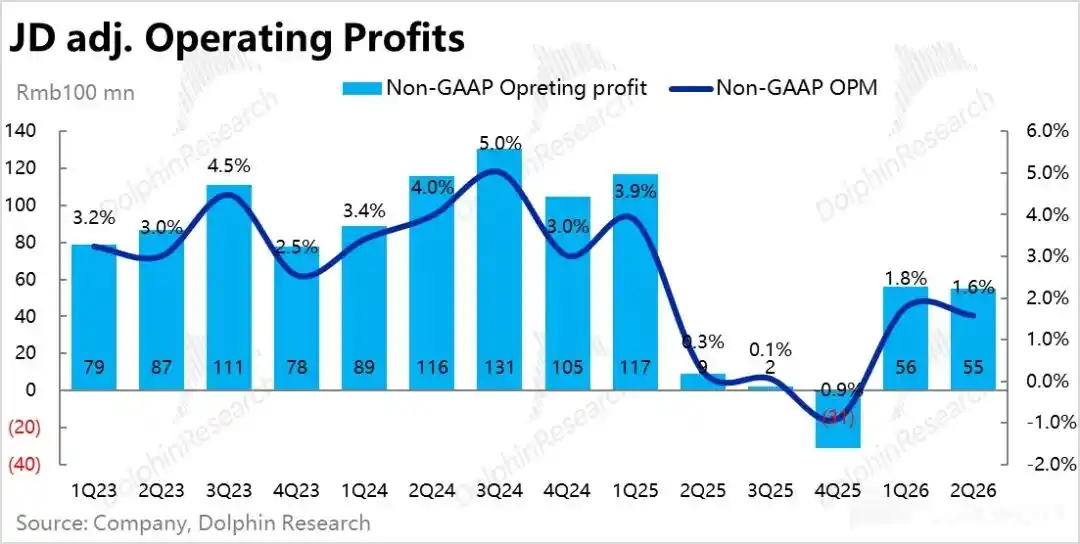
The group's overall operating profit was 4.55 billion yuan, or 5.48 billion yuan on an adjusted basis. On an adjusted basis, this was slightly better than Bloomberg's expectations but weaker than some major banks' forecasts. Specifically, the main drag was higher-than-expected losses from new business initiatives.
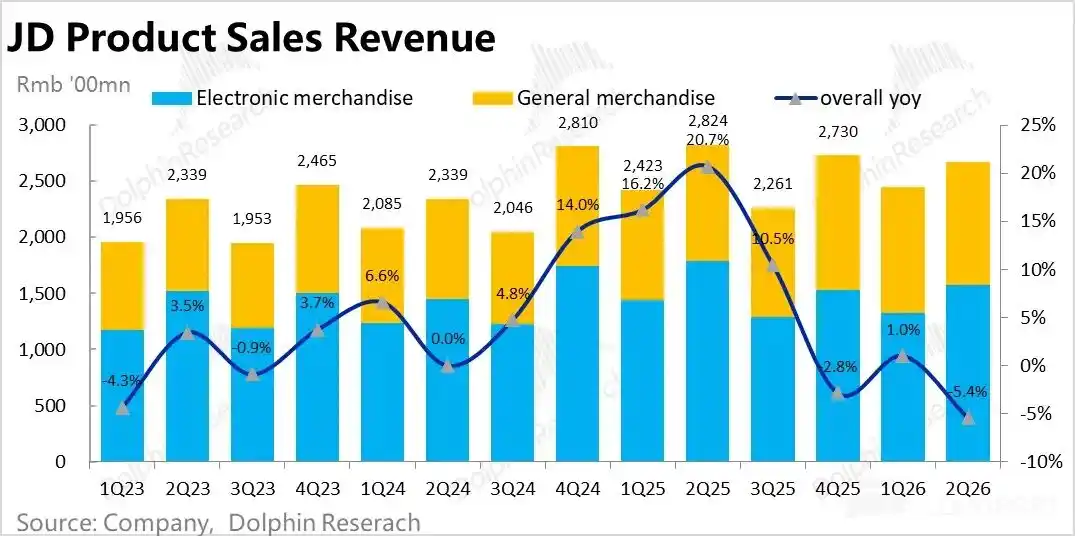
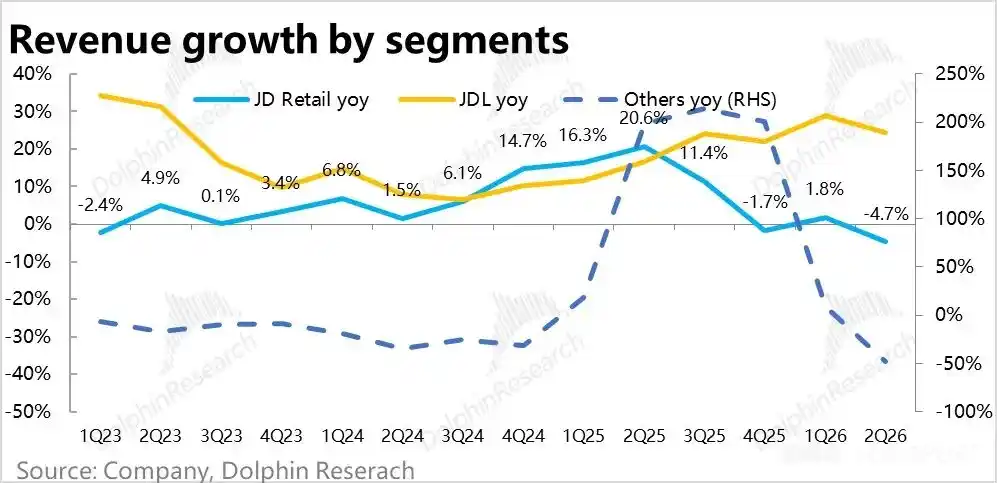
2. Sharp slowdown in daily essentials and advertising growth: For the most important domestic Mall segment, revenue this quarter fell by about 4.7% year-over-year, continuing the expected deceleration. The decline was lower than some market expectations but broadly in line with top-tier bank forecasts.
Looking closer, the actual deterioration in electronics & home appliance sales was limited, with sales falling by less than 12% YoY this quarter vs. an 8.4% decline last quarter. This might be due to a marginal rebound from national subsidy benefits, which previously mainly favored offline channels but recently began flowing back online.
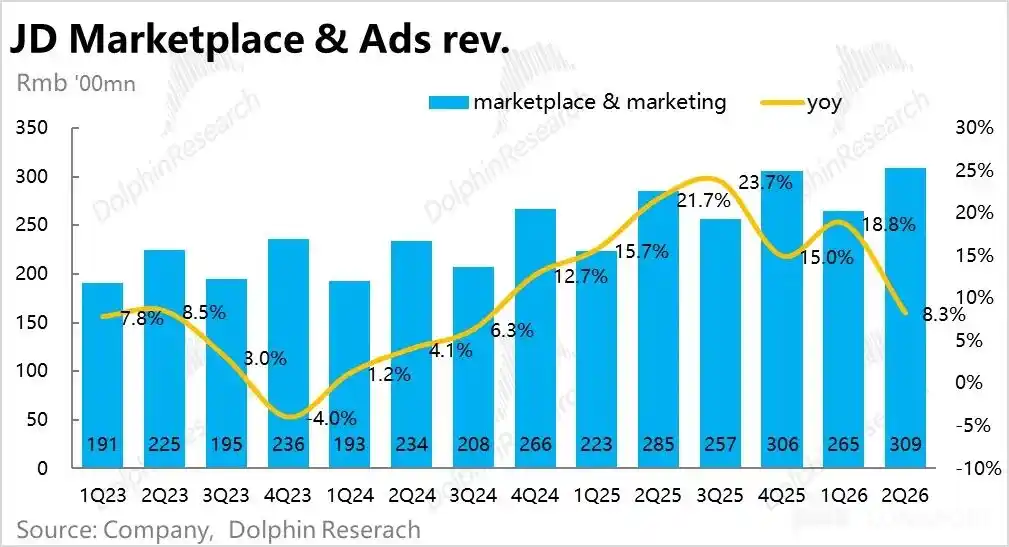
In contrast, daily essentials & general merchandise sales and service & advertising revenue—businesses theoretically not directly impacted by the subsidy phase-out—saw a more pronounced slowdown. Daily essentials sales growth dropped from 15% to 5.6%, while advertising service growth fell from nearly 19% to about 8%. The slowdown for both was around 10 percentage points.
While the market had anticipated this, and the slowdown has its reasons (reduced traffic diversion to the platform from electronics and food delivery), these two segments are the primary drivers for Jingdong's medium-term growth. This may lead the market to question whether, even after the negative impact of the subsidy phase-out passes, the Mall segment's core growth rate can reaccelerate (e.g., back above 10%).
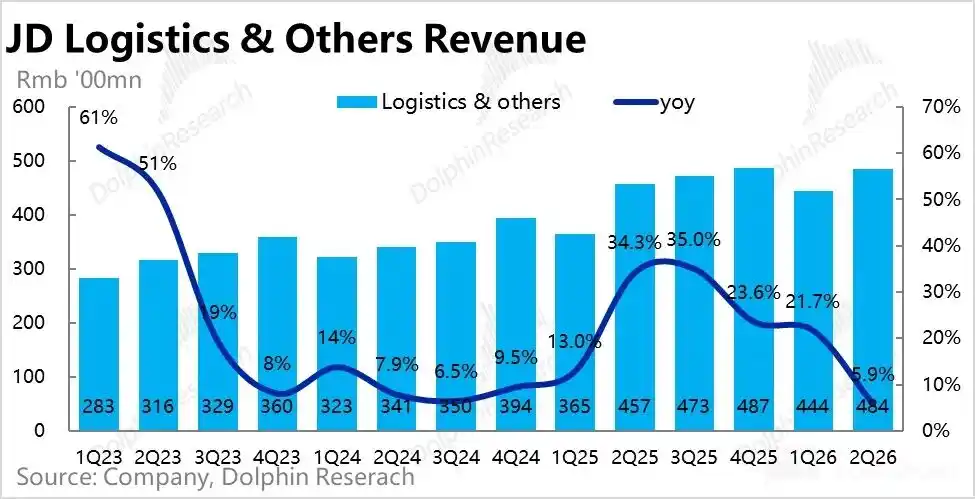
3. Food delivery war cools, logistics and new business growth also slows: As the period of high comparables from the food delivery war has begun, and this year's food delivery order volume has not increased but rather decreased, growth in logistics revenue and new business also slowed this quarter.
Logistics & other services revenue growth slowed to 5.9%, essentially returning to the mid-to-high single-digit growth rate seen before 2025 after the boost from food delivery subsided.
However, looking at new business revenue alone, it increased sequentially by about 15%, suggesting overseas business contributed to the growth.
4. Mall segment profitability still improved, new business losses slightly higher: Overall, the group's profit this quarter was largely in line with expectations.
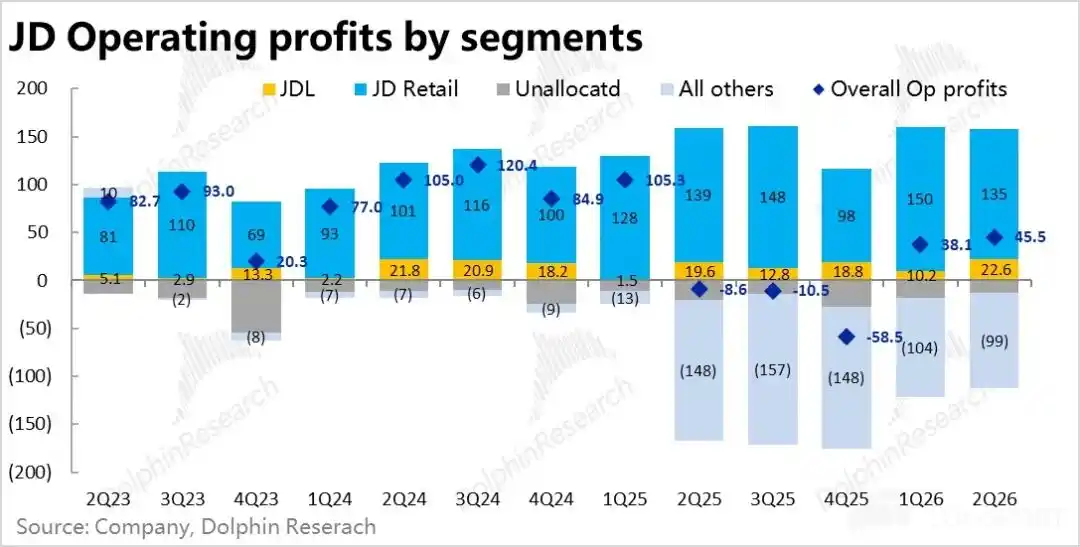
Breaking it down by segment, the Jingdong Mall segment's operating profit this quarter was nearly 13.5 billion yuan, slightly beating Bloomberg's expectation of about 13.0 billion. Trend-wise, unable to withstand the revenue contraction, profit also declined by about 3% year-over-year, failing to deliver another significantly better-than-expected result.
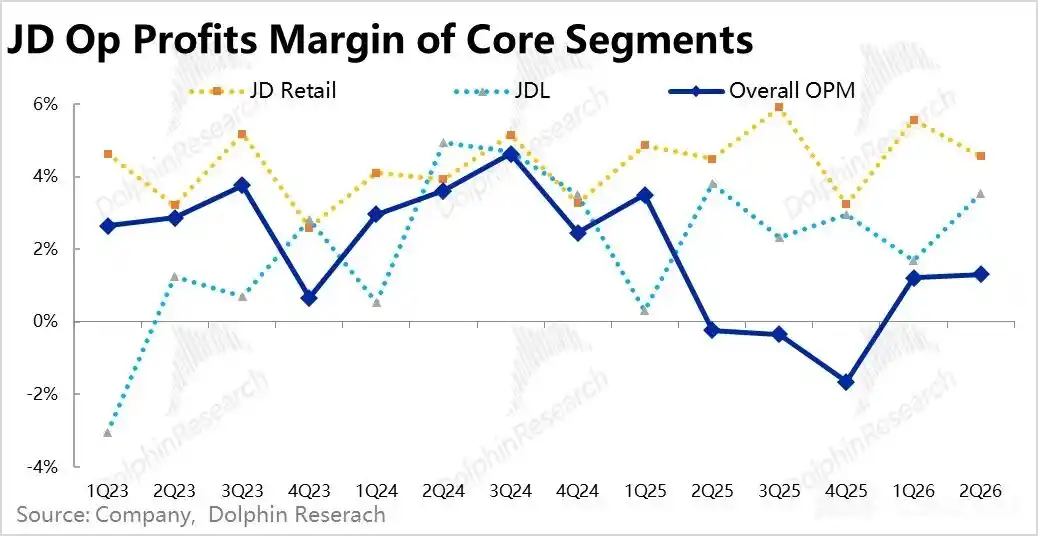
However, the operating margin still improved slightly year-over-year by less than 0.1 percentage point. Optimists might say that Jingdong managed to improve profitability while revenue shrank; pessimists might argue that there seems limited room for further margin expansion in the Mall segment.
Based on the company's explanation, the continued margin improvement is still mainly attributed to a revenue mix shift toward higher-margin businesses and supply chain optimization.
The New Business segment, which includes food delivery, reported a loss of nearly 9.9 billion yuan this quarter. As Dolphin Research expected, the loss narrowed little compared to last quarter and was also slightly higher than Bloomberg's consensus estimate.
According to common market expectations, Jingdong's food delivery losses this quarter should have decreased sequentially by about 1 billion yuan, implying that investments in overseas and other new businesses likely increased sequentially by about 500 million yuan (which doesn't seem like a huge amount).
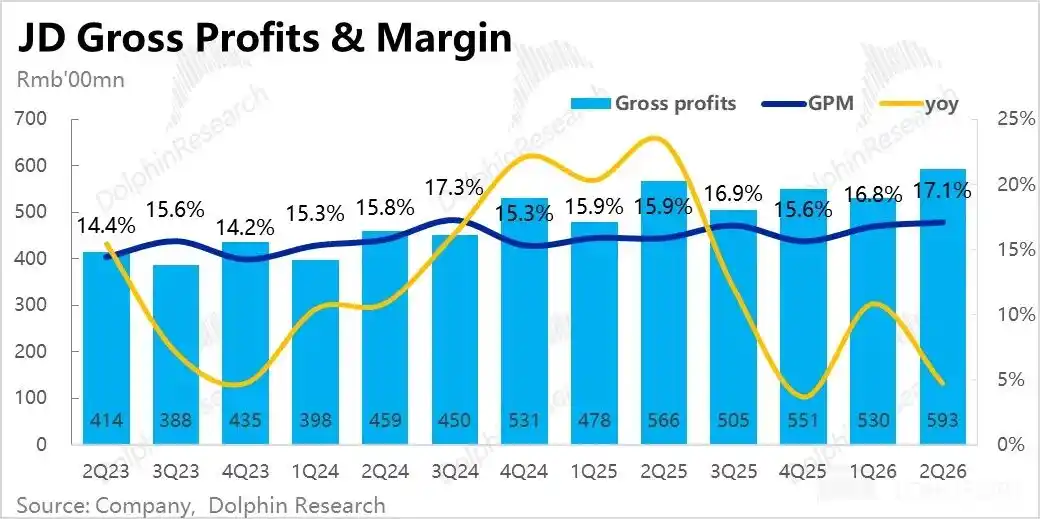
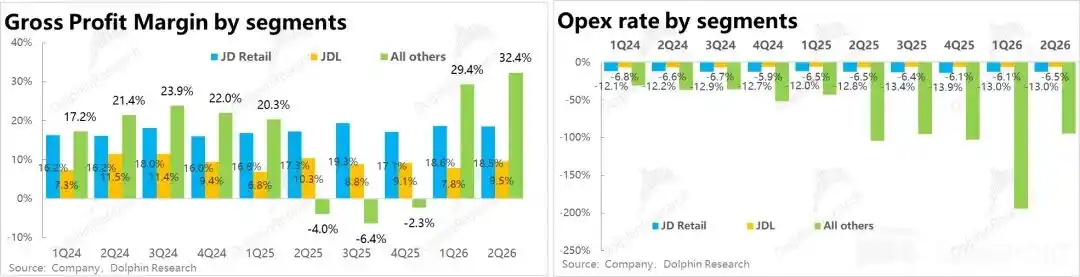
5. Cost and expense perspective: First, on gross margin, the group's overall gross margin continued to improve sequentially, from 16.8% to 17.1%. Consequently, gross profit still achieved about 5% year-over-year growth.
Specifically, this was mainly due to improved gross margins in both the New Business and Logistics segments after food delivery subsidies decreased, with the New Business segment contributing more significantly, seeing a sequential gross margin increase of 3 percentage points. In contrast, the Mall segment's gross margin declined slightly by about 0.1 percentage point sequentially (though it was still up 1.2 percentage points year-over-year), suggesting limited room left for squeezing gross margin from the upstream supply chain.
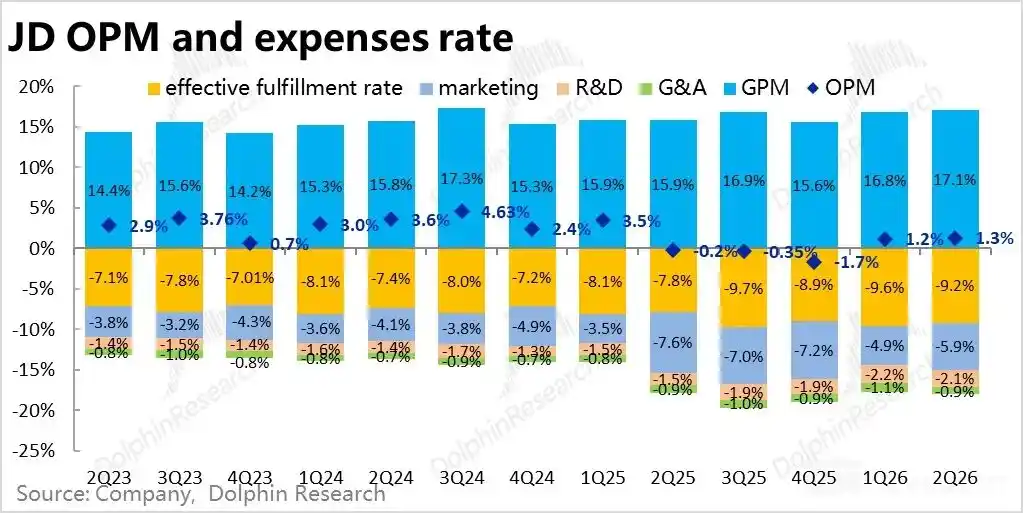
From an expense perspective, the company's total operating expenses decreased by 4.4% year-over-year this quarter, a larger drop than the revenue decline, helping profit release. Specifically, marketing expenses decreased by a predictable 25% year-over-year. Another notable point is that R&D expenses maintained rapid growth of 38%. It appears that while not investing heavily in large AI model development, Jingdong is still putting money into some internal AI applications.
By segment, the Mall segment's total expense ratio increased both year-over-year and sequentially by about 1 percentage point. This indicates greater pressure on the company to subsidize users itself after the national subsidy phase-out, which is the main reason the Mall segment's profitability couldn't improve more significantly.
The group's overall expense reduction was also mainly due to decreased investment in new businesses, down about 1.8 billion yuan year-over-year.
6. Shareholder returns decline, investing overseas instead of in AI: Another previous strength for Jingdong was its shareholder returns, among the best in the US-listed Chinese internet sector. However, in the entire first half of 2026, the company repurchased only about $1 billion worth of shares. Annualized against the current market cap, the return rate is only around 5%, a clear decline.
Unlike Alibaba or Tencent, Jingdong does not have massive AI-related capital expenditures, so its cash flow pressure isn't particularly high. On the cash flow statement this quarter, Jingdong's cash outflow for investments was about 29.5 billion yuan, but the vast majority of this was for purchasing short-term investments and wealth management products, not truly strategic investments. The perception of preferring to buy financial products rather than returning cash to shareholders is obviously poor.
Dolphin Research Viewpoint:
1. As seen above, Jingdong's results this time were unremarkable in terms of variance from expectations, with no highlights. In terms of trends, growth slowed due to macroeconomic headwinds. While overall profit seemingly improved due to reduced food delivery losses, core Mall segment profit declined. So, the overall results are certainly not good.
The core shortcomings can be summarized as follows: a. The Mall revenue decline was expected, but past Mall segment profits typically far exceeded expectations and guidance. This time was quite flat, suggesting the trend of improving Mall profitability may have hit a bottleneck; b. While food delivery losses narrowed, due to overseas investments, overall new business losses barely decreased; c. Daily essentials and advertising revenue growth slowed significantly. While understandable, this is bad news for medium-term revenue growth prospects; d. Preferring to buy financial products rather than pay dividends.
2. Outlook & Logical Assessment
This quarter's results weren't good, so what about the outlook? Dolphin Research believes the decisive factors influencing future performance and stock price are essentially two points:
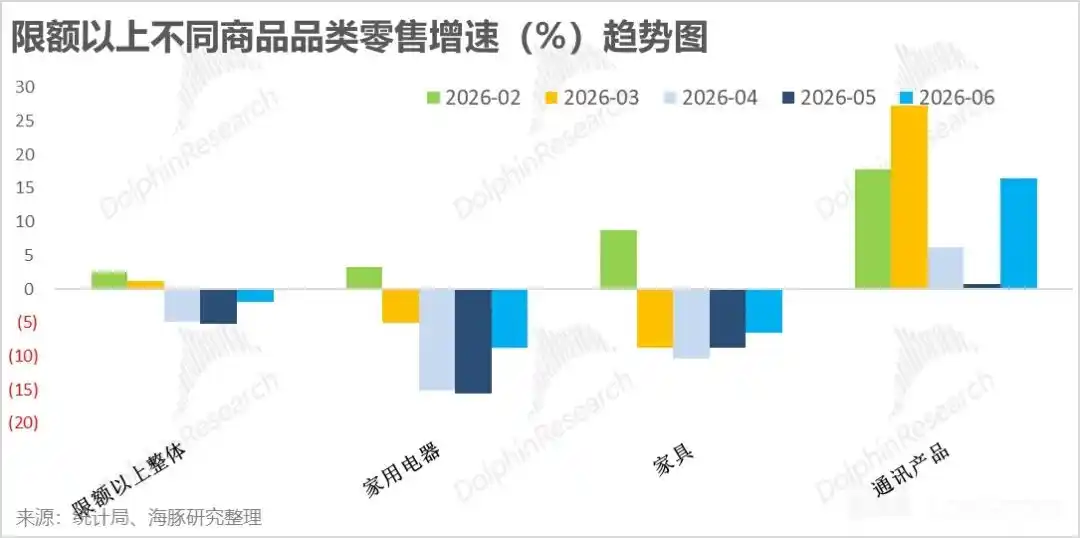
1) Whether a significant inflection point in domestic e-commerce business sentiment can emerge in the second half of the year. Looking at macro retail sales data, both overall and online consumption in Q2 were indeed at their weakest in recent years. However, the latest June retail sales growth rate showed some recovery compared to May. Overall growth improved from -0.6% to +1%, and online physical goods sales growth increased from 2.6% to 3.9%.
For categories particularly important to Jingdong, like electronics & appliances, statistics bureau data showed clear improvement (narrowing declines) in sales growth for household appliances, furniture, and communication equipment in June. This quarter's decline in electronics & appliance sales wasn't very large either.
According to research by an overseas bank, national subsidy allocation in the second half will shift marginally back from offline to online channels. Also, comparables will become increasingly easier. Therefore, Jingdong's medium-term performance trend will likely show signs of stabilization and recovery.
2) The other key factor is the attitude toward investment in new businesses & how losses will change, thereby impacting the group's overall profit.
Currently, as all participants in the food delivery war are scaling back investments and improving unit economics, losses from Jingdong's food delivery business will likely continue to narrow. However, since Jingdong's food delivery order volume has now fallen below 20 million daily orders, and it will likely be difficult to significantly increase volume without heavy subsidies again, unless Jingdong completely abandons the food delivery business, losses from this segment could be perpetual, reaching a "minimum loss level" that is difficult to reduce further.
But because the domestic main platform business has a clear ceiling, the company will likely not stop its diversified "tinkering." Therefore, one source of profit elasticity is the level of investment in "Jingxi" and its overseas businesses. In the near to medium term, Jingdong's overseas investments are unlikely to decline significantly, as JoyBuy is still in the early stages of business expansion, reportedly already operating in about 30 cities across 7 countries.
Thus, in the near term, overall new business losses will likely only trend down slowly, with a low probability of a sharp drop, which was indeed the case this quarter.
3) However, the Mall segment's profitability, which had consistently exceeded expectations for several quarters, failed to improve further this time. For investors hoping Jingdong could rely on internal efficiency gains to offset external pressures, this is undoubtedly disappointing.
Fortunately, Jingdong is not embroiled in the "AI model war," so it will not see its future profits and cash flow significantly impacted by "crazy" AI-related capital expenditures. Although this quarter's results were flat, they were largely as expected. If domestic e-commerce sentiment warms in the second half, Jingdong, with its relatively focused and domestic-centric business, can still be considered one of the companies in China's e-commerce sector with relatively high earnings certainty and defensive value.
3. On valuation, since this quarter's results were largely as expected, we haven't made major changes to our full-year forecasts. We still expect full-year 2026 operating profit for the Mall segment to be around 56 billion yuan, representing high single-digit year-over-year growth.
For new business losses (including food delivery, Jingxi, and overseas businesses), as mentioned above, due to continued overseas investment, a significant decline is unlikely. Therefore, we expect full-year new business losses of 36.5 billion yuan, resulting in group consolidated operating profit of about 19.5 billion yuan (no additional tax deduction).
In the near to medium term, Jingdong's performance fluctuations, both upward and downward, are unlikely to be very large, prioritizing stability. If it maintains good shareholder returns, it holds some allocation value for investors seeking safety and certainty. However, given the poor attitude toward shareholder returns this time, Dolphin Research finds it difficult to identify a compelling reason to invest in the company at present. While one could speculate on improved e-commerce sentiment in the second half, Jingdong may not be the stock with the highest potential upside.
This article is from the WeChat public account "Dolphin Investment Research" (ID: haituntouyan), author: Dolphin Research.