Mastercard Just Built A Payment Network For AI Agents — And It Runs On Crypto

bitcoinistPublished on 2026-06-10Last updated on 2026-06-10

Abstract

Mastercard has launched "Agent Pay for AI," a new payment protocol enabling AI agents to conduct small, automated, machine-to-machine transactions. The system addresses a gap in traditional payment infrastructure, which is poorly suited for such micropayments. A key feature is the storage of human-granted permissions on the Polygon blockchain, allowing for decentralized verification without a central authority. Mastercard is developing the protocol with partners Adyen, Coinbase, and Cloudflare. It enters a competitive field where Visa, Stripe, and Google have also introduced similar AI payment tools. While Mastercard's Chief Product Officer, Jorn Lambert, does not expect significant near-term revenue, he views it as a strategic infrastructure investment for an anticipated future where AI agents facilitate a meaningful share of commerce. This move follows Mastercard's recent integration of stablecoins, signaling a broader shift towards incorporating crypto into its core systems.

Mastercard has launched Agent Pay for AI, a new protocol designed to enable artificial intelligence agents to pay each other and send micropayments — storing the permissions that humans grant their AI agents on Polygon, a blockchain network built on top of Ethereum, according to an exclusive report by Fortune published June 10.

Related Reading: Trump’s Crypto Deals May Have Increased The Family Fortune By $2 Billion—At Investors’ Expense

The protocol is built around a specific use case that existing payment infrastructure handles poorly: small, automated, machine-to-machine transactions. When an AI agent needs to access data piecemeal from a website, or pay another service incrementally for a task it is performing on a user’s behalf, traditional card rails — built for human-initiated, merchant-facing transactions — are poorly suited for the job. Agent Pay for AI is designed to fill that gap, per Fortune’s reporting.

The decision to log permissions onto a public blockchain rather than a private database is a deliberate architectural choice. Multiple parties that want to verify whether an agent is acting within the boundaries a human has authorized can access that information directly on-chain, without relying on a single centralized authority to confirm it, per Fortune. Mastercard selected Polygon for the initial deployment.
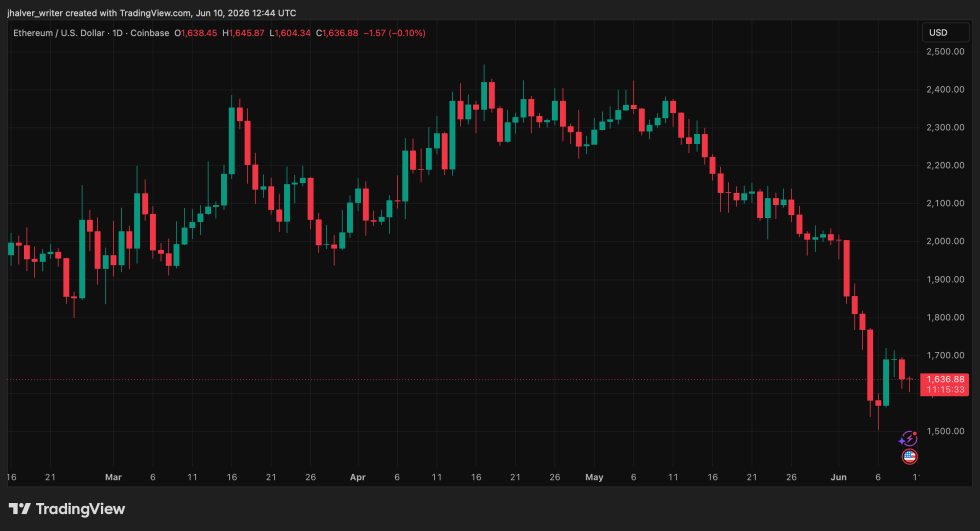
ETH's price trends to the downside on the daily chart. Source: ETHUSD on Tradingview

The Partners And The Crypto Competition

Three companies are working with Mastercard to develop the protocol: fintech platform Adyen, crypto exchange Coinbase, and web infrastructure giant Cloudflare, per Fortune’s reporting. The combination of a payment processor, a crypto-native exchange, and the company that handles a significant share of the internet’s traffic signals that Mastercard is building Agent Pay for AI as interoperable infrastructure rather than a proprietary walled garden.

The competitive landscape is already crowded. Visa and Stripe have each built tools anticipating a world where AI bots buy groceries, manage bank accounts, and pay for subscriptions. Coinbase launched the x402 protocol for AI payments, Stripe collaborated with Tempo to develop the Machine Payments Protocol, and Google released its own standard in September 2025, per Fortune.

Jorn Lambert, Mastercard’s Chief Product Officer, was measured about near-term commercial expectations in his conversation with Fortune. He does not expect Agent Pay for AI to be a significant revenue driver in the next twelve months. Over five years, however, he described it as a meaningful new addressable market. Lambert separately predicted that AI chatbots will eventually sit between a meaningful share of e-commerce transactions — framing the protocol not as a speculative bet but as infrastructure being built ahead of an inevitable shift in how commerce flows.

Related Reading: Japan’s SBI Bank Expands Crypto Push With BTC, ETH, XRP Rewards Program For Depositors

This development marks a pivotal moment for the nascent sector’s convergence with artificial intelligence. Mastercard choosing a public blockchain to anchor the permissions layer of its AI payment infrastructure — one week after opening its global settlement rails to six regulated stablecoins across eight blockchain networks — confirms that the world’s second-largest card network is systematically rebuilding its core architecture around crypto rails rather than alongside them.

Cover image from Grok, ETHUSD chart from Tradingview

Trending Cryptos

Related Questions

QWhat is the name of the new protocol launched by Mastercard for AI agents, and what problem does it aim to solve?

AMastercard launched the Agent Pay for AI protocol. It aims to solve the problem of enabling small, automated, machine-to-machine (AI agent-to-agent) payments and micropayments, a use case poorly handled by traditional card payment infrastructure designed for human-initiated, merchant-facing transactions.

QOn which blockchain network is Mastercard storing the permissions for its Agent Pay for AI protocol, and why was a public blockchain chosen?

AMastercard is storing the permissions for its Agent Pay for AI protocol on the Polygon blockchain. A public blockchain was chosen so that multiple parties can directly verify on-chain whether an agent is acting within authorized boundaries, without relying on a single centralized authority.

QWhich three companies are partnering with Mastercard to develop the Agent Pay for AI protocol?

AThe three companies partnering with Mastercard are the fintech platform Adyen, the crypto exchange Coinbase, and the web infrastructure giant Cloudflare.

QAccording to Mastercard's Chief Product Officer Jorn Lambert, what is the commercial outlook for the Agent Pay for AI protocol in the near term and over a longer period?

AAccording to Jorn Lambert, Agent Pay for AI is not expected to be a significant revenue driver in the next twelve months. However, over a five-year horizon, he described it as a meaningful new addressable market.

QHow does Mastercard's recent launch of Agent Pay for AI, combined with another recent action, indicate its strategic direction regarding cryptocurrency infrastructure?

ACombined with its decision the week prior to open its global settlement rails to regulated stablecoins, the launch of Agent Pay for AI on a public blockchain confirms that Mastercard is systematically rebuilding its core architecture around crypto rails, rather than just operating alongside them.

Related Reads

Take a Calm Look at Domestic Lithography Machines: 5 Units Delivered, How Far Are We from Challenging ASML?

This article analyzes recent news about China's domestic DUV lithography machines, advising a measured perspective. A state-backed enterprise plans to deliver about 5 immersion DUV systems this year, with a 2027 target of 20 units, aimed at 28nm processes. While this marks a step from R&D into initial customer validation, the author cautions against over-optimism. The piece clarifies this is DUV, not EUV technology. DUV is crucial but cannot economically solve challenges for advanced nodes like 5nm or below, where EUV is key. The 5-unit volume is minimal compared to ASML's annual output of over 130 such machines. The author highlights unverified claims regarding specs like 90% yield and warns against conflating this news with unconfirmed reports about Shanghai Micro Electronics' production. China's EUV efforts, while progressing with a prototype, remain in early testing, facing significant hurdles in core components like high-precision optics. The analogy of a "DeepSeek moment" is deemed misleading, as lithography involves slow, iterative precision engineering, not rapid software-like breakthroughs. Current progress represents establishing a potential second supply source and gaining vital engineering experience rather than an imminent industry disruption. For investors, the key indicators to watch are formal customer acceptance, stable operational performance, repeat orders, and growth in production volume and component localization. The conclusion is that this is a positive but early-stage development, far from altering the global competitive landscape.

marsbit6m ago

Take a Calm Look at Domestic Lithography Machines: 5 Units Delivered, How Far Are We from Challenging ASML?

marsbit6m ago

The 800x Golden Dog, "Gacha" Saves NFT Trading

Title: 800x Golden Dog: How 'Gacha' Mechanics Are Rescuing NFT Trading In the past month, the on-chain TCG (Trading Card Game) narrative, centered around "gacha" or loot box mechanics, has emerged as a major crypto-native revenue generator, second only to platforms like Hyperliquid and pump.fun. Recently, this trend hit Ethereum with Fake World Assets (FWA). Within just over a week, FWA generated approximately $1.3 million in revenue, ranking 15th in the past week's crypto app earnings. Its token, $FWA, surged from an initial market cap of ~$47,550 to a peak of ~$38.8 million—an 800x gain. Meanwhile, Collector Cards' token $CARDS declined significantly from its previous highs. FWA, developed by the team behind "PunkStrategy," operates as an NFT gacha system with a built-in token flywheel. Users deposit NFTs paired with ETH as liquidity into pools. Each deposit creates a personal pool; more ETH deposited lowers the chance of the NFT being "won" in a draw. Players spend ETH to "draw" (gacha). If they get an undesirable NFT, they can instantly sell it back to the original depositor at an 85% discount, generating income for the depositor. A 1% fee is taken on each draw and on depositor earnings when an NFT is kept. The key to FWA's momentum is its token $FWA. It cannot be bought directly externally. The primary way to acquire it is by playing the gacha and choosing to receive $FWA (instead of ETH) when selling back an unwanted NFT. This mechanism creates constant buy pressure for $FWA as players engage, especially during its price ascent. Early participants who held $FWA benefited massively from subsequent inflows. This contrasts with projects like Collector Cards, which, despite strong revenues, suffer from perceived low token utility beyond buybacks. In conclusion, while FWA's flywheel design—linking speculative token gains directly to NFT trading activity—has driven rapid growth, its sustainability is questionable. The model relies heavily on continuous $FWA price appreciation to offset the inherent negative expectancy of each draw. When price momentum stalls, activity will likely decline. The case highlights that in crypto markets, pure profitability narratives can be fleeting; understanding the relationship between attention, token buy pressure, and sustainable mechanics is crucial to avoid speculative pitfalls.

marsbit30m ago

The 800x Golden Dog, "Gacha" Saves NFT Trading

marsbit30m ago

The Quantum Computing Threat Approaches, Cryptocurrency May Be Exposed to Risks Before Banks

Quantum computing poses a significant threat to all cryptographic systems, including banks and governments, but decentralized cryptocurrencies with public ledgers like Bitcoin are likely the first practical target. Experts warn that a cryptographically relevant quantum computer (CRQC), capable of running Shor's algorithm to break the elliptic curve cryptography securing most crypto wallets, could emerge around 2029. Recent research shows the required quantum resources for such attacks are shrinking dramatically, potentially enabling key extraction in minutes. The core vulnerability for cryptocurrencies is not the cryptography itself—post-quantum standards are being developed—but the slow, decentralized governance required to implement upgrades. Unlike centralized banks that can swiftly transition, Bitcoin needs near-unanimous consensus among its global network, a historically difficult process as seen in past upgrades. Estimates suggest migrating all vulnerable Bitcoin funds could take at least 76 days of dedicated network time, and it must be completed before a CRQC exists to prevent "now-or-never" attacks on exposed keys. The threat is not binary; it begins when a quantum computer can decrypt data before it loses value, not necessarily in real-time. A significant portion of Bitcoin (estimated at millions of coins) already has public keys permanently exposed on-chain, making them vulnerable to eventual "static attacks." While technical solutions exist, the race is against time for decentralized networks to coordinate a defensive transition, serving as an early warning for the broader financial system.

marsbit41m ago

The Quantum Computing Threat Approaches, Cryptocurrency May Be Exposed to Risks Before Banks

marsbit41m ago

On the First Day of Listing, Changxin Technology's Market Value Exceeds 3 Trillion Yuan, Which Securities Firm Has the Largest Floating Profit?

On July 27th, Changxin Technology, the largest-ever IPO on China's STAR Market, debuted with its share price soaring 465.82% to close at 49 yuan. Its market capitalization reached 3.28 trillion yuan, instantly making it the most valuable A-share company. The stellar performance delivered substantial gains for involved securities firms, primarily through equity investments rather than underwriting fees. China Merchants Securities emerged as the biggest winner. Its direct investment subsidiary, Zhaozheng Investment, alone holds a 0.54% pre-issue stake, translating to a paper profit exceeding 155 billion yuan based on the first-day closing price—surpassing the firm's entire 2025 net profit of 123.5 billion yuan. Other major beneficiaries include Huaan Securities, with an estimated profit of around 123 billion yuan from its 0.44% stake, and the lead underwriters, CICC and CITIC Securities, which each gained approximately 46 billion yuan from mandatory follow-on investments. Firms like Founder Securities, Haitong Securities, and GF Securities also reported significant holdings valued in the billions. Despite these paper gains, shares of some brokerages like Huaan and China Merchants fell on the listing day, reflecting broader market pressures. Analysts remain bullish on Changxin's long-term prospects, citing the AI-driven demand surge for DRAM (Dynamic Random-Access Memory) and a supportive supply-demand dynamic with projected shortages through 2028. As China's largest and most advanced integrated DRAM designer and manufacturer, Changxin is poised to capture growth from domestic substitution and global market shifts, potentially challenging the current "big three" oligopoly (Samsung, SK Hynix, Micron). The IPO proceeds, focused on capacity upgrades and R&D, are expected to accelerate China's semiconductor self-sufficiency.

marsbit1h ago

On the First Day of Listing, Changxin Technology's Market Value Exceeds 3 Trillion Yuan, Which Securities Firm Has the Largest Floating Profit?

marsbit1h ago

Trading

Spot

Hot Articles

Discussions

Welcome to the HTX Community. Here, you can stay informed about the latest platform developments and gain access to professional market insights. Users' opinions on the price of AI (AI) are presented below.

活动图片