Getting Ahead of the Tide and Drowning First: The Fall of 'Crypto x AI' Pioneer ai16z

marsbitPublished on 2026-08-06Last updated on 2026-08-06

Abstract

"ai16z, an early pioneer of the 'crypto x AI' narrative, has officially shut down. In late 2024, its token launch sparked a massive speculative frenzy around AI Agent tokens, briefly propelling the project to a $2.6 billion valuation. However, by 2026, as functional AI agents from companies like Anthropic and OpenAI became mainstream reality, the crypto-native AI projects built largely on hype began to collapse. The founder of its underlying project, Eliza OS, announced the termination in a bitter post, citing legal threats from token holders and a depleted foundation. He expressed disillusionment with the crypto community, contrasting it with the 'optimistic' builders in pure AI. While the Eliza framework itself remains active as open-source software—ironically with contributions from AI like Claude—the token-dependent venture failed. The story highlights a core flaw: the crypto market often prices narratives far ahead of functional technology. When the promised AI future arrived, it was delivered by traditional tech companies with sustainable business models, not token projects. The episode suggests the initial path of 'tokenizing AI concepts' is broken. However, integration may still occur in reverse—with AI tools enhancing crypto analytics and trading—or in coordinating real resources like decentralized compute, as seen in projects like Bittensor and Render."

Author: David, Deep Tide TechFlow

ai16z, do you remember that name?

If you do, you experienced the AI coin frenzy in the crypto world at the end of 2024. If you don't, that's normal too; the category of AI Agent tokens has been quiet for a long time.

In the current version where AI tools are gradually landing and advancing rapidly, "crypto x AI" seems too much like a pseudo-concept and an old-fashioned toy.

Today, Shaw Walters, founder of the Eliza OS project, published a very long post. The gist is that the ai16z token is completely dead, the foundation is shut down, there will be no buybacks, and token holders should handle it themselves.
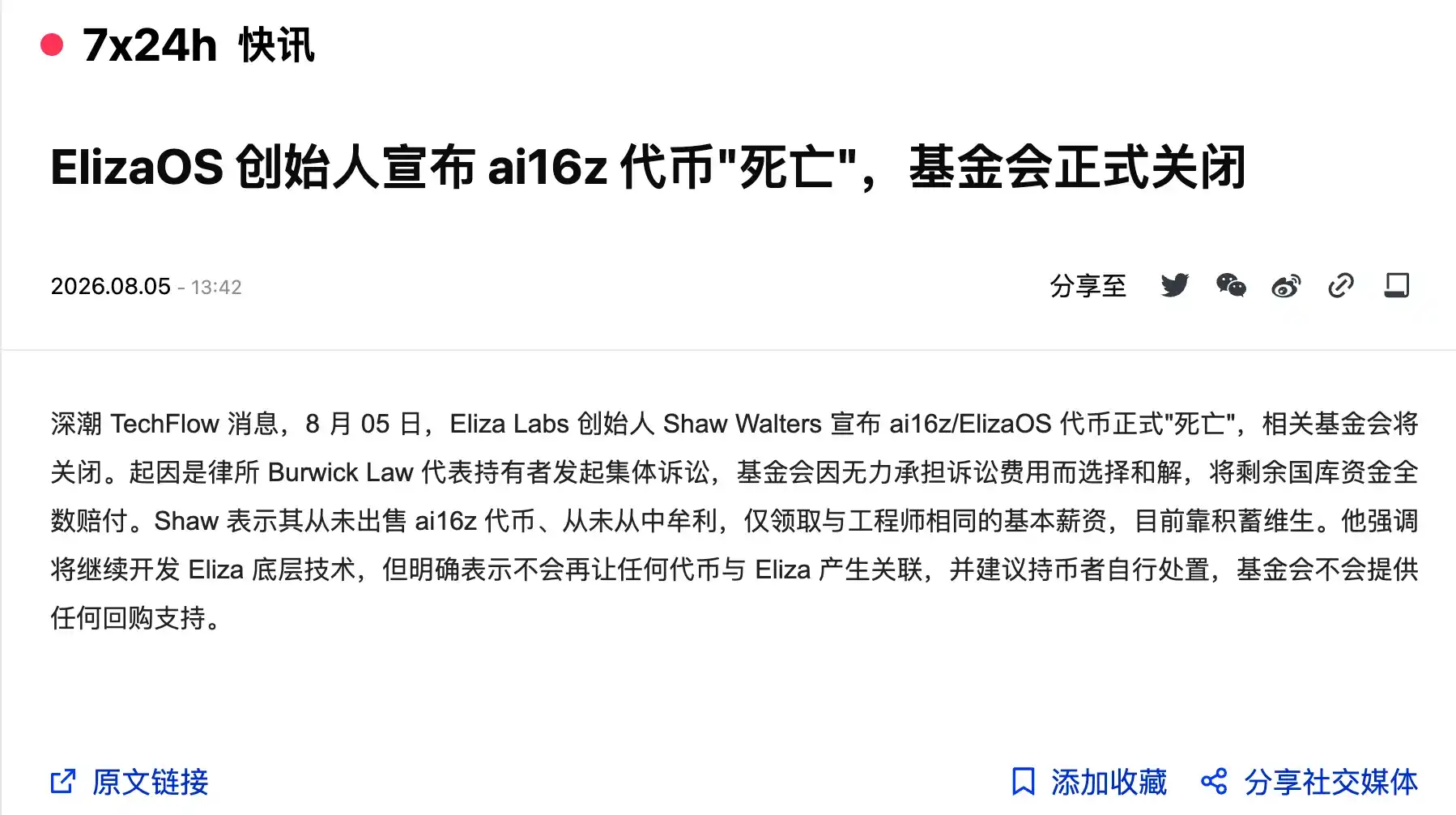
He advises you to either sell it or "find a group of people to pump it," but don't expect him to do anything more.

The tone of this letter doesn't sound like a founder gracefully announcing the end of a project, but more like someone slamming the door in disappointment after cursing everyone out. He calls the crypto community "a bunch of spoiled crybabies" and says a law firm sued him from the token holders' perspective.

And the Eliza OS Foundation has no money to fight the lawsuit and used up the remaining funds to settle.

Shaw also says he once had $25 million worth of ai16z tokens in his wallet, didn't sell a single one, and watched them go to zero; he's now living off savings in a shabby little bedroom in San Francisco, writing code every day.

From his perspective, he perhaps sees himself as someone trying to develop with an idealistic spirit in a toxic market, ending up with nothing but wreckage, disappointment, and anger.

The author has no intention of judging these personal emotions. But standing at the crossroads where hotspots shift, industry focus moves, and AI rises, the shutdown of Eliza OS inevitably makes one sigh that "crypto x AI" truly arrived too early for the party.

A Step Ahead, Riding the Wave

In October 2024, ai16z launched a crowdfunding campaign on DAOs.fun, aiming to raise 420.69 SOL, roughly $75,000, to create an AI-autonomously managed investment fund.

420.69 – those familiar with crypto culture know it's a meme number. Starting with the choice of fundraising amount, the underlying tone of this venture was already set.

But it really took off. In less than three months, ai16z's market cap surged to $2.6 billion. It also sparked an entire category: GOAT came first, VIRTUAL followed, and various Agent concept coins emerged endlessly. The entire AI Agent track grew from zero to nearly $10 billion.
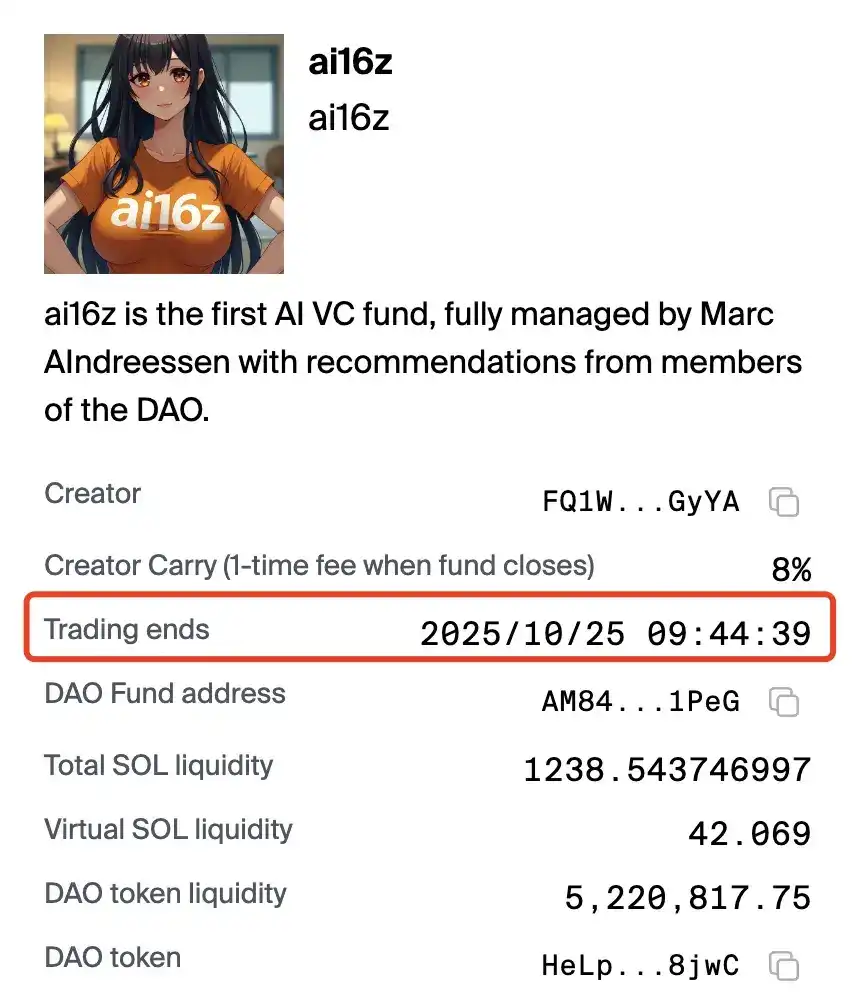
Crypto is indeed a step ahead in concept. What was the AI market like at the end of 2024?

ChatGPT had just turned two, often criticized for its hallucinated answers; Claude didn't yet have tools to directly operate computers; most people's understanding of "AI Agent" was still at the conceptual level. The crypto market had already priced this concept.

But there was one detail few paid attention to at the time.

Less than a week after ai16z launched, a crypto media outlet published a report questioning whether the core AI Agent of the ai16z project – the one claiming to make autonomous investment decisions, "Marc AIndreessen" – was actually operated by humans, not a true Agent thinking for itself.

This same skepticism later arose regarding the well-known crypto market analysis Agent aiIxbt.

Back then, such doubts could hardly cause any waves or FUD. Market cap kept rising, the community kept cheering, new AI Agent tokens kept launching... Looking back, the author sees this as perhaps the most precise microcosm of the entire crypto AI narrative.

Truth or falsehood didn't matter. In an environment of liquidity overflow, a narrative one version ahead was enough to spark a speculative frenzy.

Concept guaranteed authentic, direction guaranteed correct, but tokens existed before products, price existed before technology – this is precisely the essence of crypto being a step ahead.

The Future Has Arrived, But It Has Nothing to Do with You

In 2026, AI Agents are truly here.

In the West, there's CodeX and Claude; in the East, there are products like Workbuddy and others more suited to the domestic market. Looking back at the narratives that lived in whitepapers during the crypto AI hype wave – like automatically analyzing markets, handling workflows, monitoring public opinion – these have all become reality.

This might be, besides stablecoins, one of the few realized narratives within the crypto industry.

But the ones realizing them are a different group. It's Anthropic, it's OpenAI, it's teams writing code in San Francisco and Hangzhou. Money flows to aggregation platforms like OpenRouter, to cloud providers' GPU bills, to every single API call that actually runs.

Another sentence from Shaw's long post evokes infinite emotion:

"AI doesn't have these problems. The people there are optimistic, powerful, building the future instead of tearing each other down. Those are my people." Someone who once ignited the crypto AI Agent narrative concludes in the end that this industry is incompatible with AI?

Objectively speaking, none of these successful current AI applications or large models have any reason to issue tokens.

Anthropic charges via subscriptions and API calls, OpenRouter's relay business has an annual turnover over $100 million. These companies never issued tokens, never built DAOs, but their business models work, developers vote with their feet, and bills are the best consensus mechanism.

Conversely, the situation for crypto AI projects is quite brutal. When token prices were high, they seemed to have everything – a treasury with money, a community with people, a hot narrative. Once the price collapsed, everything vanished simultaneously.

Developers left because the purchasing power of token-based salaries shrank by ninety percent; the community turned into a rights protection group. Those who genuinely wanted to build might find the project couldn't even afford to hire one engineer.

And ironically, the Eliza framework itself in his hands isn't dead. The code is still being updated, companies are discussing collaboration on it. An open-source AI framework can survive without issuing tokens – selling services, getting acquired – its paths are much wider than a token's.
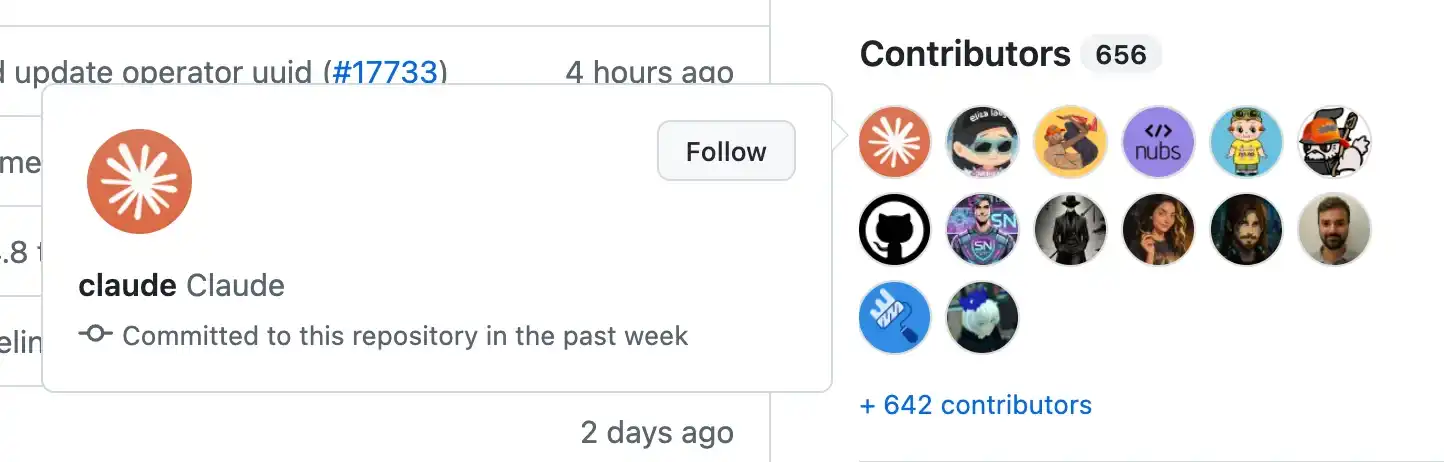
What's even more lamentable is that among the active contributors to the Eliza open-source AI framework, which originated in crypto, in the past week, was actually Claude.

In the 2026 market, an AI developer or project without a token attached might be worth more than one with a token.

Embrace Change

As someone in the crypto industry, seeing once-hot projects fall one by one is inevitably melancholic.

But sentiment doesn't mean complete pessimism.

The crypto AI narrative is indeed shattered. But what's shattered is the path of "issuing tokens for AI concepts." The possibilities between crypto and AI haven't been completely severed.

The few projects still alive are doing things completely different from ai16z. For example, Bittensor is building a decentralized AI compute market, Render is working on a distributed GPU rendering network.

They both use tokens to coordinate a real computational resource, which still holds a certain market, though bull markets grant more premium and persuasiveness.

Furthermore, within the circle, on-chain data analysis, vulnerability scanning, whale wallet tracking, public opinion monitoring, DEX contract strategies – AI is gradually finding its place and creating value in these scenarios.

In 2026, when a professional crypto trader opens Hyperliquid, a strategy window powered by Claude or GPT is most likely open beside it. This also means the relationship between crypto and AI isn't over, but the direction needs to reverse.

AI empowering all scenarios has become a political correctness; crypto can equally be covered. As for how big the crypto pie still is, that might depend on when BTC gets better.

On a personal level, what one should do is embrace change. A developer shedding the token burden is worth much more in today's AI world than what tokens can offer; and a crypto player solidly embracing AI can obviously obtain greater benefits than the previous rough-and-tumble model.

Being in crypto, we often see the direction a step ahead, or perhaps we've just mistaken our own position.


Trending Cryptos

Related Questions

QAccording to the article, what were the main reasons for the failure and shutdown of the ai16z project?

AThe main reasons were the inherent flaws of the "crypto x AI" narrative it pioneered, including a token-first approach with products lagging behind hype, a model dependent on token price for viability, and a toxic community environment. The project ran out of funds for legal battles, and the founder expressed disillusionment with the crypto community while finding more alignment with the broader, more optimistic AI industry.

QHow does the article contrast the trajectory of ai16z with the development of the broader AI industry?

AThe article contrasts them as "early bird, late arrival." While ai16z and crypto quickly priced the AI Agent concept in late 2024, the real, functional AI Agents (like CodeX, Claude, Workbuddy) were built and commercialized successfully by traditional tech companies (Anthropic, OpenAI) in 2026. The value flowed to service fees, API calls, and subscriptions, not to speculative tokens. The crypto narrative was a precursor, but the actual future was built elsewhere without tokens.

QWhat is the current state and ironic twist regarding the Eliza OS framework mentioned in the article?

AThe Eliza OS framework, the underlying technology of the ai16z project, is still alive and being updated. Ironically, its most active recent contributor is Claude, an AI. The article notes that as an open-source AI framework without a token, it has more viable paths forward (corporate partnerships, acquisition, service sales) than it did when burdened by its associated token.

QWhat alternative paths for the intersection of crypto and AI does the article suggest are more viable than the ai16z model?

AThe article suggests two more viable paths: 1) Using tokens to coordinate real-world computational resources, like decentralized AI compute markets (e.g., Bittensor) or distributed GPU networks (e.g., Render). 2) Reversing the relationship: using AI to empower crypto-native activities, such as on-chain data analysis, vulnerability scanning, wallet tracking, sentiment monitoring, and trading strategy generation on DEXs.

QWhat is the article's final advice or perspective for individuals in the crypto space regarding AI?

AThe article advises individuals to embrace change by repositioning themselves. Developers should shed the token burden, as their skills are more valuable in the broader AI industry. Crypto participants should focus on practically leveraging AI tools to enhance their activities (e.g., trading, analysis), which can offer greater rewards than previous speculative models. It suggests the crypto community often sees directions early but may have mistaken its role.

Related Reads

Michael Saylor: Bitcoin Halved, My Digital Credit is Making Money

Michael Saylor discusses Bitcoin, digital credit, and corporate treasury strategies in a recent roundtable. He explains that while Bitcoin remains "digital capital" with no counterparty risk, its ~40% annual volatility makes it unsuitable for most institutional and retail capital. To attract this capital, he advocates for Bitcoin-backed "digital credit" and "digital currency" products. These offer low volatility against fiat currencies, generate yield, and compete with traditional money market funds, stablecoins, and other yield-bearing crypto assets. Saylor clarifies that these products are not meant to replace direct Bitcoin ownership but to onboard capital that otherwise wouldn't enter the Bitcoin ecosystem. He provides examples: during a period when Bitcoin fell 50%, his company's digital credit products (STRC, SATA) delivered positive returns of 3-4%, demonstrating their ability to strip out ~90% of Bitcoin's volatility. He frames "digital currency" as a fiat-referenced, yield-bearing, stable-value asset backed by Bitcoin, designed to meet the needs of the global capital pool. This approach, he argues, can expand the Bitcoin network's reach by 10x to 100x more effectively than pure education. The discussion also covers corporate finance for Bitcoin treasury companies. Saylor argues that equity issuance is not inherently dilutive if done above net asset value per share and if the acquired asset (Bitcoin or cash) supports future value creation. He distinguishes between debt with maturity dates and hybrid capital like preferred shares (e.g., STRC), which offer issuer options and do not force liquidation. Evaluating these companies requires modeling based on future Bitcoin price and volatility assumptions, not relying on a single metric like mNAV (market-adjusted net asset value). The business models are still evolving, and investors must analyze full disclosures to form a complete view.

marsbit47m ago

Michael Saylor: Bitcoin Halved, My Digital Credit is Making Money

marsbit47m ago

Changxin Rejects Apple's Price Pressure, Prices Not Lower Than Samsung and SK Hynix, Apple Loses Pricing Power

Apple recently attempted to negotiate lower-priced DRAM procurement deals with China's CXMT (ChangXin Memory Technologies) compared to its agreements with Samsung and SK Hynix but was rejected. CXMT stated its prices would not be lower, and could even be higher, than those of the South Korean suppliers. This refusal is attributed to CXMT's production capacity being largely secured by long-term contracts with major domestic clients like Huawei, Xiaomi, OPPO, Vivo, and Chinese internet giants. Consequently, CXMT feels no pressure to meet Apple's stringent terms. The backdrop is a significant surge in memory prices driven by the AI boom. As Samsung and SK Hynix shift more production capacity towards high-margin High Bandwidth Memory (HBM) for AI servers, the supply of conventional DRAM has tightened, causing prices to skyrocket. This has drastically increased the bill-of-materials cost for devices like iPhones, pressuring Apple's profits. Apple's traditional strategy of leveraging multiple suppliers for price competition has weakened, as memory makers prioritize more profitable AI-related orders. CXMT's confidence stems from achieving technological parity. Its DDR5 and LPDDR5X products have reached mass-production yields above 90%, closely matching Samsung's performance. With technical gaps closed, CXMT no longer competes solely on low prices. Furthermore, Chinese companies are wary of the risks associated with over-reliance on Apple's supply chain, citing cases like OFILM and Wingtech, which suffered severe losses after being removed from or impacted by US sanctions. This event signals a shift in the semiconductor industry's power dynamics. The AI-driven demand has transformed the market from buyer-centric to supplier-centric, where control over scarce, advanced production capacity grants pricing power. For Chinese semiconductor firms, the episode marks a transition from being low-cost alternatives to becoming equal suppliers with their own pricing authority, backed by domestic demand and technological advancement. Apple's loss of leverage with a mainland supplier underscores this changing era.

marsbit1h ago

Changxin Rejects Apple's Price Pressure, Prices Not Lower Than Samsung and SK Hynix, Apple Loses Pricing Power

marsbit1h ago

Tiger Research: Four Ordinary People's Stories Reveal the Ultimate Destination of Blockchain in 2036

Tiger Research: 2036 - Four Stories of Blockchain's Integration This speculative narrative presents four vignettes set in 2036, illustrating the subtle yet profound ways blockchain technology could reshape everyday life and global systems. Story 1: The Irrelevance of National Currency. In the inflation-plagued fictional nation of Zutopia, Judy, a longtime currency exchange worker, witnesses the endgame. Dollar-pegged stablecoins (USDT, USDC), once a niche tool, have completely supplanted the volatile local Bucks for daily transactions, salaries, taxes, and even government bonds, eroding traditional monetary sovereignty. Story 2: The 24/7 Global Casino. Lia, a young investor in Singapore, operates in a world where every asset—stocks, real estate, bonds—is tokenized and trades endlessly on borderless platforms. For her generation, constant, leveraged, global trading is the norm, contrasting sharply with the cautious, scheduled investments of her parents. Story 3: The Great Consolidation. Do-hyun, an infrastructure engineer, recalls the 2020s boom of countless independent blockchains (like the fictional "Allchain") that collapsed after incentive programs ended. By 2036, the landscape has consolidated into a handful of major, efficient networks, as users and liquidity coalesced around durability over fragmentation. Story 4: The End of the Banner Ad. Media entrepreneur Jae-hoon observes the final shift from human-centric advertising. With most web traffic now from AI agents, the old pageview-and-banner model is dead. A new machine-to-machine economy thrives via protocols like x402, where media companies charge AI agents micropayments for data access, creating a more reliable revenue stream than traditional ads ever did. Together, these stories depict a 2036 where blockchain is not a standalone revolution but an integrated, almost invisible infrastructure enabling global digital currency, seamless asset markets, consolidated networks, and a new paradigm for digital content commerce.

marsbit1h ago

Tiger Research: Four Ordinary People's Stories Reveal the Ultimate Destination of Blockchain in 2036

marsbit1h ago

Trading

Spot

Hot Articles

Discussions

Welcome to the HTX Community. Here, you can stay informed about the latest platform developments and gain access to professional market insights. Users' opinions on the price of AI (AI) are presented below.

活动图片