Mining Companies' High-Stakes Bet on AI: Valuations Enter a Phase of Divergence, Uphill Battle Ahead

marsbitPublished on 2026-06-20Last updated on 2026-06-20

Abstract

Crypto miners are facing increasing pressure amid weak digital asset markets, pushing many to pivot towards AI infrastructure as a new growth avenue. Leveraging existing assets like power resources, land, and cooling systems, miners can convert facilities for AI compute at lower costs. This transition narrative has fueled significant stock rallies, with some miners' shares outperforming Bitcoin year-to-date. Market valuations have diverged, with pioneers like CoreWeave reaching a multi-billion dollar valuation, while others lag. The shift is driven by AI's explosive demand for data centers and compute, with clients willing to pay premiums for power and space. However, the transformation is capital-intensive, requiring massive funding for GPU procurement and facility upgrades, with an estimated short-term funding gap of $50 billion. Miners are raising capital through convertible bonds, Bitcoin sales, and securing long-term AI contracts to finance the build-out. While AI offers greater long-term potential than mining, success hinges on execution, timely project delivery, and securing quality tenants, moving the valuation focus from power capacity to cash flow and return metrics.

Author: Nancy, PANews

As crypto assets continue to experience weakness and decline, crypto mining companies are facing increasingly severe survival pressures. In search of new growth avenues, more and more mining companies are accelerating their shift into the AI arena. This transformation narrative has quickly gained favor in the capital markets, leading to significant stock price increases for many mining firms, with some even reaching new all-time highs.

However, while the AI business injects new growth potential into mining companies, the massive capital expenditures, ongoing funding requirements, and lengthy return cycles behind it are pushing these firms into another battle of capital consumption. At a time when the profitability of mining operations remains under pressure, this high-stakes gamble of transitioning to AI is testing the financial strength and execution capabilities of mining enterprises.

Stock Prices Outperform Bitcoin Significantly, Mining Companies' Valuations Enter a Divergence Phase

Mining companies are transforming into landlords of computing power in the AI era.

With the profit margins for Bitcoin mining continuously narrowing and some mining companies even falling into losses, the AI boom has fueled a sharp surge in global demand for data centers, power resources, and GPU computing power. An increasing number of mining companies are accelerating their pivot towards AI infrastructure, seeking new growth curves.

For mining companies, this transition offers inherent advantages. Over the years, to meet the demands of large-scale mining, they have amassed critical assets such as abundant power resources, land reserves, substation access capabilities, and mature cooling and heat dissipation systems. Compared to data center operators starting from scratch, mining companies only need to upgrade and retrofit their existing facilities to quickly enter the AI infrastructure market, catering to AI computing power demands at a lower cost and with a shorter cycle.

Since last year, the pace of mining companies transitioning to AI has noticeably accelerated. Some miners have decisively scaled back or even exited traditional mining operations, fully shifting to AI computing and data center operations; others have retained part of their mining business but are gradually reallocating resources and capital expenditure focus towards the AI sector. Today, several mining companies have grown into significant players in AI infrastructure construction.
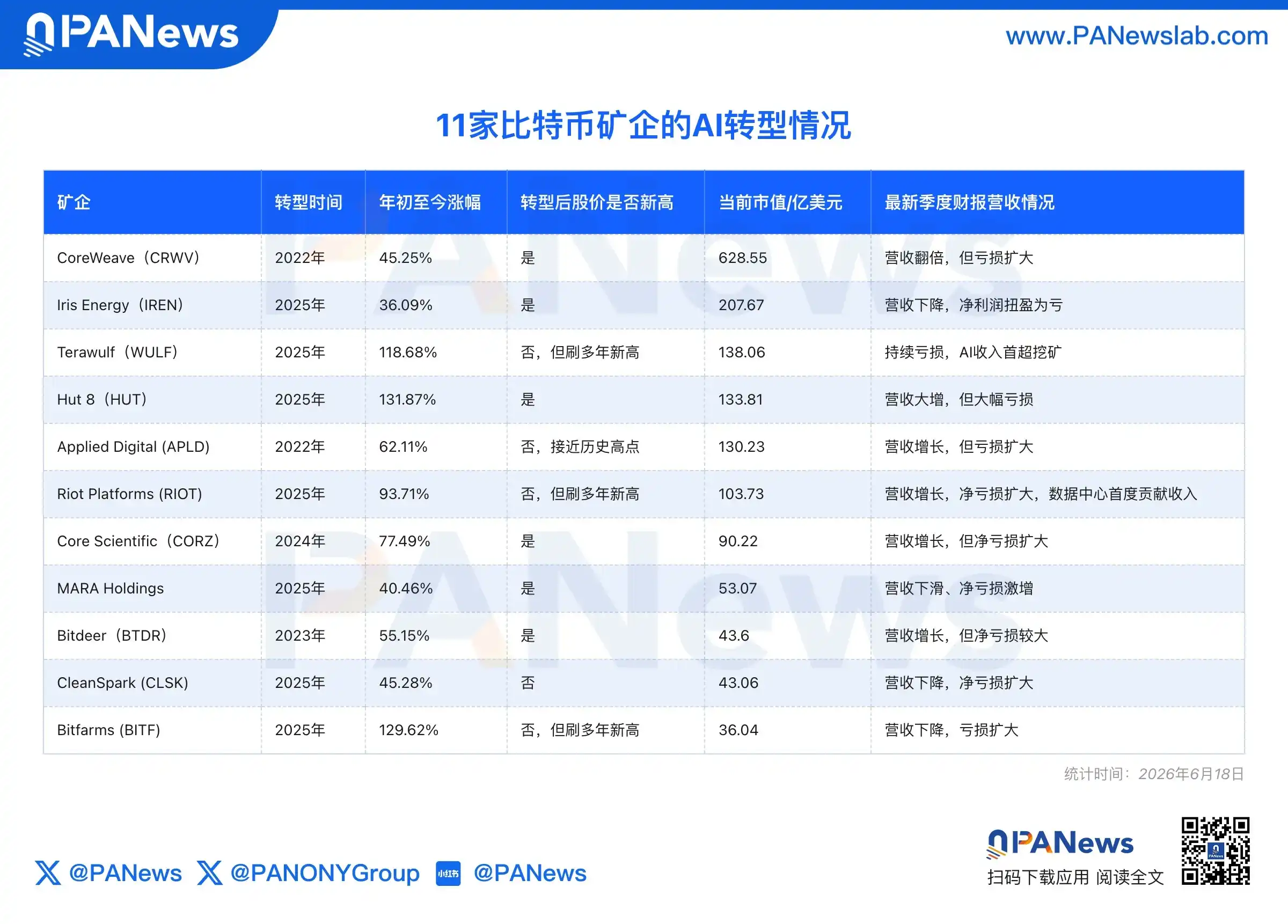
Looking at the timing of transition, CoreWeave, Applied Digital, and Bitdeer began laying out AI computing and data center businesses as early as 2022-2023, among the earlier movers in the industry; while mining firms like Iris Energy, Terawulf, Hut 8, Riot Platforms, and Bitfarms began to fully ramp up AI infrastructure construction in 2025, coinciding with the AI industry's rapid expansion cycle.

In terms of stock performance, the market has shown considerable recognition for the AI transition narrative of mining companies. The 11 mining companies have seen an average year-to-date gain of 75.97%, significantly outperforming Bitcoin over the same period, with most hitting new highs after their transition. Among them, Bitfarms (129.62%), Hut 8 (131.87%), Terawulf (118.68%), and Riot Platforms (93.71%) have been particularly standout performers, benefiting from this wave of AI infrastructure revaluation.

In terms of market capitalization, mining companies have shown clear divergence. As a representative of successful transition, CoreWeave's market cap has reached $62.855 billion, far exceeding other miners and setting a new valuation benchmark for the industry; Iris Energy, Terawulf, Hut 8, Applied Digital, and Riot Platforms form a tier with market caps between $10 billion and $20 billion; companies like MARA Holdings, Core Scientific, Bitdeer, CleanSpark, and Bitfarms remain in the sub-$5 billion range. This divergence stems not only from first-mover advantages but also reflects the market's differentiated pricing based on each mining company's AI strategy execution capabilities, client resources, and data center deployment progress.

However, from a fundamental perspective, most mining companies are still in the heavy investment phase of their AI transition. Although the latest quarterly earnings reports of many miners show revenue growth, overall profitability remains under pressure. On one hand, volatility in the value of crypto asset portfolios weighs on profit performance; on the other hand, the construction of AI data centers requires massive capital expenditures, with costs for power expansion, infrastructure development, and procurement of equipment like GPUs continuously increasing, driving up operating costs and leaving most mining companies yet to escape a loss-making state.

It is noteworthy that despite generally pressured earnings performance, the stock prices of related mining companies have still risen significantly, indicating that the current market focus is not on short-term profitability but rather on the growth potential of mining companies as operators of next-generation computing power infrastructure.

Mining Companies' Survival Battle Escalates, AI Transition Requires Overcoming Multiple Hurdles

The downturn in the Bitcoin market is making the survival environment for mining companies increasingly severe.
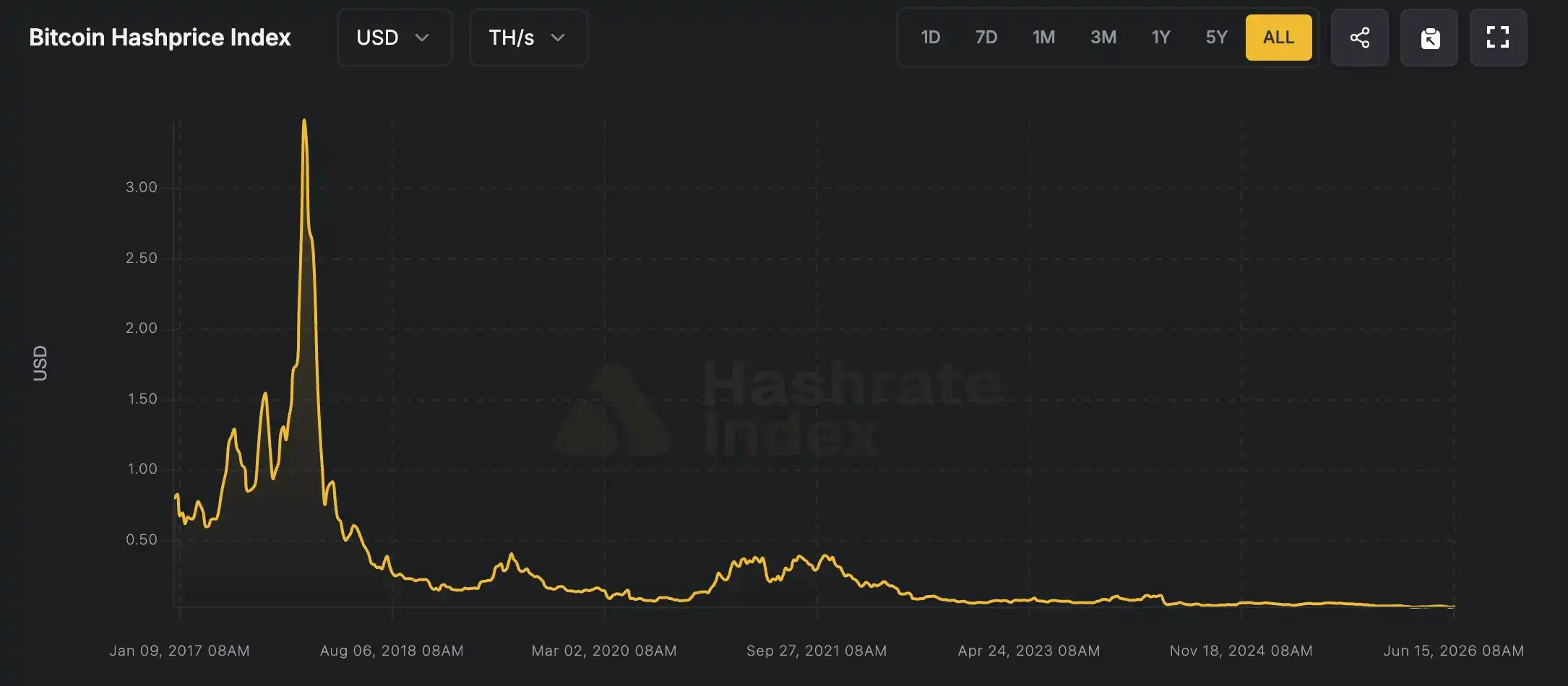
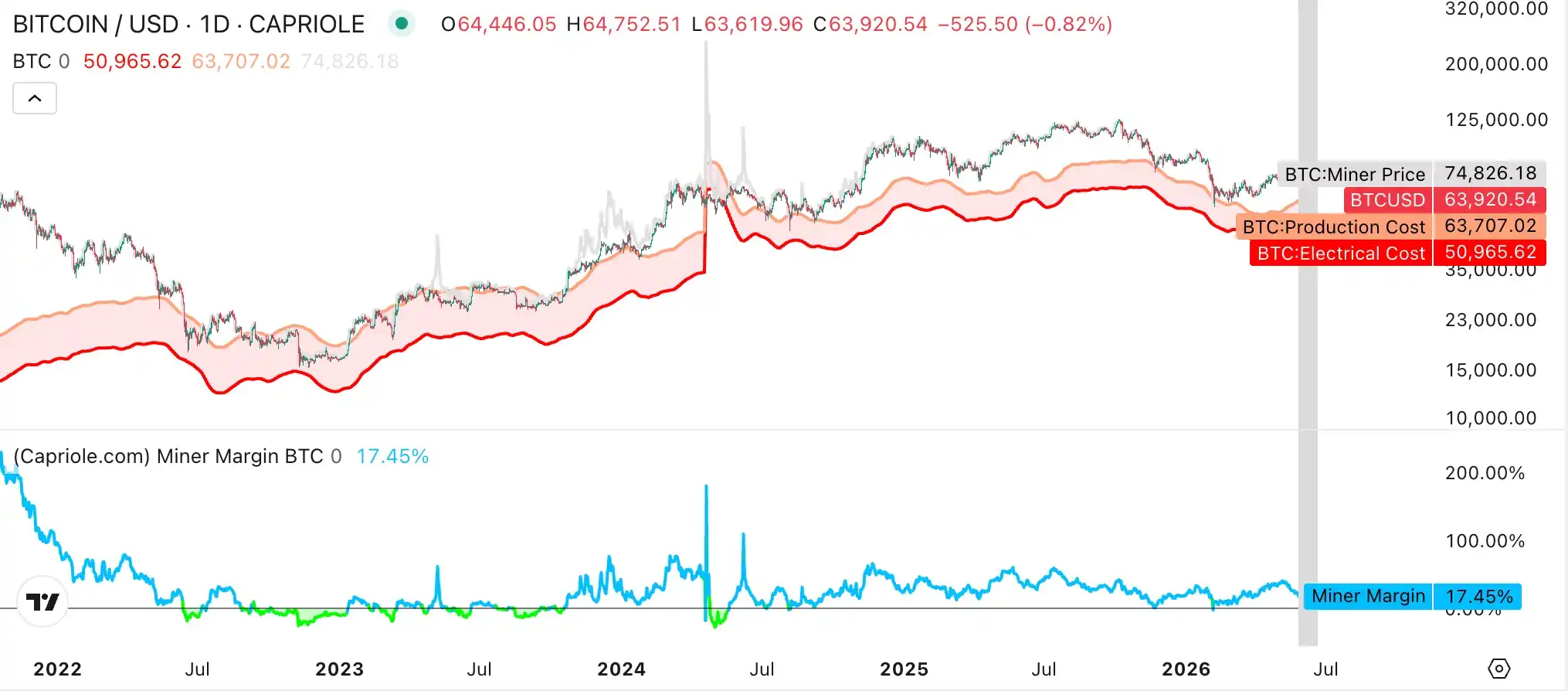
Data from Capriole Investments shows that as of June 18, the average production cost for Bitcoin is approximately $63,707, with power costs around $50,965, resulting in a miner profit margin of only 17.45%. Over the past 30 days, miner profit margins have contracted by 47.8%. Meanwhile, data from the Luxor Hashrate Index also shows that as of June 18, the daily revenue per 1 TH/s of hashrate has dropped to $0.032, a significant decline from $0.053 during the same period last year.
As mining revenues continue to shrink, many mining companies have had to sell Bitcoin to maintain cash flow, further increasing survival pressure on small and medium-sized miners, and mining resources are accelerating their concentration towards top players. Currently, the three major mining pools—Foundry USA, AntPool, and F2Pool—collectively account for 59% of the global network's hashrate share. In comparison, in 2022, the top three Bitcoin mining pools collectively accounted for only 44% of the hashrate share.

Although traditional mining operations are struggling, the explosive growth in demand for AI data centers is also driving a market re-evaluation of mining companies' value. VanEck points out in its latest research report that the most valuable assets of mining companies are not their mining rigs, but rather their power resources, substation access capabilities, land reserves, and data center infrastructure—precisely the scarce core resources most needed by the current AI industry. Because AI clients are willing to pay electricity and rental rates far higher than those of traditional mining operations, AI infrastructure is expected to become the primary growth engine for mining companies over the next decade.

According to a report from research firm Bernstein, hyperscale cloud providers, AI cloud service providers, and chip companies have announced over $90 billion in AI infrastructure partnerships, involving approximately 3.7 GW of power capacity. Currently, the pursuit of power resources has become the core of AI infrastructure competition, with Bitcoin mining companies collectively controlling over 27 GW of planned power capacity. In some parts of the United States, the cycle for securing new 1 GW power connections can be as long as 50 months, making existing mining sites important landing spots for AI data center expansion.

However, the transition to AI is far from an easy path. VanEck states that the market is still in the early stages of the AI transition, with enterprise valuations primarily measured based on Gross Energized Power. Mining companies that have signed AI leases generally receive higher valuation premiums, while projects still in the planning stage struggle to gain market recognition. Future industry valuation logic will gradually shift from "power capacity" to "project delivery capability," eventually returning to core metrics such as cash flow, return on capital, and tenant quality. Currently, the industry has only delivered about 25% of its signed capacity. The ability to complete AI data center construction on time and within budget will become a key factor determining enterprise valuation.

VanEck also emphasizes that AI tenant quality will directly impact the valuation levels of mining companies. Clients like Microsoft, Amazon, and Google—hyperscale cloud providers—can bring more stable cash flows and lower financing costs, while smaller GPU cloud service providers correspond to higher operational risks and capital costs.

Meanwhile, the enormous funding required for the transition is testing the financial strength of mining companies. VanEck estimates that mining companies transitioning to AI infrastructure still face massive capital expenditure needs, with a short-term funding gap of approximately $50 billion and long-term capital requirements potentially reaching $221 billion.

Under immense financial pressure, many mining companies have begun raising funds through various methods. For instance, miners like Iris Energy, TeraWulf, Bitfarms, and CleanSpark have raised capital through issuing convertible bonds, attracting investors with low coupon rates and future conversion potential; while companies like Core Scientific, Terawulf, MARA, Bitdeer, and Riot Platforms have chosen to sell off or even liquidate part of their Bitcoin reserves to continually fuel their AI transitions.

Additionally, many mining companies are beginning to secure future revenue by signing long-term AI or high-performance computing (HPC) contracts, thereby obtaining project financing support and reducing overall operational risks. For example, CoreWeave reached a $6 billion AI cloud services cooperation agreement with Jane Street; IREN secured a $9.7 billion AI cloud computing contract with Microsoft; Hut 8 signed data center leasing agreements totaling $9.8 billion; and Bitdeer is collaborating with Norway's DCI to build the country's largest AI data center project.

For mining companies, AI currently offers a development path with far greater imagination space than traditional mining operations. However, this transition is not a simple switch from mining to selling computing power; it is essentially a long-term competition centered on capital, resources, and execution capabilities.


Trending Cryptos

Related Questions

QWhat are the main challenges cryptocurrency mining companies face when transitioning to the AI infrastructure sector?

AThe main challenges include significant capital expenditures, continuous financial investment, prolonged return periods, intense competition for capital, resources, and execution capabilities, and the need to transition from a valuation based on 'power capacity' to 'project delivery capability' and ultimately to core financial metrics such as cash flow and capital returns.

QWhy are cryptocurrency mining companies considered to have natural advantages in transitioning to AI infrastructure?

AMining companies possess key assets like extensive power resources, land reserves, substation access capabilities, and mature cooling systems built for large-scale mining operations. This allows them to upgrade existing facilities to enter the AI infrastructure market more quickly and at a lower cost compared to starting from scratch.

QHow has the stock market performance of mining companies transitioning to AI compared to Bitcoin's performance?

AThe stock prices of mining companies transitioning to AI have significantly outperformed Bitcoin. The average year-to-date increase for 11 such companies was 75.97%, far exceeding Bitcoin's performance during the same period. Many saw their stock prices reach new highs following their AI transition announcements.

QAccording to the article, what is the new basis for valuing mining companies that are pivoting to AI, and how might this evolve?

ACurrently, valuation is primarily based on 'Gross Energized Power.' However, it is expected to shift towards 'project delivery capability' and eventually return to core financial indicators like cash flow, return on capital, and the quality of AI tenants or clients secured by the company.

QWhat methods are mining companies using to finance their expensive transition into AI infrastructure?

AMining companies are raising funds through various methods, including issuing convertible bonds (e.g., Iris Energy, TeraWulf), selling or liquidating part of their Bitcoin reserves (e.g., Core Scientific, Riot Platforms), and securing large, long-term contracts with AI or HPC clients (e.g., CoreWeave, Hut 8) to lock in future revenue and facilitate project financing.

Related Reads

Two Legends Lost in Three Days: Is Google's AI Talent Dam Cracking?

In three days, Google lost two AI legends. On June 18, Noam Shazeer, co-author of the seminal "Attention is All You Need" paper and Gemini co-lead, left for OpenAI. Just 48 hours later, John Jumper, 2024 Nobel laureate and AlphaFold lead, departed DeepMind for Anthropic. This follows Andrej Karpathy joining Anthropic in May. These moves highlight a structural trend: top AI talent is concentrating at mission-driven, pre-IPO firms like OpenAI and Anthropic, while Google becomes a primary source. The exodus stems from a core mission mismatch. Google's ad-centric model often subordinates AI research to product and revenue goals, creating friction for pioneers like Shazeer, who returned in 2024 only to leave again. In contrast, OpenAI and Anthropic offer singular focus on pushing AI boundaries, whether towards AGI or safety-aligned models, which deeply appeals to top researchers like Jumper. Financial incentives amplify the pull. With both OpenAI and Anthropic nearing IPO, employees stand to gain immensely from equity, an upside Google's mature stock cannot match. Furthermore, the 2023 merger of Google Brain and DeepMind, intended to consolidate strength, has instead created cultural tension and slowed the path from research to product, as evidenced by Gemini's pace. This talent redistribution is reshaping the AI landscape. While Google retains vast data and compute resources, its true crisis is the quiet, continuous loss of the people who define the field's future. The real moat in AI is not infrastructure, but the concentration of brilliant minds—a battle Google is currently losing.

marsbit1h ago

Two Legends Lost in Three Days: Is Google's AI Talent Dam Cracking?

marsbit1h ago

Behind the AI Report Card, Lies a Chinese 'Exam Setter'

Beyond the familiar performance charts like MMLU-Pro and MMMU, which major AI models strive to ace, stands a key "examiner": Chinese-Canadian researcher Wenhu Chen. An assistant professor at the University of Waterloo and founder of TIGERLab, Chen addresses the crucial need for more rigorous AI evaluation. As models like GPT-4 began scoring near-perfect results on older benchmarks like MMLU, it became difficult to distinguish their true capabilities. In response, Chen introduced MMLU-Pro in 2024, featuring harder, more reasoning-focused questions with more answer choices, successfully reintroducing meaningful performance gaps. His work extends to multi-modal evaluation with MMMU and its enhanced version, MMMU-Pro. These benchmarks test a model's ability to understand and reason with complex information from images, charts, and text across diverse academic subjects, exposing the significant challenges even top models face in genuine comprehension. Chen's background in complex QA, table reasoning, and his experience at Google DeepMind on projects like Gemini inform his approach. He understands that effective benchmarks must anticipate how models might "cheat" by memorizing data or avoiding visual analysis. His lab also actively researches video understanding and generation models (e.g., UniVideo, Vamba), ensuring his evaluation work is grounded in practical model-building challenges. Now at Meta's Super Intelligence Lab, Chen continues his focus on multi-modal data and evaluation, representing the deep yet often unseen contributions of Chinese talent in shaping the fundamental tools of the AI industry.

marsbit1h ago

Behind the AI Report Card, Lies a Chinese 'Exam Setter'

marsbit1h ago

Alliance Co-founder's Letter to Entrepreneurs: Written at the Moment Cursor Sold for $600 Billion

Alliance Co-founder's Letter to Entrepreneurs: On Cursor's $60 Billion Sale Many aspiring founders see massive exits like Cursor's $60B sale and wonder why they can't achieve the same, often concluding opportunities are exhausted. But great companies aren't built in obvious, crowded spaces. Cursor, like Stripe, Figma, and Shopify before it, started with a non-consensus belief about the future. Before ChatGPT, they believed AI would transform knowledge work. They focused on a genuinely exciting domain, became their own customer, and obsessed over power users. Their journey involved years of "glass-chewing" effort before the market was ready. The pattern is consistent: identify a long-term technological shift, find a missed entry point, and execute for years before the trend becomes obvious. First-generation products (PayPal, Adobe, Amazon) prove a market exists. Second-generation winners (Stripe, Figma, Shopify) rebuild that market around new insights, technology, or changing customer behaviors. Founders must identify their phase in the cycle. Early entrants like Coinbase or Cursor focus on making new technology usable for power users. Later entrants find the "yin" to the established "yang"—the blind spots incumbents miss as they grow distant from individual users. The key is deep market immersion. Use every product in your space. Talk to users. Build an audience. Stop looking for ideas and start *seeing* them everywhere. Then, choose one. The idea must offer a 10x improvement or solve a "hair-on-fire" pain point—something severe enough that users are already crafting workarounds. When building, avoid feature bloat. Ask: why would someone switch? Great startups rarely force new behaviors; they improve familiar workflows with drastically lower friction (e.g., Cursor forked VS Code instead of creating a new editor). Distribution is the underestimated moat. Before product-market fit, achieve distribution-market fit. How do customers discover new tools? Founders like those at Airbnb, Stripe, and Cursor did unscalable, manual work to recruit early users. The final, unteachable ingredient is resilience. Cursor built for years pre-market, faced rejection, and persisted. So did Airbnb, Nvidia, and Rain (which launched post-FTX collapse). The lesson isn't that these founders were smarter, but that they stayed in the game long enough for their insights to compound. Framework: Spot technological cycles. Cultivate unique insight. Obsess over your market. Talk to customers. Find a hair-on-fire problem. Build the simplest wedge. Win your distribution channel. Above all, don't quit when it gets hard. Most people won't do these things consistently. The few who do build the next generation of great companies. Go build.

marsbit1h ago

Alliance Co-founder's Letter to Entrepreneurs: Written at the Moment Cursor Sold for $600 Billion

marsbit1h ago

Weekly Editor's Picks (0613-0619)

Weekly Editor's Picks (0613-0619): Market Insights & Analysis This weekly digest curates in-depth analysis often lost in the information flow, focusing on key insights across macro trends, investment, and technology. **Macro & Geopolitics:** With the Strait of Hormuz reopening and military conflict shifting to negotiation, markets are pivoting from "war shock" to "supply restoration." Trades include shorting crude risk premiums, longing airlines/tourism, Asian energy importers, and bond duration, while shorting inflation expectations. LNG, fertilizer, and chemical chains are also being repriced. **Investment & VC:** Ray Dalio advises against betting on concentrated AI giants dominating indices, advocating for diversified portfolios of high-quality, low-correlation assets instead. Analysis covers the 4-year crypto cycle, predicting the core surviving product by 2029 will be asset trading markets. Current BTC metrics suggest a potential bottoming zone, presenting a patient accumulation window. SpaceX's high-profile IPO at a $2.1T valuation faces scrutiny over fundamentals, with key watchpoints being its likely inclusion in the Nasdaq index and Q2 earnings. Concerns are raised about potential "gamma squeeze" and systemic risks if its narrative-driven valuation gets amplified by passive index funds. Robinhood (HOOD) is noted for breaking its high correlation with crypto, bolstered by its stock trading and new underwriting business. **Web3 & AI:** A warning highlights ~$1.8T in off-balance-sheet AI infrastructure commitments (purchase commitments, leases) as a potential systemic risk if AI monetization lags. AI models are being used for World Cup predictions, adding a new layer for betting markets. A cost breakdown of a $20 AI subscription reveals the supply chain from model companies to cloud, GPUs, and power. **Prediction Markets:** The emergence of prediction market "concept stocks" is noted, with Robinhood developing its own platform, Rothera, signaling a shift from market competition to a "channel war" for user access. **CeFi & DeFi:** The SpaceX IPO tested perpetual contract mechanisms for pre-IPO assets, highlighting challenges in handling corporate actions like stock splits on-chain. The de-pegging of STRC (Strategy's preferred share) to ~$89 reflects market concerns over MicroStrategy's capital structure and BTC-backed leverage model. BlackRock's covered-call Bitcoin ETF (BITA) offers yield but caps upside, appealing to yield-seeking institutions. **Ethereum:** An opinion piece argues Ethereum's core strength is its vast developer community and composability, solidifying its role as the default operating system for the financial internet. **Weekly Hot Topics:** Include the US-Iran deal reopening the Strait of Hormuz, Fed's hawkish hold, Anthropic restricting model access, SpaceX acquiring Cursor, and a humorous stock surge for "Liuliumei" due to its "LLM" ticker.

marsbit1h ago

Weekly Editor's Picks (0613-0619)

marsbit1h ago

Alliance's Co-Founder's Letter to Entrepreneurs: Written on the Occasion of Cursor's $60 Billion Sale

In this letter to entrepreneurs, Alliance reflects on the success of Cursor's $60 billion sale to Elon Musk, using it as a case study to counter the misconception that opportunities in crowded fields like AI or crypto are exhausted. The piece argues that great companies like Cursor, Stripe, Figma, and Shopify are not built by geniuses with perfect ideas, but by founders who start with a non-consensus belief about the future and build for years before that future becomes obvious to everyone. They identify long-term shifts, find overlooked entry points, and execute relentlessly. The framework for success involves: 1. **Identifying your place in the technology cycle**: Early-stage opportunities focus on making new tech usable for power users (e.g., Coinbase, Cursor). Later-stage opportunities involve finding the "yin" to an existing "yang"—the blind spots of first-generation players (e.g., Stripe vs. PayPal, Figma vs. Adobe). 2. **Cultivating unique insights**: Immerse yourself deeply in the market. Use every product, talk to users, and build an audience. Insights will emerge naturally from deep engagement. 3. **Finding a "hair-on-fire" problem**: Look for a 10x improvement or a severe, urgent pain point. The strongest signal is people already building clumsy workarounds. 4. **Building a focused MVP**: Don't just add features because you can. Ask why users would abandon their current tool for yours. The best startups rarely force new behaviors; they improve familiar workflows with drastically lower friction. 5. **Winning a distribution channel**: Distribution is often the moat. Before product-market fit, achieve channel-market fit. Find where your customers are and build an engine to reach them, even through unscalable, manual efforts initially. 6. **Persistence**: The final, unteachable ingredient is resilience. Success stories like Cursor, Airbnb, and Nvidia involved years of grinding, rejection, and perseverance when the path forward seemed unclear. The conclusion is that there is no secret. Most people fail to consistently execute these steps over the long term. The few who do build the companies that define the next era. The world is yours to create.

链捕手1h ago

Alliance's Co-Founder's Letter to Entrepreneurs: Written on the Occasion of Cursor's $60 Billion Sale

链捕手1h ago

Trading

Spot
Futures

Hot Articles

Discussions

Welcome to the HTX Community. Here, you can stay informed about the latest platform developments and gain access to professional market insights. Users' opinions on the price of AI (AI) are presented below.

活动图片