Two Wall Street heavyweights, Mark Cuban and Michael Burry, have just sounded warnings about Nvidia's vast artificial intelligence (AI) ecosystem network.
This comes after a user on social media platform X expressed concern that Nvidia, by funding its customers' purchases of its GPUs for data center construction, is acting as a "backstop," making itself vulnerable to a potential "bust" in the AI boom. Subsequently, American billionaire investor Mark Cuban voiced similar concerns.
He posted on X, writing: "This is very much like the dot com crash. But instead of a lot of IPOs, Nvidia is the 'IPO'. They are funding everyone."
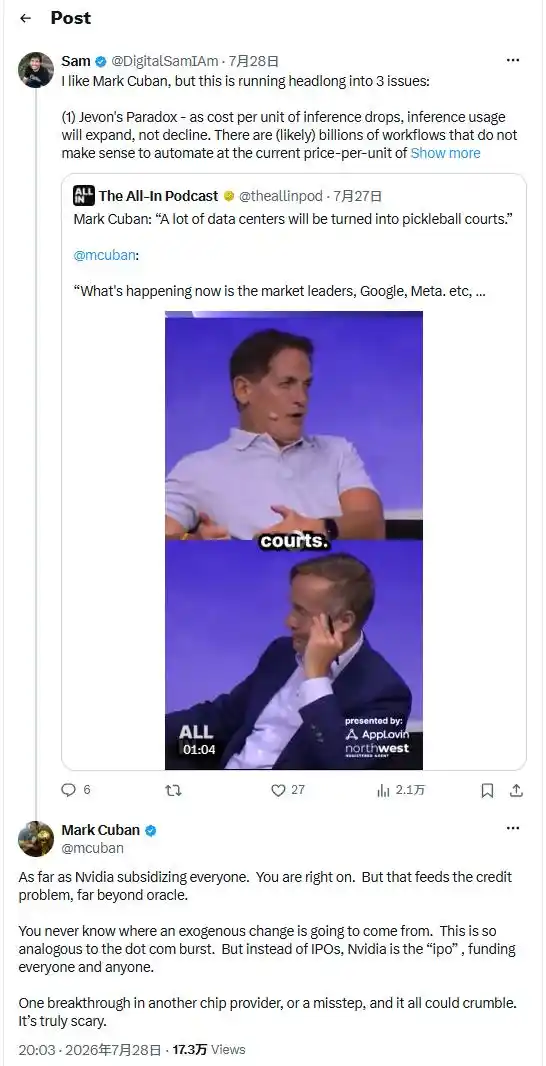
Cuban was referring to a common phenomenon during the dot-com bubble where startups raised capital and gained high valuations through public offerings. He further stated that during this tech boom, Nvidia has essentially replaced the stock market in playing this role.
"One breakthrough by other chip vendors, or one mistake, and the whole thing could come crashing down," he wrote on X. "It's really scary."
His comments came as Nvidia has struck deals worth hundreds of billions of dollars with numerous players in the AI ecosystem, including OpenAI, Microsoft, CoreWeave, and SK Hynix. Cuban worries that this chipmaker is so intertwined with its customers that if problems arise, the damage could spread quickly, causing painful and widespread consequences.
Nvidia CEO Jensen Huang himself acknowledged the company's pivotal role at a corporate event last November, noting the abundance of memes online about the company propping up the AI boom, the stock market, and the global economy.
"We're basically holding up the planet — and it's not even hyperbole," Huang said. Nvidia's stock fell more than 3% on Wednesday and is roughly flat year-to-date.
Coincidentally, renowned short-seller investor Michael Burry, famously known as the "Big Short," issued a similar warning.
"Nvidia 5yr CDS pricing parabolic for a reason," he wrote, attaching a chart showing the price of insuring against a default on Nvidia's debt has roughly doubled over the past two months.
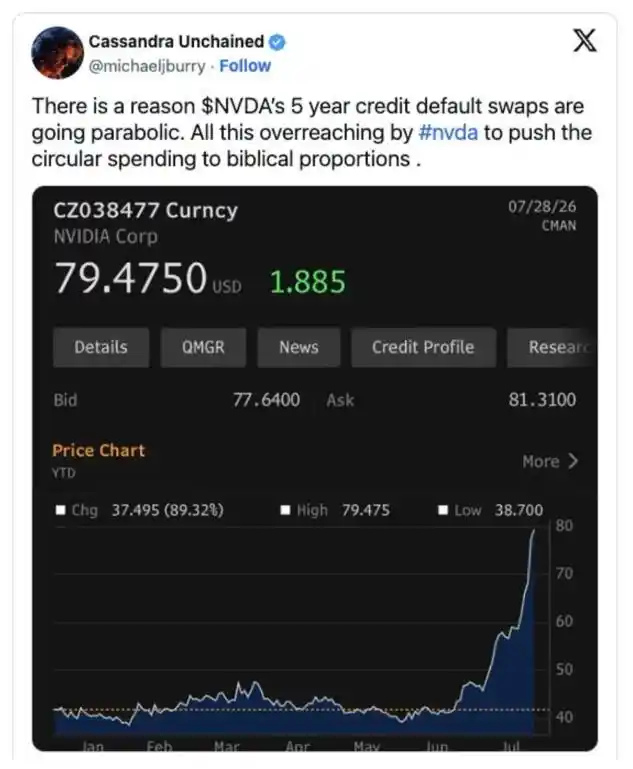
"Nvidia stretched this far, pushing the revolving spend to epic proportions," he added, implying the market is pricing in a greater risk that Nvidia cannot meet its financial commitments as it has overextended itself through too many deals.
In recent weeks, both Cuban and Burry have criticized certain aspects of the AI boom.
On a podcast, Cuban warned that companies are overbuilding AI infrastructure, which will become more efficient over time, leading to overcapacity. He joked that many such buildings would ultimately be converted into pickleball courts.
Similarly, Burry has argued that tech giants are over-investing in microchips and data centers that will soon become obsolete, stretching depreciation to inflate their earnings, and signing "mutually beneficial" deals to sustain the AI hype.
Burry also wrote in a July 24th post that he increased his short position in Nvidia and holds a "decent-sized" number of put options. He believes a significant portion of Nvidia's demand comes not from end customers but is facilitated through financing, not reflected on its balance sheet. "Much of the future revenue is obtained through revolving financing," he wrote.
This article is from the WeChat public account "Kechuangban Daily," author: Huang Junzhi