A Maximum of 20 Submissions Per Person? DeepMind Researcher Satirically 'Petitions' Against ICLR's New Rule

marsbitPublished on 2026-08-03Last updated on 2026-08-03

Abstract

The International Conference on Learning Representations (ICLR) 2027 has introduced a new submission rule limiting authors to a maximum of 20 papers per conference. This policy, announced due to a 68% surge in submissions for ICLR 2026 that strained the review system, aims to ensure fair and informative peer review. Google DeepMind researcher Dan Roy responded with a sarcastic petition on X, calling the 20-paper cap "absurd" and claiming it would slow AI progress. His post mockingly argued that AI agents can now produce incremental research and that large language models (LLMs) already handle all reviewing, so output should be maximized. This satire critiques the broader trend of AI's role in academia, referencing a 2025 study that found about 21% of ICLR 2026 reviews were likely fully AI-generated. Roy's underlying point questions whether simply capping submissions addresses the systemic issue of AI potentially flooding conferences with agent-written papers and AI-assisted reviews. The debate highlights tensions between managing submission volume and maintaining research quality as AI tools become pervasive.

For one author at a top-tier AI conference, what is an appropriate number of papers to be involved in?

ICLR's answer is 20.

Recently, ICLR 2027 announced new submission rules, explicitly stating that any author can appear on the author list of no more than 20 submissions. Papers exceeding this quota will receive a reminder during the abstract submission phase. If adjustments are not made by the full paper deadline, the conference will randomly reject some papers until each author is back within the limit...
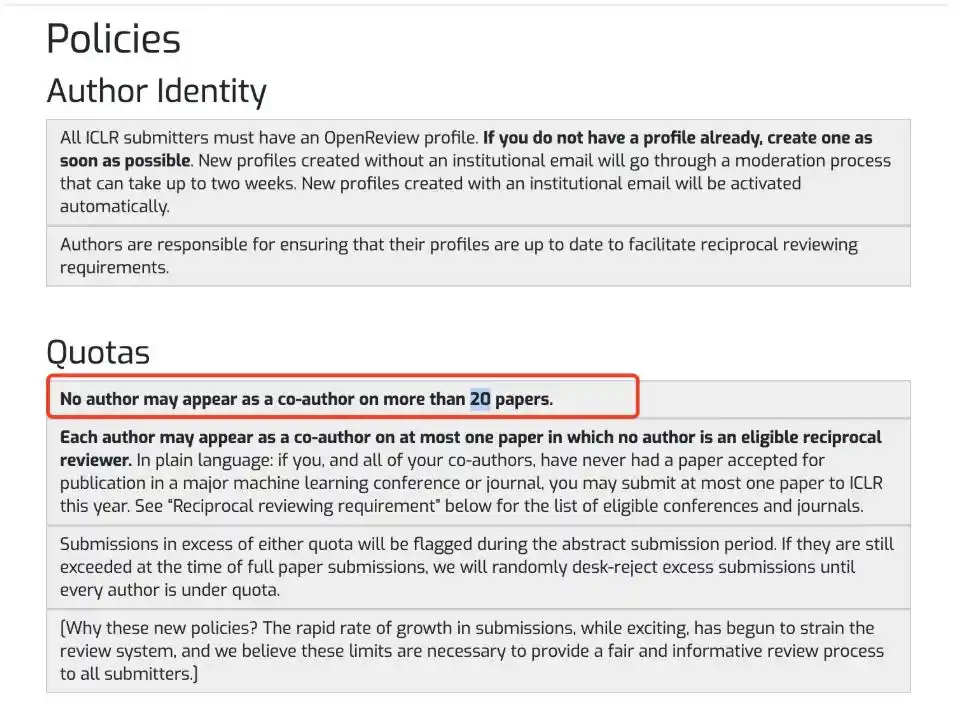
ICLR's explanation is simple: The number of submissions is growing too fast, placing enormous strain on the review system. Quotas are necessary to maintain fair and informative reviewing.

Behind this lies the "crisis" of submissions and reviewing experienced by ICLR 2026.

Data shows that ICLR 2026 received 19,525 valid submissions, with 13,763 papers ultimately receiving formal acceptance or rejection decisions. This involved 18,054 reviewers providing 76,139 review comments.

Compared to approximately 11,603 submissions for ICLR 2025, the 2026 submission volume increased by about 68%. This means the conference had to handle nearly 8,000 additional papers and tens of thousands more review tasks within a year...

The announcement sparked heated discussion online. Google DeepMind Visiting Researcher and University of Toronto Professor Dan Roy also noted this change and initiated a "petition" against the rule: Petition to abolish the 20-paper submission limit per author at ICLR conferences.

He posted on X:

"Limiting submissions to 20 per author at ICLR is absurd! It will also slow down AI progress.

Why 20? It's a completely arbitrary number. Today, AI Agents can conduct interesting, albeit incremental, AI research with minimal guidance. We should encourage everyone to produce and submit as many papers as possible, especially now that all reviewing is done by LLMs... Admit it!

Click the link to sign my petition!"
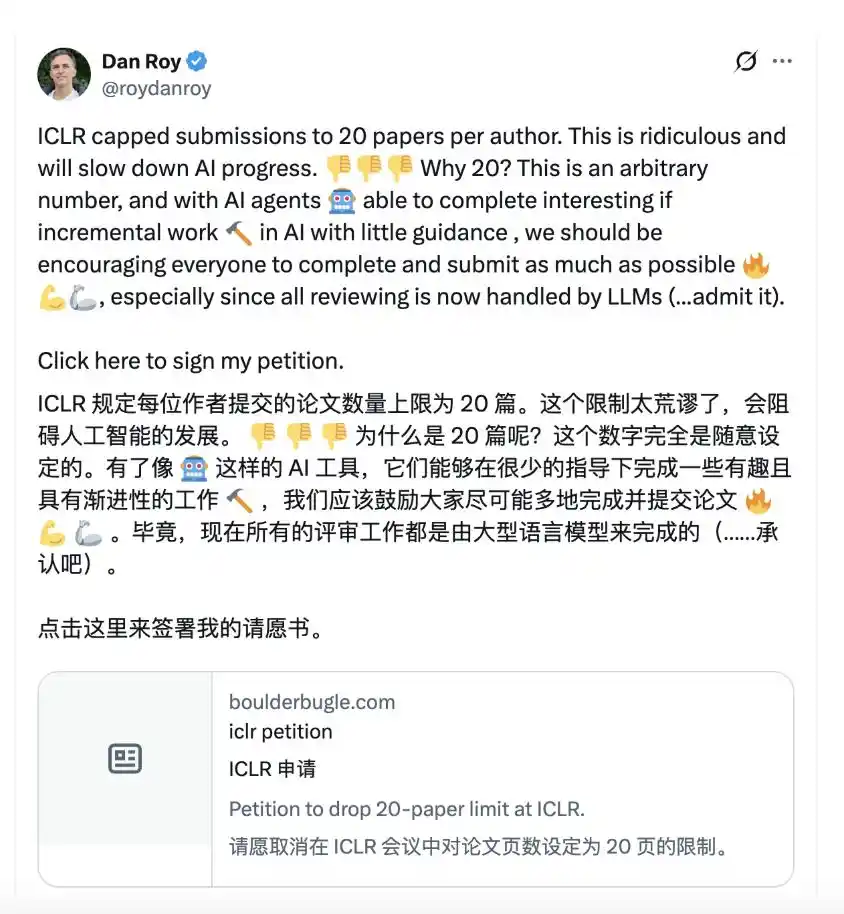
Clearly, Dan Roy is dissatisfied with the 20-paper limit, but is also subtly "mocking" the current impact of AI on the academic environment. The entire post carries a satirical tone.

For instance, ICLR reminds researchers that current AI Agents cannot yet independently produce a paper meeting top conference standards. With code assistants and research infrastructure improving efficiency, researchers should tackle more ambitious problems and submit more complete, mature results, reducing the flood of incremental papers into the conference.

Dan Roy has completely inverted this narrative.

Where ICLR wants to see more complete "slow science," Dan Roy pretends to advocate for "letting Agents produce as many incremental results as possible"; where ICLR tries to limit the paper "flood," he pretends to worry that "it will slow down AI development."

Especially the line "now that all reviewing is done by large language models... Admit it," also satirizes the fact that large models are not only involved in paper writing but also in the peer review process.

On this point, Dan Roy isn't exaggerating.

In late 2025, during the peak review period for ICLR 2026, renowned AI researcher Graham Neubig from Carnegie Mellon University, after receiving several review comments, sensed anomalies and suspected AI "watering down." He then used the AI text detection tool EditLens, developed by Pangram Labs, to scan and analyze publicly available review comments from the conference.

The results showed that out of 75,800 review comments analyzed, approximately 21% were highly suspected to be "entirely AI-generated."

This revelation caused an uproar in the industry and heightened academic concerns about declining review quality and "AI abuse."

Perhaps, in this "petition," the real question Dan Roy wants to raise is this: As the scenario of "Agents generating papers in bulk, researchers submitting in bulk, and reviewers using large models to complete reviews in bulk" becomes increasingly common, a simple "one-size-fits-all" approach like limiting submission numbers might not be the best solution...

What do you think about ICLR's approach and Dan Roy's "petition"? Feel free to leave your comments and thoughts below!

References:

https://iclr.cc/Conferences/2027/AuthorGuidelines

https://x.com/roydanroy/status/2083202134414102594

This article is from the WeChat public account "机器之心" (ID: almosthuman2014), Author: 关注AI的

Trending Cryptos

Related Questions

QWhat is the new submission rule announced by ICLR for 2027, and what is the main reason behind it?

AFor ICLR 2027, the new rule limits any author to appearing on a maximum of 20 submitted papers. If this quota is exceeded, the conference will randomly reject papers until each author is within the limit. The primary reason given is the overwhelming growth in submissions, which has put immense pressure on the peer-review system. ICLR 2026 saw a 68% increase in submissions compared to 2025, and this rule aims to maintain fair and informative reviews.

QWho is Dan Roy, and what was the nature of his 'petition' against the ICLR rule?

ADan Roy is a visiting researcher at Google DeepMind and a professor at the University of Toronto. He posted a 'petition' on X calling for the removal of the 20-paper limit. However, his post was heavily satirical. He reversed ICLR's arguments, facetiously advocating for letting AI Agents produce as many incremental papers as possible and suggesting all reviewing is done by LLMs anyway, to criticize the growing trend of AI in both paper writing and peer review.

QWhat evidence does the article mention regarding the use of AI in the peer-review process for ICLR 2026?

AThe article cites an analysis by Carnegie Mellon University researcher Graham Neubig. Using the AI text detection tool EditLens, he scanned approximately 75,800 public review comments from ICLR 2026. The analysis found that about 21% of the reviews were highly suspected of being 'entirely AI-generated.' This discovery raised significant concerns about review quality and AI misuse in academia.

QAccording to the article, what is ICLR's stated goal in encouraging 'slow science' through its new policy?

AICLR's stated goal is to encourage researchers to focus on more ambitious, complete, and mature scientific work, often referred to as 'slow science.' With tools like coding assistants improving efficiency, the conference hopes researchers will challenge themselves with more significant problems rather than flooding the system with numerous incremental papers. The 20-paper limit is a mechanism to support this shift in focus.

QWhat core problem is Dan Roy's satirical petition, according to the article, actually trying to highlight about the current AI research landscape?

ADan Roy's satire highlights a worrying cycle in the current AI research landscape: the potential for AI Agents to generate a flood of incremental papers, researchers to submit them en masse, and then reviewers to use large language models to assess them. His 'petition' critiques this automated loop and questions whether a simple quota on submissions is an adequate solution to the deeper systemic issues of quality and authenticity in AI-driven academic publishing.

Related Reads

Rubin Ultra Makes Major Cuts, Even Nvidia Can't Handle Memory Price Hikes?

NVIDIA's Rubin Ultra, the top-tier variant of the newly announced Rubin AI accelerators, has reportedly seen significant specification downgrades, according to an industry report from SemiAnalysis. Initially designed with four compute dies (4-die), the Rubin Ultra is now said to be reduced to a 2-die design. Key changes highlighted in the report include: * **No increase in peak theoretical compute performance**, remaining at 35 PFLOPs like the standard Rubin. * **Severe reduction in memory capacity** to 192GB using 8-Hi HBM stacks, which is less than the standard Rubin's 288GB using 12-Hi stacks. * **Negligible memory bandwidth improvement** of only 1 TB/s. * **Slightly higher chip-level power consumption**. * The **primary upgrade is a massive increase in scale-up interconnect capacity**, supporting connections for up to 576 GPUs via NVLink, compared to 72 for the standard Rubin. The report suggests the redesign is primarily a cost-optimization move driven by the sharp rise in HBM (High-Bandwidth Memory) prices. By reducing the expensive HBM content and shifting investment towards enhanced system-scale networking, NVIDIA aims to maintain the platform's value for large-scale AI training clusters while managing soaring material costs. The news reportedly triggered a sell-off in South Korean memory stocks, with SK Hynix and Samsung shares falling around 8%, as markets grew concerned that NVIDIA—a major HBM buyer—might be reducing its reliance on high-capacity memory, potentially capping future pricing power for memory makers.

Odaily星球日报6m ago

Rubin Ultra Makes Major Cuts, Even Nvidia Can't Handle Memory Price Hikes?

Odaily星球日报6m ago

Can Generative Models Finally Be Trained End-to-End? The Core Is a For Loop

This article introduces a novel training paradigm for generative models called Explorative Modeling (XM), which enables true end-to-end training. Traditionally, powerful generative models like autoregressive and diffusion models are not trained end-to-end. They are trained to predict a single small step but require iterative multi-step sampling for inference. This "exposure bias" leads to error accumulation and limits performance. The core challenge XM addresses is "mode blurring." In generative tasks, a single input (e.g., "generate a dog") corresponds to many valid outputs (multiple modes). Standard training objectives like reconstruction loss force the model to average these modes, producing unrealistic, blurry outputs. To avoid this, existing models break generation into many small, almost deterministic steps, sacrificing end-to-end training. XM tackles this by restructuring the training loop itself. Its key insight is to amplify "generative expressivity." For each training input, instead of generating one sample, the model generates K candidate outputs. Only the candidate closest to the real data is used for computing the loss and updating the model via backpropagation. This simple "best-of-K" mechanism is implemented as a short for-loop. By exploring multiple possibilities, the model learns to distribute its guesses across different modes rather than collapsing to their uninformative average. The paper demonstrates that "exploration" acts as a new, powerful scaling axis. Gains from XM increase with model size, data scale, and compute. Experiments show improvements in FID scores for image generation and significant efficiency gains, sometimes outperforming larger models without exploration. When pushed to the limit, XM enables fully single-step, end-to-end generative models. In robotics tasks, an "Explorative Policy" matched the performance of a 100-step Diffusion Policy with a single forward pass, drastically improving inference speed. While the best-of-K concept is not entirely new, the authors' contribution lies in formally understanding it as a direct method to boost generative expressivity without fragmenting the generation process. This work suggests that as models scale, enhancing exploration during training may become crucial for overcoming fundamental performance bottlenecks.

marsbit1h ago

Can Generative Models Finally Be Trained End-to-End? The Core Is a For Loop

marsbit1h ago

Annual Salary of Millions Competing for Electricians, Meta Rushes to Open Its Own Technical School

The AI boom is facing an unexpected bottleneck: a severe shortage of skilled construction workers and electricians. As tech giants like Meta, OpenAI, and Alphabet race to build massive data centers—such as OpenAI's $16 billion "Stargate" project—they are hitting a critical labor wall. The U.S. needs an estimated 130,000 more electricians, 240,000 construction workers, and 150,000 supervisors by 2030 for AI infrastructure alone, but tens of thousands of electrician jobs go unfilled each year. While AI companies offer high premiums, with electricians earning up to $280,000 annually, worker scarcity still causes massive losses—delays on a single project can cost $14.2 million per month. The complexity of building AI data centers, which require immense power (equivalent to powering hundreds of thousands of homes), sophisticated electrical systems, and advanced liquid cooling solutions, demands highly skilled technicians who are in short supply. To combat this, companies are investing heavily in training. Meta has committed $115 million to a free training school offering tuition, housing, and stipends, targeting 5,000 new workers. OpenAI is partnering with unions to secure skilled labor. These efforts are paying off, with a significant rise in Gen Z interest in trade schools over college. However, the power demands are staggering. AI data centers are driving a rapid surge in electricity consumption, projected to account for up to 12% of U.S. power use by 2028 and raising costs for consumers. Furthermore, the construction boom is project-based, leading to a potential future glut of trained workers once building peaks, which could depress wages industry-wide. The race for AI supremacy now depends as much on skilled hands as on advanced chips.

marsbit2h ago

Annual Salary of Millions Competing for Electricians, Meta Rushes to Open Its Own Technical School

marsbit2h ago

Trading

Spot

Hot Articles

Discussions

Welcome to the HTX Community. Here, you can stay informed about the latest platform developments and gain access to professional market insights. Users' opinions on the price of AI (AI) are presented below.

活动图片