Author: Long Yue,Wall Street News
Two senior macro investors sat together and reached an almost highly consistent judgment: this AI-driven uptrend cycle is approaching its end, and the coming decline will not be a single-digit drop, but a 30% to 50% major bear market.
On June 22, a deep-dive interview was broadcast in the latest blog from U.S. asset management company DoubleLine Capital. In the dialogue, the "New Bond King" Jeffrey Gundlach and Swiss hedge fund manager and "stock market prophet" Felix Zulauf stated that the world is shifting from unipolar to multipolar, with geopolitical conflicts and sanctions bringing structural inflation. Against the backdrop of the old order collapsing, whether it's the tech frenzy in U.S. stocks or the bottomless U.S. fiscal black hole, both have reached an extremely dangerous tipping point.
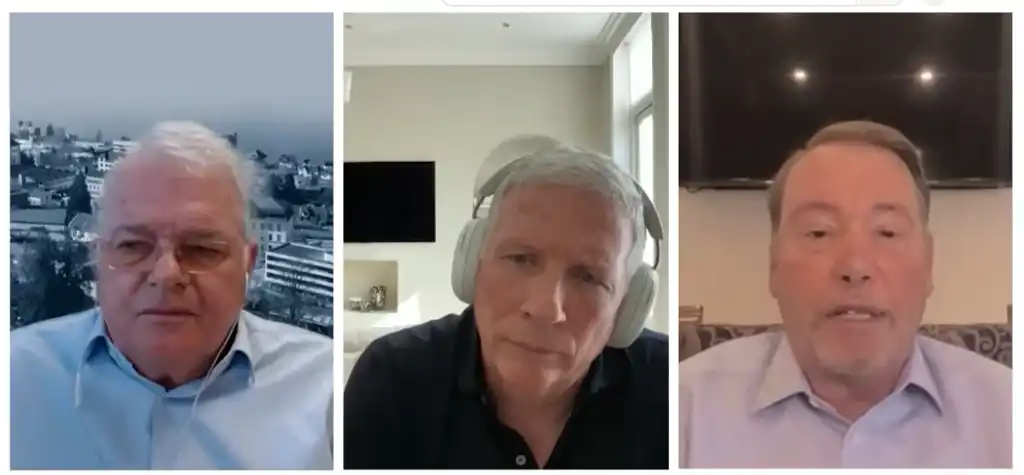
From left to right: Felix Zulauf, host Grant Williams, Jeffrey Gundlach
AI Frenzy Reaching Its End, U.S. Stocks Facing a 30% to 50% Plunge
"This is absolutely not a 20% pullback, but a bear market based on economic recession and valuation contraction, with declines between 30% and 50%." Zulauf started straightforwardly with this judgment, predicting U.S. stocks will peak as soon as the third quarter of this year, and no later than the first quarter of next year.
His logical chain is clear: the capital expenditure to revenue ratio of hyperscale cloud computing companies (hyperscalers) has surged from 10% to 30%, semiconductor memory chip prices have risen 200%-300%, and free cash flow is turning negative—Oracle is already negative, and the next will follow. "When these companies start raising capital from the market, when their free cash flow starts to shrink, the entire AI cycle begins to decelerate."
To accurately exit the top, one must closely watch the price action of those semiconductor stocks that "sell shovels to gold miners."
Gundlach fully agrees. Currently, the weight of the top ten AI-related stocks in the S&P 500 index has reached a staggering 41%. This extremely concentrated figure remarkably coincides with historical peaks of major market cycles.
"I advise people not to hold any momentum-driven or market-cap-weighted U.S. stocks." Gundlach gives a direct hedging strategy.
He also mentioned his "notorious misjudgment" on September 30, 1999—when he turned maximally bearish on the Nasdaq, only for the index to rise another roughly 80% in the fourth quarter. "But 18 months later, from that point, the Nasdaq fell from 100 to around 20. So, when fundamentals are deteriorating while stock prices are still rising, that's the most dangerous moment. We are there right now."
Recession is Coming, but U.S. Bond Yields Won't Come Down; U.S.-style YCC and 'U.S. Treasury Restructuring' are Unavoidable
This is one of Gundlach's core judgments and his biggest point of divergence from traditional economic logic.
The usual logic is: economic recession → Fed cuts rates → long-end rates fall → bond prices rise. But Gundlach believes this time is different. Even if the U.S. economy falls into recession in 2027, long-term U.S. Treasury yields will not meaningfully decline.
The reason is that fiscal problems have reached a structurally uncontrollable level: U.S. interest payments have soared from about $300 billion seven years ago to nearly $1.4 trillion per year now. Meanwhile, the fiscal deficit is expanding at a pace of $2 trillion annually, about 6% of GDP.
"Once recession comes, the deficit won't be 6% of GDP, but 10% or even higher. That will trigger a buyers' strike." He says, "We've seen this in developed countries—even Japan's long-term rates are rising, which many thought would never happen."
Gundlach believes the policy response will have two directions then:
Option A: Yield Curve Control (YCC). Treasury Secretary [sic, likely referring to the Fed or Treasury] might choose to suppress long-end rates, as the U.S. did post-World War II—inflation rises, but long-end rates are artificially held down, resulting in sustained negative real interest rates and a 40-year bond bear market thereafter.
Option B: U.S. Treasury Restructuring. Gundlach revealed he had already reduced the coupon rate on 10-year+ Treasuries in his managed fund from 4.75% to 1.5% two years ago to hedge against restructuring risk. After he publicly discussed this idea in an interview last year, media inquiries reached Kevin Hassett at the White House National Economic Council, who stated it "absolutely could not happen."
Gundlach's reaction: "In the investment world, 'Never' is synonymous with 'Imminent'."
Zulauf has a slight divergence on the long-end rate issue: he believes during a recession, the 10-year Treasury yield could still fall from a peak of around 5.25% to about 3.75%—but this window will only last about 6 months, not 12 months. He adds that short-term rates will be pressed very low by central banks.
Private Credit Crisis: 'It Feels Like 2006 Now,' 'Everybody's Lying'
Compared to public markets, the private credit market hidden beneath the surface raises even stronger concerns. It's filled with rating fraud, liquidity illusions, and accounting games to conceal losses.
Gundlach stated:
"It gives me an intense feeling, exactly the same feeling I had in 2005, 2006: Everybody's lying, lying about credit quality, lying about software exposure—they say it's 15%, it's actually 28%—creating a completely illusory liquidity that is now shattered."
Ratings are bought. "These private rating agencies have only 30 employees but are rating hundreds of loans, each with 200-250 pages of documents. I don't think they're really analyzing, I think they're selling price sheets. Want a CCC rating, that'll cost you $1; want a single B, that'll be $10. In the end, everyone gets BBB-."
Credit quality is severely misreported. A large private credit fund claimed in marketing materials that "investment-grade corporate bonds are the backbone of the portfolio," but in reality, in the private world, securities rated B+ and above constitute only 2% of all securities. "Less than 2% are single B+ and above, what backbone are you using?"
Software asset risk is underreported. A fund claimed software exposure was 15%, actually 28%.
The liquidity illusion is broken. Many investors who bought interval funds through financial intermediaries thought they could fully redeem quarterly, but the fund-level redemption cap is actually only 5%.
Valuation marks are chaotic. Gundlach cited that the same loan held by 8 different private firms was marked anywhere from 95 to 8—the same asset, someone marks it 95, someone marks it 8. Another case: a $100 million principal PIK bond was still marked at par value 100, even though the underlying private equity had already been written down 98% to $800,000.
Offshore reinsurance is the final black box. A closed loop is formed between private equity, private credit, and the insurance companies they control, with risks transferred to offshore reinsurers in Barbados, Cayman Islands, Bermuda, etc., with no regulation or transparency. "I'm not sure those risks are really hedged. Once recession hits, fixed annuities and life insurance need to be paid out, and those assets have no adequate reserves."
Zulauf added: "All problems will surface when the market turns and the tide goes out."
The AI Funding Chain and Private Credit Are Actually the Same Line
AI and private credit seem like two markets, one on the equity side, one on the credit side. But in this framework, they are connected through funding costs.
Rising AI capital expenditures will depress free cash flow. After free cash flow declines, companies either issue equity or borrow. When borrowing, if long-term rates don't fall, funding costs won't automatically ease as in past cycles.
Lower-rated companies are in more trouble. In past economic slowdowns, spreads widened, but risk-free rates fell, sometimes offsetting some pressure, allowing struggling companies to refinance and survive. Now, if risk-free rates don't fall but rise, the refinancing window narrows.
This directly transmits to bank loans, CCC-rated loans, and private credit. Gundlach mentioned cracks are already starting to appear in these markets. The core reason isn't a sudden deterioration in one sector, but the model reliant on low rates and refinancing is no longer smooth.
So, the AI trade isn't just about watching Nvidia, cloud providers, or data center orders. Ultimately, it also depends on whether the funding market can continue to provide money and whether the credit market can withstand higher rates.
Dollar Weakens, U.S. Stocks Underperform, 'The Second Inning' Has Just Begun
Gundlach mentioned a historical pattern: In the previous 13 U.S. stock market declines, the dollar rose in the first 12, by about 8%-10%. But during the 2025 tariff turmoil, the dollar instead fell 8%-10%.
"This confirms my judgment—the market's reaction function has changed in this interest rate hike cycle."
He believes the long-term outperformance of U.S. stocks relative to global markets has ended, and emerging markets are starting to outperform the S&P 500. "We are in the second inning, not the eighth, not the ninth."
Zulauf added a risk point: Asian sovereign funds have bought a large amount of U.S. dollar assets over the past 12 months, but no longer U.S. Treasuries; instead, they are buying AI stocks. "Once the market turns, they will sell stocks and sell dollars simultaneously. This is completely different from holding U.S. Treasuries and will accelerate the dollar's decline."