After 10 Years, Altman Finally Has the Person He Wanted

marsbitPublished on 2026-06-18Last updated on 2026-06-18

Abstract

After a decade of waiting, OpenAI CEO Sam Altman has finally secured his desired collaborator: Noam Shazeer, a legendary AI researcher and co-author of the seminal "Attention Is All You Need" paper that introduced the Transformer architecture. Shazeer has announced his departure from Google to join OpenAI as Head of Architectural Research. Shazeer, a crucial early Google employee who returned to Google DeepMind in a high-profile $2.7 billion deal two years ago, confirmed his move on social media platform X. Altman expressed his long-standing desire to work with Shazeer, stating the 10-year wait would be worth it. OpenAI's research lead, Mark Chen, welcomed Shazeer, highlighting his foundational work on Transformer, Mixture-of-Experts (MoE) models, and efficient decoding, which have profoundly shaped modern AI. His departure is seen as a significant blow to Google's Gemini project, where he served as a technical co-lead. Industry observers note this move represents a major win for OpenAI in the ongoing AI talent war, with some quipping that OpenAI acquired his expertise "for free" after Google's massive investment.

Noam Shazeer, the legendary AI figure whom Google brought back two years ago with a $2.7 billion deal, announced his departure from Google to join OpenAI.

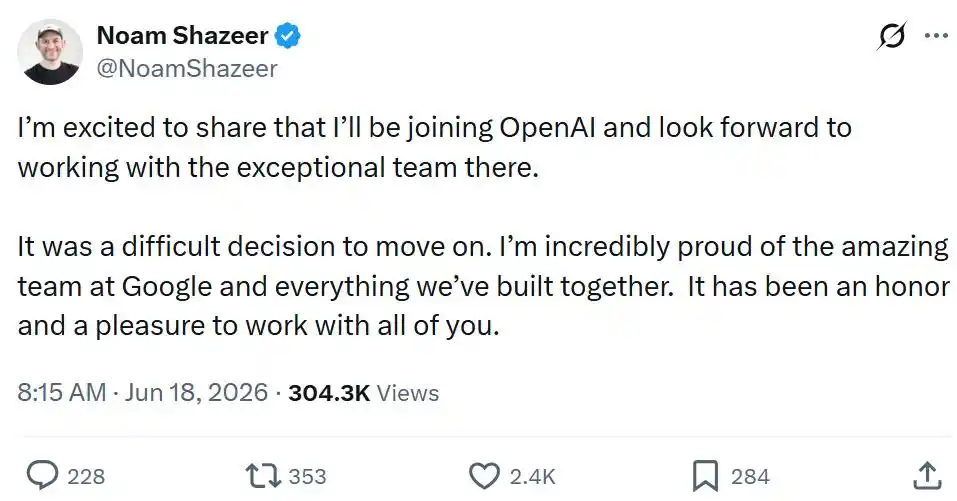
Just now, Noam Shazeer confirmed this news on X. He stated that he is joining OpenAI and looks forward to working with the excellent team there. He also expressed that leaving Google was not an easy decision; he is immensely proud of the Google team and everything they have built together, and it has been an honor and a pleasure to work alongside these colleagues.
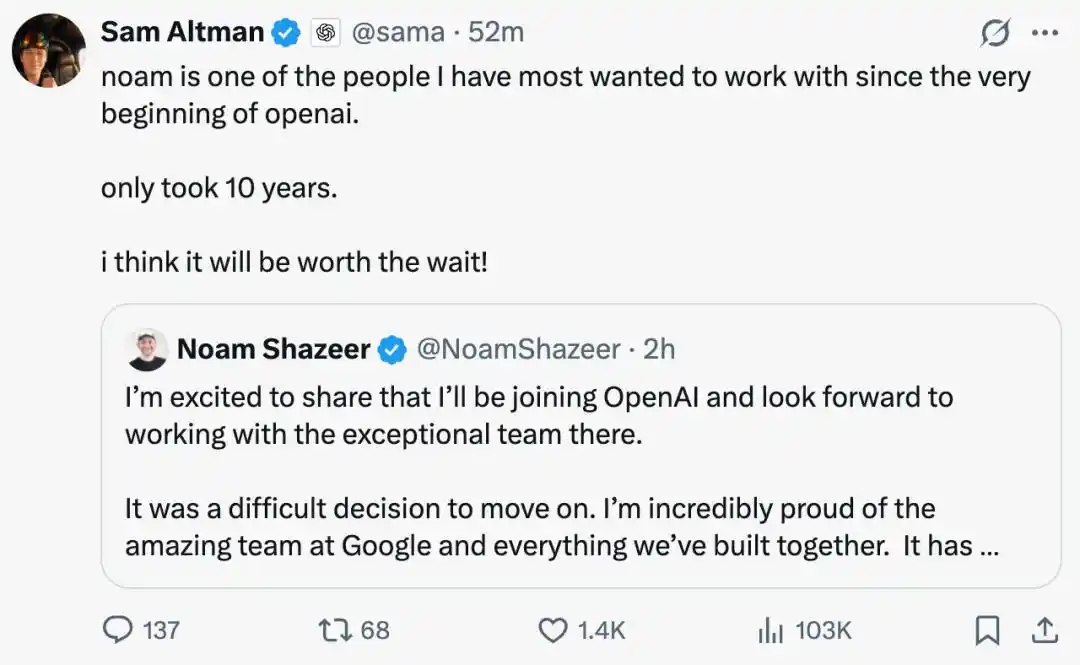
Subsequently, Sam Altman said, "From the very beginning of OpenAI's founding, Noam has been one of the people I most wanted to work with. It just took 10 years to finally get the chance. I believe the wait will be worth it!"
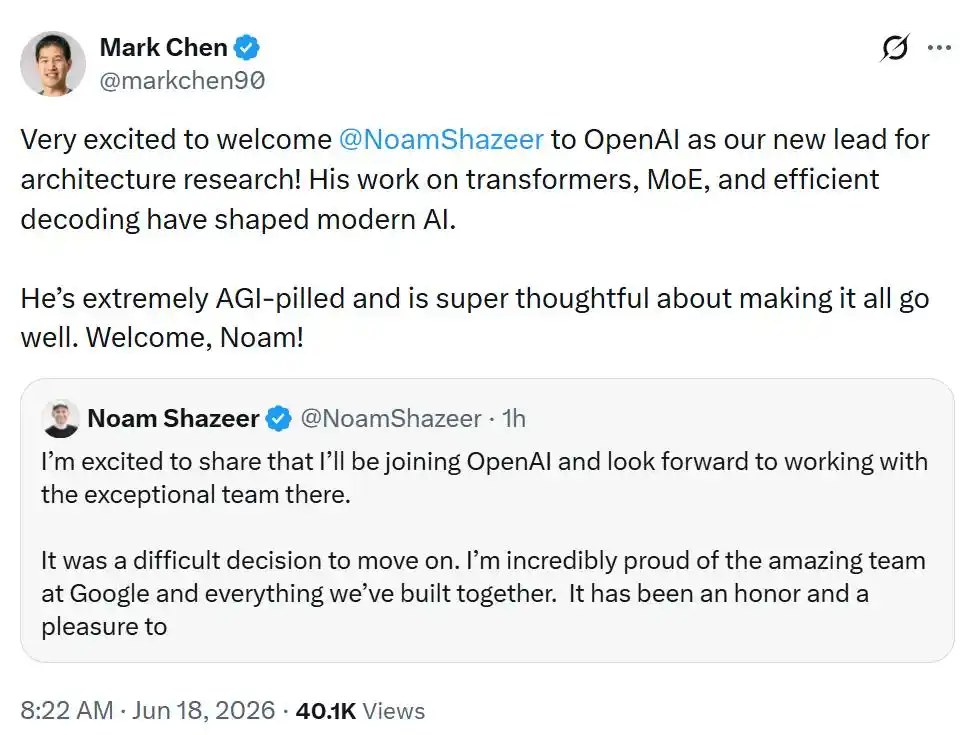
OpenAI research lead Mark Chen and others also responded on X: "A huge welcome to Noam Shazeer joining OpenAI as Head of Architecture Research! His research contributions in Transformer, MoE (Mixture of Experts), and efficient decoding have profoundly shaped the development of modern AI.

He not only holds a strong belief in achieving AGI but also has deeply considered insights on how to ensure its smooth development. Welcome, Noam!"
Noam Shazeer

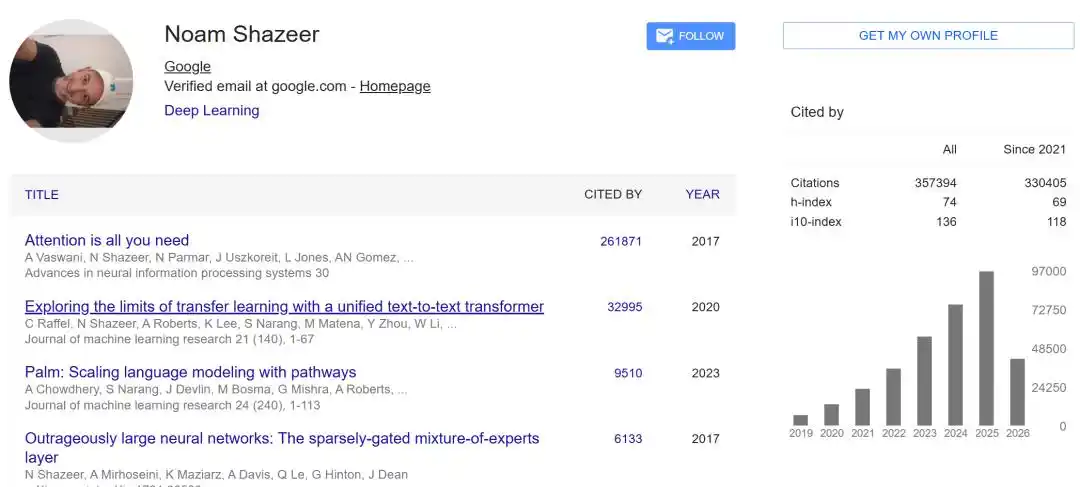
Noam Shazeer is one of Google's most important early employees. He joined Google at the end of 2000, serving as a Principal Software Engineer responsible for early advertising systems.

Noam Shazeer is no ordinary researcher. He is one of the co-authors of the seminal 2017 paper "Attention Is All You Need." The Transformer architecture proposed in this paper later became the most crucial technical foundation of the large language model era. From GPT and Gemini to Claude, and nearly all mainstream large models today, they all rely on the Transformer technical lineage.

More importantly, Shazeer's contributions extend beyond Transformer itself.

Long before large models truly entered the phase of scale competition, he had been focused on model scaling, sparse computation, and training of massive models. He co-proposed Sparsely-Gated Mixture-of-Experts, an important early foundation for the later MoE approach; Switch Transformer further pushed sparse expert models to the trillion-parameter scale. Today, MoE has become one of the key approaches for frontier models to increase parameter scale while controlling inference costs.
In 2021, Noam Shazeer left Google, disappointed by the bureaucracy at the search giant, and co-founded Character.AI with Daniel De Freitas. That company once became one of the most watched AI startups.

In 2024, Google reached a technology licensing deal with Character.AI and brought Shazeer and others back to Google DeepMind. Subsequently, he was appointed as co-head of Gemini technology, involved in Google's core large model project.
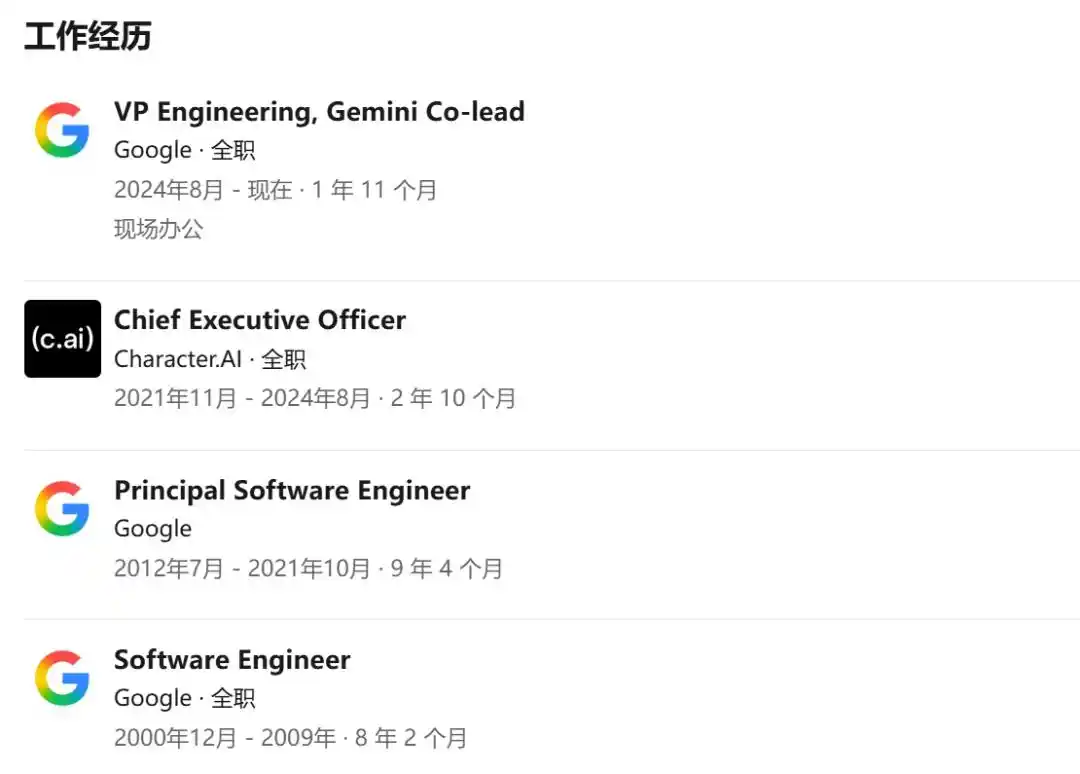
Now, in less than two years, he has turned to join OpenAI. This is truly harsh news for Gemini's development.

Many netizens believe that during the critical stage where Gemini still needs to continuously strengthen model capabilities and engineering systems, losing a figure like Shazeer will be a significant talent drain.

Others were more blunt in their jokes: Gemini wasn't that great to begin with; now with a core figure leaving, it's completely finished.
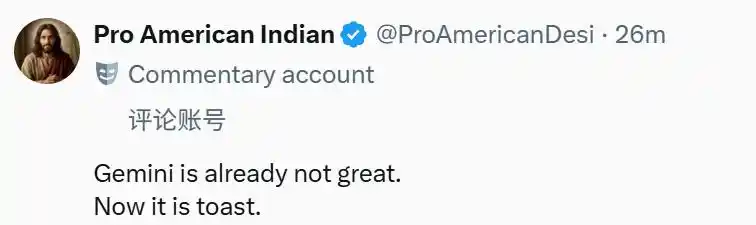
Another netizen joked: Google paid $2.7 billion for Shazeer's intellectual property. And OpenAI got these patents for free. This is the most favorable acquisition price in tech history.

In this AI talent war, Shazeer's addition is undoubtedly a significant victory for OpenAI.

This article is from the WeChat public account "Machine Heart" (ID: almosthuman2014), author: Focus on AI Big Shots.


Trending Cryptos

Related Questions

QWho is Noam Shazeer and what are his key contributions to AI?

ANoam Shazeer is a prominent AI researcher and a co-author of the seminal 2017 paper "Attention Is All You Need," which introduced the Transformer architecture. He is also known for his foundational work on Sparsely-Gated Mixture-of-Experts (MoE) and efficient decoding, technologies that are critical to modern large language models.

QWhy did Sam Altman say it took 10 years to get Noam Shazeer to join OpenAI?

ASam Altman stated that Noam Shazeer had been one of the people he most wanted to work with since OpenAI's founding. The wait of 10 years refers to the period from OpenAI's establishment to finally securing Shazeer's collaboration.

QWhat position did Noam Shazeer hold at Google before joining OpenAI, and why is his departure significant?

ABefore joining OpenAI, Noam Shazeer was a co-technical lead for the Gemini project at Google DeepMind. His departure is seen as a significant talent loss for Google, potentially impacting the Gemini project's development during a critical phase of strengthening its capabilities.

QWhat was the reported financial deal between Google and Character.AI involving Noam Shazeer?

AAccording to the article, Google reportedly struck a $2.7 billion deal for a technology license with Character.AI, the company co-founded by Shazeer, which also led to his return to Google in 2024.

QHow did the AI community react to Noam Shazeer's move to OpenAI?

AReactions were mixed. Some viewed it as a major win for OpenAI in the AI talent war. Others expressed concern for Google's Gemini project, with some joking that OpenAI got Shazeer's expertise 'for free' while Google had paid billions, and some even suggesting it was a devastating blow for Gemini.

Related Reads

WeChat AI Card Hands-On Guide: Has the AI Shopping Era Arrived?

**"WeChat AI Card" Practical Test Guide: Has the Era of AI Shopping Arrived?** WeChat has officially launched the "AI Exclusive Card," a feature integrated into its Workbuddy AI assistant. This card is designed to handle payments for AI-initiated purchases. Our hands-on test reveals it's not yet a tool for fully autonomous AI shopping, but rather a controlled payment layer for AI agents. The AI Card functions as an isolated sub-wallet within WeChat Pay. Users must bind the card and transfer funds into it from their main wallet. Crucially, every transaction requires explicit user confirmation via smartphone scan; AI cannot spend autonomously. Currently accessible through the Workbuddy agent, the card targets specific digital consumption scenarios: purchasing paid content (reports, data), calling paid APIs/tools, and subscribing to services. Its design prioritizes security and control by separating funds and mandating approval for each payment. We tested a real-world scenario: ordering bubble tea via Workbuddy using a "Meituan Life Assistant" skill. The process encountered multiple hurdles: high "skill" usage costs (exceeding daily free credits), and most importantly, while a payment was successfully initiated, the AI purchased an incorrect product (a mismatched group-buy coupon instead of the desired drink). This highlights the current limitation: the **AI Card only solves the payment step**. The broader challenge lies in the **AI agent's execution chain**—accurately understanding intent, navigating third-party platforms, selecting the right product, and ensuring proper fulfillment. The payment succeeded, but the purchase failed to meet the user's need. In conclusion, the WeChat AI Exclusive Card is a cautious, early-step experiment in AI commerce. It provides a secure, user-controlled payment method for agent interactions but is not yet capable of reliable, end-to-end complex purchases. For now, it's best used for low-value, low-risk digital services with careful user verification at each step. The vision of AI handling complete shopping tasks remains a work in progress.

marsbit53m ago

WeChat AI Card Hands-On Guide: Has the AI Shopping Era Arrived?

marsbit53m ago

Deconstructing Notion's Growth: From a Note-taking Tool to 100 Million Users—How Notion Built a Triple Growth Flywheel Through Product, Templates, and Community

Notion's growth from a niche note-taking tool to a platform with 100 million users is powered by three interconnected flywheels: Product-Led Growth (PLG), a Template Economy, and Community-Driven Growth. First, Notion's PLG strategy relies on a highly flexible, "plastic" product that users can adapt to countless personal and team workflows. Its freemium model lowers the barrier to entry, while features like page sharing and collaboration drive organic, usage-based viral growth as users naturally invite others. Second, the Template Economy solves the "blank page" problem. Templates, created by both Notion and its community, transform abstract product capabilities into concrete, copyable solutions for specific scenarios (e.g., project management, content calendars). This dramatically lowers activation costs for new users and fuels SEO-driven discovery. Third, a vibrant Community acts as a distributed growth engine. Users and official Ambassadors create tutorials, share use cases, and host local events. This community not only educates users but also fosters a sense of identity around pursuing "better ways of working," strengthening loyalty and enabling global, low-cost expansion. Together, these flywheels create a self-reinforcing ecosystem: a great product attracts users who create templates and community content, which in turn attracts more users and deepens engagement. This system allowed Notion to scale from individuals to teams and enterprises through a bottom-up adoption path. Looking ahead, AI integration promises to accelerate these flywheels further by making templates smarter and the platform a potential AI-native work operating system. Ultimately, Notion's defensible advantage is not just its features, but this deeply entrenched network of user assets, creators, and community trust.

marsbit54m ago

Deconstructing Notion's Growth: From a Note-taking Tool to 100 Million Users—How Notion Built a Triple Growth Flywheel Through Product, Templates, and Community

marsbit54m ago

$10 Billion, Qualcomm to Acquire Chip Legend Jim Keller's Company

Global mobile chip giant Qualcomm is in advanced talks to acquire AI chip startup Tenstorrent in a deal valued between $8-10 billion, according to media reports. This potential acquisition would be one of the largest in the AI chip sector in recent years. Tenstorrent, led by legendary chip architect Jim Keller, has gained prominence for its RISC-V architecture and AI accelerator designs. The move highlights Qualcomm's strategic push to diversify beyond its core smartphone chip business. As the smartphone market matures, Qualcomm is aggressively targeting growth in automotive, data center, and cloud AI. Acquiring Tenstorrent would allow Qualcomm to rapidly enter the high-end AI computing market, bypassing lengthy in-house development cycles. Tenstorrent's cost-effective system architecture, which avoids expensive HBM memory and relies on standard Ethernet for clustering, offers a potential alternative to Nvidia's costly solutions. Furthermore, Tenstorrent's high-performance RISC-V CPU technology and its focus on the automotive and edge computing segments align with Qualcomm's strategic goals, including its "Snapdragon Digital Chassis" platform. Despite the strategic rationale, the high valuation has sparked some investor caution. The successful integration of Tenstorrent's open-source culture and independent team into Qualcomm's organization, along with the commercialization of its technology, remains a key challenge.

marsbit1h ago

$10 Billion, Qualcomm to Acquire Chip Legend Jim Keller's Company

marsbit1h ago

Trading

Spot
Futures

Hot Articles

Discussions

Welcome to the HTX Community. Here, you can stay informed about the latest platform developments and gain access to professional market insights. Users' opinions on the price of AI (AI) are presented below.

活动图片