‘AI Broke Through NSA in Hours’ Goes Viral, But Is It Actually a Red Team Exercise?

marsbitPublished on 2026-06-23Last updated on 2026-06-23

Abstract

The viral claim that Anthropic's AI model 'Mythos' breached almost all of NSA's classified systems in 'hours, not weeks' has been clarified as a misinterpretation. The statement originated from a U.S. Senator citing the NSA director within a broader argument for mandatory pre-release testing of frontier AI models. The author of the original Economist article later clarified that the feat was achieved under very specific, controlled conditions during an authorized red-team exercise, where Mythos was used alongside other tools to find vulnerabilities in a replica of NSA systems, not a live breach. This highlights Mythos's advanced capabilities in vulnerability discovery and attack path reasoning during security testing. Anthropic restricts access to such powerful models through its 'Project Glasswing' program for vetted defense organizations. The incident underscores the U.S. government's conflicted stance: while citing security risks to justify actions like export controls on Anthropic's models, agencies like the NSA reportedly continue using them for defense purposes. The narrative evolved from a call for regulation into a sensationalized 'AI hacks NSA' headline, demonstrating how technical achievements in controlled environments can be misconstrued as real-world attacks.

A sentence that went viral online recently has seen a reversal.

‘Mythos broke through almost all of our classified systems in hours, not weeks, in hours.’

This sentence has been flooding English social media platforms in recent days.
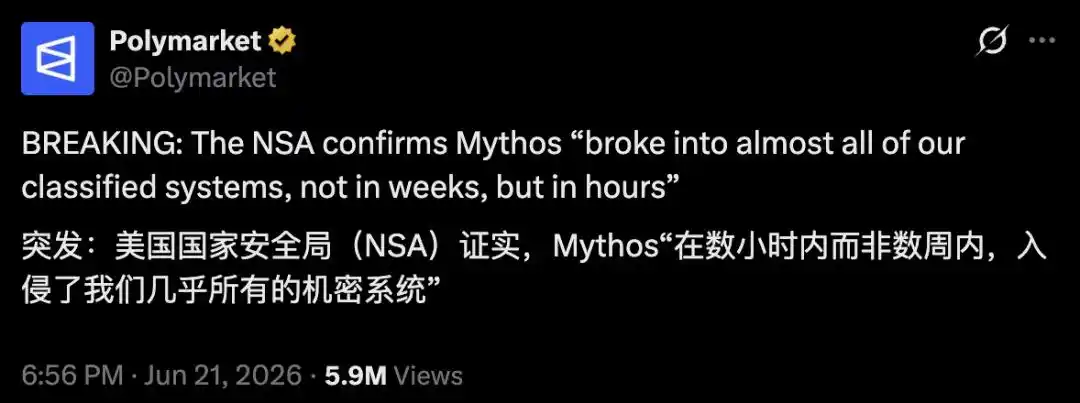
The protagonist is Anthropic's most powerful model, Mythos, and what was breached were the classified systems of the NSA (National Security Agency). Combined with the timeframe anchor of ‘in hours,’ this sentence spread rapidly across the internet.

All onlookers were shocked by the image it painted: AI can now breach the most stringent cyber defenses of a nation within a few hours.

This sentence originally came from a report by Shashank Joshi published in The Economist.
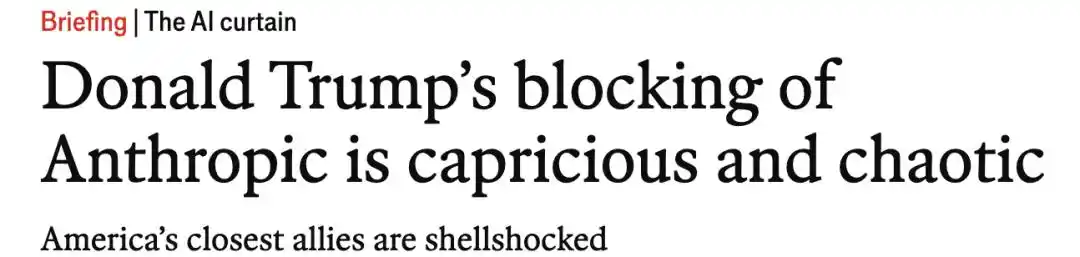
https://www.economist.com/briefing/2026/06/14/donald-trumps-blocking-of-anthropic-is-capricious-and-chaotic

In the article, to illustrate how powerful AI is, Joshi quoted a statement from Senate Intelligence Committee Vice Chairman Mark Warner, and Warner's statement was itself a recounting of someone else's words: General Joshua Rudd, who heads both the NSA and the Pentagon's Cyber Command.

Rudd told Warner that Mythos broke through almost all classified systems in hours.
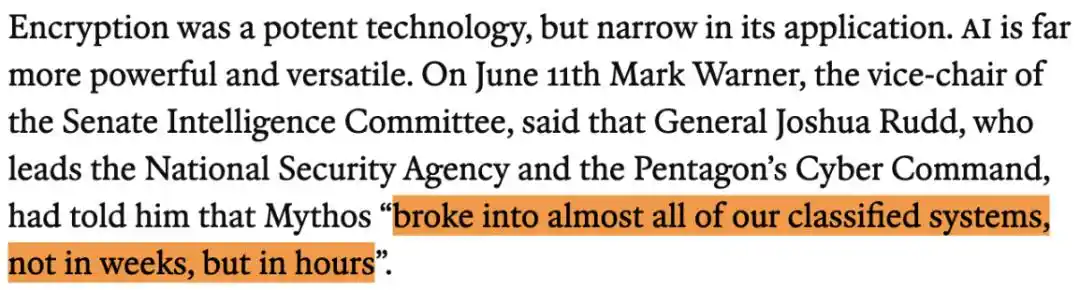
After being reported by The Economist, Rudd's statement quickly became a hot topic on social platforms.

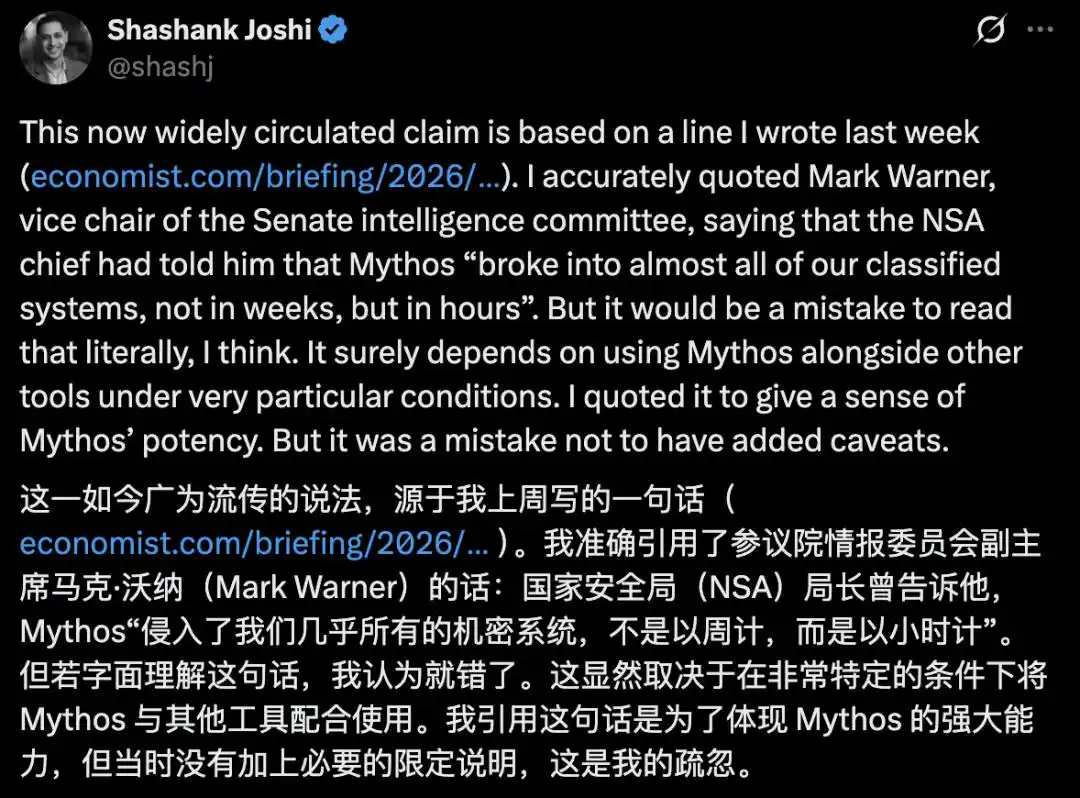
Concerned about public misinterpretation, Joshi, who wrote the sentence, personally stepped in on June 21st to temper the statement.

He said on X that the source of the quote was accurate; he did indeed quote Warner verbatim. However, taking it literally might lead to misunderstanding.

Mythos achieved this only under very specific conditions and when used in conjunction with other tools. He stated that he cited the quote to convey the strength of Mythos, but failing to add qualifications was his oversight.
Another easily overlooked point is that Warner's original intention in bringing up this example was not to denounce Anthropic; on the contrary.

His original words were: we need to let these AI companies ‘go full throttle,’ and thank goodness, it was Anthropic that did this. With another company with less rigid principles, relying solely on voluntary testing simply wouldn't suffice.

What Warner really wanted to push for was establishing mandatory pre-release testing for frontier models, rather than gambling on corporate self-regulation.

Thus, we see a complete chain of distortion: a sentence originally meant to advocate for ‘mandatory testing for frontier models’ comes from the NSA, passes through a senator's mouth, lands in a magazine's pages, and finally becomes breaking news of ‘AI Breaks NSA’ on social media.

Each time it was relayed, the tone became more exaggerated and absolute.

Behind the Cooling Down

How Powerful Is Mythos Actually Now?

In the original post, Joshi said the sentence shouldn't be taken literally.

He said the incident where Mythos broke through NSA systems in hours almost certainly occurred under very specific conditions, with Mythos being used alongside other tools. He said it was his ‘negligence’ not to include these qualifications when writing the article to emphasize its strength.

So, how capable are models like Mythos at this point?

Public information points more towards three things: finding vulnerabilities, reasoning attack paths, and running tests in red team environments.

According to an Axios report, institutions granted access to Mythos primarily use it to scan their own environments and identify potential vulnerabilities that could be exploited, not to attack live production systems running others' operations.

As early as April, reports confirmed that the NSA was taking precisely this approach: using the Mythos preview to scan its own environment for vulnerabilities, with a team of Anthropic engineers providing support.

This is also a common point reiterated by those who have come forward to correct the record in recent days.

BitGo founder and CEO Mike Belshe directly called it out in a repost: this is false. Security analyst Kyle Chase clarified that the ‘breach’ was a test; Zack Korman complained about how the statement went from senator to journalist to social media without anyone verifying it along the way.
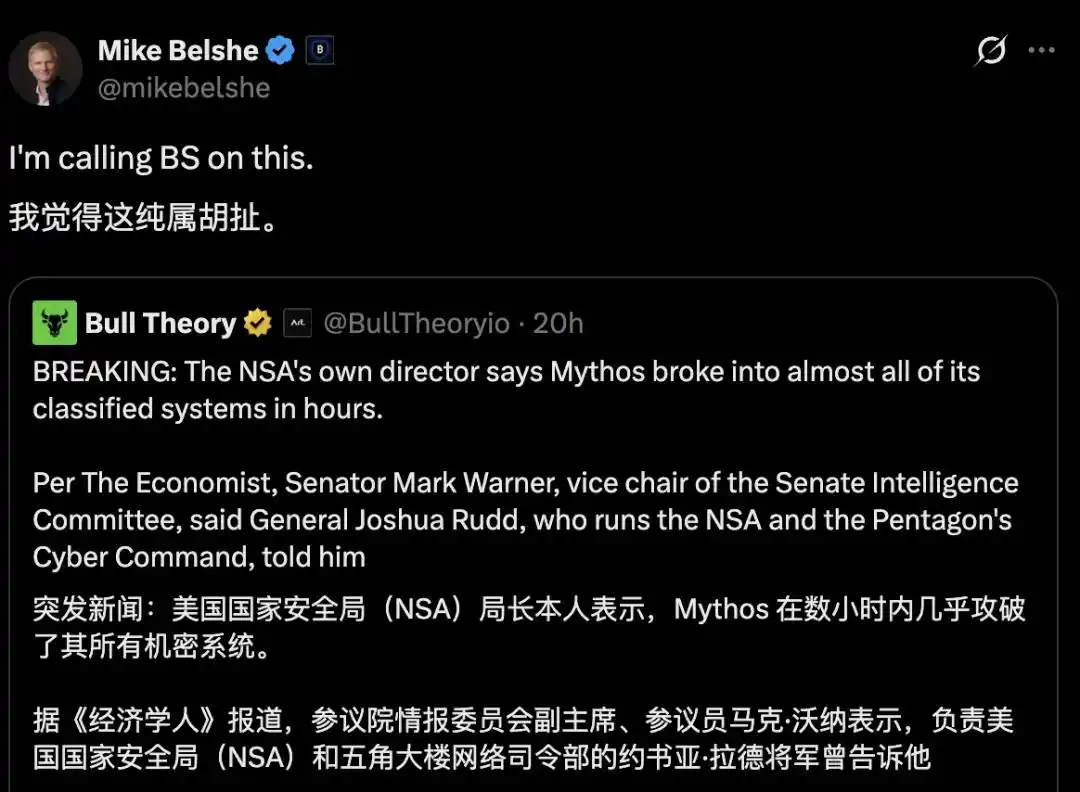
The more credible version they point to is that Rudd was referring to an authorized red team exercise: the NSA placed Mythos in a replica of its own classified environment, tasked it with finding and chaining vulnerabilities, and it did so at a speed far exceeding that of human teams.

Red Team Exercise vs. Real Intrusion

A red team exercise is when you hire people, in your own controlled environment (a ‘range’), with authorization, to test your own defenses, finding holes before the enemy does.

Being able to breach a complex defense setup in a controlled range in a few hours is separated from actually breaching the NSA's live classified systems by a whole set of prerequisites: specific environment, specific authorization, specific toolchains.

Writing ‘red team found all holes in range in hours’ as ‘NSA classified systems breached’ is a bit like writing a fire drill report as ‘building on fire.’

That said, even if it's just the result of a red team exercise, Mythos's performance itself is alarming enough.

A replica of a national-level classified environment, with a model chaining together almost all vulnerabilities within hours – that speed itself is a significant security warning.

Given the capabilities of the Mythos model, Anthropic specifically established a program to lock it down: Project Glasswing.
The model is not sold publicly; it's only distributed to vetted defense entities. The first batch in April included about 50 organizations, with 12 publicly named founding partners including AWS, Apple, Google, Microsoft, NVIDIA, and JPMorgan Chase; by June 2nd, the list expanded to about 150 institutions across more than 15 countries.

The reason remains consistent: its offensive cyber capabilities are too dangerous, and it cannot be widely released to the public before sufficient guardrails are in place.

Even the initial partners have already used it to uncover over 10,000 high or critical severity vulnerabilities.

Calling It Dangerous

While Continuing to Use It

What's interesting is the U.S. government's attitude toward Mythos.

In February of this year, the Pentagon raised the ban hammer, cutting off cooperation with Anthropic and demanding its suppliers follow suit. The reason cited was that the company was a ‘supply chain risk.’ The legal battle is still ongoing.

But recently, President Trump himself changed his tune. During an interview on ‘The Axios Show,’ when asked ‘Do you see Anthropic, its CEO Dario Amodei, as a national security threat?’, he responded:

Not now, but maybe a week ago, yes.

On June 19, Trump gave an interview at the White House for ‘The Axios Show,’ changing his stance on Anthropic: Not now, but maybe a week ago, yes.

Just a week prior, Amazon, a shareholder behind Anthropic, submitted a vulnerability report that alarmed the White House. When the government took this report to Anthropic's senior management, they felt the company didn't take it seriously.

So, the Trump administration took direct action.

According to Anthropic's official account, at 5:21 PM EST on June 12th, the company received an export control order. The wording was firm: it prohibited any foreign national from accessing Fable 5 and Mythos 5, regardless of whether they were inside or outside the United States, not even Anthropic's own foreign employees were exempt.
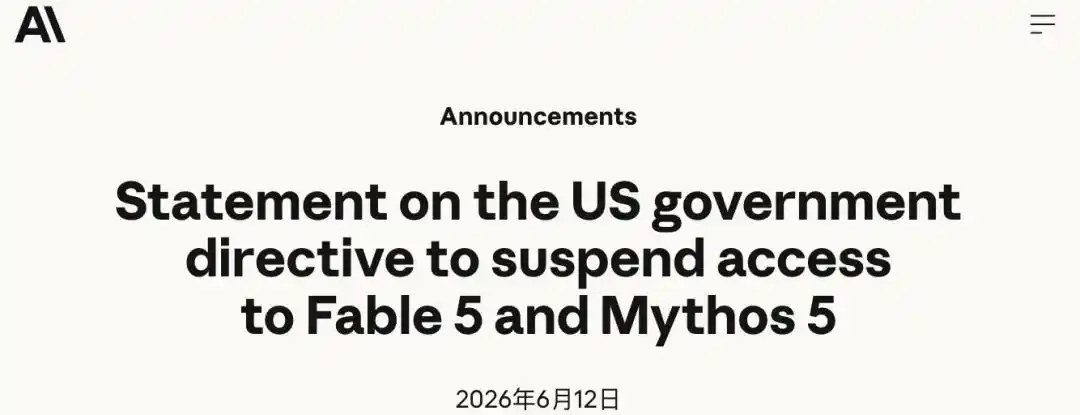
The problem is, you can't filter people by nationality one by one during real-time API calls.

Therefore, Anthropic had to implement a blanket shutdown, directly disabling Fable 5 and Mythos 5 for all users worldwide. Other models, including Claude Opus 4.8, were unaffected.

A model for global commercial use, taken offline just like that.

According to Anthropic's official statement, the trigger was a claimed ‘jailbreak’ method that could bypass Fable 5's guardrails. However, the company does not accept this claim: it reviewed the demonstration, and what was found after the bypass were several minor, already known vulnerabilities that even public models like OpenAI's GPT-5.5 could find, hardly a capability unique to Mythos.

Anthropic characterized this as a misunderstanding, stating it complied with the order but is working to restore access as soon as possible.

What's more contradictory is that, according to an Axios report on April 19th, while the lawsuit was ongoing, the NSA was still using Anthropic's strongest model, the Mythos Preview. While the Department of Defense argued in court that using it threatened national security, its subordinate, the NSA, continued using it.
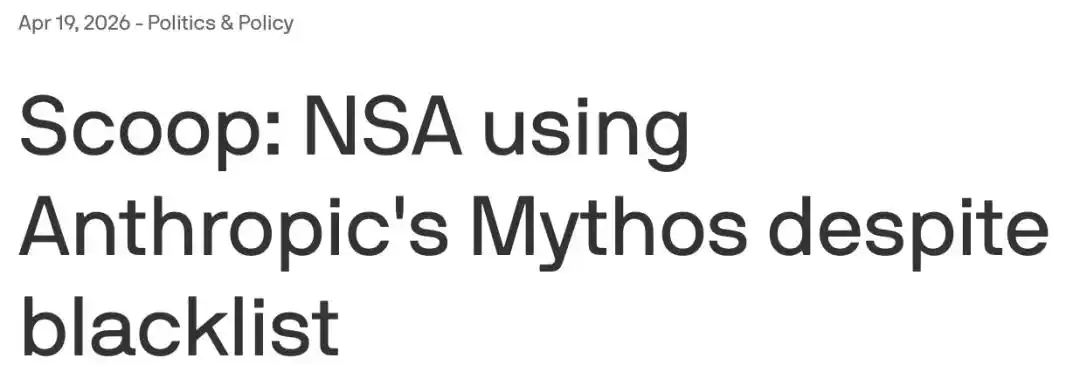
Among the approximately 40 authorized institutions, Anthropic only publicly named 12. According to sources, the NSA is among those names not publicly disclosed.

The most dangerous model is first labeled a risk, then quietly used in national security defense.

It's unclear whether this is a ban or a dependency.

You can ban a model, but you can't ban a capability.

Export controls can stop Mythos 5, but they can't stop the underlying capability represented by ‘AI can find holes in a defense setup in hours.’

The bigger trouble lies ahead.

The government agency CAISI, responsible for assessing the dangerous capabilities of frontier models, has recently been ordered to stop publishing its reports.

Who decides whether a model can be used or not is becoming increasingly unclear to outsiders.

References:

https://x.com/shashj/status/2068704535124508717

https://www.economist.com/briefing/2026/06/14/donald-trumps-blocking-of-anthropic-is-capricious-and-chaotic

This article is from the WeChat public account “新智元” (Xinzhiyuan), author: ASI启示录, editor: 元宇

Trending Cryptos

Related Questions

QAccording to the article, what was the original context and intended meaning behind the statement 'Mythos breached nearly all classified systems in hours'?

AAccording to the article, the original statement by NSA Director Joshua Rudd was intended to highlight the need for mandatory pre-release testing for frontier AI models. It was cited by Senator Mark Warner to argue that companies like Anthropic must be allowed to 'push the limits,' and that their voluntary testing is crucial, but a stronger mandatory framework is needed. The statement was meant to advocate for regulations, not to declare a real-world attack on the NSA.

QWhat does the article clarify about the conditions under which Mythos achieved the reported 'breach' of NSA systems?

AThe article clarifies that the reported 'breach' was the result of an authorized 'red team' exercise. In this exercise, the NSA provided Mythos with a copy or a replica of its classified environment and allowed it, alongside other tools, to search for and chain together vulnerabilities. This was a controlled, internal security test, not an actual external attack on live operational systems.

QWhat was the primary purpose of Anthropic's 'Project Glasswing' program mentioned in the article?

AThe primary purpose of Anthropic's 'Project Glasswing' program was to provide controlled access to its advanced and potentially dangerous model, Mythos, to pre-approved defense and security organizations. The program restricts the model's release because its offensive cybersecurity capabilities are considered too risky for public availability, and aims to allow vetted entities to find vulnerabilities in their own systems before malicious actors can exploit them.

QWhat paradoxical or contradictory stance does the U.S. government hold towards Anthropic's Mythos model, as described in the article?

AThe article describes a paradoxical stance where, on one hand, the U.S. government (specifically the Department of Defense and President Trump) has issued bans and export controls against Anthropic, labeling the company a supply chain risk. On the other hand, agencies like the National Security Agency (NSA) were reportedly still using the Mythos Preview for red teaming and vulnerability detection even while the legal battle was ongoing.

QWhat key distinction does the article make between the sensationalized headline of 'AI breached NSA' and the more nuanced reality of the event?

AThe key distinction is between a real-world, unauthorized attack and an authorized red team exercise. The sensationalized headline implies an external AI successfully infiltrated and compromised the NSA's live, operational classified systems. The nuanced reality is that it was an internal, controlled security test where an AI model was given permission to probe a replica of the NSA's environment to find security weaknesses, which is a standard and defensive security practice.

Related Reads

SK Hynix Market Cap Exceeds Samsung for First Time in 26 Years, Korean Broker Calls for 50% More Upside

SK Hynix's market capitalization surpassed Samsung Electronics for the first time in 26 years on June 22, reaching 208.1 trillion won. The shift reflects a market trend where companies directly benefiting from AI infrastructure, like SK Hynix, are receiving higher valuation premiums than diversified giants. The surge is driven by AI-driven demand for High Bandwidth Memory (HBM), where SK Hynix holds a dominant 70-80% market share. Its Q1 2026 revenue exceeded 50 trillion won for the first time, with an operating profit margin of 72%. Hanwha Investment & Securities significantly raised its price target for SK Hynix to 430,000 won, the highest among Korean brokerages. The key rationale is that Long-Term Supply Agreements (LTAs) and robust HBM demand have fundamentally reduced the company's historical profit volatility. Several other brokers have also raised targets, arguing the valuation framework for memory semiconductors is being rewritten, moving away from a cyclical model. Despite the bullish outlook, the stock experienced a pullback of over 5% in regular trading on June 23 after briefly surpassing 3 million won pre-market, amid broader tech sector weakness. Some analysts caution that the市值 overtaking Samsung, whose profit scale and growth forecasts remain higher, could signal short-term overheating. However, high-return investors viewed the dip as a buying opportunity.

marsbit4m ago

SK Hynix Market Cap Exceeds Samsung for First Time in 26 Years, Korean Broker Calls for 50% More Upside

marsbit4m ago

GPU Rental Prices Drop 30% in Three Weeks: AI Value Chain Migrating from Nvidia to Memory Chips

GPU rental prices for Nvidia's flagship B200 chip have fallen by approximately 30% over three weeks, dropping from a high of $6.11/hour to $4.22/hour. This decline signals a potential easing of the "compute scarcity" narrative that has long supported AI hardware valuations. Concurrently, the semiconductor market is witnessing a significant divergence: while the VanEck Semiconductor ETF (SMH) has risen 15% in the past month, with memory giants Micron and SanDisk each surging nearly 60%, Nvidia's stock has declined about 3% over the same period. Analysts suggest this shift indicates that the AI value chain's bottleneck and profits are migrating from compute (GPUs) to memory. Demand for high-bandwidth memory (HBM) remains intensely strong, with contract prices soaring over 100% in H1 2026, granting memory manufacturers significant pricing power. In contrast, increased B200 supply from improved manufacturing yields and competitive pressure from new cloud providers are softening GPU rental rates. While long-term contracts, like SpaceX's $30 billion deal with Google, show sustained large-scale demand for Nvidia hardware, the softening spot prices pressure the margins of cloud providers and could eventually impact Nvidia's order flow if chip prices don't adjust. The key takeaway for investors is not a weakening AI thesis, but a recalibration within the sector: pricing power appears to be strengthening for memory chipmakers while showing signs of strain for leading GPU suppliers.

marsbit13m ago

GPU Rental Prices Drop 30% in Three Weeks: AI Value Chain Migrating from Nvidia to Memory Chips

marsbit13m ago

From Corning to Ciena: The 10X Stock Opportunities in the AI Optical Communication Chain

From Copper to Light: The AI-Driven Optical Communication Supply Chain and Investment Opportunities The exponential data demands of AI are pushing data centers beyond the physical limits of copper cables, forcing a critical transition to optical communication. This shift from electrical to photonic signals over distances greater than ~3 feet solves heat, power, and bandwidth constraints. The real investment opportunity lies not just in headline chipmakers, but across the entire essential photonics supply chain. **Key Investment Layers & Companies:** * **Glass & Fiber:** **Corning** is a dominant, irreplaceable supplier of advanced fiber to all major cloud/AI players (Meta, Amazon, Google, MSFT, OpenAI, NVIDIA), with multi-billion-dollar, multi-year contracts locked in years ahead of delivery. Its profit growth (93%) far outpaces revenue growth (36%), showing pricing power. * **Interconnects:** **Amphenol**, a consolidating giant in high-speed connectors (both copper and optical), shows robust growth (>80% in AI data centers) and expanding margins post-acquisition. **Credo Technology** bridges old and new worlds, extending copper's life in racks while moving into optics. It has hyper-growth but carries high customer concentration risk. * **Systems:** **Ciena** is a leader in coherent optics, enabling massive data capacity upgrades on existing fiber. It has a massive, growing order backlog ($~7B) and strong ties with cloud providers. * **Upstream & Enablers:** **AXT** produces mission-critical indium phosphide wafers for lasers, creating a supply bottleneck, but faces significant geopolitical/export license risk from its China-based manufacturing. **VEO Solutions** is the essential "picks and shovels" play, providing test equipment needed by every component in the optical chain, regardless of the eventual winner. A new pure-play photonics ETF (**FOTO**) offers a consolidated investment vehicle for this theme, though it is new and small. The core thesis is clear: the move from copper to light is inevitable and accelerating, with wealth creation spreading across this critical, multi-layered supply chain.

marsbit33m ago

From Corning to Ciena: The 10X Stock Opportunities in the AI Optical Communication Chain

marsbit33m ago

A Chip Company Releases AIDC Energy Storage Certification Standards. Why NVIDIA? Computing Power Reshapes Power Supply Logic. Who's in the Lead and Who's Left Out?

NVIDIA has released a "Battery Energy Storage System Self-Certification Guide," setting strict technical standards for energy storage systems specifically for AI data centers (AIDC). The guide focuses solely on certifying the Power Conversion System (PCS), not the batteries, with 10 mandatory performance metrics and 12 validation tests requiring real-world and simulation comparisons. Key requirements include rapid dynamic response to AI workloads, high-frequency system telemetry, and detailed electromagnetic transient models. The move is driven by the extreme and fluctuating power demands of next-generation AI hardware. Modern AIDCs require energy storage systems to act as intelligent, controllable grid assets, not just passive backup, to manage instantaneous, massive power load shifts that traditional UPS systems cannot handle. This redefines the competitive landscape for energy storage providers, shifting focus from capacity and cost to advanced control capabilities and system integration. While the market potential is significant—with forecasts of hundreds of GWh in new demand by 2030—the certification creates a high barrier to entry. It requires proven PCS delivery volumes and credible plans for rapid capacity scaling, favoring established, well-resourced players. Early movers like Fluence (partnering with Siemens) and several Chinese companies have secured projects ahead of the standard, but new entrants must now navigate this rigorous, costly, and time-intensive certification process to compete in the AIDC energy storage market.

marsbit1h ago

A Chip Company Releases AIDC Energy Storage Certification Standards. Why NVIDIA? Computing Power Reshapes Power Supply Logic. Who's in the Lead and Who's Left Out?

marsbit1h ago

Trading

Spot
Futures

Hot Articles

Discussions

Welcome to the HTX Community. Here, you can stay informed about the latest platform developments and gain access to professional market insights. Users' opinions on the price of AI (AI) are presented below.

活动图片