Grayscale: AI Development Will Increase Demand for Public Blockchains

cryptonews.ruPublished on 2026-08-12Last updated on 2026-08-12

Abstract

Grayscale research head Zach Pandl believes that advancements in artificial intelligence (AI) will generate new demand for public blockchain networks. He identifies three primary areas of growth. First, AI agents will require programmable wallets to autonomously hold and spend funds, driving demand for infrastructure supporting micropayments, cross-border settlements, automated trading, and risk management. He cites Ethereum and Solana as suitable open networks for these tasks. Second, as AI assumes more tasks, there will be a need for verifiable records of which models, data, and rules were used in decision-making. Public blockchains could serve as independent ledgers for this information and for managing digital identities and reputations. Third, decentralized networks could offer an alternative to the current concentration of AI computational resources, capital, and control among a few large companies, allowing participants to share resources and governance. Pandl acknowledges the practical benefits of combining blockchain and AI are still debated. Other researchers have noted that while a blockchain can verify data existence, it does not inherently prove the correctness of an AI model's output. His view aligns with other financial firms, like Franklin Templeton, which see AI agents as a potential driver for crypto payments.

Progress in the field of artificial intelligence will give rise to a number of new use cases for public blockchains—from AI agent transactions to verifiable digital records. This opinion was shared by the head of Grayscale's research unit, Zach Pandl.
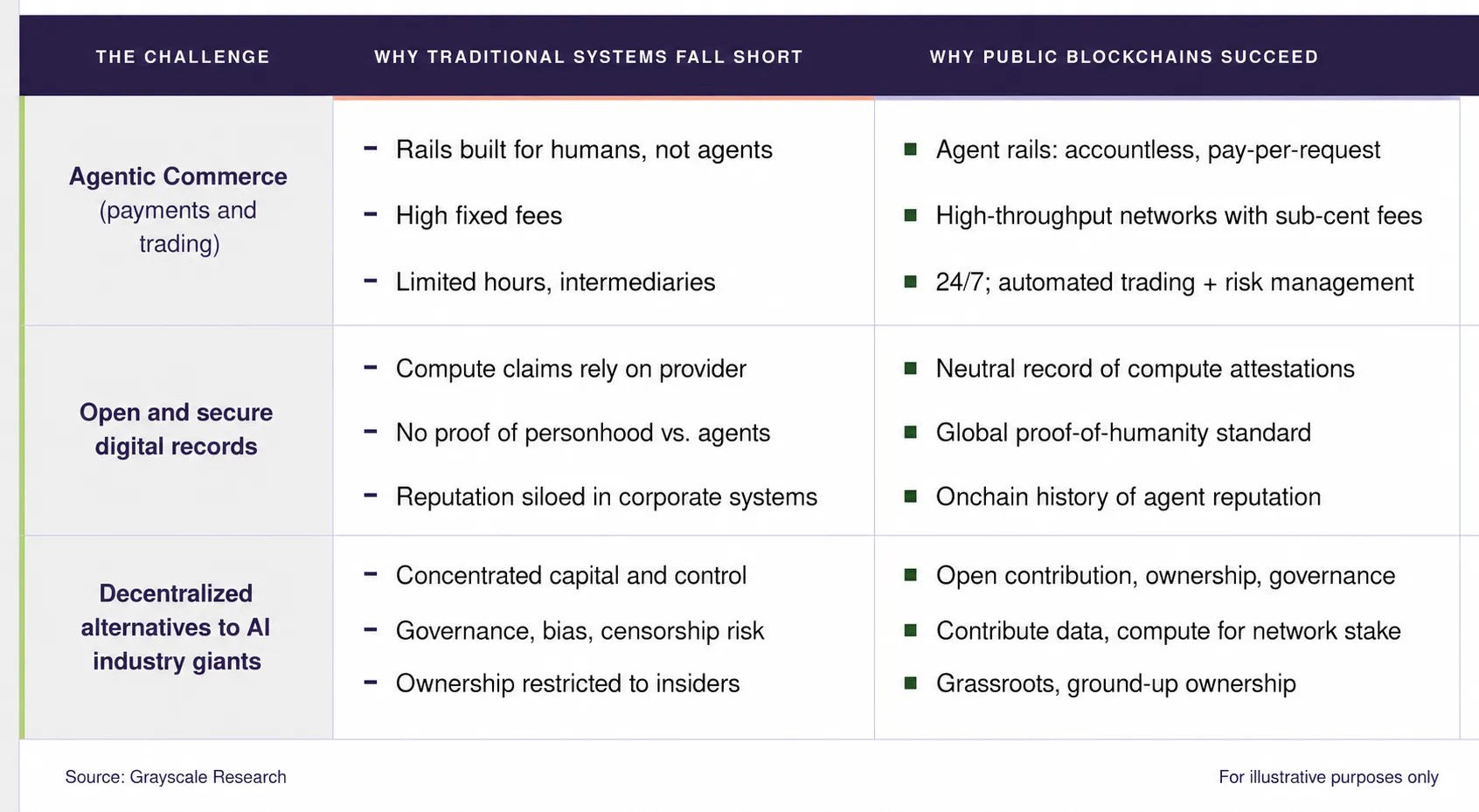
Source: Grayscale.

According to his assessment, the most obvious source of new demand is related to payments. Digital assistants that perform tasks on behalf of users need programmable wallets to independently store and spend funds.

The expert believes this will create a need for infrastructure for micropayments, cross-border settlements, automatic trading, and risk management. Pandl named Ethereum and Solana as suitable networks for this: open ledgers allow for programmable transactions 24/7.

Another direction is verifiable records of AI work. As more tasks are delegated to algorithms, companies will need to record which models, data, and rules were used in decision-making. According to the researcher, a public blockchain can serve as an independent ledger for such information.

A similar mechanism can also be applied to identifying people and digital agents and storing their reputation. Pandl named the project World as an example.

He named a third factor as the concentration of computational resources, capital, and control over AI in a small number of companies. An alternative could be decentralized networks where participants provide resources and participate in the ownership and governance of the infrastructure.

However, the practical utility of such a combination remains a subject of debate. In June, researchers from the IC3 consortium noted that many arguments about the benefits of blockchain for AI require additional proof. For example, an entry in a distributed ledger can confirm the existence of certain data at a specific moment, but it does not in itself prove the correctness of a model's operation.

Recall that in July, Franklin Templeton named AI agents as one of the potential drivers of crypto payments. The company noted that blockchain could be used for settlements between autonomous programs without constant human involvement.


Trending Cryptos

Related Questions

QAccording to Grayscale's head of research Zach Pandl, what are the primary new use cases that AI advancements will create for public blockchains?

AThe primary new use cases are AI-agent payments, verifiable digital records of AI work, and the need for decentralized networks as an alternative to the concentration of AI resources and control among a few companies.

QWhy does Zach Pandl believe AI agents will drive demand for programmable payment infrastructure on blockchains?

ABecause digital assistants that perform tasks on behalf of users will need programmable wallets to autonomously store and spend funds, creating demand for micropayments, cross-border settlements, automated trading, and risk management infrastructure.

QWhich two blockchain networks did Zach Pandl specifically mention as suitable for handling the needs of AI agents?

AHe specifically named Ethereum and Solana, stating their open ledgers allow for programmable transactions 24/7.

QWhat is the IC3 consortium's criticism regarding the proposed synergy between blockchain and AI, as mentioned in the article?

AResearchers from the IC3 consortium noted that many claims about blockchain's utility for AI require further proof. For example, while a blockchain can confirm data existed at a certain time, it does not itself prove the correctness of an AI model's work.

QWhich other financial institution, mentioned in the article, has also identified AI agents as a potential driver for cryptocurrency payments?

AFranklin Templeton, which in July stated that blockchain could be used for settlements between autonomous programs without constant human involvement.

Related Reads

El Salvador’s Bitcoin experiment turns 5: ‘It was for us, not them’

Five years after becoming the first country to adopt Bitcoin as legal tender, El Salvador's national experiment is widely viewed as a failure based on its original stated goals of banking the unbanked, slashing remittance costs, and attracting major foreign investment. Research indicates mass adoption by citizens never occurred; Bitcoin use remained concentrated among young, urban, educated, and already banked males. The government's Chivo wallet failed to address core barriers to financial inclusion, and Bitcoin accounted for barely 1% of remittances by 2024, offering little advantage as most funds arrive in US dollars. Following a 2024 IMF financing deal, El Salvador scaled back its involvement, making Bitcoin acceptance voluntary and limiting state use. However, the experiment undeniably changed the global conversation, turning nation-state Bitcoin adoption from theory into reality and positioning El Salvador at the center of the Bitcoin movement. It provided a proof of concept and a global platform, attracting prominent Bitcoin advocates. Success stories exist in localized economies like Bitcoin Beach, but analysts note the project's symbolic benefits were largely "for" the international Bitcoin community rather than "for" the economic transformation of most Salvadorans. The assessment is further complicated by President Nayib Bukele's popular, yet authoritarian, governance style, which delivered drastically improved security but raised concerns about centralized power and civil liberties. Ultimately, Bitcoin gave Bukele a global stage, and Bukele gave Bitcoin its first national adoption test.

cointelegraph17m ago

El Salvador’s Bitcoin experiment turns 5: ‘It was for us, not them’

cointelegraph17m ago

Trading

Spot

Hot Articles

Discussions

Welcome to the HTX Community. Here, you can stay informed about the latest platform developments and gain access to professional market insights. Users' opinions on the price of AI (AI) are presented below.

活动图片