Sudden Halt, Gemini 3.5 Pro Stalls, Google Plunges into a Trap of Disappointment

marsbitPublished on 2026-07-17Last updated on 2026-07-17

Abstract

Gemini 3.5 Pro's launch has been delayed for months, according to a Bloomberg report. Hype had built after leaks suggested the AI model, codenamed 'Cappuccino', would feature a 2M-token context window and a 'Deep Think' mode, potentially surpassing rivals like GPT-4.5. However, internal sources reveal the model failed to meet strict standards, particularly in AI coding performance, despite a last-minute data update. The report details internal challenges at Google: bureaucratic hurdles slow decision-making as multiple departments compete for resources and alignment. Furthermore, a cultural reluctance among some engineers to use AI-generated code, coupled with internal GPU shortages, hampered the development of this critical capability. This inefficiency and perceived lag behind competitors like OpenAI and Anthropic is reportedly causing talent drain. Analysts suggest this isn't just a Google issue but part of a broader "next-gen giant model disappointment trap." As models scale, they face data bottlenecks, diminishing returns from compute scaling, and potential architectural limits. While OpenAI currently leads, the industry may be entering a platform period where explosive progress slows. Google's delay underscores the immense difficulty of advancing frontier AI models.

Just yesterday, the entire AI community was immersed in a state of high excitement.

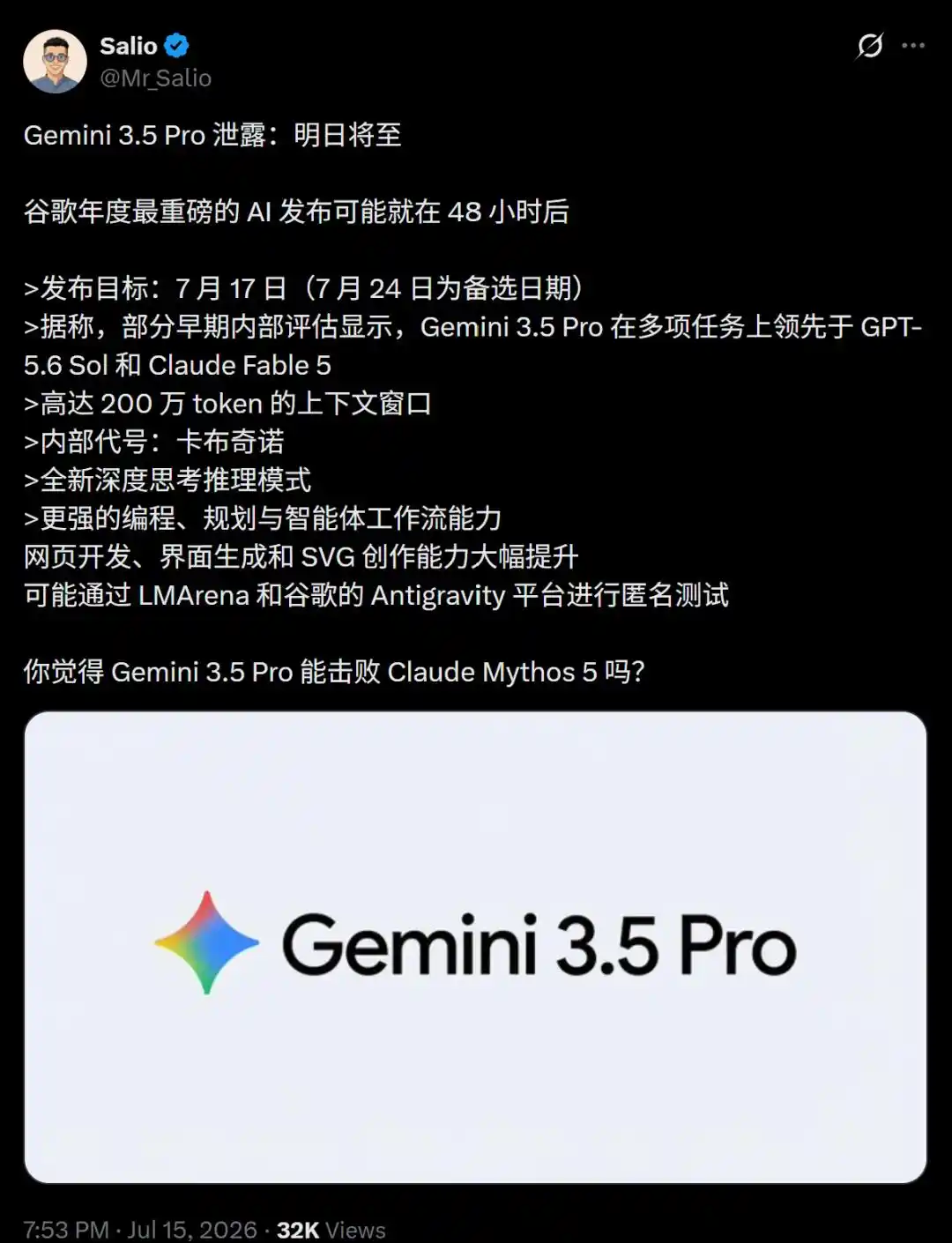
A flood of leaks came pouring in: Google's ultimate weapon – Gemini 3.5 Pro, codenamed 'Cappuccino', would officially launch within 48 hours!

A massive 2-million-token context window, a brand new 'Deep Think' reasoning mode, reportedly outperforming GPT-5.6 Sol and Claude Fable 5 in internal evaluations.
Clearly, this was a blockbuster product poised to disrupt the AI landscape.

Everyone was excitedly counting down, rolling up their sleeves, ready to witness history.

However, after waking up this morning, the mood suddenly shifted.

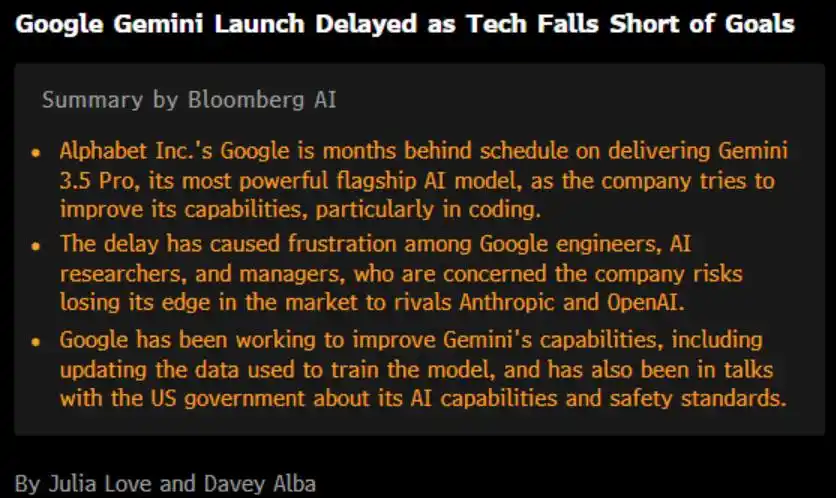
A Bloomberg exclusive report poured cold water on everyone's enthusiasm like a bucket of ice: the launch of Gemini 3.5 Pro is delayed, and not by a few days, but by a delay of months!

A launch that should have been recorded in history was put on hold by Google itself.

Why exactly?

48-Hour Frenzy and an Emergency Brake

Just yesterday, social platforms were flooded with spoilers about Gemini 3.5 Pro.

Codenamed: Cappuccino.

Super long context: 2 million tokens.

Deep Thinking: The new 'Deep Think' mode brings it to unprecedented heights in mathematics, programming, and logical reasoning.

Comprehensive evolution: Significant improvements in code writing, agent workflows, front-end UI design, and SVG graphic generation.

Insiders predicted this would be Google's 'ultimate weapon' for a full-scale counterattack against OpenAI and Anthropic.

The reaction was extreme. Everyone was looking forward to the rumored launch date of July 17th.

However, this morning, a report by a Bloomberg journalist instantly plunged everyone into disappointment.
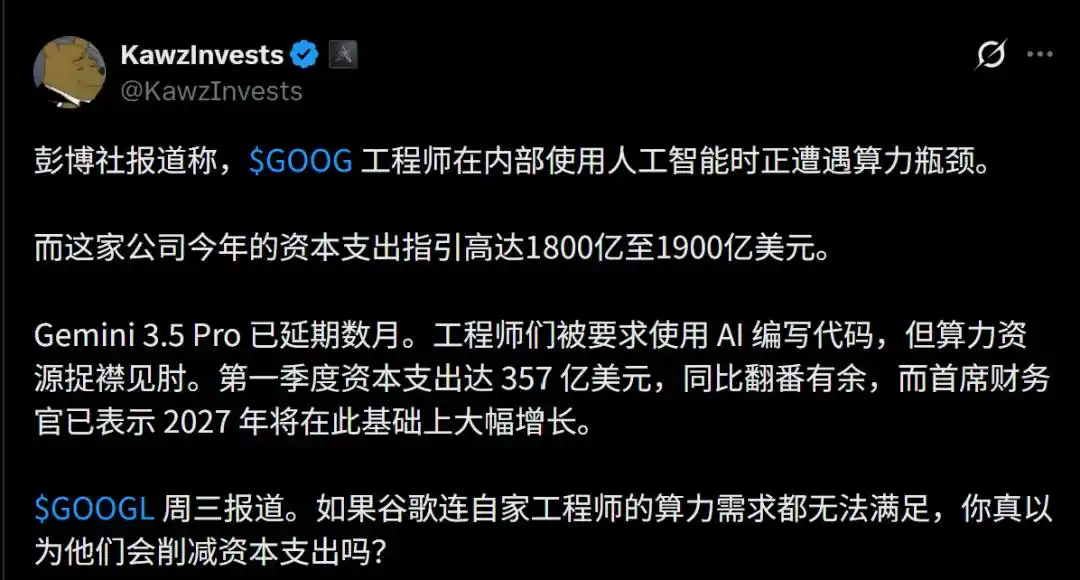
Insiders say the development of Gemini 3.5 Pro has fallen months behind schedule. The core problem is that the model's performance in key capabilities, especially AI coding, failed to meet stringent internal standards.

Just at the end of last month, Google urgently updated the training data in a final sprint to boost coding capabilities, but the results were 'disappointing'.

Two words declared the end of this 48-hour frenzy.

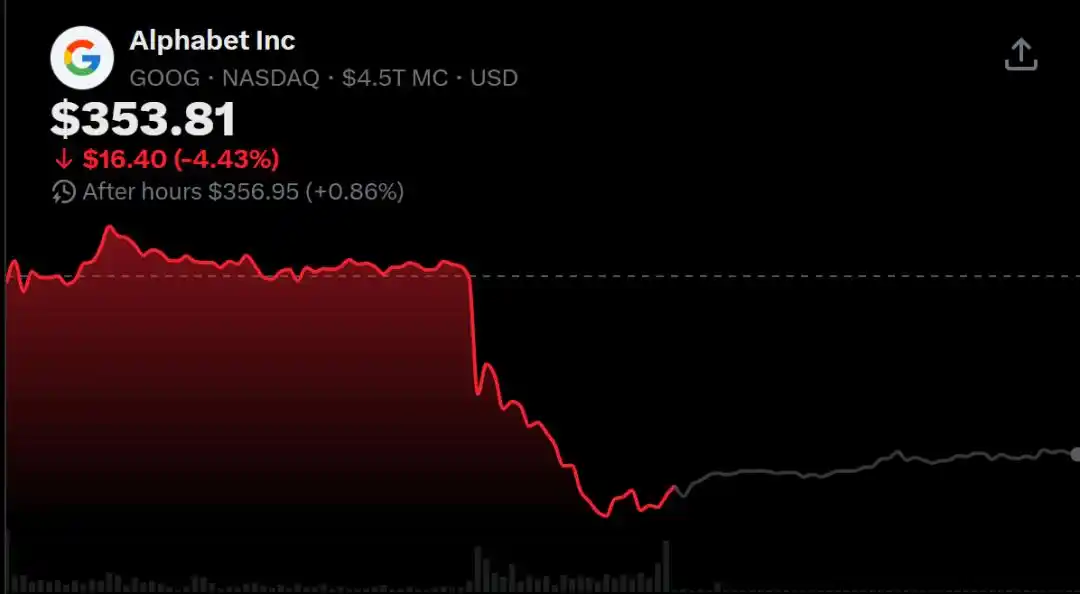
Google's stock price fell immediately after the news broke, at one point dropping by 4.43%.
While OpenAI and Meta's new models race ahead in coding capabilities, the difficulties with Gemini 3.5 Pro have directly caused severe anxiety within Google.

Engineers, AI researchers, and executives feel deeply frustrated. They are increasingly worried that Google is losing what was already a not-so-wide moat.

Google's 'Tacitus Trap': Why Can't an Entire Company Build the Best AI?

Why did the highly anticipated trump card fizzle?

This report reveals the multiple layers of internal struggles at Google. It's a microcosm of a colossal empire during a transitional era.
Innovation Speed 'Dragged Down' by Bureaucracy

The report mentions a crucial detail: Google's internal hierarchy is complex, with numerous stakeholders.

The launch of a model must consider the needs of massive product lines like Search, Maps, and YouTube.

This 'wanting it all' decision-making model leads to dispersed resources and sluggish decisions.

A former employee gave a vivid analogy: "Getting all department leadership to pull in the same direction is like trying to boil the entire ocean."

The result is frequent changes in directives, multiple departments reinventing the wheel, making it difficult to form a concerted effort.

While OpenAI and Anthropic sprint forward at startup speed, Google's 'giant ship' is stalled by internal coordination.

One netizen commented incisively: "Google needs to cut its bloated bureaucracy to make progress in this field."

The Waterloo of AI Coding: Engineers' 'Pure-Blood' Complex and Compute Hunger

Moreover, why did coding capability specifically fall short? This hides a deeper conflict within Google.

On one hand, Google has a top-tier engineering culture globally, which also fosters a 'pure-blood' complex.

Many old-school engineers believe that 'all important code should be written by hand.' This distrust of AI-generated code limits engineers from using Gemini to assist in development, fearing proprietary code could leak into training data.

When Google finally recognized the importance of AI coding and decided to mandate its use, a new problem arose – insufficient compute power.

The report points out that when engineers tried to use internal AI tools, they frequently encountered compute capacity limits.

The most ironic detail in the entire report: In a company expected to spend $180 to $190 billion in capital expenditures this year, its own engineers can't get access to GPUs!

Wall Street data shows Google's Q1 capital expenditure this year reached a staggering $35.7 billion, more than double year-over-year. So much money poured into buying chips and building data centers, and the result?

Faced with this chaos, Google is trying to mend the fold after the sheep are lost.

The Chief AI Architect is consolidating departmental AI programming tools under the Google Antigravity foundational architecture and has established a dedicated AI programming team within DeepMind, but it might be too late.

Internal Horse Race, A Vicious Cycle of Talent Drain

Google isn't unaware of the problems. It has top research labs like Google DeepMind, the Google Cloud division, the Android team, and has even formed multiple internal groups to tackle AI coding.

But this 'horse race' mechanism also means internal friction.

Different teams operate independently, products overlap, strategies waver. Worse, this confusion and sense of frustration directly lead to the loss of top talent.

The report states that a large number of researchers, disappointed by Google's lagging position, have jumped ship to Anthropic and OpenAI.

This forms a terrifying closed loop: Bureaucracy leads to inefficiency -> Inefficiency leads to product delays -> Product delays lead to talent drain -> Talent drain exacerbates technological lag.

The delay of Gemini 3.5 Pro is the inevitable outcome of this loop.

Alarm Sounds Across the Industry, Giants Collectively Fall into the 'Next-Gen Giant Model Disappointment Trap'

Wharton's Ethan Mollick, while sharing the report, raised a thought-provoking point –

This is not just Google's tragedy, but a 'periodic tech winter' that the entire Silicon Valley is experiencing.

Mollick pointedly noted that Google's current setbacks perfectly replicate the pains previously experienced by Meta's Llama 4 and xAI's Grok 4.

He named this phenomenon the 'Next-Gen Giant Model Disappointment Trap.'

Investing huge sums of money and compute to train the next-generation model, only for the actual performance gains to fall far short of expectations, leading to a noticeable decline in market leadership.

In the past, the industry believed in Scaling Law. However, when model scale expands to a certain point, the 'brute force' approach of merely piling on compute and data begins to fail.

Data bottleneck: High-quality human text data has almost been 'squeezed dry,' and the effectiveness of synthetic data remains to be proven.

Algorithm bottleneck: The existing Transformer architecture and its variants may be approaching their performance ceiling.

Diminishing returns: To achieve tiny performance gains, an exponentially increasing compute cost is required.

In this giants' game, only OpenAI has temporarily escaped this trap with Orion/GPT-4.5, avoiding a major setback.

What is certain is that as model sizes approach physical and engineering limits, the difficulty of iterating on frontier models is rising sharply.

The delay of Gemini 3.5 Pro is a wake-up call for everyone –

We are in a plateau period. The era of breakneck advancement where 'AI moves a year in a day' is coming to a pause.

For the entire industry, this might be a good thing. When the hype subsides, people will truly contemplate the value of AI.

As for Google, the time and patience the market has left for it may truly be running out.

References:

https://x.com/Mr_Salio/status/207736089707741624811

https://x.com/emollick/status/2077849021150888408

https://www.bloomberg.com/news/articles/2026-07-16/google-gemini-launch-delayed-as-tech-falls-short-of-internal-goals

This article is from the WeChat public account "New Zhiyuan", author: ASI Apocalypse

Trending Cryptos

Related Questions

QWhat was the reason for the delay in the release of Google's Gemini 3.5 Pro model?

AThe release was delayed because the model failed to meet Google's internal, stringent standards for key capabilities, specifically in AI coding.

QAccording to the article, what is a major internal challenge hindering Google's AI innovation speed?

AA major challenge is Google's complex bureaucracy and hierarchical structure, which leads to resource dispersion, slow decision-making, and difficulties in aligning multiple product divisions.

QWhat ironic situation regarding resources did Google engineers face while working on AI code generation?

ADespite Google's massive capital expenditure on GPUs and data centers, its own engineers frequently encountered compute capacity limits and couldn't get access to sufficient GPU resources for using internal AI coding tools.

QWhat is the "Next-Generation Giant Model Disappointment Trap" as described by Ethan Mollick in the article?

AIt's a phenomenon where tech companies invest huge resources in training next-generation AI models, but the actual performance improvements are much lower than expected, leading to a significant loss of market leadership position.

QWhat fundamental bottlenecks are contributing to the slowdown in AI model advancement mentioned at the end of the article?

AThe article mentions several bottlenecks: the depletion of high-quality human text data, the potential performance ceiling of the Transformer architecture, and the law of diminishing returns where exponentially more compute is needed for minor performance gains.

Related Reads

Stable Vaults Are the Final Piece in Aave's Mass Commercialization Puzzle

Aave's introduction of "Stable Vaults" aims to bridge the gap between complex DeFi protocols and mainstream users by offering a simplified, predictable savings product. The core innovation is a fixed-yield layer built atop Aave's volatile underlying lending pools. Partnering platforms (like digital banks or wallets) can offer users a guaranteed interest rate (e.g., 4%), shielding them from market fluctuations. The partner absorbs the risk and profit/loss from the difference between this fixed rate and Aave's variable rate. From the user's perspective, Stable Vaults provide ease of use, predictable returns, and familiar services like customer support and account recovery, addressing key barriers like wallet management and volatility. However, users pay a price: they cap their potential earnings (forgoing higher market yields), add counterparty risk from the partner platform, and may lack transparency into the true spread being captured. For partners, Stable Vaults turn idle user funds into a revenue stream via the yield spread. For Aave, this strategy attracts sticky, "sticky" capital from mass-market applications, providing a stable fee revenue stream crucial for its tokenomics (e.g., buyback mechanisms), especially in bear markets. The article contrasts this approach with direct DeFi interaction, where users keep all yield but face complexity and volatility. It argues that Stable Vaults align with proven consumer behavior: most users prioritize convenience, safety, and predictability over maximizing returns, willingly paying a "peace of mind" premium. Examples like Coinbase and Robinhood offering similar "savings" products validate this demand. Thus, Stable Vaults represent Aave's strategic move to commercialize by catering to fundamental human preferences for simplicity and stability in finance.

marsbit35m ago

Stable Vaults Are the Final Piece in Aave's Mass Commercialization Puzzle

marsbit35m ago

Support Rate Less Than 1%, BIP-110 Still Pushes Bitcoin Towards a Soft Fork?

Title: BIP-110 Pushes Bitcoin Towards a Soft Fork Despite Less Than 1% Approval With its August mandatory activation window approaching, the controversial BIP-110 proposal is back in the spotlight. Proposed in December 2025 by Dathon Ohm and supported by Bitcoin Core developer Luke Dashjr, BIP-110 aims to impose a one-year limit on arbitrary/non-monetary data in Bitcoin transactions, primarily targeting large data storage like Ordinals and Bitcoin NFTs, to reduce network "spam" and refocus Bitcoin on its monetary function. However, the proposal faces overwhelming opposition. To activate, BIP-110 requires a 55% threshold, yet current miner support is below 1%. Of the 102,674 network nodes, only 14.64% (15,035) signal readiness to enforce it. Despite this lack of consensus, BIP-110 has a contentious "mandatory window" mechanism: if the threshold isn't met by block height 961,632, supporting nodes will begin rejecting non-compliant blocks from height 961,632 to 963,647, attempting to force activation by block 965,664. This could lead to a chain split in early August between a minority chain enforcing BIP-110 and the main chain. Proponents, led by Luke Dashjr (founder of Ocean mining pool), argue that inscriptions constitute an "attack" on Bitcoin, congesting block space and raising transaction fees, thereby undermining Bitcoin's primary use as money. They view BIP-110 not as a change but as a reversal of a harmful change. Opponents, including figures like Adam Back, Jameson Lopp, and Michael Saylor, contend that BIP-110 fails to solve the spam problem while creating new risks. They warn it could stifle future innovation (e.g., impacting BitVM), introduce transaction censorship—eroding Bitcoin's neutrality—and potentially cause a damaging chain split that fragments developer resources, hash power, and monetary consensus. They argue market-based fee pressure and block size limits already manage congestion effectively. Potential outcomes post-activation include: 1) The BIP-110 chain stalling due to insufficient hash power; 2) The BIP-110 chain becoming the longest chain if it gains majority miner support (though currently, Ocean holds only 2.6% of hash power vs. opponents like F2Pool at 13.6%); or 3) A persistent minority chain that remains economically unviable, potentially leading to a permanent fork. Most analysts and prediction markets deem BIP-110's success unlikely, with one market giving only a 10% probability that it will become the accepted longest chain by September 2026.

marsbit39m ago

Support Rate Less Than 1%, BIP-110 Still Pushes Bitcoin Towards a Soft Fork?

marsbit39m ago

Mining Stocks Are Moving Further Away from Crypto

Title: Mining Stocks Are Drifting Away from Crypto Summary: Despite Bitcoin (BTC) falling approximately 46% over the past year, leading Bitcoin mining stocks (e.g., HUT, WULF, IREN) have surged significantly. This divergence stems from a fundamental shift in how the market values these companies. Their stock prices are no longer tied primarily to crypto prices, mining output, or hash rates. Instead, investors are now pricing them as AI infrastructure plays. Mining companies possess critical assets for AI data centers: pre-permitted land, grid-connected power capacity, and operational expertise for high-load facilities—resources facing severe shortages and long lead times for new entrants. For example, CleanSpark signed a 20-year, ~$6.6 billion infrastructure lease for an AI data center, while Marathon Digital acquired a project with up to 2 GW of planned power capacity. Analysts note a strong correlation between a mining company's market valuation and its contracted or potential AI power capacity in North America. CoinShares predicts that by year-end, up to 70% of revenue for listed miners could come from AI/HPC, compared to about 30% at the start of 2026. However, this re-rating introduces new risks: 1) Valuation volatility linked to the broader AI/semiconductor sector, 2) Potentially low baseline return rates (estimated at 4-5% for some firms), and 3) Execution risks including massive financing needs, regulatory permits, and tenant quality. This strategic pivot is also changing miner behavior. They are selling BTC holdings more aggressively to fund AI capex, meaning selling pressure may persist regardless of Bitcoin's price. Furthermore, once power and sites are locked into long-term AI contracts, they are unlikely to return to Bitcoin mining, potentially altering the network's hash rate dynamics long-term. In essence, mining firms are being valued for what they are becoming—AI infrastructure providers—rather than pure-play crypto miners.

链捕手46m ago

Mining Stocks Are Moving Further Away from Crypto

链捕手46m ago

Trading

Spot

Hot Articles

Discussions

Welcome to the HTX Community. Here, you can stay informed about the latest platform developments and gain access to professional market insights. Users' opinions on the price of AI (AI) are presented below.

活动图片