Once, our expectations of AI were quite simple: writing emails, translating papers, being a chat buddy... Back then, AI was like a green intern, doing exactly as told but often spouting nonsense with a straight face.
In recent years, AI development has surged forward like a tidal wave.
It is no longer content with just writing a few paragraphs for people; it has started taking over entire workflows: writing code, researching information, conducting analysis, generating proposals, and even breaking down tasks, calling tools, arranging steps, and checking results on its own.
Along with this came many amusing and ironic changes. The AI developed by programmers began taking over some of the work originally done by programmers themselves; many white-collar positions also found AI sitting at the desk next door.
The situation in academia is even more interesting. AI has greatly lowered the barrier to writing academic papers. Without needing to understand academic ideals, it can format papers with impressive solemnity.
Thus, some have begun mass-producing papers and mass-submitting them. Overworked reviewers use AI to assist in reviewing; authors, discovering this, embed prompts in their papers that are easily recognized only by machines, hoping the review AI will give positive evaluations. All participants save time, but whether knowledge itself has increased remains a matter of debate.
But the problem lies precisely here: Are we getting more knowledge, or more things that merely look like knowledge? As more and more work can be handed over to AI, what is left for humans?
The 2026 Blue Book on Intelligent Development in Humanities and Social Sciences released by Fudan University attempts to address these very questions.
Compared to the first edition, which primarily observed how AI empowers humanities and social sciences, this edition focuses on the theme of "Rediscovering the Value of Deep Thinking." It further proposes that the relationship between AI and the humanities/social sciences is moving from "one-way empowerment" to "two-way integration": AI changes how humanities and social sciences conduct research, while humanities and social sciences must participate in determining why AI is used, for what purposes, and what constraints it should be subject to.
As a special supporting unit of this book, the Shanghai Institute for Science of Intelligence is also collaborating with Fudan University to continuously explore the path of deep integration between AI and humanities/social sciences.
Why Stronger AI Makes Deep Thinking More Important
After calculators became widespread, people no longer needed to perform complex calculations by hand; after navigation appeared, people no longer needed to remember every route. Following this logic, perhaps after AI can analyze data and generate conclusions, humans could also think a little less.
Unfortunately, social problems are not arithmetic problems.
Taking the climate-society system coupling as an example, the Blue Book points out that the real difficulty is not handling more variables, but understanding the mismatches between natural and social systems in structure, variables, and scale. A model being able to compute does not mean it has understood the problem.
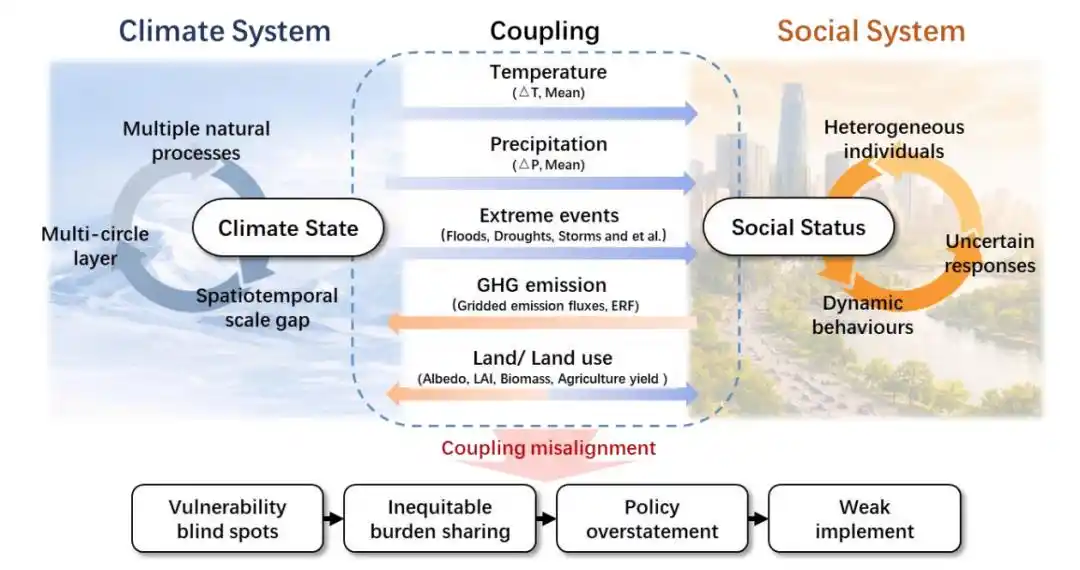
Three types of mismatches in climate-society system coupling: structure, variables, and scale.
Arithmetic problems only require judging if the answer is correct, but knowledge production and public decision-making must continue to ask: Is the reasoning process reliable? Are the underlying assumptions reasonable? Are potential risks controllable? And does the question itself have value in guiding the future?
The Blue Book argues that the research bottleneck is shifting: The past problem was whether we could process enough material; the current problem is whether we can ask good questions, establish real mechanisms, and form verifiable chains of evidence.
Judgments about what questions are worth researching, how observed patterns should be interpreted, whether a certain outcome is fair and just, and what biases are omitted or reinforced in research—these cannot be completely automated. The more capable AI becomes, the greater the human responsibility for judgment.
AI Seems Capable of Everything, But Can It Do Everything Well?
AI is becoming increasingly proficient at speaking, reasoning, and using tools, making it seem more and more like a collaborative "research partner." But is it truly understanding, or is it simulating understanding in a highly sophisticated way?
Over forty years ago, Searle used the "Chinese Room" thought experiment to question whether pure syntactic operations could produce semantic understanding. Today, large language models bring this question to everyone: How do we judge what large models actually understand and what they miss?
An important judgment in the Blue Book is that human intelligence is not a simple "input-output" process. Humans understand the world because perception and attention organize external stimuli into contexts; memory and cognitive maps organize past experiences into structures that can be transferred and reasoned about; emotions and values determine which information is more important and which goals are more worth pursuing.
The first step in human-AI collaboration is not to let AI do the work, but to first clarify the division of labor between humans and AI. AI can help us identify objects, retrieve information, and generate text, but it easily rewrites complex social experience into formats it can easily handle, turning problems that truly require understanding into problems that merely appear answered. We need to move from object recognition to contextual understanding, from information storage to experience organization, from generation to value judgment and self-reflection.
Cognitive science thus becomes particularly important. It tells us that deep thinking is not an ability opposed to AI, but an ability that needs to be more actively activated in human-machine collaboration. Truly valuable cognitive AI should not just provide a single, fluent, definitive answer, but should help people pose questions, compare evidence, and maintain the initiative in judgment.
Papers Are Written Faster and Faster, Who Ensures They Are Credible?
After AI entered scientific research, the most noticeable change is speed. Literature review, data cleaning, code generation, chart creation, and first drafts of papers can all be completed in a very short time. Researchers have no obligation to expend precious time on repetitive labor; whether a scholar has ideas should not be proven by how many times they manually adjusted a reference format.
But the speed of research and the speed of knowledge are not the same. Papers can be generated quickly, but that does not mean concepts have been clarified, data has been understood, or causal relationships have been established. Language models are especially good at organizing scattered materials into coherent narratives, and the most dangerous moment in academic research is often when the narrative appears overly coherent.
Risks also hide in seemingly "technical" steps. Choices like which variables to select, how to construct indicators, which year to start the sample from, and which cases to include all involve theoretical judgment.
The machine, of course, has no conspiracy; it only needs to make a small error in the first step and remain confident throughout the next twenty steps.
Another risk comes from automated model searching. AI can continuously try different variable combinations, parameter settings, and sample ranges until it finds results with stronger significance, better fit, and prettier charts. In the past, "trying until significance is found" was limited by time and energy; now, AI agents can search tirelessly. With increased efficiency, statistical flukes can be more efficiently packaged as theoretical discoveries.
The real challenge of automated research is not just whether machines make mistakes, but whether mistakes can be detected in time, whether the research process can be traced back, and whether final conclusions can be re-evaluated.
When AI Makes Decisions, Who Is Responsible?
AI's ability to recognize and categorize humans is rapidly increasing. It can identify claims, assess risks, review materials, match policies, and provide decision-making references for staff.
The appeal of such systems is obvious: they are faster than humans, do not get tired, and do not change their processing pace due to pressure or emotional fluctuations.
However, not getting tired is not the same as being fair.
Research cited in the Blue Book found that when analyzing health forum posts and international student interviews, human researchers could identify subtle nuances like doctor-patient interaction and cultural responsibility, while large models tended to generalize them into more ordinary, standardized categories.
The model is not completely devoid of understanding. It is just very good at rewriting things it doesn't easily understand into forms it can easily handle.
In public governance, such simplification can directly affect people's rights and treatment. The Blue Book thus distinguishes between two modes of AI embedding.
One is the "agentic" mode. The algorithm becomes the actor, moving from information input all the way to decision output, with humans reappearing only in case of system failure or appeals. The other is the "assistive" mode. AI is responsible for retrieval, calculation, risk alerts, and generating options, but the final decision is made by a human.
The difference between the two modes lies not in how much technology is used, but in whether power has been transferred.
Of course, having "human-in-the-loop" written in policy documents does not guarantee a human is actually in the loop. If staff can only click "confirm" after the algorithm's conclusion, so-called human review is merely using a human finger to execute the machine's decision.
The human role must possess the rights to intervene, correct, and explain. Otherwise, human review becomes a performance of accountability.
When AI begins to affect people's rights, the question cannot stop at "Is the model accurate?" It must also clarify who deploys, who reviews, who explains, who accepts appeals, and who bears ultimate responsibility.
Responsibilities can be divided, but they cannot evaporate simply because the division is too fine.
Deep Thinking: More Than Just "Thinking a Little Longer"
"Deep thinking" sounds like a personal virtue: faced with a problem, don't rush to answer, think a little longer. But truly meaningful deep thinking must be integrated into research processes, governance procedures, and organizational systems. It requires not only greater individual caution but also systems that preserve conditions for caution, questioning, and correction.
AI Can Help, But the Evidence Chain Cannot Be Omitted
Deep thinking does not mean rejecting AI. There is no need to insist on personally sorting through thousands of documents or spending a whole day adjusting reference formats just to prove human dignity.
The key is, work can be delegated to AI, but the evidence chain cannot be delegated along with it. AI can retrieve literature, process data, run code, but researchers still need to judge whether a question is worth asking, whether concepts are accurately translated into indicators, whether data relationships support causal explanations, and to what scope conclusions apply.
The STRIDES framework introduced in the Blue Book attempts to break down complex research into stages like theory, method, data, execution, and review, setting up checkpoints at key nodes: assumptions need to be stated, evidence must be traceable, data and code retain version records, and high-risk or low-confidence conclusions are re-submitted for human judgment.
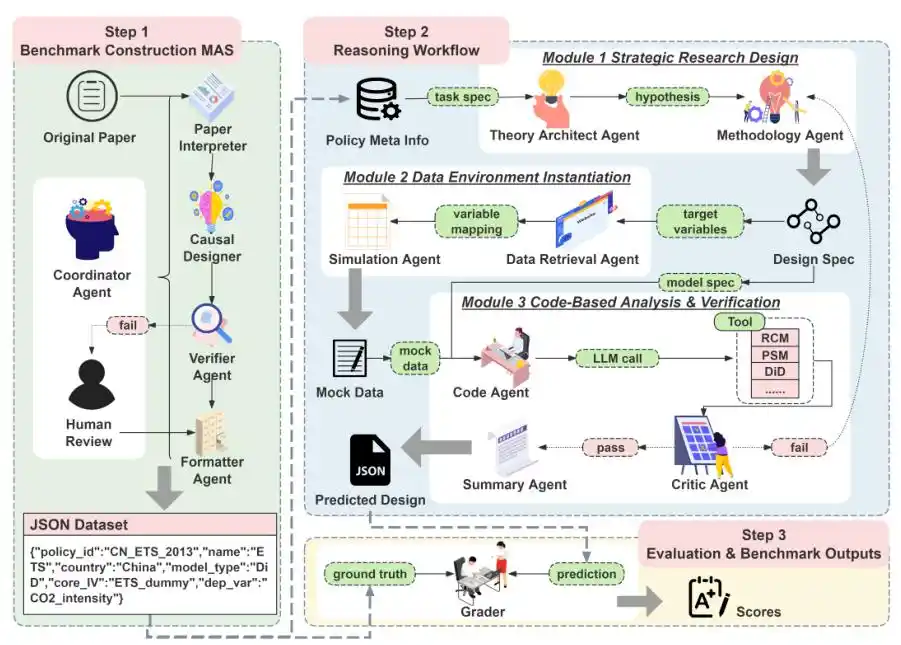
STRIDES System Overview: A workflow closed loop from research design to adversarial review.
After AI participates in research, the research output should not be just a final paper. The research question, data dictionary, analysis scripts, execution logs, review comments, and human adjudications should also be preserved, allowing others to see where results came from, at which step errors might occur, and what modifications were made.
Science is credible not because conclusions come quickly, but because others can retrace the chain of evidence.
In an interview, the team gave a simple self-check: After turning off the model, can you explain in your own words what the problem is, where the evidence comes from, what assumptions the conclusion relies on, what possible counterexamples exist, and what its boundaries of applicability are?
If you can only say "it sounds very reasonable" but cannot explain why; if the problem is gradually transformed into one the model can easily answer; if the writing becomes more fluent while your own viewpoint becomes fuzzier, then AI has likely shifted from being an expression assistant to a judgment agent.
Rules Cannot Be Just Written in Slogans
Regarding AI governance, many correct principles have been proposed: fairness, transparency, safety, human-centricity, privacy protection, accountability.
The problem is, if principles cannot be turned into procedures, they easily only exist in meetings and documents.
A system with only principles and no implementation mechanisms is like a person with only ideals and no alarm clock. They plan to do the right thing every day, but simply never wake up at the right time.
The Blue Book emphasizes that AI governance must cover the entire lifecycle of a system: assessing risks and applicable boundaries before deployment; recording key decisions, monitoring anomalies, and preserving avenues for human intervention during operation; and enabling review, correction, and accountability when problems arise.
Systems with different risk levels should not be governed identically. Ordinary information retrieval and text organization can have lower thresholds; systems involving public safety, important rights, and critical decisions should be subject to stricter testing, auditing, and deployment requirements.
Governance also cannot stop at "informed." Affected individuals should know on what basis decisions are made, what they can challenge, to whom they should raise objections, be able to request human review, and receive actual redress when errors occur. Otherwise, the duty to inform can easily become a technical document nobody understands, and appeal channels may be reduced to a mere webpage.
Of course, governance is not about putting the brakes on technology. It is more like building roads: where can speed be increased, where must it be limited, where are guardrails needed, and who is responsible after an accident. A road without rules does not represent freedom; it usually only means the strong drive faster, and everyone else must look out for themselves.
AI Can Organize Answers, But Humans Must Still Decide Direction
AI is very good at answering questions that have already been posed. But the truly difficult questions in society are often not ones without answers, but ones without a single standard answer everyone agrees on.
When efficiency conflicts with fairness, which should be prioritized? When technological innovation brings overall benefits but makes some bear greater costs, what is considered reasonable? Where should the boundary be drawn when public interest clashes with individual rights?
These problems will not disappear automatically by scaling up parameters.
The Blue Book concretely summarizes the "reverse empowerment" of AI by humanities and social sciences: It is not about standing next to technology and offering abstract moral opinions, but about transforming value conflicts into analyzable trade-offs, social consequences into measurable indicators, and providing a more directional and explanatory knowledge framework for technological development.
Models can tell us the possible consequences of different choices, but they cannot, by themselves, decide which group of people should pay the price for overall efficiency, nor can they decide if a certain price is worth paying.
The early Chinese civilization large model discussed in the Blue Book is an example. Historical documents, excavated texts, artifact images, site information, and geographical data were previously scattered across different archive systems and expert knowledge; multimodal models can organize them into the same knowledge space, allowing evidence from different sources to cross-reference each other.
Its significance lies not only in improving retrieval efficiency but in changing how evidence is organized. However, the more materials are connected, the more experts need to judge: which connections have historical significance, and which are merely superficial similarities; which narratives are built on reliable evidence, and which are merely made more fluent by the model.
This is precisely why humanities and social sciences cannot be reduced to "finding faults in AI." They are responsible not only for pointing out biases, risks, and flaws, but also for explaining value conflicts, analyzing systemic consequences, understanding specific human situations, and helping society form judgments it can collectively bear.
Technology solves "what can be done"; humanities and social sciences continue to ask "why should it be done," "to what extent should it be done," and "who bears the cost."
Relying on a Few Teams Is Not Enough
When discussing the integration of AI and humanities/social sciences, people easily think of a few labs, some star achievements, and a handful of researchers who understand both technology and social science.
This is, of course, important, but it cannot rely solely on these.
For a field to develop long-term capacity, it requires support from data, computing power, models, toolchains, talent cultivation, organizational collaboration, and evaluation systems. The Blue Book specifically reminds that AI4SSH infrastructure is not about buying more machines or putting several models on the same webpage, but the holistic construction of a multimodal data foundation, computing environment, domain-specific models, agents, toolchains, and collaboration mechanisms.
Buying computing power is relatively easy; establishing common data rules is hard. Releasing a model is relatively easy; making different disciplines truly understand each other's problems is hard. The real challenge is transforming scattered projects into sustainable organizational capabilities.
More importantly, emerging disciplines like cognitive science also need joint planning. Cognitive science connects philosophy, psychology, neuroscience, computing science, linguistics, and social sciences. It helps us understand human intelligence and also helps us reflect on and calibrate machine intelligence. For universities, building such foundational disciplines may not immediately correspond to a demonstrable application, but it determines whether future human-AI collaboration can move from tool use to paradigm innovation.
The Blue Book thus constructs the "Chinese Universities AI4SSH Index", expanding from three dimensions: core research capability, innovative development potential, and social dissemination capability, including 3 first-level indicators, 7 second-level indicators, and 10 third-level indicators.
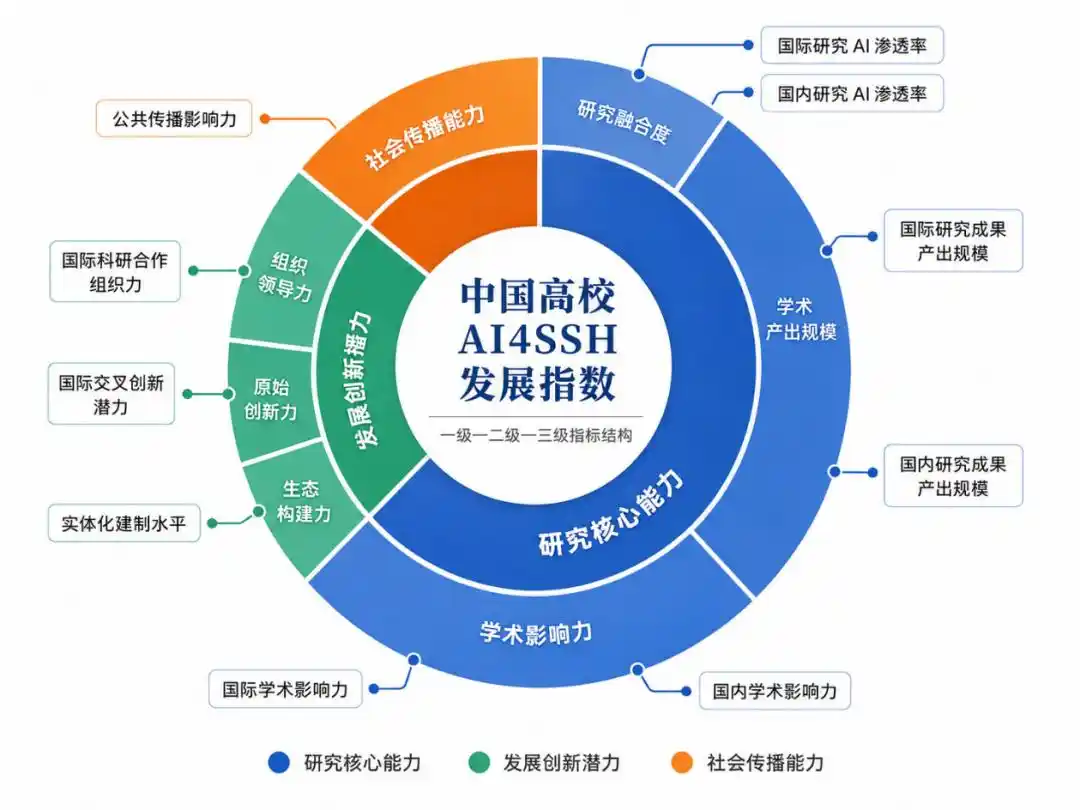
Chinese Universities AI4SSH Index Framework
It provides a structured observation window: which universities have formed stable interdisciplinary research systems, which remain at scattered project stages; which have research output but lack institutional support; which have academic achievements but have not yet translated them into public impact and social service.
The Blue Book's overall judgment is that the development of AI4SSH in Chinese universities presents a pattern of "initial system construction, distinct tiers." Research output and local integration progress relatively quickly, but international academic influence, source innovation, institutional support, and social service transformation still have shortcomings.
Therefore, measuring AI4SSH development cannot rely solely on model, paper, and project counts. One must also examine whether data, tools, norms, talent, and collaboration mechanisms can operate long-term. Technology can upgrade rapidly, but systems and organizations can only learn slowly; what truly determines how far AI and humanities/social sciences can go are precisely these parts less easily turned into demo videos.
Conclusion: The More Proficient AI Becomes at Answering, the More Humans Need to Know What to Ask
In the foreword to the Blue Book, Qiu Xin, Party Committee Secretary of Fudan University, writes to readers: in the intelligent era, we should "always safeguard thought, hone thinking, retain the composure and steadfastness for independent contemplation, rational judgment, inquiry into values, and discerning choices, guiding the transformation of intelligence with the depth of thought."
This is also the attitude this Blue Book hopes to convey. It is not merely an observation of a wave of technological change, but also a collective reflection by Fudan's humanities in facing the intelligent age.
What truly matters is judging what questions are worth posing before automatic generation; continuing to question whether evidence is credible after a model gives conclusions; clarifying its boundaries and responsibilities before technology enters society; and preserving human value judgments and directional choices among many possible futures.
We no longer need to prove in which tasks humans are faster than machines, but to reaffirm the non-transferable judgment and responsibility of humans in knowledge production and social operation.
Machines can help us reach many places. As for why we set out, where we should go, and what kind of life we want to live upon arrival—these things probably still cannot be entirely entrusted to it.
The Blue Book will be officially released on July 17 at the WAIC 2026 "Global AI Governance and Sustainable Development" forum. For the full text download, please follow the official account of the Fudan University National Development and Intelligent Governance Comprehensive Laboratory.
This article is from the WeChat public account "Almost Human" (ID: almosthuman2014), author: Focus on AI.