SHIB gains 8% in 24 hours as Musk’s Twitter takeover offers dog coins a bone

FinboldPublished on 2022-10-27Last updated on 2022-10-27

Abstract

Since it was announced that Elon Musk would complete the purchase of Twitter on Friday, October 28, dog meme coins Dogecoin (DOGE) and Shiba Inu (SHIB) have seen significant price increases, with both having registered gains that are greater than those of the Twitter (NYSE: TWTR) stock itself in the last 24 hours.

Since it was announced that Elon Musk would complete the purchase of Twitter on Friday, October 28, dog meme coins Dogecoin (DOGE) and Shiba Inu (SHIB) have seen significant price increases, with both having registered gains that are greater than those of the Twitter (NYSE: TWTR) stock itself in the last 24 hours.

Notably, Dogecoin has seen $2 billion flow into its tokens market cap in two days, pushing the meme coin 30% higher. Interestingly, SHIB has experienced a price rally, riding the wave of attention of its dog token competitor.

Currently, the SHIB token is trading at $0.00001122, up 8.12% in the last 24 hours and a further 12.47% across the week, with a total market worth of $6.17 billion, according to data retrieved by Finbold from CoinMarketCap.
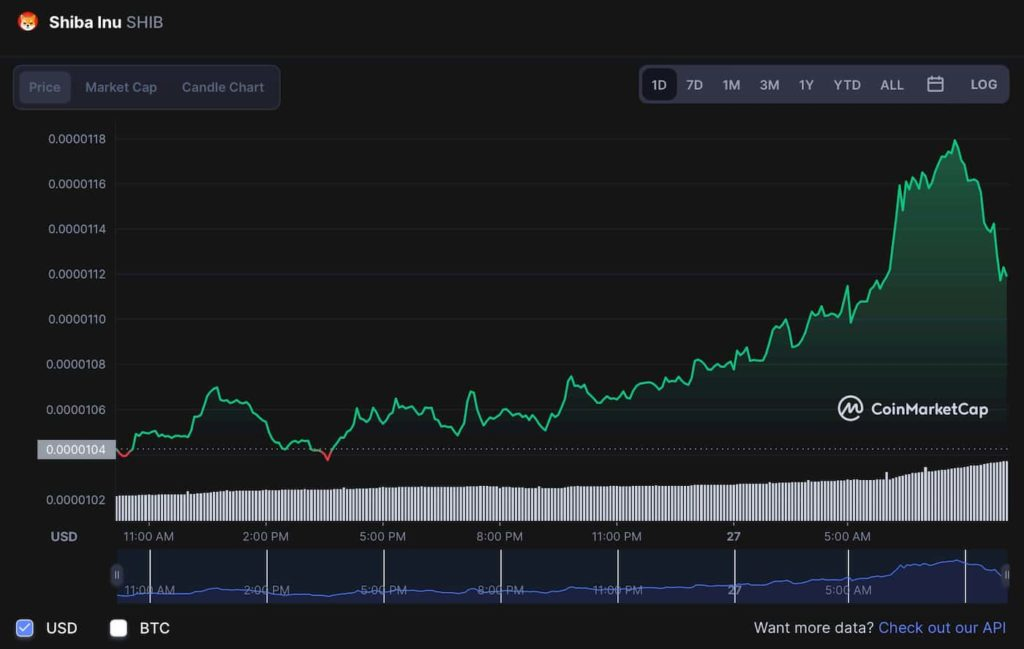
Earlier in the day, Shiba Inu was trading at $0.00001179 before it somewhat retraced with the larger market. Although the cryptocurrency market as a whole turned green on October 26, driven by the ascent of Bitcoin (BTC) and Ethereum (ETH), most cryptocurrencies only had marginal gains on October 27, with Dogecoin and Shiba Inu undergoing a significant surge on the day among the top 20 assets by market cap.

Meme tokens rally

As soon as the news broke that Musk was changing his mind about the Twitter deal, there was a surge in DOGE whale activity, with 85 transactions of at least $100,000 being recorded, leading to renewed hopes that the token will recover its value to where it was in 2021.

The whole meme coin market has the propensity to increase in value whenever Dogecoin rises in value, and Shiba Inu has the propensity to follow closely after it; the current situation is not an exception to this rule.

Elsewhere, Shiba Inu’s price movement also occurs at the same time as Bitstamp, a cryptocurrency exchange located in Luxembourg, named token available to users in the United States.

Finally, with the launch of Shibarium still in the works and the Layer-2 solution slated for a release in early October but still in the testing phase, the price could still see more bullish moves. Investors hoping toprofit fromf the price speculation will be pleased to hear of a new launch date for the update to the ecosystem.


Trending Cryptos

Related Reads

The Truth Behind Digital Banking: The Fragile Ecosystem Supporting 1.46 Billion Users

The article "The Truth About Digital Banks: The Fragile Ecosystem Behind 1.46 Billion Users" provides a data-driven analysis of the digital banking sector based on a verified list of 368 active neobanks as of July 2026. While these platforms collectively serve 1.46 billion users, with Asia (817 million users) and institutions like WeBank and Nubank dominating the landscape, the sector faces significant structural vulnerabilities. A key finding is that only 127 of the 368 neobanks hold full banking licenses. The majority operate atop third-party infrastructure providers like Banking-as-a-Service (BaaS) platforms, creating systemic risk where the failure of a single provider, as seen in past cases like Wirecard and Synapse, can jeopardize multiple consumer brands. Furthermore, the industry experiences a steady, quiet stream of failures, mergers, and shutdowns that often go unreported. The analysis also examines the adoption of artificial intelligence (AI), finding only 67 platforms (18%) have deployed AI at scale, with many innovators based in emerging markets like Nigeria and the Philippines. The infrastructure layer is highly concentrated, with 106 providers supporting the entire ecosystem of 368 consumer-facing brands. The article concludes with three predictions: the unlicensed gap will close through acquisitions or exits; an AI credit model is likely to fail in the next economic downturn; and a nascent but significant trend is the emergence of financial services designed for AI agents rather than humans.

marsbit8m ago

The Truth Behind Digital Banking: The Fragile Ecosystem Supporting 1.46 Billion Users

marsbit8m ago

Digital Asset Trading Platform Uphold Cuts 17% of Global Workforce Amid 'Crypto Winter'

Cryptocurrency trading platform Uphold has laid off approximately 17% of its global workforce, affecting 85 full-time employees and contractors. The cuts are part of a strategic shift to reallocate resources towards its rapidly growing corporate services business, as retail cryptocurrency trading activity has declined amid the ongoing market downturn. CEO Simon McLaughlin stated the company is restructuring after years of significant growth and remains confident in the long-term prospects of digital assets and blockchain technology. Founded in 2015, Uphold offers trading and custody services for cryptocurrencies, fiat, stocks, and precious metals. It has recently expanded to provide infrastructure for banks, fintech firms, and broker-dealers to integrate crypto services. The layoffs occur against a backdrop of a prolonged crypto market slump, with total market capitalization falling to around $2.1 trillion by Q2 2024. Factors include weakened trading volumes, reduced retail participation, interest rate hikes, geopolitical uncertainty, and net outflows from U.S. spot Bitcoin ETFs. Uphold clarified it is not shutting down its UK operations or any international offices. The company highlighted strong growth in its corporate platform and announced plans to evolve its consumer app into a broader blockchain-based financial assistant by 2026, offering U.S. stocks, tokenized securities, lending, credit cards, and DeFi yield opportunities.

cryptonews.ru8m ago

Digital Asset Trading Platform Uphold Cuts 17% of Global Workforce Amid 'Crypto Winter'

cryptonews.ru8m ago

Has the Crypto Utopia Collapsed? The Industry Reaches an Inflection Point After the Frenzy Subsides

Has the crypto utopia collapsed? The industry is at an inflection point as the hype fades. The prevailing view is that crypto has become an outlet for excess liquidity, with many participants leaving as financial returns have fallen short of past-decade expectations. The 2021 boom has been revealed as an illusion, placing the industry in the "trough of disillusionment" on Gartner's Hype Cycle. This forces a return to first principles: re-evaluating token value, securing DeFi protocols, and finding real-world applications. The core failure is a repetitive cycle of reflexive speculation, driven by the premature liquidity of tokens. The industry's incentives prioritized short-term gains over genuine innovation. While curiosity drives invention, recent DeFi hacks signal a need for engineering and iteration, including token models. The culture is shifting; the industry is no longer in its early stages. Positioned at a turning point on the technology adoption curve, crypto faces the immense challenge of rebuilding finance from scratch, a process of inevitable iteration and failure. Regarding crypto VC, claims of its death are overstated. The exceptional returns of 2016-2021 were an anomaly. The initial crypto-anarchist ethos has largely been co-opted by Wall Street and regulators. The utopian vision is over; the industry is being assimilated into the existing system, becoming a business. Current viable project categories include stablecoins, prediction markets, tokenized assets/RWA, perpetual contracts, and AI/agent integration. Crypto is converging with fintech, far from the envisioned DeFi revolution, and must find killer apps within regulatory boundaries. A reconciliation is possible: cryptocurrency may change value storage and transfer in subtle, imperceptible ways that integrate into existing systems, rather than through revolutionary fanfare. True creativity often emerges from adversity. There remains much to build for those driven by genuine curiosity.

marsbit23m ago

Has the Crypto Utopia Collapsed? The Industry Reaches an Inflection Point After the Frenzy Subsides

marsbit23m ago

Trading

Spot

Hot Articles

What is $BITCOIN

DIGITAL GOLD ($BITCOIN): A Comprehensive Analysis Introduction to DIGITAL GOLD ($BITCOIN) DIGITAL GOLD ($BITCOIN) is a blockchain-based project operating on the Solana network, which aims to combine the characteristics of traditional precious metals with the innovation of decentralized technologies. While it shares a name with Bitcoin, often referred to as “digital gold” due to its perception as a store of value, DIGITAL GOLD is a separate token designed to create a unique ecosystem within the Web3 landscape. Its goal is to position itself as a viable alternative digital asset, although specifics regarding its applications and functionalities are still developing. What is DIGITAL GOLD ($BITCOIN)? DIGITAL GOLD ($BITCOIN) is a cryptocurrency token explicitly designed for use on the Solana blockchain. In contrast to Bitcoin, which provides a widely recognized value storage role, this token appears to focus on broader applications and characteristics. Notable aspects include: Blockchain Infrastructure: The token is built on the Solana blockchain, known for its capacity to handle high-speed and low-cost transactions. Supply Dynamics: DIGITAL GOLD has a maximum supply capped at 100 quadrillion tokens (100P $BITCOIN), although details regarding its circulating supply are currently undisclosed. Utility: While precise functionalities are not explicitly outlined, there are indications that the token could be utilized for various applications, potentially involving decentralized applications (dApps) or asset tokenization strategies. Who is the Creator of DIGITAL GOLD ($BITCOIN)? At present, the identity of the creators and development team behind DIGITAL GOLD ($BITCOIN) remains unknown. This situation is typical among many innovative projects within the blockchain space, particularly those aligning with decentralized finance and meme coin phenomena. While such anonymity may foster a community-driven culture, it intensifies concerns about governance and accountability. Who are the Investors of DIGITAL GOLD ($BITCOIN)? The available information indicates that DIGITAL GOLD ($BITCOIN) does not have any known institutional backers or prominent venture capital investments. The project seems to operate on a peer-to-peer model focused on community support and adoption rather than traditional funding routes. Its activity and liquidity are primarily situated on decentralized exchanges (DEXs), such as PumpSwap, rather than established centralized trading platforms, further highlighting its grassroots approach. How DIGITAL GOLD ($BITCOIN) Works The operational mechanics of DIGITAL GOLD ($BITCOIN) can be elaborated on based on its blockchain design and network attributes: Consensus Mechanism: By leveraging Solana’s unique proof-of-history (PoH) combined with a proof-of-stake (PoS) model, the project ensures efficient transaction validation contributing to the network's high performance. Tokenomics: While specific deflationary mechanisms have not been extensively detailed, the vast maximum token supply implies that it may cater to microtransactions or niche use cases that are still to be defined. Interoperability: There exists the potential for integration with Solana’s broader ecosystem, including various decentralized finance (DeFi) platforms. However, the details regarding specific integrations remain unspecified. Timeline of Key Events Here is a timeline that highlights significant milestones concerning DIGITAL GOLD ($BITCOIN): 2023: The initial deployment of the token occurs on the Solana blockchain, marked by its contract address. 2024: DIGITAL GOLD gains visibility as it becomes available for trading on decentralized exchanges like PumpSwap, allowing users to trade it against SOL. 2025: The project witnesses sporadic trading activity and potential interest in community-led engagements, although no noteworthy partnerships or technical advancements have been documented as of yet. Critical Analysis Strengths Scalability: The underlying Solana infrastructure supports high transaction volumes, which could enhance the utility of $BITCOIN in various transaction scenarios. Accessibility: The potential low trading price per token could attract retail investors, facilitating wider participation due to fractional ownership opportunities. Risks Lack of Transparency: The absence of publicly known backers, developers, or an audit process may yield skepticism regarding the project's sustainability and trustworthiness. Market Volatility: The trading activity is heavily reliant on speculative behavior, which can result in significant price volatility and uncertainty for investors. Conclusion DIGITAL GOLD ($BITCOIN) emerges as an intriguing yet ambiguous project within the rapidly evolving Solana ecosystem. While it attempts to leverage the “digital gold” narrative, its departure from Bitcoin's established role as a store of value underscores the need for a clearer differentiation of its intended utility and governance structure. Future acceptance and adoption will likely depend on addressing the current opacity and defining its operational and economic strategies more explicitly. Note: This report encompasses synthesised information available as of October 2023, and developments may have transpired beyond the research period.

1.1k Total ViewsPublished 2025.05.13Updated 2025.05.13

What is $BITCOIN

Discussions

Welcome to the HTX Community. Here, you can stay informed about the latest platform developments and gain access to professional market insights. Users' opinions on the price of BTC (BTC) are presented below.

活动图片