The Truth Behind Digital Banking: The Fragile Ecosystem Supporting 1.46 Billion Users

marsbitPublished on 2026-07-28Last updated on 2026-07-28

Abstract

The article "The Truth About Digital Banks: The Fragile Ecosystem Behind 1.46 Billion Users" provides a data-driven analysis of the digital banking sector based on a verified list of 368 active neobanks as of July 2026. While these platforms collectively serve 1.46 billion users, with Asia (817 million users) and institutions like WeBank and Nubank dominating the landscape, the sector faces significant structural vulnerabilities. A key finding is that only 127 of the 368 neobanks hold full banking licenses. The majority operate atop third-party infrastructure providers like Banking-as-a-Service (BaaS) platforms, creating systemic risk where the failure of a single provider, as seen in past cases like Wirecard and Synapse, can jeopardize multiple consumer brands. Furthermore, the industry experiences a steady, quiet stream of failures, mergers, and shutdowns that often go unreported. The analysis also examines the adoption of artificial intelligence (AI), finding only 67 platforms (18%) have deployed AI at scale, with many innovators based in emerging markets like Nigeria and the Philippines. The infrastructure layer is highly concentrated, with 106 providers supporting the entire ecosystem of 368 consumer-facing brands. The article concludes with three predictions: the unlicensed gap will close through acquisitions or exits; an AI credit model is likely to fail in the next economic downturn; and a nascent but significant trend is the emergence of financial services designe...

Author: Francesco Andreoli, Head of Developer Relations, Consensys

Translation: Chopper, Foresight News

Everyone is focused on round after round of funding, but no one notices the closures. So, I decided to document both.

Six months ago, I started counting neobanks. I realized no one could definitively say how many were still operational. Not analysts selling reports for $4,000, not the VCs funding them, not even the competing founders could give an accurate answer.

As of July 2026, after verification, there are 368 neobanks in active operation. I continue to track each institution based on public data from neobankbeat.

But the number that truly reshaped my understanding of the industry wasn't 368. It was the names I had to remove while compiling the list.

368 Active Neobanks

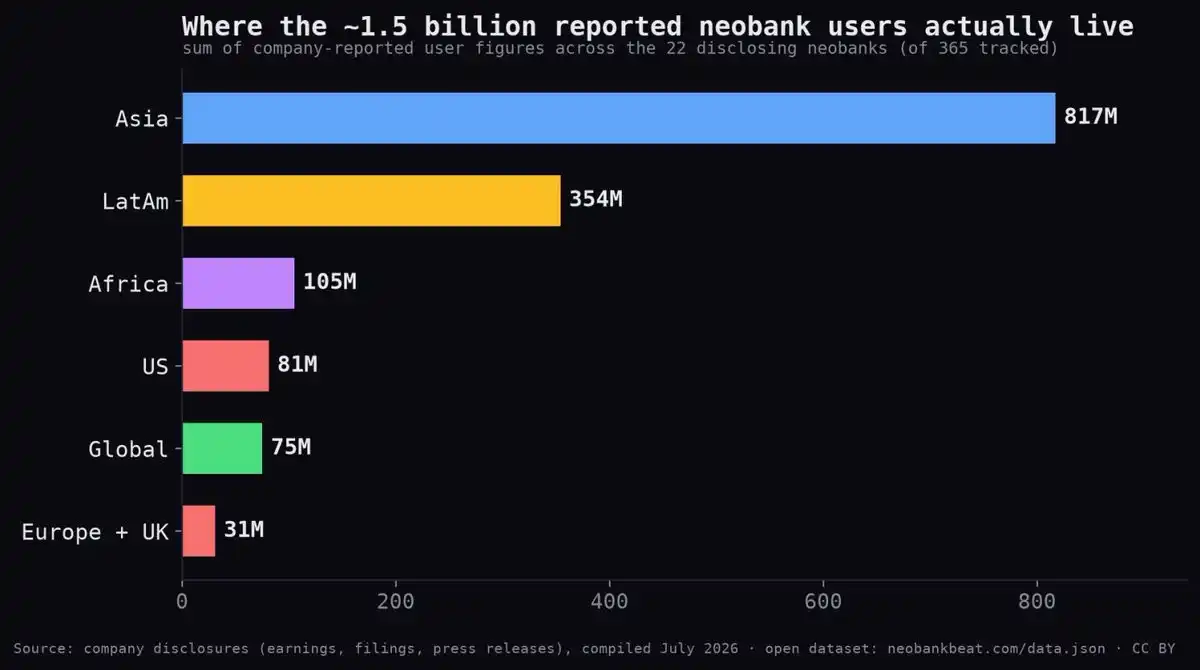
First, let's acknowledge the undeniable rise of the industry. Aggregating the self-reported data from each company in the database, the neobanks we track collectively serve approximately 1.46 billion users. This is not a forecast or a market size projection, but the real customer base reported by each.

The geographical distribution of users will shatter the assumptions of Western fintech media readers: 817 million users are located in Asia. WeBank alone serves over 400 million users, more than the total user base of all US and European neobanks combined. Nubank has 131 million more customers than all US neobanks put together. Revolut, the European benchmark with over 50 million users, is impressive, but it's only a small fraction compared to the Asian market.
The center of innovation has also shifted. Among neobanks founded after 2020 and surviving to this day, 30% are native Web3 self-custody applications where the platform does not hold user funds. Among those founded in the 2010s, this proportion is only 4%. Regardless of how you view cryptocurrency, builders have already voted with their feet.

So, the rise of neobanks is real. These 368 institutions can be divided into three distinct waves: 254 traditional challenger banks, 58 fiat-crypto hybrid platforms, and 56 native Web3 platforms; supported by 106 infrastructure providers and backed by 219 investment firms. The complete ecosystem map is clear.

Next, here's the truth you won't find in any funding pitch deck.

Out of the 368 institutions, only 127 hold full banking licenses.

Yes, two-thirds of the platforms called "banks" in the app stores do not have banking licenses. They operate through partnerships with licensed banks, electronic money licenses, or little-known card issuers. The vast majority of customers can't tell the difference.
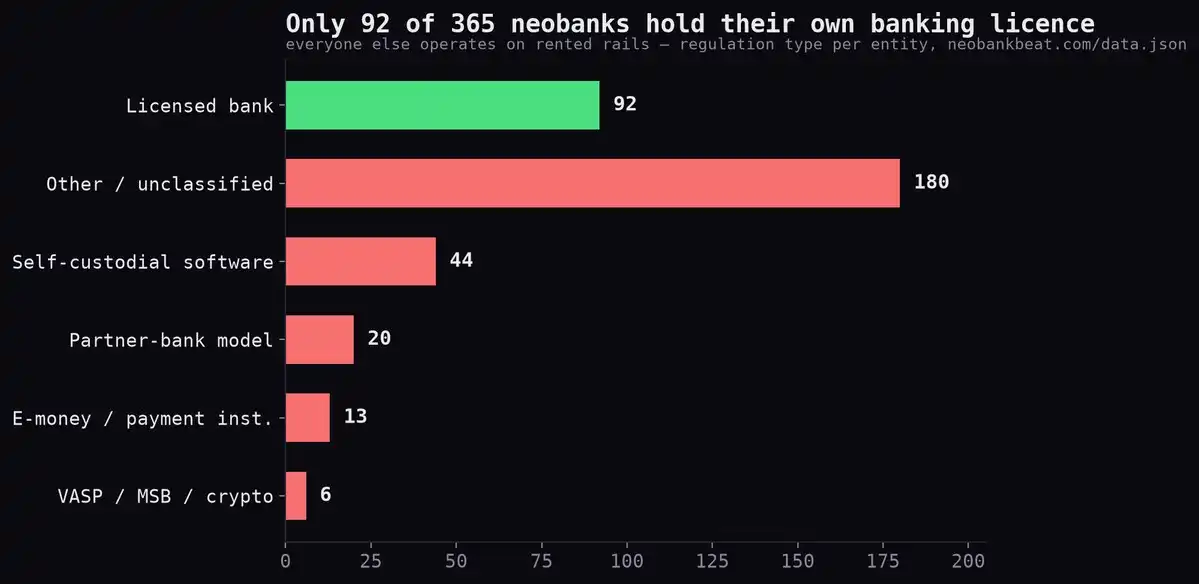
This is not an insignificant technical detail; it is the core structural risk of the entire industry and has already led to multiple incidents:

  • 2018 WaveCrest: Visa terminated the partnership, leading to overnight shutdowns of dozens of crypto card projects;
  • 2020 Wirecard: A €1.9 billion funding gap caused the freezing of many European neobank services built on its platform;
  • 2024 Synapse: The collapse of this Banking-as-a-Service (BaaS) provider made ordinary US users realize that "FDIC insurance" wasn't what they imagined, because the underlying system recording fund ownership had failed;
  • 2026 Ready: History repeats, but with a new cast of characters.

When a traditional bank fails, deposit insurance pays out customer funds. When the infrastructure a neobank relies on collapses, customers can only wait in line during the bankruptcy liquidation process.

The demise in this industry is always silent, which is precisely what is most alarming.

When I first started compiling this database, I didn't anticipate that the removal of names from the list would never stop.
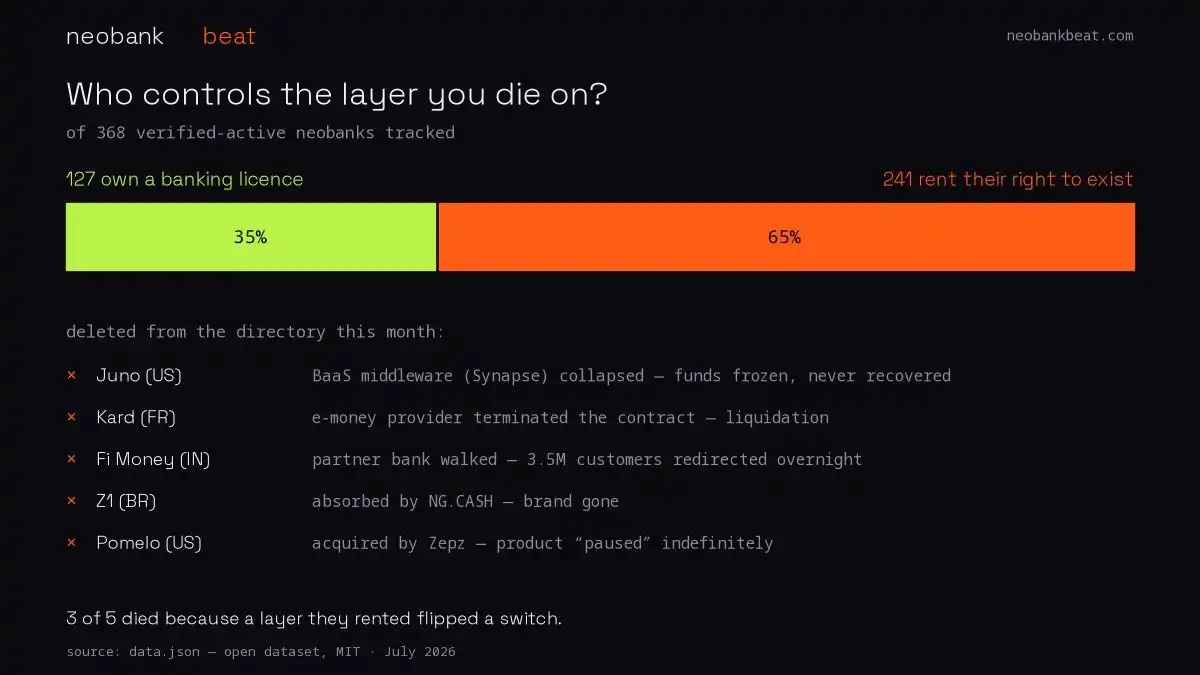
Just this month, five institutions were removed from the list: liquidated, acquired/merged, or quietly pivoted. No press releases, no post-mortems. Neobanks don't collapse dramatically like FTX. The apps simply stop updating, customer service stops responding; one day, the website domain redirects to a partner's page, and hundreds of thousands of customers either move their funds or lose them altogether.

No media writes obituaries for failed neobanks. Fintech media love covering new launches and funding rounds, with ad revenue and industry resources concentrated there. Failed businesses are forever hidden from view. So, a new generation of founders keeps stepping into the same traps, thinking they are the first to spot the problem.

This is precisely why we give equal importance to the birth of new institutions and the exit of old ones. Data on failures is far more valuable than funding news. Press releases don't teach lessons.

"AI Can Solve the Profitability Problem"? Really?

Now, almost every neobank funding pitch deck mentions artificial intelligence. We cross-checked all 368 platforms against regulatory filings, official records, and actual launched products, not just marketing copy.

Only 67 platforms have implemented AI at scale, accounting for 18%. The remaining 300+ are either still piloting, "exploring R&D," or simply claiming proprietary tech by using a partner's model.
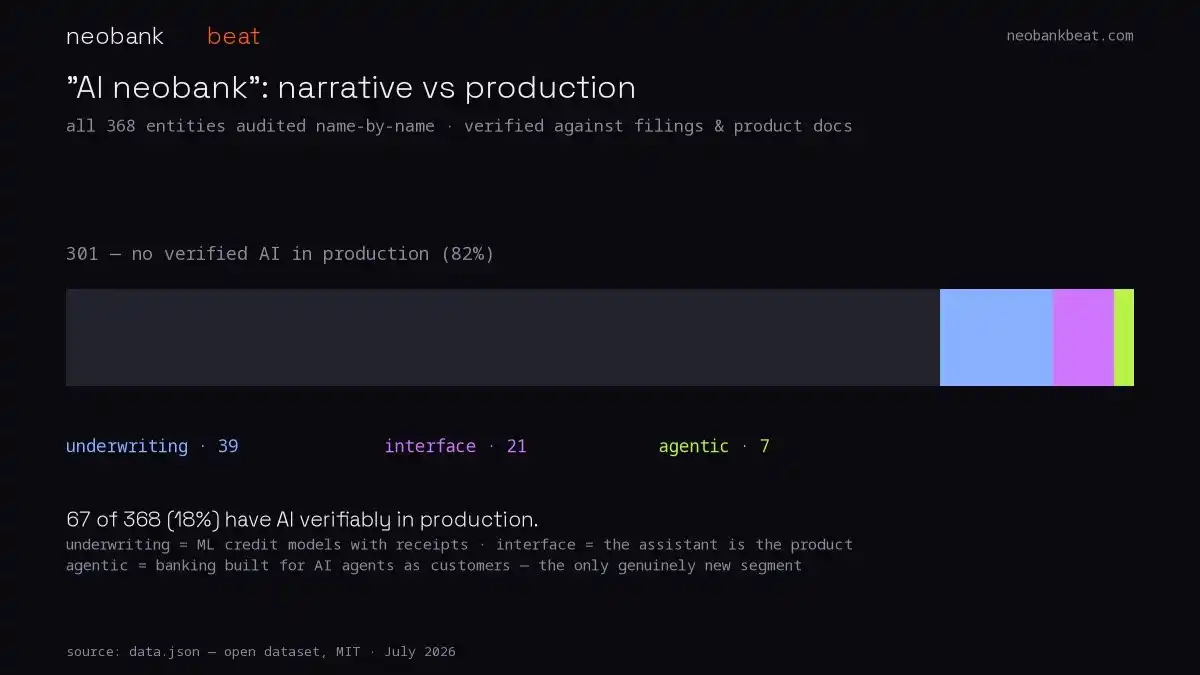
Who are the true pioneers of AI-powered neobanking? The answer is surprising. The early adopters of AI applications in the industry are mostly not well-known giants, but credit institutions in emerging markets like Nigeria, the Philippines, Mexico, and Bangladesh. In regions with underdeveloped credit systems, relying on models to grant credit to people with little history isn't just a product feature; it's the foundation for survival. While Western markets talk about AI banking, markets in the Global South have already implemented it at scale—innovation driven by the necessity to survive.

The Truth Revealed by the Ecosystem Map

Looking across the infrastructure ecosystem, 106 service providers support 368 consumer-facing brands. At this layer, a handful of partner banks, BaaS platforms, and card processors simultaneously host dozens of upper-layer brands. This high degree of concentration, invisible to consumers, is the source of potential risk for the next Synapse-like crisis.

This is the true state of the industry in 2026. The industry has experienced transformative growth, with 1.5 billion people accessing banking services via their phones, many for the first time; but the entire system is built on underlying service providers that the public knows almost nothing about. Two-thirds of the platforms would struggle to survive if their upstream partners faced a crisis.

Finally, I offer three predictions, while accepting they may be proven wrong:

  • The license gap will close from both ends. Well-funded unlicensed platforms will acquire or apply for banking licenses; weaker platforms will exit the market in 2027. Players in the middle ground will disappear.
  • The first AI credit model failure will occur within the next credit cycle. The majority of the 67 scaled models have not yet experienced a full economic downturn. Some teams are about to encounter risk scenarios not covered in their AI training data.
  • The next generation of financial services customers will not be natural persons. Financial infrastructure channels for AI agents, agent-managed wallets, agent-issued cards, and machine-to-machine payments—only 7 companies are currently working on this. The current landscape resembles the Web3 sector in 2021: few participants, niche models, but with long-term structural opportunities.

Related Questions

QHow many digital banks are currently operational according to the author's verified data as of July 2026?

AThere are 368 verified, operational digital banks.

QWhat is the total number of users served by the digital banks tracked in the database?

AThe digital banks in the database collectively serve approximately 1.46 billion users based on their self-reported data.

QWhat major structural risk does the article identify for the neobank industry, and how many active platforms are affected by it?

AThe major structural risk is that many digital banks lack full banking licenses, relying instead on partner banks or other licenses. Out of the 368 active platforms, only 127 hold full banking licenses, meaning two-thirds operate without one.

QAccording to the article, how many of the 368 digital banks have achieved scaled implementation of AI, and which regions are leading in this area?

AOnly 67 out of the 368 digital banks have achieved scaled implementation of AI. The leaders in AI application are often neobanks in emerging markets like Nigeria, the Philippines, Mexico, and Bangladesh.

QWhat are the three predictions the author makes about the future of the digital banking industry?

A1. The licensing gap will close from both ends: strong unlicensed players will acquire licenses, and weak ones will exit, eliminating the middle ground. 2. The first major failure of an AI credit model will occur in the next credit cycle as models face untested economic downturns. 3. The next generation of financial services will cater to AI agents rather than individual humans, with only 7 companies currently exploring this niche.

Related Reads

MSX US Stock Daily Insight: Amazon 2026 Q2 Earnings: AWS Records Fastest Growth in Five Years

**MSX Daily US Stock Observation: Amazon's Q2 2026 Earnings: AWS Achieves Fastest Growth in Five Years** Amazon's latest quarterly results exceeded expectations, driven by a strong performance from its cloud computing unit. The company reported revenue of $200.66 billion, surpassing estimates of approximately $197 billion. The key highlight was Amazon Web Services (AWS), which generated $42.232 billion in revenue, surging 37% year-over-year. This marked the segment's fastest growth pace in 18 quarters, indicating robust demand for cloud services. Reported Earnings Per Share (EPS) of $5.75 significantly exceeded the $1.84 forecast. However, this figure included a substantial one-time, non-operating gain of $53.4 billion, primarily from the revaluation of Amazon's investment in AI company Anthropic. Excluding this item, core operating profit was $27.461 billion, a strong increase of 43% compared to the same period last year. Despite the positive results, Amazon provided guidance for the upcoming third quarter that fell short of market expectations. The company's revenue guidance midpoint is $199.5 billion, below the consensus estimate of around $204 billion. Operating profit guidance of $24.5 billion also slightly missed expectations of approximately $247.9 billion. Furthermore, Amazon raised its forecast for full-year capital expenditures to $220 billion, citing rising memory chip costs, which weighed on investor sentiment regarding future profitability. In summary, Amazon's quarter showcased accelerating momentum in its core AWS business. The underlying operational profit growth remains solid. However, cautious forward guidance and increased investment spending present key areas for monitoring in the coming quarters, as the market assesses whether the current growth phase will translate into sustained profit margin expansion.

Odaily星球日报6m ago

MSX US Stock Daily Insight: Amazon 2026 Q2 Earnings: AWS Records Fastest Growth in Five Years

Odaily星球日报6m ago

Cyclical Stock or Growth Stock? Coinbase's Q2 Earnings Report Reveals 'Valuation Disagreement'

Coinbase's Q2 2026 financial results revealed a mixed performance, reigniting debate over whether the company should be valued as a cyclical stock tied to crypto markets or a growth stock with future potential. Total revenue missed expectations at $1.22 billion, down 19% year-over-year. Transaction revenue fell to $599 million, with retail crypto spot trading revenue dropping 30% to $452 million, back to 2023 levels. The company reported a net loss of $359 million, marking its third consecutive quarterly loss. Despite CEO Brian Armstrong's positive commentary on metrics like a 10.3% overall crypto trading market share and 106% growth in prediction markets, the market reacted negatively, with shares dropping over 5% after-hours. A key issue is the decline in core retail trading. While Coinbase touted record market share, this figure includes derivatives and new products. Its traditional crypto spot trading share is likely shrinking. New ventures like prediction markets, while growing, contributed less than $30 million, insufficient to offset the core revenue decline. The valuation debate hinges on perspective. As a cyclical stock, Coinbase remains deeply tied to the crypto bear market, with user attrition and competitive pressures justifying a lower valuation. The company's strategy appears focused on surviving until the next bull cycle. Viewed as a growth stock, however, Coinbase shows promising diversification. Subscription and service revenue reached $555 million, nearly matching transaction revenue. Stablecoin revenue, its second-largest source at $292 million, remains strong through its partnership with Circle. Critically, Coinbase is positioning itself as a leader in the emerging on-chain "agent economy." Over 90% of agent-based stablecoin transactions occur on its Base network, which it believes could handle trillions in future agent transactions. The recent acquisition of Deribit also aims to boost its international derivatives offering. In summary, Coinbase's present struggles are clear, but its future hinges on whether its investments in revenue diversification, stablecoins, and the agent economy can ultimately transform its business model and justify a growth premium.

Odaily星球日报26m ago

Cyclical Stock or Growth Stock? Coinbase's Q2 Earnings Report Reveals 'Valuation Disagreement'

Odaily星球日报26m ago

Global Market Share Survey: Japanese Firms Lead in Semiconductor Materials

Global Market Share Survey: Japanese Firms Lead in Semiconductor Materials According to the 2025 "Major Goods and Services Market Share Survey" by Nikkei, Japanese companies maintain strong positions in semiconductor-related materials. In silicon wafers, Shin-Etsu Chemical ranks first with a 26.3% share, followed by SUMCO at 17.8%. Together, they hold 44.1% of the market, widening their lead over competitors from Taiwan, Germany, and South Korea. In photoresists, Tokyo Ohka Kogyo, JSR, and Shin-Etsu Chemical occupy the top three spots, with a combined share of 60.5%. Despite their strength in materials, Japanese firms have a weaker presence in core semiconductor segments like DRAM and NAND flash memory, where South Korean and U.S. companies dominate. For instance, SK Hynix and Samsung lead in DRAM, while China’s CXMT doubled its share to 6% in 2025. The semiconductor market is projected to grow rapidly, with WSTS forecasting a 90% increase to $1.5112 trillion by 2026. Major players like Samsung, SK Hynix, and Micron are making massive investments to expand capacity. To maintain their edge in materials, Japanese companies must similarly commit to large-scale, risk-taking investments. In contrast, Japan’s automotive sector shows stagnation. Toyota remains the global leader but with only a slight share increase to 12.3%, while Japanese brands are absent from the top five in the EV market. In shipbuilding, Imabari Shipbuilding rose to third place globally with a 7.2% share, benefiting from large container ship deliveries. However, Chinese and South Korean firms dominate the sector, holding the top two positions. Japan aims to revitalize its shipbuilding industry through government and corporate efforts, targeting a near doubling of output by 2035. Addressing labor shortages and adopting advanced technologies like physical AI will be critical for competitiveness.

marsbit50m ago

Global Market Share Survey: Japanese Firms Lead in Semiconductor Materials

marsbit50m ago

Trading

Spot
活动图片