$700 Billion Poured into AI, Americans Taste the Bitter Fruit of Inflation First

marsbitPublished on 2026-04-02Last updated on 2026-04-02

Abstract

A Federal Reserve analysis from the St. Louis Fed argues that AI optimism itself is a driver of inflation. The "news shock" of AI's revolutionary potential causes households and businesses to increase spending and investment in anticipation of future gains, pushing demand beyond current supply and creating inflationary pressure. This is supported by a Deutsche Bank experiment where AI models (dbLumina, Claude, ChatGPT-5.2) assessed a 20-40% probability that AI would raise inflation in the next year, citing surging demand for data centers, semiconductors, and electricity. They saw only a 5% chance of AI significantly reducing inflation. Massive capital expenditure underscores this demand. Amazon, Microsoft, Google, and Meta are projected to spend a combined ~$663B in 2026, a fourfold increase in four years. A significant portion funds power-hungry data centers. For example, OpenAI's "Stargate" project plans a 10-gigawatt capacity, equivalent to the entire electricity load of 16 Vermont states. U.S. data center electricity consumption is forecast to triple by 2030. While AI could eventually boost productivity and be disinflationary long-term, current data shows no such productivity jump. The U.S. economy now faces a cycle: massive AI investment fuels inflation, delays interest rate cuts, raises financing costs—yet the investment continues to accelerate. The outcome hinges on whether these AI models will ultimately make the economy more efficient, a question that remains unan...

On April 1, St. Louis Fed economists Miguel Faria-e-Castro and Serdar Ozkan published a blog post with a restrained title and a sharp conclusion: AI optimism itself is an inflation driver. Not because electricity bills are rising, not because of a chip shortage, but because everyone believes AI will make the future better—this belief makes them spend more money now.

On the same day, Fortune disclosed an experiment by Deutsche Bank: they had three AI models evaluate the "impact of AI on inflation." The conclusion was that even AI itself believes it is pushing up prices.
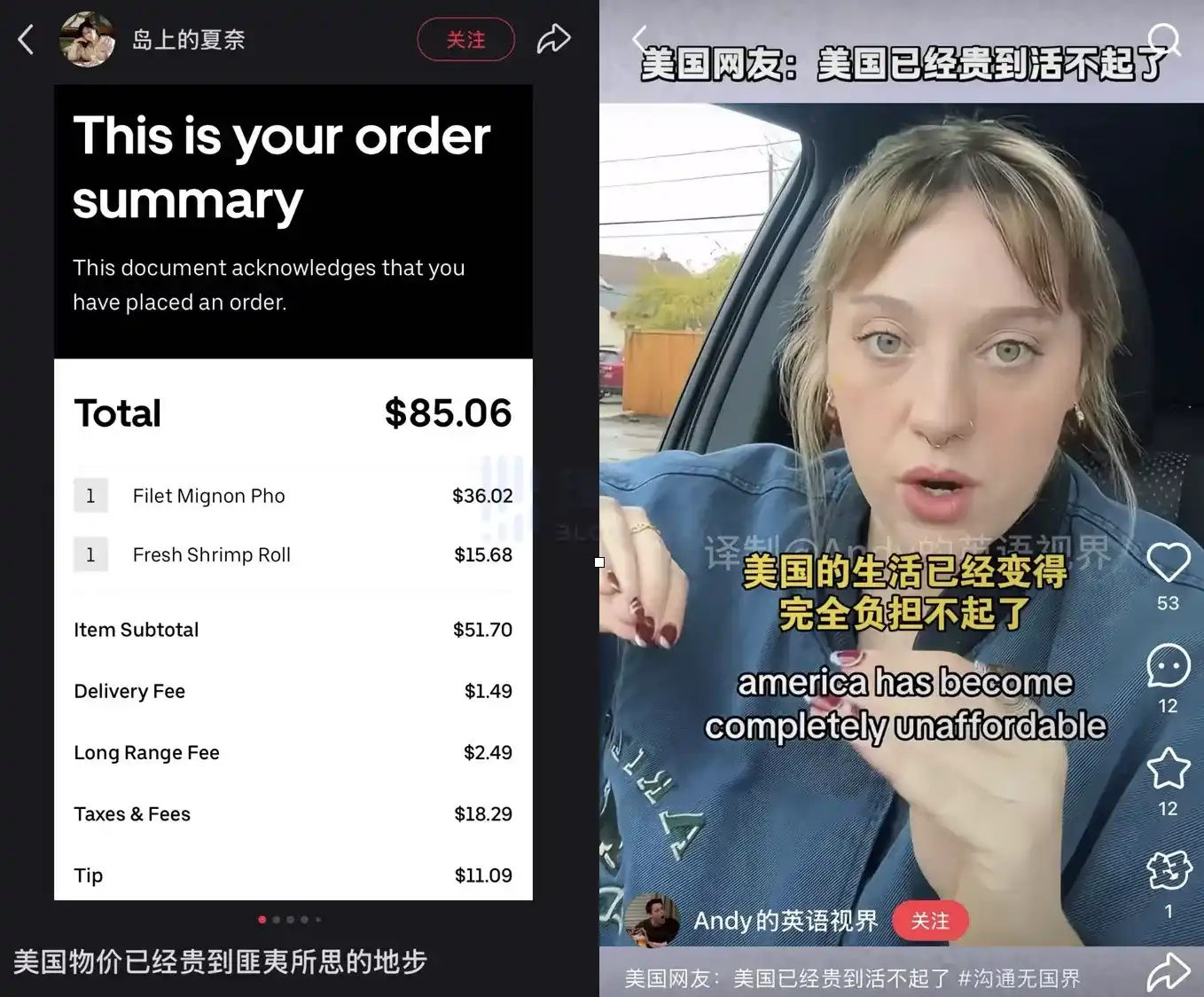

On social media, posts about soaring US prices are abundant

These two pieces together point to an uncomfortable cycle: the more investment in AI, the higher inflation, the further away interest rate cuts are, the higher financing costs become—yet investment continues to accelerate.

The Unstoppable Arms Race

First, look at the money. According to company financial reports, the combined capital expenditures of Amazon, Microsoft, Google, and Meta in 2023 were approximately $152 billion. By 2024, this number jumped to $251 billion, a 65% increase. For the full year 2025, it settled at $416 billion, another 66% increase.

Company guidance for 2026 is even more aggressive. According to a summary by Wolf Street, Amazon guided for $200 billion, Google for $175 to $185 billion, Microsoft for $145 to $150 billion, and Meta for $135 billion. The four together amount to about $663 billion. Adding Oracle's $42 billion, the total for the five companies approaches $700 billion.
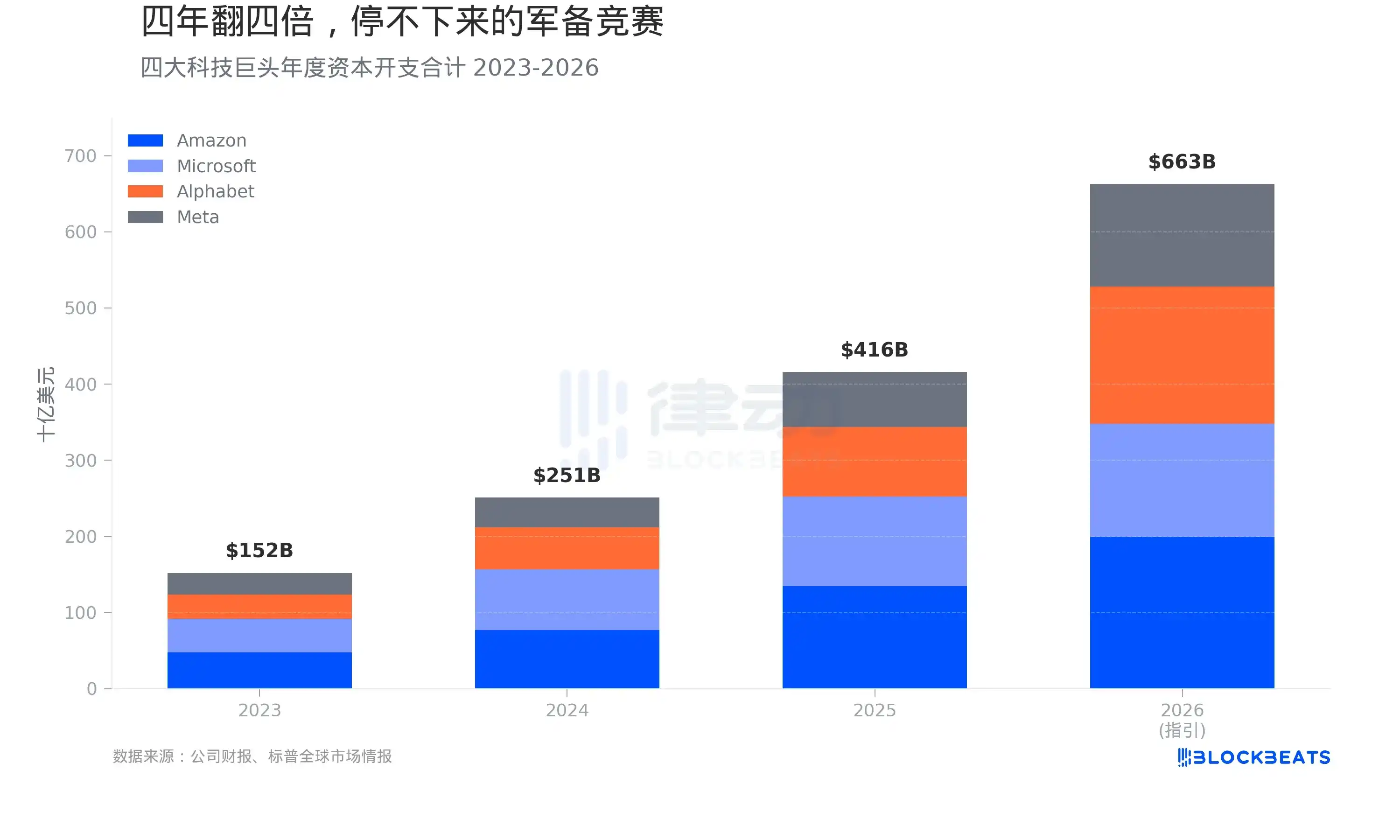
In four years, the capital expenditures of these four companies have quadrupled. This growth rate is unprecedented in US corporate history. According to a Fortune report, this scale already exceeds Sweden's annual GDP.

One Data Center, Consuming as Much Power as an Entire State

Most of this money is flowing into data centers. And the biggest bottleneck for data centers is not land, but electricity. According to EIA data, Vermont's annual electricity consumption is about 5,364 GWh, which translates to an average load of 0.61 GW. Rhode Island is slightly higher, about 0.83 GW.

Now look at what data centers are doing. According to company announcements, the total planned power capacity for the Stargate project, a collaboration between OpenAI, Oracle, and SoftBank, reaches 10 GW, equivalent to the entire electricity consumption of 16 Vermonts. Meta's Hyperion campus in Louisiana is planned for 5 GW, with an investment of $27 billion. Musk's xAI Colossus in Memphis, Tennessee, has expanded to 2 GW; according to an Introl report, it deployed 555,000 Nvidia GPUs, costing about $18 billion. Amazon and Anthropic's joint Project Rainier in Indiana is planned for 2.2 GW.
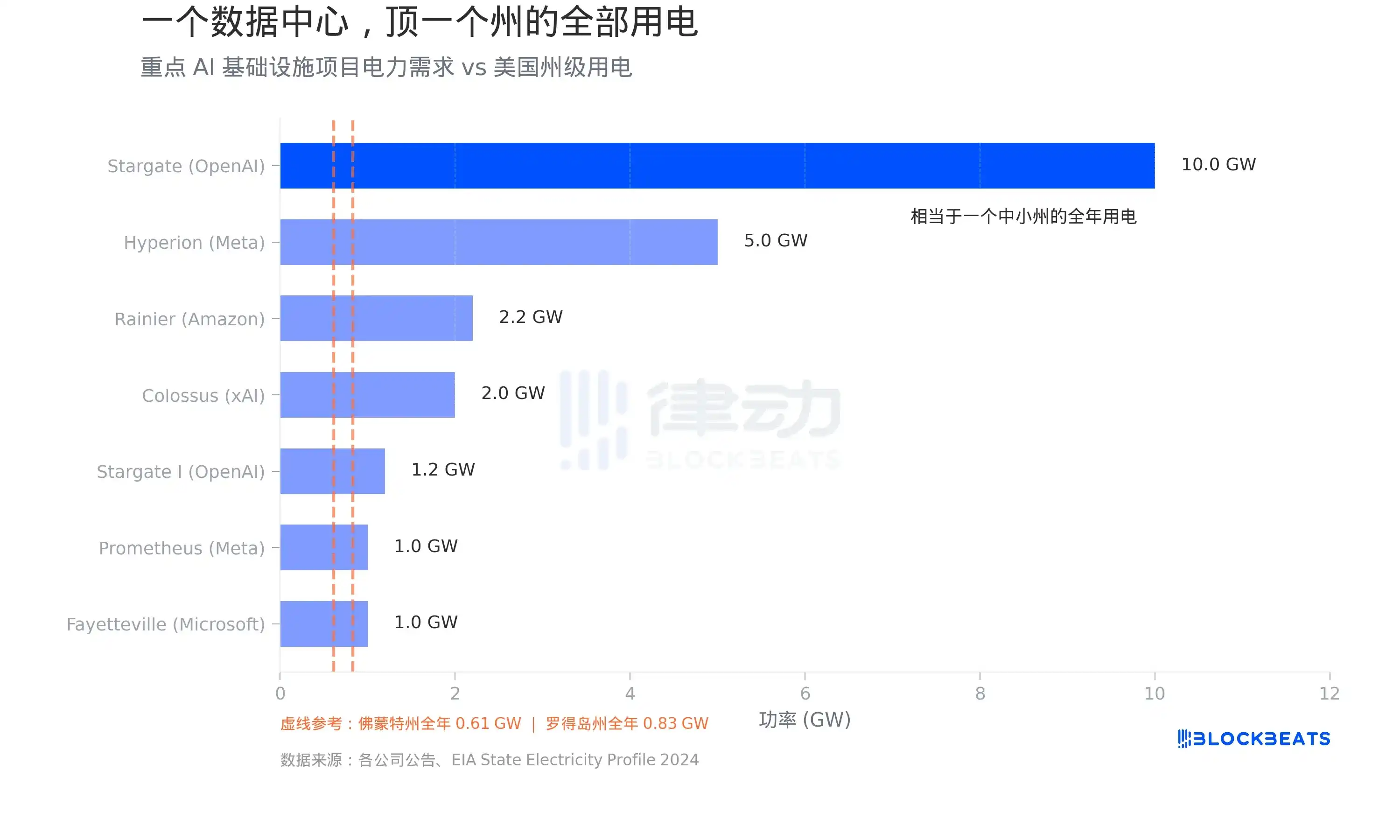
According to S&P Global data, US data centers consumed 183 TWh of electricity in 2024, accounting for over 4% of the nation's total electricity consumption. By 2030, this number is expected to triple.

This power demand is not a distant, planned story; it is already straining existing grids. According to a CBRE report, the vacancy rate for North American data centers dropped from 3.3% in the first half of 2023 to a record low of 1.6% in the first half of 2025. According to Cushman & Wakefield data, the vacancy rate slightly recovered to 3.5% in the second half of 2025, but only because a large amount of new capacity was delivered—absolute levels remain at historical lows, and meaningful supply relief is unlikely to appear before 2030.

Even AI Itself Says It's Pushing Up Inflation

While these investments are driving demand, pushing up electricity prices, and causing chip shortages, there is also a more hidden inflation channel.

According to a Fortune report on April 1, a team led by Deutsche Bank's chief US economist, Matthew Luzzetti, conducted an experiment: they asked Deutsche Bank's own model dbLumina, Anthropic's Claude, and OpenAI's ChatGPT-5.2 to respectively assess the "probability that AI will push up inflation in the next year."

Results: dbLumina gave 40%, Claude gave 25%, and ChatGPT-5.2 gave 20%. All three models were consistent in their assessment of the probability of "AI significantly reducing inflation": only 5%.
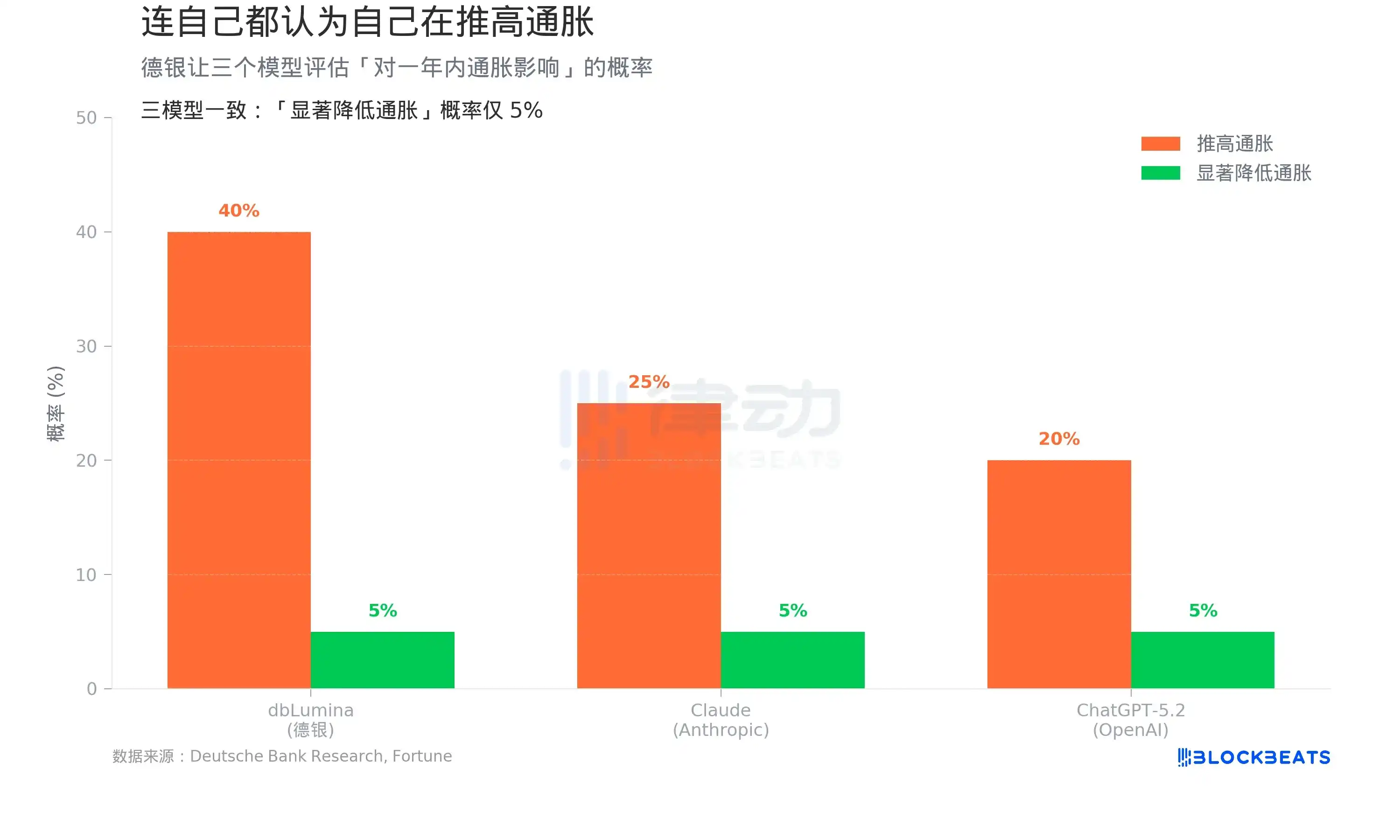
The inflation drivers cited by the three models were highly consistent: data centers are expanding massively, semiconductor demand is soaring, and the power consumption of AI workloads is growing rapidly—all of these are demand-pull price pressures.

This is the opposite of the consensus among some Wall Street investors. The Deutsche Bank team wrote in their research report: "Will AI be a major deflationary force? Even AI itself doesn't think so."

On a five-year horizon, the models did turn to more deflationary possibilities. But the probability of "AI causing large-scale deflation" is still relegated to the tail risk zone.

Optimism Itself Is Inflationary

The St. Louis Fed paper provides a theoretical framework to explain all of this.

Faria-e-Castro and Ozkan used a standard macroeconomic model, defining the AI investment boom as a "news shock." According to the Fed blog post, the model's logic is: when households see AI described as a revolutionary technology, they expect future income to rise and increase consumption提前 (in advance). Firms expect productivity gains and increase investment. The two combined cause demand to quickly exceed supply. The paper states: "These forces together generate an inflationary surge in aggregate demand—a core feature of the initial phase of a news shock."

The model presents two paths. If AI does bring a productivity leap, short-term inflation will be digested by long-term output growth, and the economy enters a virtuous cycle. But if productivity does not materialize—the paper uses the term "persistent low growth and stubborn high inflation," i.e., stagflation.
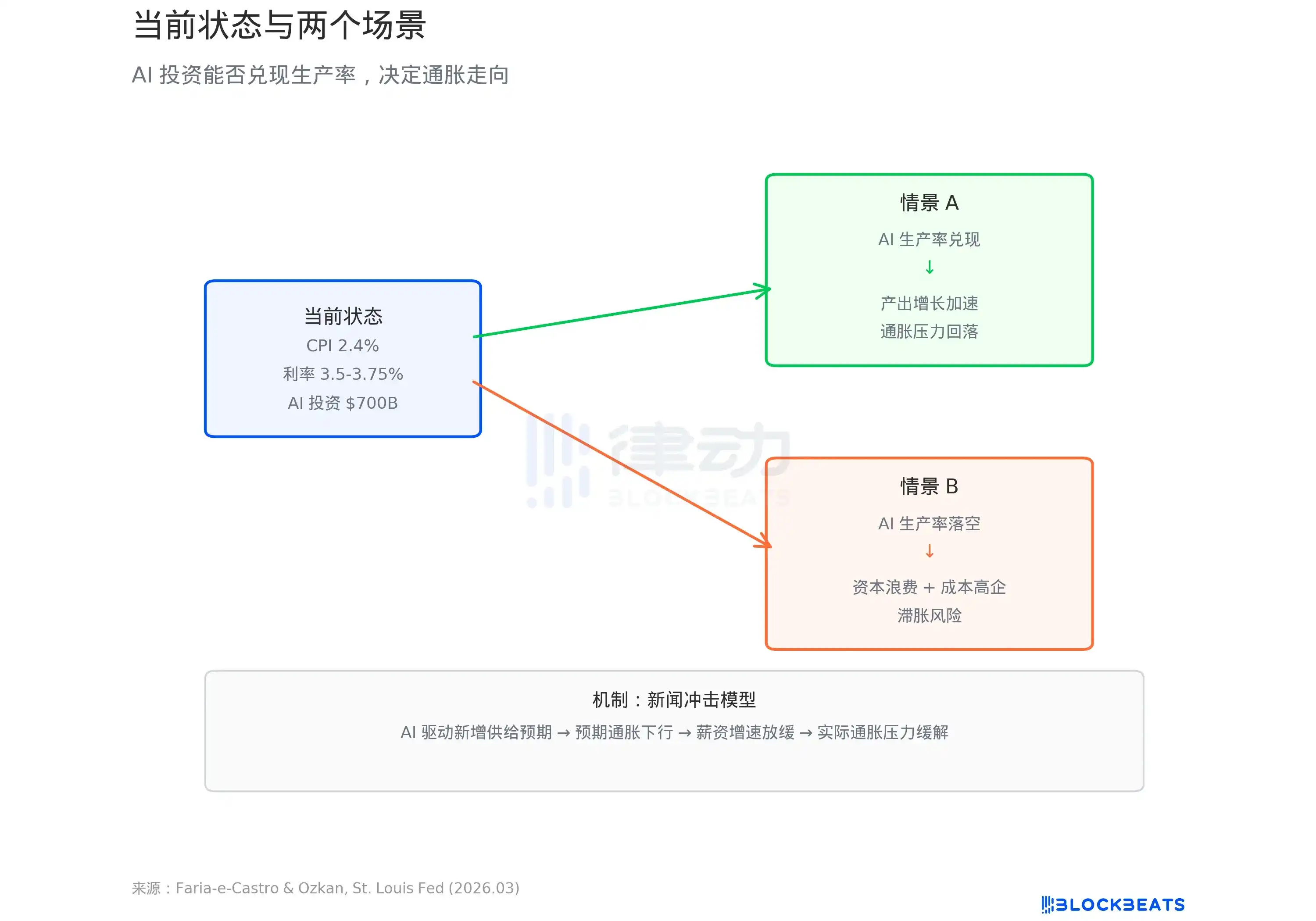
According to data cited in the Fed blog post, the annualized growth rate of US Total Factor Productivity (TFP) since the release of ChatGPT has been 1.11%, lower than the historical average of 1.23%. So far, AI has left no mark on productivity data.

Meanwhile, according to BLS data, the US CPI in February 2026 was 2.4% year-on-year, and core CPI was 2.5%, neither yet back to the Fed's 2% target. The Fed's March dot plot shows a median forecast for the year-end rate of 3.4%, pointing to only one rate cut this year.

$700 billion is pouring into AI infrastructure. Whether this money is a cause of inflation or the prelude to a productivity revolution depends on a question no one can yet answer: will the models running in these data centers actually make the economy more efficient.


Trending Cryptos

Related Questions

QAccording to the St. Louis Fed economists, what is the primary mechanism through which AI optimism is driving inflation?

AThe primary mechanism is a 'news shock' where households, believing AI will increase future income, increase current consumption, and firms, expecting productivity gains, increase investment. This surge in aggregate demand outpaces supply, creating inflationary pressure.

QHow much did the combined capital expenditures of Amazon, Microsoft, Google, and Meta increase from 2023 to their projected 2026 total?

ATheir combined capital expenditures increased from $152 billion in 2023 to a projected total of approximately $663 billion in 2026 for the four companies, representing a more than fourfold increase.

QWhat was the consensus among the three AI models (dbLumina, Claude, ChatGPT-5.2) regarding AI's probability of significantly lowering inflation in the next year?

AThe consensus was a low probability of only 5% for AI significantly lowering inflation in the next year.

QWhat is the major bottleneck for the expansion of AI data centers mentioned in the article?

AThe major bottleneck is the supply of electricity, not land.

QWhat does the St. Louis Fed model present as the two potential economic outcomes from the current AI investment boom?

AThe two potential outcomes are: 1. A benign cycle where short-term inflation is digested by long-term output growth if AI delivers a productivity leap. 2. Stagflation, characterized by persistent low growth and stubborn high inflation, if productivity gains fail to materialize.

Related Reads

NVIDIA CPU Advances, China's RISC-V Responds: Semiconductor Deep Dive - Part Four

NVIDIA is set to launch its new Vera AI data center CPU in China as early as August, with high pricing. While this move offers a new option, it highlights China's continued dependence on foreign-controlled Arm architecture. In response, the Chinese semiconductor industry is increasingly turning to RISC-V as a strategic alternative for achieving high-performance computing autonomy. The article explores the concept of the "impossible triangle" in CPU development—balancing prosperity, control, and autonomy—and posits that RISC-V's open-source, modular nature offers a unique path to achieving all three. While RISC-V is already dominant in embedded systems, the focus is now shifting to data centers and AI workloads. China has become a global hotspot for RISC-V development, driven by AI-driven compute demand, supply chain concerns from export controls, cost benefits of open-source, and strong policy support. Multiple Chinese companies have reportedly crossed the key performance threshold of 15 SPECint per GHz, a benchmark for entering the high-performance CPU club. Progress extends beyond single-core benchmarks. Companies are developing complete computing subsystems, including commercial-grade coherent network-on-chip (NoC) technology and server processors with up to 40 cores that strictly adhere to the RVA23 standard to ensure software compatibility. Real-world applications are emerging in areas like video transcoding and edge AI. However, significant challenges remain. The RISC-V ecosystem faces fragmentation, immature toolchains and verification processes, and gaps in single-core performance and energy efficiency compared to mature x86 and Arm architectures. The formidable software moat, epitomized by NVIDIA's CUDA, is a long-term hurdle. In conclusion, while RISC-V cannot immediately replace offerings like NVIDIA's Vera, it represents a viable long-term path for China to develop a self-sufficient, high-performance CPU ecosystem. The journey is acknowledged to be long and arduous, requiring sustained effort to overcome technical and ecosystem challenges.

marsbit5h ago

NVIDIA CPU Advances, China's RISC-V Responds: Semiconductor Deep Dive - Part Four

marsbit5h ago

My Coding Betting Dashboard is Profiting, but Polymarket is Truly Not a Good Place for 'Arbitrage'

The author built a custom monitoring dashboard for Polymarket, a prediction market platform, and tested it with $1,600, achieving over 30% returns. However, the core argument is that Polymarket is not a good venue for traditional arbitrage. The dashboard has two main sections: a "Portfolio Dashboard" for tracking active positions with key metrics like total capital, P&L, and a risk-control module using a tier system (T1, T2, T3), and an "Opportunity Watchlist" for monitoring markets. The article details a critical structural trap in binary markets: a bet with a high perceived probability of success still carries a 100% loss risk if wrong. The author's T1/T2/T3 system is designed to manage this by limiting position sizes based on conviction and time horizon, emphasizing that high confidence should not equal high concentration. A key insight is the danger of "pseudo-diversification"—betting on different markets driven by the same underlying variable. The author concludes that Polymarket offers few true low-risk, arbitrage opportunities. It is instead a high-risk environment where wins can create a false sense of mastery, leading to large losses. The platform is better viewed as a training ground for honing judgment through disciplined, framework-driven betting rather than a reliable income source. The tools help transform intuition into structured, rule-based decisions to mitigate the risk of catastrophic errors.

marsbit8h ago

My Coding Betting Dashboard is Profiting, but Polymarket is Truly Not a Good Place for 'Arbitrage'

marsbit8h ago

WeChat AI Card Hands-On Guide: Has the AI Shopping Era Arrived?

**"WeChat AI Card" Practical Test Guide: Has the Era of AI Shopping Arrived?** WeChat has officially launched the "AI Exclusive Card," a feature integrated into its Workbuddy AI assistant. This card is designed to handle payments for AI-initiated purchases. Our hands-on test reveals it's not yet a tool for fully autonomous AI shopping, but rather a controlled payment layer for AI agents. The AI Card functions as an isolated sub-wallet within WeChat Pay. Users must bind the card and transfer funds into it from their main wallet. Crucially, every transaction requires explicit user confirmation via smartphone scan; AI cannot spend autonomously. Currently accessible through the Workbuddy agent, the card targets specific digital consumption scenarios: purchasing paid content (reports, data), calling paid APIs/tools, and subscribing to services. Its design prioritizes security and control by separating funds and mandating approval for each payment. We tested a real-world scenario: ordering bubble tea via Workbuddy using a "Meituan Life Assistant" skill. The process encountered multiple hurdles: high "skill" usage costs (exceeding daily free credits), and most importantly, while a payment was successfully initiated, the AI purchased an incorrect product (a mismatched group-buy coupon instead of the desired drink). This highlights the current limitation: the **AI Card only solves the payment step**. The broader challenge lies in the **AI agent's execution chain**—accurately understanding intent, navigating third-party platforms, selecting the right product, and ensuring proper fulfillment. The payment succeeded, but the purchase failed to meet the user's need. In conclusion, the WeChat AI Exclusive Card is a cautious, early-step experiment in AI commerce. It provides a secure, user-controlled payment method for agent interactions but is not yet capable of reliable, end-to-end complex purchases. For now, it's best used for low-value, low-risk digital services with careful user verification at each step. The vision of AI handling complete shopping tasks remains a work in progress.

marsbit11h ago

WeChat AI Card Hands-On Guide: Has the AI Shopping Era Arrived?

marsbit11h ago

Trading

Spot
Futures

Hot Articles

Discussions

Welcome to the HTX Community. Here, you can stay informed about the latest platform developments and gain access to professional market insights. Users' opinions on the price of AI (AI) are presented below.

活动图片