Un géant des produits d'entretien devient discrètement champion du "lavage de puces"

marsbitPublished on 2026-08-20Last updated on 2026-08-20

Abstract

Le géant japonais des produits d'entretien Kao, connu pour ses détergents et cosmétiques, est devenu un leader méconnu dans les détergents de nettoyage de précision pour semi-conducteurs. Son activité chimique liée à ce secteur, en croissance de 9,4% et représentant 247,2 milliards de yens, est le segment qui progresse le plus vite. Kao détient environ 60% du marché des détergents pour le nettoyage des substrats d'encapsulation (back-end) et est numéro un pour certains produits chimiques utilisés dans la fabrication de mémoires NAND (front-end). Ses clients incluent TSMC, Samsung et Kioxia. Cette expertise trouve son origine dans les compétences historiques de Kao en chimie des surfaces et des tensioactifs, développées pour ses produits grand public. Face à l'interdiction du fréon dans les années 1990, Kao a appliqué ce savoir-faire pour créer des détergents aqueux de remplacement, pénétrant ainsi le marché du nettoyage électronique. Aujourd'hui, Kao propose une large gamme de produits pour les procédés front-end (nettoyage de plaquettes, élimination de particules, enlèvement de résine photosensible) et back-end (nettoyage des substrats d'encapsulation avancés). Sa force réside dans sa technologie de "contrôle d'interface de précision", assurant un nettoyage uniforme dans des structures nanométriques sans endommager les matériaux. Pour consolider sa position, Kao adopte une stratégie de partenariat étroit avec les fabricants. Elle a ouvert des centres de nettoyage de préci...

Rapporté par CoreThings le 19 août 2026, le 5 août, le géant japonais des produits d'entretien Kao a publié ses résultats semestriels pour l'année fiscale 2026. Dans les rapports financiers de cette entreprise connue pour ses lessives et gels nettoyants, une ligne d'activité peu connue du grand public est devenue le moteur principal de la croissance : les agents de nettoyage de précision pour semi-conducteurs.

Le rapport montre que, dans les procédés back-end des semi-conducteurs, Kao détient environ 60% de part de marché pour les agents de nettoyage de précision des substrats de boîtier (package substrates). Dans les procédés front-end, Kao occupe la première place en termes de part de marché pour les produits chimiques utilisés dans certains procédés de fabrication de NAND.

Sur la même période, les activités chimiques de Kao, incluant les agents de nettoyage de précision pour semi-conducteurs, ont réalisé un chiffre d'affaires net de 247,2 milliards de yens (environ 10,44 milliards de yuans RMB), soit une croissance de 9,4%, plus du double du taux de croissance de ses activités de biens de consommation, en faisant le secteur à la croissance la plus rapide. Actuellement, les agents de nettoyage de Kao ont intégré les chaînes d'approvisionnement de grands fabricants de semi-conducteurs tels que TSMC, Samsung et Kioxia.

Lors de la conférence téléphonique sur les résultats du 5 août, un cadre de Kao a déclaré que l'entreprise s'orientait vers des activités à haute valeur ajoutée comme les matériaux électroniques et les produits liés aux semi-conducteurs, étendant ses activités chimiques front-end de la NAND vers les domaines plus en vogue de la DRAM et des semi-conducteurs logiques.

Comment une entreprise connue pour ses détergents et produits de soins personnels a-t-elle pu occuper une position de leader dans un segment de marché aussi exigeant que celui des matériaux pour semi-conducteurs ?

01. Des débuts avec un savon à une entrée sur le marché du nettoyage de précision dans les années 1990

En 1887, le fondateur de Kao, Tomiro Nagase, a ouvert une épicerie appelée "Nagase Shoten" à Tokyo, vendant principalement divers produits occidentaux, le savon étant une catégorie importante.

À l'époque, le savon au Japon dépendait principalement des importations, était cher, et la qualité du savon produit localement n'était pas élevée. Tomiro Nagase a vu une opportunité et, trois ans plus tard, a développé un savon facial de qualité raisonnable à un prix abordable. Ce savon fut plus tard baptisé "Kao", donnant ainsi son nom à l'entreprise.

Le fondateur de Kao, Tomiro Nagase, et les produits savons Kao

Les affaires de savon ont rapidement atteint un plafond : les matières premières. Le cœur du savon est la graisse, et la technologie de transformation profonde des graisses était détenue par les fabricants occidentaux. Pour ne pas être à la merci des matières premières, en 1925, l'usine de Tokyo de Kao est mise en service, permettant une production à l'échelle de glycérine ; en 1928, Kao a créé la première graisse de cuisson industrielle pour aliments du Japon, étendant l'application des graisses du savon à l'alimentation. Le secteur chimique des graisses, initialement dérivé de la fabrication du savon, est progressivement devenu une activité indépendante.

En 1951, Kao a commencé à vendre des agents de surface, l'ingrédient clé des détergents synthétiques, ce qui est à l'origine de l'activité "Kao Chemical". Les agents de surface peuvent manipuler tout ce qui se passe au contact d'un liquide et d'un solide : mouillage, pénétration, dispersion, décollage. En maîtrisant cette technologie, Kao a obtenu un laissez-passer pour presque tous les "problèmes d'interface".

Au cours des décennies suivantes, l'activité chimique de Kao s'est étendue le long de cette ligne : dans les années 1960, leurs catalyseurs de polyuréthane et adjuvants pour béton ont été utilisés dans la construction d'autoroutes et de gratte-ciel ; les agents de désencrage des papiers usagés lancés dans les années 1970 ont profité de la vague du papier recyclé ; les liants de toner pour photocopieurs des années 1980 ont suivi la vague de l'automatisation de bureau. Ces produits appartenaient à des secteurs apparemment sans rapport, mais leur cœur restait toujours le contrôle de l'interface.

L'intersection de Kao avec les semi-conducteurs a commencé avec un remaniement industriel déclenché par une réglementation environnementale. Le fréon était le solvant dominant pour le nettoyage des circuits imprimés et des composants de précision à l'époque, performant, volatile, non inflammable, et l'industrie en dépendait profondément. Cependant, avec la signature du Protocole de Montréal en 1987, les composés chlorofluorocarbonés (représentés notamment par le fréon) destructeurs de la couche d'ozone sont entrés dans un compte à rebours d'élimination.

Sous cette interdiction, les substituts devaient simultanément répondre à plusieurs conditions presque contradictoires : éliminer les résidus de graisse et de flux, ne pas corroder les métaux et les résines, être facile à rincer, et les effluents devaient pouvoir être traités. Les divers solvants de remplacement apparus successivement présentaient chacun des lacunes évidentes, plongeant temporairement l'industrie dans une impasse de "ce qui est conforme n'est pas efficace, ce qui est efficace n'est pas conforme".

C'était précisément le point fort de Kao. L'une des principales contradictions du développement des produits d'entretien est l'équilibre entre le pouvoir nettoyant et la douceur, et l'accumulation de Kao en matière de purification des matières premières et de formulation à faible résidu correspondait justement aux exigences de pureté du nettoyage électronique.

En 1991, Kao a lancé l'agent de nettoyage aqueux CLEANTHROUGH, remplaçant le fréon par un système formulé d'agents de surface, pénétrant ainsi le marché du nettoyage de précision et accumulant des données de procédé et des relations clients pour sa future entrée dans le nettoyage des semi-conducteurs.

02. Des produits couvrant les procédés front-end et back-end des semi-conducteurs, s'étendant aux étapes adjacentes

Au cours des trente années suivantes, la gamme de produits CLEANTHROUGH de Kao s'est étendue le long de la voie de la modernisation de la fabrication électronique. En 2001, Kao a mis en production un agent de polissage pour la fabrication des plateaux de disques durs (HDD), étendant ses produits du nettoyage à l'étape de meulage ; par la suite, avec la réduction continue des procédés des puces, l'objet de nettoyage de ses produits est passé des circuits imprimés aux wafers, établissant progressivement un système de produits couvrant le rinçage des tranches de silicium, l'élimination des particules, l'amélioration du mouillage et le décapage des photorésines, avec presque une étape de nettoyage ayant son produit correspondant.
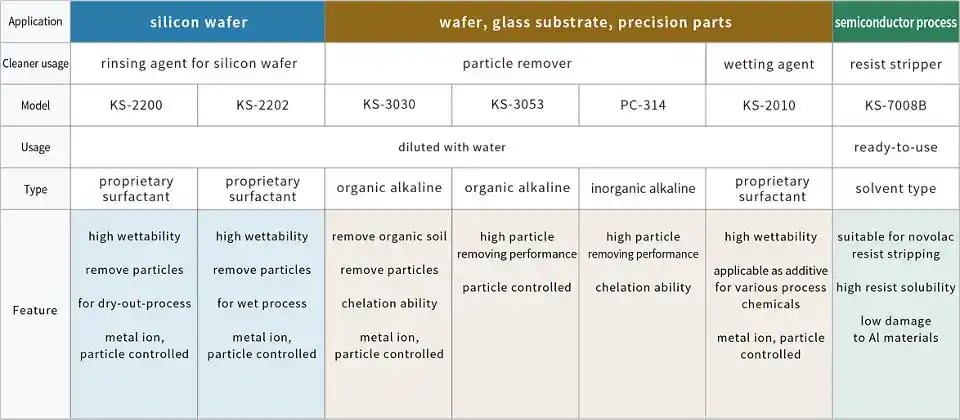
Sous-tendant ces produits se trouve ce que Kao appelle la "technologie de contrôle d'interface de précision". En principe, son essence est d'atteindre une uniformité de l'action de nettoyage sur des structures complexes à l'échelle nanométrique, tout en maintenant une sélectivité vis-à-vis de divers matériaux, et en atteignant les spécifications de pureté, de contrôle des particules et des impuretés métalliques requises par l'industrie des semi-conducteurs.

Concrètement, dans l'étape de fabrication front-end des wafers, le nettoyage représente environ 30% du nombre total d'étapes. Les procédés avancés ont une faible tolérance aux particules, ions métalliques et résidus organiques, et des résidus superflus peuvent facilement affecter le rendement. Le nettoyage RCA traditionnel repose sur des cycles multiples de produits chimiques forts comme le peroxyde d'hydrogène, l'acide sulfurique, l'ammoniaque, l'acide fluorhydrique, etc., présentant des problèmes tels que l'endommagement de la surface du wafer, une forte consommation d'eau et d'électricité, et un lourd fardeau de traitement des effluents.

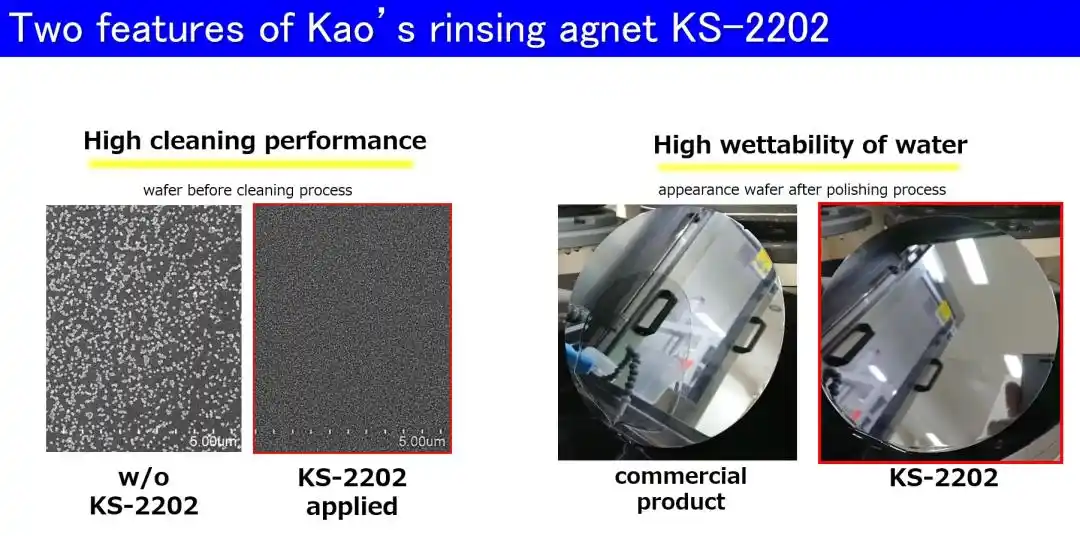
Le point d'entrée de Kao est la série d'agents de prénettoyage et de rinçage des tranches de silicium KS-2200 : selon les estimations de Kao, après polissage avec un abrasif en dioxyde de silicium, environ 7 000 milliards de particules adhèrent à la surface d'un wafer de 300 mm, et la surface du silicium étant naturellement hydrophobe, il est difficile pour les solutions chimiques de pénétrer uniformément. La série KS-2200 modifie chimiquement la surface du silicium pour la rendre superhydrophile, améliorant ainsi la mouillabilité, permettant à un film d'eau de s'étaler uniformément, supprimant mécaniquement l'adhérence des particules et réduisant ainsi le nombre de cycles de nettoyage.
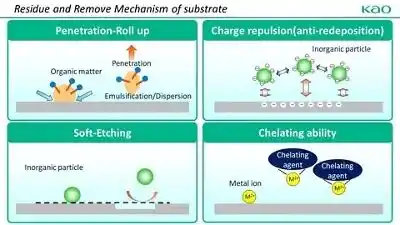
Un autre indicateur clé de l'élimination des particules est la prévention de la recontamination. La série KS-3000 de Kao est destinée aux scénarios de nettoyage post-CMP, masques optiques, supports en quartz, etc. Elle améliore la stabilité de dispersion des particules grâce aux agents de surface et régule le potentiel Zeta de la surface des particules pour créer une répulsion électrostatique, inhibant ainsi la réadhésion des particules de dioxyde de silicium ou de cérium déjà éliminées lors du processus de rinçage.
En matière de décapage des photorésines, la série KS-7000 de Kao utilise un mécanisme de gonflement et de décollage plutôt que de dissolution chimique, réduisant le risque d'endommagement des lignes métalliques sous-jacentes ; les agents de mouillage semi-aqueux comme le KS-2010 sont utilisés pour améliorer l'infiltration des solutions chimiques dans les structures à interstices étroits.

L'étape d'encapsulation est le domaine où la part de marché de Kao est la plus élevée. Les largeurs et espacements de lignes des substrats ABF haut de gamme sont désormais inférieurs à 10 microns, avec des micro-vias profonds et étroits. Les résidus de forage, de placage ou de flux, s'ils ne sont pas complètement éliminés, peuvent provoquer des courts-circuits ou des défaillances de fiabilité dues à la migration ionique.

La difficulté de cette étape réside dans la sélectivité : sur un même substrat coexistent divers matériaux tels que le cuivre, la résine, le nickel, l'or, etc. L'agent de nettoyage doit pénétrer les structures micro-fines pour éliminer les contaminants, sans corroder aucun des matériaux de base, tout en étant facile à rincer et avec des résidus ioniques extrêmement faibles.

Kao a effectué une segmentation très poussée à cette étape, chaque produit correspondant à un problème de procédé spécifique. Les résidus de flux et de pâte à souder à base de colophane sont les contaminants les plus courants dans le nettoyage de l'encapsulation. La solution de Kao est le CLEANTHROUGH 750H, cet agent de nettoyage étant destiné aux composants à haute densité d'encapsulation avec film OSP (Organic Solderability Preservative), couvrant les principales formes d'encapsulation comme BGA, CSP, WLCSP, PiP, PoP, dissolvant les résidus sans endommager le film OSP lui-même.

Un autre point critique apparaît après le nettoyage : les pastilles de cuivre OSP peuvent changer de couleur pendant le processus de nettoyage, affectant la fiabilité de la soudure ultérieure. Le 770A a été développé spécifiquement pour ce problème. Avec l'essor des semi-conducteurs de puissance, les objets à nettoyer s'étendent également aux matériaux de frittage et aux soudures à point de fusion élevé des modules de puissance, pour lesquels Kao a également configuré une ligne de produits spécialisée.

Au-delà du nettoyage, la combinaison de produits de Kao s'étend également aux étapes adjacentes. La création des motifs de circuits sur le substrat et des plots de soudure nécessite le décapage des photorésines en film sec. Kao fournit des décapants, y compris des formulations sans amine, ces dernières offrant une marge de manœuvre pour le traitement des eaux usées des clients. Dans l'encapsulation 2,5D/3D, les résidus tenaces laissés par les matériaux d'adhésion temporaire après traitement à haute température ou au laser ont constitué un point bloquant pour la production de masse. Les agents de nettoyage associés figurent également sur la liste de produits de Kao.

03. Participation directe au développement des procédés clients, se positionner sur la vague d'expansion pilotée par l'IA

Pour s'ancrer dans l'industrie des semi-conducteurs, Kao ne s'appuie pas seulement sur des produits, mais aussi sur un système commercial construit autour des lignes de production des clients.

Le modèle économique des matériaux pour semi-conducteurs présente une caractéristique : une fois qu'un produit est validé par un client et intégré à un procédé de production de masse, le coût de changement de fournisseur est extrêmement élevé. Remplacer un agent de nettoyage signifie refaire l'ensemble des validations de fiabilité, un cycle long avec des risques sur le rendement. Ainsi, les parts de marché des principaux fournisseurs présentent généralement une forte adhérence.

Pour tirer pleinement parti de cette caractéristique sectorielle, Kao dispose de Centres de Nettoyage de Précision (Fine Cleaning Center) à Wakayama au Japon et à Hsinchu à Taiwan. Ces centres offrent aux clients des analyses et tests réels des procédés de nettoyage et de décapage, permettant à Kao de participer au développement des procédés des clients plutôt que de simplement vendre des produits chimiques.

Le centre de Hsinchu à Taiwan, inauguré en décembre 2025, est le premier centre de nettoyage de précision de Kao à l'étranger. Les services officiellement déclarés s'adressent aux PCB, substrats pour circuits intégrés, substrats pour automobile et télécommunications, ainsi qu'aux lignes de production d'encapsulation avancée comme CoWoS, CoWoP, FOPLP, etc.
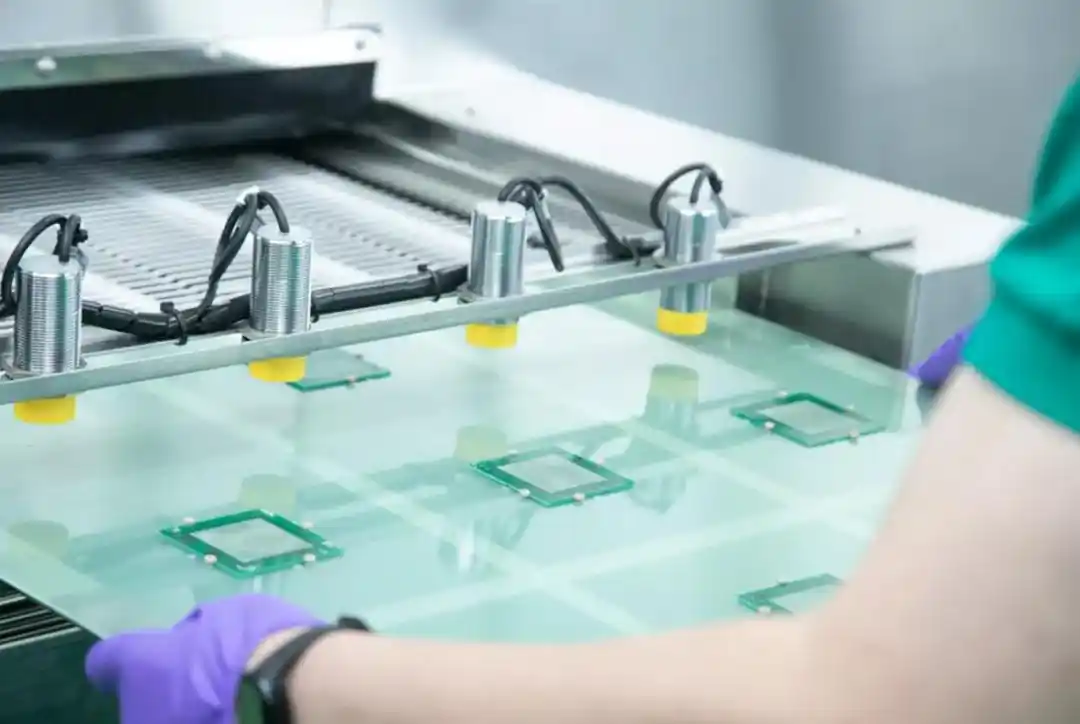
Kao a équipé le centre de nettoyage de précision de Hsinchu avec des équipements de haute spécification

Hsinchu est l'une des régions où la densité d'entreprises de fabrication de semi-conducteurs est la plus élevée au monde. Le siège de TSMC et ses installations de R&D et de production de procédés les plus avancés s'y trouvent. Des fonderies comme UMC, Powerchip, Macronix, Winbond y sont également implantées, tandis que les étapes d'assemblage et de test rassemblent des entreprises comme KYEC, Chipbond. Dans le domaine des substrats, des entreprises comme Unimicron, Kinsus forment également un cluster complet d'approvisionnement dans le nord de Taiwan.

En choisissant ce moment pour implanter son premier centre de nettoyage de précision à l'étranger à Hsinchu, Kao se positionne sur cette vague d'expansion pilotée par l'IA. Aujourd'hui, les puces IA de sociétés comme Nvidia, AMD utilisent généralement des solutions d'encapsulation 2,5D/3D comme le CoWoS. TSMC développe continuellement ses capacités d'encapsulation avancée depuis deux ans, mais la demande dépasse encore l'offre.

Plus le nombre de couches d'encapsulation est élevé et plus les structures sont complexes, plus le nombre et la difficulté des étapes de nettoyage augmentent. En tant que consommable utilisé à chaque étape clé, la demande en agents de nettoyage croît en parallèle de l'expansion des capacités d'encapsulation avancée.

Lors de la conférence téléphonique sur les résultats semestriels de l'année fiscale 2026, les cadres de Kao ont révélé qu'ils prévoyaient de continuer à conserver et à étendre leurs parts back-end à l'avenir, en continuant à pénétrer dans leurs domaines d'avantage existants comme le nettoyage des substrats d'encapsulation, et en s'étendant également de la NAND vers la DRAM, les semi-conducteurs logiques, etc.

Dans un contexte où des activités comme les produits chimiques à base de graisses subissent continuellement les fluctuations des prix des matières premières, l'entreprise a clairement indiqué son intention de s'orienter vers les matériaux électroniques et les produits liés aux semi-conducteurs.

04. Conclusion : Les acteurs transsectoriels des semi-conducteurs gagnent sur un même point

Dans la fabrication des semi-conducteurs, la part en valeur de l'étape de nettoyage est loin d'égaler celle des équipements et des matériaux principaux, mais son impact sur le rendement est direct et rigide. Alors que l'encapsulation avancée pousse le nombre d'étapes de nettoyage à augmenter continuellement, la valeur stratégique de ce type d'activité matérielle "à faible bruit mais à forte adhérence" est en train d'être réévaluée.

Le cas de Kao n'est pas isolé. Le film ABF d'Ajinomoto, les palettes électrostatiques (chucks) de TOTO, le ruban de découpe de Nitto Denko sont des produits représentatifs. Les activités principales de ces entreprises japonaises sont respectivement l'assaisonnement (glutamate), la sanitaires et les adhésifs, mais elles occupent chacune une position de leader dans une catégorie spécifique des matériaux pour semi-conducteurs.

Leur point commun réside dans le fait que leur technologie de base provient de l'accumulation à long terme de leur métier principal. La concurrence dans les matériaux pour semi-conducteurs est en grande partie une concurrence sur le fonds de roulement chimique de base, et c'est précisément la partie difficile à acquérir rapidement.

Cet article provient du compte WeChat "CoreThings", auteur : Chen Junda, éditeur : Xinyuan

Trending Cryptos

Related Questions

QQuel est le secteur d'activité principal de Kao, et quelle est leur part de marché dans un domaine connexe moins connu ?

AKao est principalement une entreprise de biens de consommation dans les secteurs des détergents et des produits de soins personnels. Cependant, dans un domaine connexe moins connu, celui des nettoyants de précision pour semi-conducteurs, elle détient environ 60% des parts de marché pour les nettoyants utilisés dans les substrats d'emballage (package substrates).

QQuel événement historique a été un déclencheur pour que Kao s'engage dans le marché du nettoyage de précision électronique ?

AL'événement déclencheur a été la signature du Protocole de Montréal en 1987, qui a programmé l'élimination progressive des chlorofluorocarbones (CFC) comme le fréon, solvant principal pour le nettoyage à l'époque. Cette réglementation environnementale a créé un besoin urgent de substituts, domaine où Kao, avec son expertise en tensioactifs et en équilibre détergence/douceur, a pu intervenir en lançant en 1991 le nettoyant aqueux CLEANTHROUGH.

QQuelle est la technologie centrale que Kao applique à ses produits de nettoyage pour semi-conducteurs ?

ALa technologie centrale que Kao applique est la "technologie de contrôle d'interface de précision". Elle consiste à maîtriser les interactions aux interfaces liquide/solide pour assurer un nettoyage uniforme à l'échelle nanométrique, tout en préservant la sélectivité des matériaux et en répondant aux exigences strictes de pureté et de contrôle des particules et des impuretés métalliques de l'industrie des semi-conducteurs.

QPourquoi Kao a-t-elle établi son premier centre de nettoyage de précision à l'étranger à Hsinchu, Taiwan ?

AKao a établi son premier centre de nettoyage de précision à l'étranger à Hsinchu, Taiwan, car cette région est l'une des zones de plus forte concentration d'entreprises de fabrication de semi-conducteurs au monde. Elle abrite le siège et les sites de production de pointe de TSMC, ainsi que de nombreuses autres fonderies, sociétés d'assemblage et de test, et fabricants de substrats. Ce positionnement lui permet de se rapprocher de ses clients clés et de participer activement au développement de leurs procédés, surtout pendant la vague d'expansion actuelle tirée par l'IA et l'emballage avancé.

QSelon la conclusion de l'article, quelle est le point commun entre Kao et d'autres entreprises japonaises comme Ajinomoto, TOTO et Nitto Denko qui réussissent dans les matériaux pour semi-conducteurs ?

ALe point commun est que leur technologie fondamentale pour les matériaux semi-conducteurs provient de l'expertise et des connaissances accumulées de longue date dans leur activité principale d'origine (produits chimiques pour Kao, acides aminés pour Ajinomoto, céramiques pour TOTO, adhésifs pour Nitto Denko). Leur succès repose sur une maîtrise profonde de la chimie de base, difficile à acquérir rapidement, qu'elles ont ensuite adaptée et appliquée aux exigences spécifiques de l'industrie des semi-conducteurs.

Related Reads

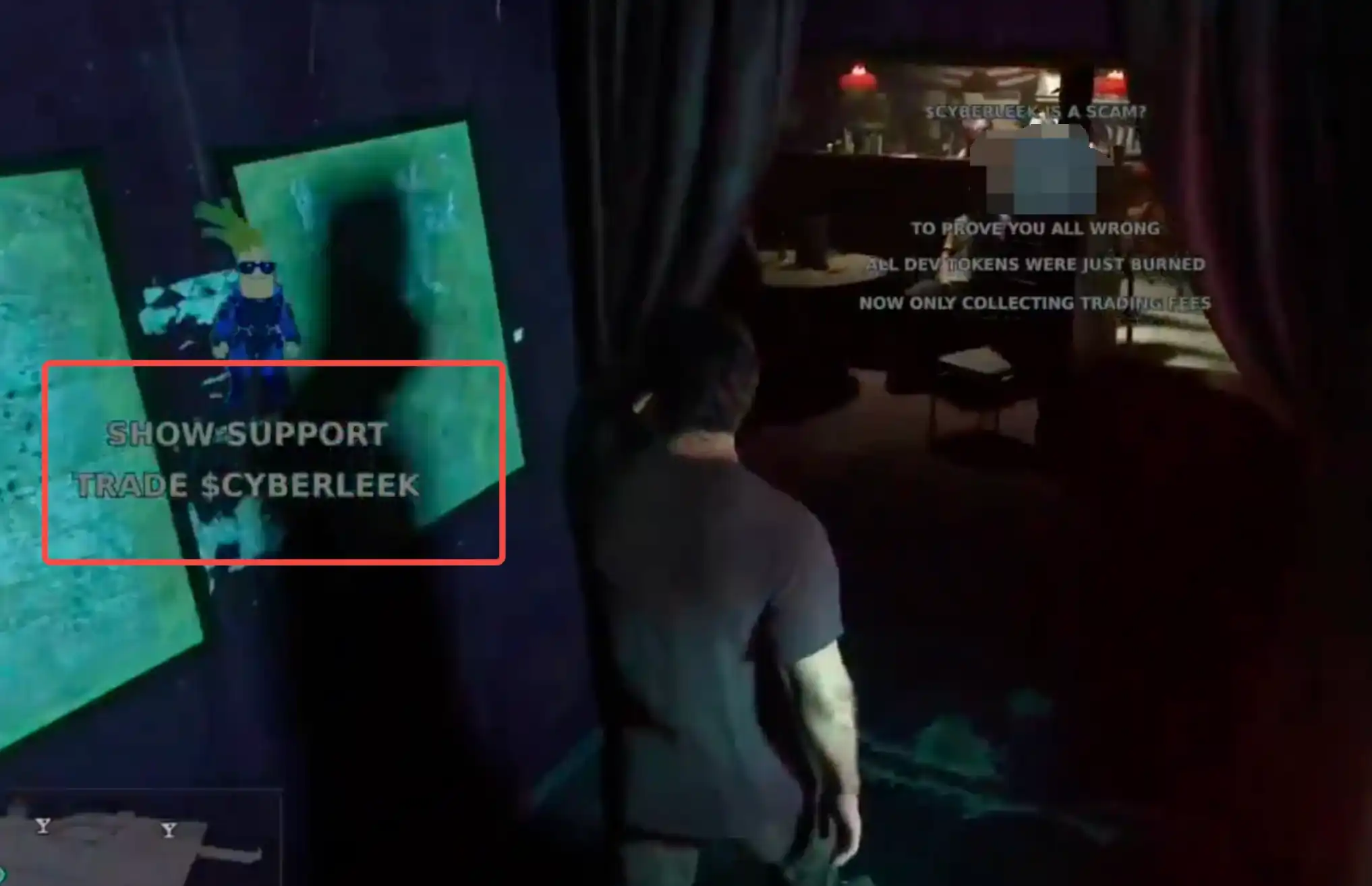
Hacker Leaks GTA6 and Launches a Token: Leaked Videos Become Ad Space for $CYBERLEEK, Must Buy Tokens to Vote for Next Clip

A hacker group called "CyberLeek" has leaked gameplay footage of the highly anticipated video game *GTA 6*, which is slated for release in 2026. Simultaneously, the group launched a meme token, $CYBERLEEK, on Solana. The leaks, which include maps and gameplay clips, are heavily watermarked with advertisements urging viewers to buy the token. Investigations of blockchain data reveal that the token was created and funded from a single wallet approximately eight hours before the first leak was released, suggesting a coordinated plan. The group has implemented a voting system where token holders can "vote" for the next type of content to be leaked by sending $CYBERLEEK tokens to a designated wallet—a process that permanently transfers the tokens to the hackers. This creates a self-sustaining cycle where interest in the leaks drives token purchases. Financially, the operation involved minimal upfront costs (less than $3,500 in out-of-pocket expenses) but generated significant revenue. On its first day, the token saw $15 million in trading volume, netting the creators an estimated $30,000 from transaction fees alone. While the group later burned a large portion of its developer-held tokens (worth over $1 million) to build trust, the fee-generating mechanism remains intact. The game's publisher, Take-Two Interactive, has initiated legal proceedings to identify the hackers. Despite this, the case demonstrates a new model where leaked intellectual property is used as leverage to promote and profit from a cryptocurrency, with meme token markets serving as an additional revenue stream.

marsbit57m ago

Hacker Leaks GTA6 and Launches a Token: Leaked Videos Become Ad Space for $CYBERLEEK, Must Buy Tokens to Vote for Next Clip

marsbit57m ago

Jensen Huang's Daughter: From Chef to an $8 Million Annual Salary

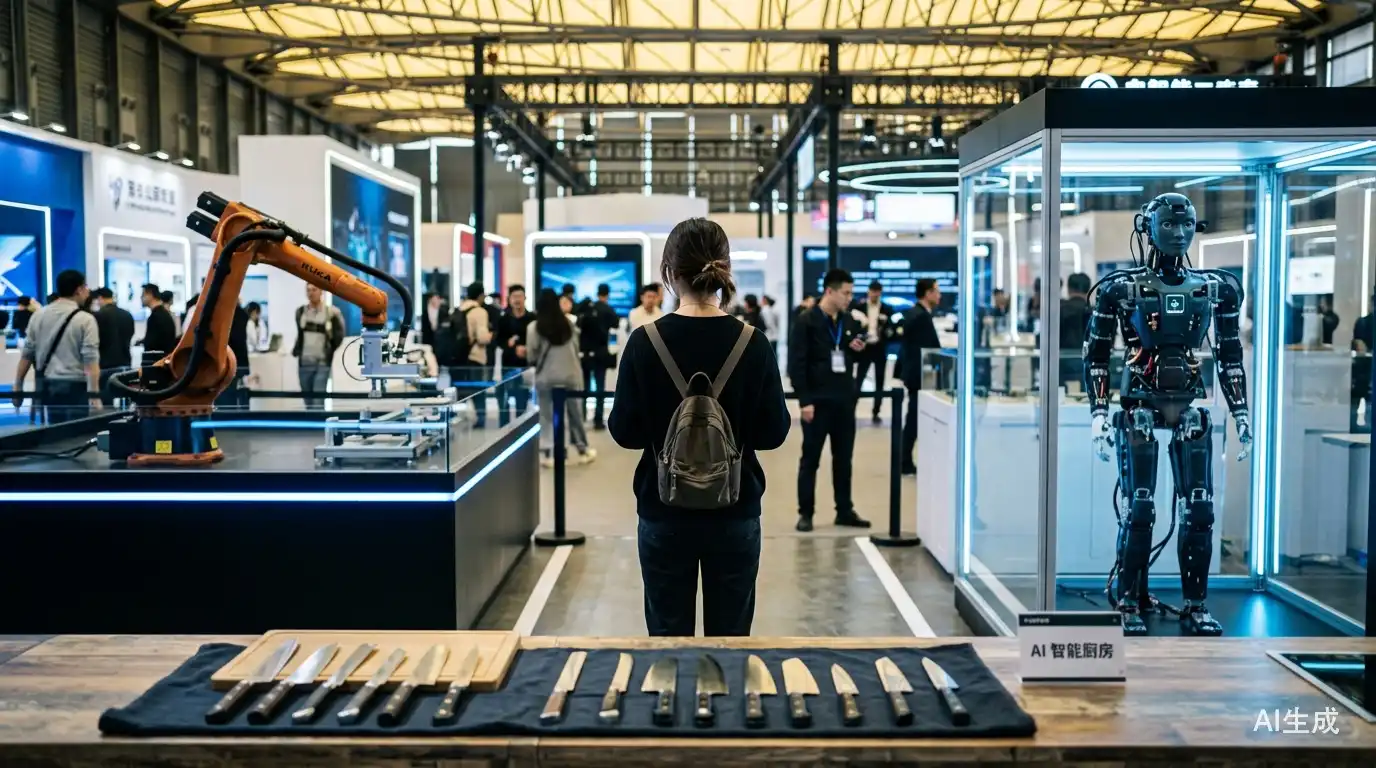
Madison Huang, daughter of NVIDIA founder Jensen Huang, recently made a rare public appearance in Beijing during the 2026 World Robot Conference. As the Senior Director of Product and Technology Marketing for NVIDIA's Physical AI Platform, with an annual salary of approximately $1.2 million, her visit focused on evaluating leading Chinese robotics companies like UBTech, Unitree, and others. This highlights NVIDIA's strategic interest in the burgeoning Chinese robotics ecosystem, a key battleground for the development of Physical AI—technology that enables machines to understand and interact with the physical world. Huang's career path is unconventional. Initially pursuing her passion, she studied culinary arts, worked as a chef, and later held a marketing role at LVMH. She joined NVIDIA as an intern in 2020 after completing an MBA, quickly rising through the ranks. Her brother, Spencer Huang, followed a similar path, closing a cocktail bar he co-founded to also join NVIDIA, where he now works on robotics software. Jensen Huang has publicly addressed nepotism concerns, humorously noting that some "second-generation" employees outperform their parents. The conference itself underscored China's vibrant robotics sector, marked by Unitree's recent blockbuster IPO and a pipeline of companies preparing to go public. While hardware development and manufacturing are advancing rapidly, industry leaders like Wang Xingxing of Unitree point to the next critical challenge: developing the "brain" or AI that allows robots to perform diverse, unseen tasks based on simple instructions. With massive manufacturing scale and diverse real-world testing scenarios, China is positioned as a central player in the global race to define the future of robotics.

marsbit3h ago

Jensen Huang's Daughter: From Chef to an $8 Million Annual Salary

marsbit3h ago

He Gave Wang Xingxing the First 2 Million, Now Serves as Chairman for the Next 'Unitree'

On August 19, 2024, Unitree Robotics, China's "first humanoid robotics stock," went public. Its founder, Wang Xingxing, started a decade ago with his self-developed XDog. In 2016, at a critical funding juncture, he received his first angel investment of 2 million RMB from Yin Fangming. This bet has since yielded a return of over 140 times. Yin Fangming is more than just a key investor. He was a co-founder of the AI robotics company ROOBO, whose own venture ultimately struggled. This firsthand experience with the hardware challenges in robotics gave him unique insight when backing Unitree, a company renowned for its hardware R&D and cost control. While his own company faltered, Yin continued investing shrewdly. He partially cashed out some Unitree shares early, reinvesting the proceeds into sectors like energy (e.g., solid-state battery firm TaiLan) and commercial aerospace (e.g., small launch vehicle developer XianDeng Aerospace). However, his most significant move after Unitree is his deep involvement with Galaxy General, a leading embodied AI unicorn. In July 2024, Yin stepped from behind the scenes to officially become its Chairman, indicating a role far beyond a typical investor. This comes as Galaxy General is viewed as preparing for future capital moves. Yin's career has consistently been ahead of the curve—from mobile internet to AI and robotics. Known for his foresight and low profile, he declined an interview for this story, offering only a statement encouraging support for visionary entrepreneurs like Wang Xingxing.

marsbit3h ago

He Gave Wang Xingxing the First 2 Million, Now Serves as Chairman for the Next 'Unitree'

marsbit3h ago

Trading

Spot

Hot Articles

What is LINON

Linde plc Tokenized Stock (Ondo): Revolutionizing Traditional Equity Access Through Blockchain Innovation The emergence of Linde plc Tokenized Stock (Ondo), represented by the ticker $LINON, signifies a monumental shift in the fusion of traditional financial structures and decentralized finance (DeFi). This innovative financial instrument showcases the tremendous potential of blockchain technology to democratize access to traditional equity markets while ensuring the security and regulatory compliance necessary for institutional-grade financial products. Through Ondo Finance's pioneering tokenization platform, $LINON provides a seamless pathway for global investors to engage with one of the world's leading industrial gas companies, Linde plc, creating a blockchain-native representation of the underlying equity. Introduction to Linde plc Tokenized Stock The landscape of financial markets is witnessing a groundbreaking transformation through the tokenization of real-world assets. Linde plc Tokenized Stock (Ondo) epitomizes this revolutionary approach by bridging the gap between conventional stock ownership and blockchain-enabled financial infrastructure. The $LINON token allows investors to gain exposure to one of the prominent industrial companies worldwide through decentralized technology. Operating within Ondo Finance's comprehensive ecosystem, $LINON symbolizes a practical application of tokenization technology that enhances accessibility, efficiency, and global connectivity in traditional financial markets. By leveraging blockchain infrastructure, this tokenized stock enables international investors to participate in U.S. equity markets, overcoming traditional barriers associated with cross-border investing. The significance of $LINON goes beyond technological innovation; it represents a fundamental shift in asset structuring, distribution, and trading in the digital age. This tokenized stock maintains all the economic benefits associated with traditional Linde plc shares while offering improved liquidity, programmable compliance features, and seamless integration with decentralized finance protocols. The development of $LINON indicates a growing acceptance of blockchain technology as a viable means for traditional finance, exemplifying how even well-established assets like Linde plc can integrate into blockchain systems. This approach preserves the core attributes that appeal to investors while introducing advanced capabilities that enhance the overall investment proposition. Project Overview and Objectives Linde plc Tokenized Stock (Ondo) encapsulates a strategic effort to democratize access to traditional equity markets through advanced blockchain technologies. The primary objective of $LINON is to provide approved global investors seamless access to the economic exposure associated with Linde plc shares, furthering an effort to create a more inclusive financial ecosystem. Beyond the digital representation of traditional assets, $LINON endeavors to eliminate barriers of geography and time zones that limit investor participation. Its design ensures that blockchain technology can elevate traditional investment vehicles without undermining the security or compliance requirements expected by investors. Key goals of the project include enhanced liquidity provision, programmable compliance mechanisms, and interoperability with other blockchain networks. Each $LINON token is fortified by actual Linde plc securities housed at U.S.-registered broker-dealers, allowing holders to reap economic advantages akin to traditional stockholders, such as dividend reinvestment. Furthermore, $LINON aims to establish new industry standards for institutional-grade tokenized securities, paving the way for traditional assets to embrace blockchain technology while remaining compliant with regulatory frameworks. By associating itself with a company as reputable as Linde plc, the project opens avenues for exploring tokenized equities catering to both conservative institutional players and daring retail investors. Project Creator and Development Team The vision for Linde plc Tokenized Stock (Ondo) comes from Nathan Allman, founder and CEO of Ondo Finance. His background in traditional finance coupled with expertise in blockchain technology positions him uniquely to navigate the complexities of asset tokenization. Allman's academic journey began at Brown University, focusing on Economics and Biology, equipping him with valuable analytical skills. His time at Goldman Sachs in the Digital Assets division strengthened his understanding of the interplay between financial institutions and emerging technologies, laying the groundwork for his later endeavors in alternative investment strategies. Under Allman's guidance, Ondo Finance has emerged as a leader in asset tokenization, launching $LINON as a flagship example of the company's larger mission towards revolutionizing traditional financial systems using blockchain technology. His commitment to leveraging blockchain for creating institutional-grade financial products has shaped the landscape of real-world asset tokenization. Investment and Funding Structure The growth of Ondo Finance, the platform powering Linde plc Tokenized Stock (Ondo), is bolstered by robust financial backing from prestigious venture capital firms and strategic investors. This strong investment foundation underpins the development of the key infrastructure essential for compliant tokenized securities like $LINON. In August 2021, Ondo Finance secured $4 million in seed funding led by a major venture capital firm, which enabled the company to commence platform development and establish the necessary regulatory processes for tokenizing real-world assets. This early investment cemented Ondo Finance's credibility within the industry. The Series A funding round followed, garnering $20 million with participation from renowned firms committed to transformative technology companies. This backing demonstrated substantial institutional confidence in Ondo Finance's vision, allowing it to hone its approach to asset tokenization through mechanisms that ensure compliance and accessibility. Noteworthy contributors, including institutional investors and experienced partners, have added significant value to Ondo Finance’s development efforts. Their involvement underscores the confidence across sectors in Ondo Finance's approach to bridging traditional finance with blockchain innovations. Technical Infrastructure and Innovation The technical architecture that underpins Linde plc Tokenized Stock (Ondo) represents a sophisticated melding of traditional finance systems and cutting-edge blockchain technology. The architecture's foundation is built on the Ethereum network, renowned for its security and programmability—both critical for intricate financial instruments. The $LINON tokenization process comprises creating a blockchain-native representation of Linde plc shares that preserves economic benefits while augmenting investor capabilities. Each token corresponds to actual shares held at U.S.-registered broker-dealers, creating a compliant custody structure that legitimizes the asset's existence and value. Automated compliance systems are integrated into the tokenization process, managing critical components such as know-your-customer (KYC) verification and anti-money laundering (AML) protocols. This incorporation of programmable compliance empowers $LINON to uphold regulatory standards essential for institutional proliferation. Cross-chain interoperability characterizes the advanced technical features of $LINON. While initially deployed on Ethereum, the framework is designed for expansion to other networks such as Solana and BNB Chain. This adaptability enhances liquidity and accessibility, allowing investors to select their preferred blockchain ecosystems. Historical Timeline and Development Crafting the history of Linde plc Tokenized Stock (Ondo) unfolds in parallel with the evolution of Ondo Finance's tokenization platform. The timeline's inception dates back to March 2021 when Nathan Allman laid the foundations for creating institutional-grade financial products on blockchain infrastructure. The initial funding round in August 2021 provided crucial resources for developing the platform and establishing partnerships necessary for effective tokenization. By January 2023, Ondo Finance launched its tokenized treasury products, establishing mechanisms that would facilitate future tokenized equities such as $LINON. A pivotal milestone arose in February 2025 when Ondo Chain—a Layer 1 blockchain designed specifically for asset tokenization—was introduced. This infrastructure enhances capabilities vital for institutional markets, demonstrating Ondo Finance's long-term commitment to tokenization. Subsequently, the launch of Ondo Global Markets in September 2025 marked the official debut of $LINON. This milestone showcased the successful transition from development to active trading, enabling investors around the world to access American financial markets seamlessly. Ongoing development plans include a targeted expansion of available tokenized assets to over 1,000 by the end of 2025, pointing to a bright future for Ondo Finance's ecosystem and its mission to broaden tokenized equity accessibility. Regulatory Compliance and Legal Framework The legal architecture governing Linde plc Tokenized Stock (Ondo) emphasizes a sophisticated approach to regulatory compliance, allowing tokenized securities to be implemented within a blockchain-based framework. The legal structure governing $LINON spans multiple jurisdictions while maintaining a robust legal footing. Compliance systems ensure that only eligible investors can access the token, enforced through automated verification that aligns with international regulations. This innovative regulatory technology promises real-time enforcement of complex requirements, considerably enhancing efficiency in operating within the regulatory landscape. The custody framework undergirding $LINON ensures that the underlying shares are securely held at U.S.-registered broker-dealers, complying with necessary regulations while delivering blockchain-driven access to investors. The token maintains its economic equivalency and security through this carefully structured custody arrangement. KYC and AML compliance systems are embedded within the smart contract architecture, ensuring integrity and adherence to regulatory practices while fostering transparency for investors. The jurisdictional restrictions mark a commitment to navigating the evolving landscape of international securities laws. Market Impact and Industry Significance The advent of Linde plc Tokenized Stock (Ondo) holds profound implications for the broader financial landscape, symbolizing a clear shift towards blockchain-enabled markets. $LINON serves as a proof-of-concept for integrating traditional companies into blockchain ecosystems, showcasing the potential benefits such as broader accessibility and improved efficiency. The market's response to $LINON indicates a growing acceptance of tokenization among institutional investors, contributing to the emergence of an expanding sector wherein traditional assets can be interconnected with blockchain innovations. The success of $LINON further solidifies market confidence, indicating an overarching shift towards recognizing asset tokenization as a transformative force in finance. Future Development and Expansion Plans The future trajectory for Linde plc Tokenized Stock (Ondo) centers around the expansion of the tokenization ecosystem and enhanced infrastructure supporting blockchain-enabled financial services. Plans for cross-chain integration usher in new opportunities for liquidity and flexibility within the investment framework, with existing capabilities poised for continuous enhancement. With the introduction of Ondo Chain, Ondo Finance aims to transition $LINON to an optimized blockchain environment specifically designed for asset tokenization. This new infrastructure heralds exciting prospects for the development of institutional-grade financial products, ensuring ongoing compatibility with contemporary investment strategies. Further integration with decentralized finance protocols signifies a commitment to empowering $LINON holders through advanced financial strategies. The anticipated expansion of available tokenized assets promises to broaden investor access, enhancing the utility and appeal of the platform. In alignment with ambitions for regulatory expansion, ongoing efforts to secure approvals for new jurisdictions will enhance investor access, further positioning $LINON at the forefront of the burgeoning tokenization market. Conclusion Linde plc Tokenized Stock (Ondo), as represented by the $LINON token, stands at the intersection of traditional finance and blockchain innovation. It embodies a transformative milestone in how financial assets are structured, distributed, and engaged within modern investment ecosystems. The technical sophistication behind $LINON, combined with its regulatory compliance framework, illustrates that asset tokenization can improve financial infrastructure rather than simply digitizing existing products. This pioneering effort not only enhances investor access to U.S. equity markets but also signifies an evolution of how traditional financial services can integrate blockchain technology. As the asset tokenization market grows exponentially, with prospects suggesting significant valuation increases, $LINON paves the way for a future where tokenized securities become standard fixtures in the financial landscape. The trajectory of $LINON will undoubtedly influence how traditional finance adapts to a transformed, blockchain-powered world.

4.7k Total ViewsPublished 2025.12.05Updated 2025.12.05

What is LINON

What is CRMON

Salesforce Tokenized Stock (Ondo): Revolutionising Traditional Equity Access Through Blockchain Innovation The emergence of Salesforce Tokenized Stock (CRMON) marks a pivotal advancement in integrating traditional financial markets with blockchain technology. This innovative approach offers investors unprecedented access to equity exposure through tokenisation. Developed by Ondo Finance, CRMON provides tokenholders with economic exposure equivalent to holding Salesforce stock (CRM) while automatically reinvesting dividends. This effectively bridges the gap between conventional equity markets and decentralised finance (DeFi). Introduction and Comprehensive Overview of Salesforce Tokenized Stock In recent years, the financial landscape has dramatically transformed due to blockchain technology, fundamentally altering how investors access and interact with traditional assets. The development of Salesforce Tokenized Stock (CRMON) is a prime example of this evolution, representing a sophisticated fusion of conventional equity markets with cutting-edge distributed ledger technology. CRMON is a tokenised version of Salesforce stock, emerging from the innovative work of Ondo Finance, a leading platform in the real-world asset tokenisation sector that positions itself as a bridge between traditional finance and decentralised systems. Designed to provide tokenholders with economic exposure that mirrors the performance of the underlying Salesforce stock, CRMON incorporates automatic dividend reinvestment mechanisms. This eliminates many traditional barriers associated with international equity investment, such as complex brokerage relationships, currency conversion challenges, and restricted trading hours. The tokenisation process reimagines stock ownership as a blockchain-native asset while maintaining its economic equivalence with the underlying security, offering enhanced portability and integration capabilities within decentralised finance ecosystems. CRMON transcends its individual utility as an investment instrument to represent a fundamental shift in how financial markets can operate in an increasingly digital world. By maintaining full backing through U.S.-registered broker-dealers and implementing robust compliance frameworks, CRMON demonstrates that tokenised securities can achieve the regulatory standards necessary for institutional adoption while delivering the technological advantages of blockchain infrastructure. Understanding Tokenized Real-World Assets and CRMON's Strategic Position Tokenised real-world assets signify one of the most significant innovations in modern finance, fundamentally reimagining how traditional securities are represented, traded, and utilised within digital ecosystems. CRMON operates as a tokenised equity instrument correlating directly with Salesforce stock while optimising accessibility and efficiency. This aligns with Ondo Finance's broader mission to democratise access to institutional-grade financial products through innovative tokenisation strategies. The tokenisation process guarantees complete economic equivalence with the underlying Salesforce equity. Each CRMON token represents a proportional claim on Salesforce stock held by qualified custodians, with dividend payments automatically reinvested to maintain continuous exposure to total return performance. This structure simplifies dividend management and ensures that tokenholders receive the full economic benefit of their equity exposure, encompassing both capital appreciation and income generation. Ondo Finance's strategy in tokenising Salesforce stock demonstrates its expertise in creating compliant, institutional-grade products that meet traditional financial markets' stringent requirements. The platform’s focus on merging regulatory compliance with blockchain benefits positions it at the forefront of decentralised finance, captivating both institutional and retail investors seeking blockchain-native solutions. The Technology and Innovation Framework Behind CRMON The technological infrastructure supporting CRMON integrates blockchain technology with traditional financial mechanisms, delivering institutional-grade security and compliance while maintaining the operational advantages of decentralised systems. Built on the Ethereum blockchain, CRMON utilises robust smart contract capabilities to ensure transparent, secure operations. The smart contract architecture incorporates layered security and compliance mechanisms, enabling automated compliance checks and real-time asset backing verification. Integration with oracle services maintains accurate pricing and dividend information, ensuring CRMON reflects the underlying Salesforce stock's accurate performance. This architecture delivers automated dividend reinvestments and other corporate actions, eliminating manual processing requirements and directly enhancing tokenholder benefits. Ondo Finance ensures CRMON's security structure includes daily third-party verification of holdings, independent collateral agents, and a multiple-layer custody system through partnerships with established financial institutions. This framework safeguards tokenholder interests against operational risks while providing robust asset backing. The user interface enhances integration capabilities, allowing seamless interaction between CRMON and various decentralised finance protocols, as well as cryptocurrency exchanges. This interoperability enables users to leverage their tokenised equity across multiple platforms, creating sophisticated investment strategies that marry traditional equity characteristics with blockchain-native innovation. Leadership and Corporate Structure of Ondo Finance The leadership team behind CRMON and Ondo Finance blends expertise from traditional finance and blockchain technology, presenting a robust combination of skills essential for successfully bridging conventional markets with decentralised finance. Nathan Allman, the founder and CEO, emerged from a distinguished financial background before establishing Ondo Finance in 2021. Allman's experience includes notable roles at major financial institutions, including significant contributions to developing cryptocurrency market services. His insights into regulatory compliance were paramount in developing products like CRMON that successfully unify traditional securities with blockchain technology. With a team of professionals boasting substantial experience in both conventional finance and blockchain sectors, Ondo Finance's leadership comprises diverse expertise that covers every aspect of tokenised asset development. Justin Schmidt serves as President and COO, contributing unique operational expertise, while Chris Tyrell brings essential compliance knowledge. Investment Landscape and Funding History The investment landscape surrounding Ondo Finance reflects significant institutional confidence in its mission to tokenise real-world assets. The company has raised substantial funds through various investment rounds, attracting leading venture capital firms and strategic investors that recognise the transformative potential of tokenised securities like CRMON. Notably, Ondo Finance completed a successful Series A funding round in 2022, led by well-known venture capital firms. This funding success validates Ondo Finance's innovative approach to creating compliant, institutional-grade tokenised products. In total, Ondo Finance has successfully secured substantial funding, raising significant capital for product development and market expansion, including a noteworthy token sale that reinforced its governance structure through the establishment of the ONDO token. The diverse composition of investors reflects broad market confidence in Ondo Finance's business model, demonstrating support from both traditional and blockchain-native organisations. Operational Mechanics and Technical Implementation The operational framework supporting CRMON exemplifies sophisticated integration of traditional financial mechanisms with blockchain technology. The technical implementation introduces multiple layers of security, compliance, and operational efficiency to meet institutional standards while enhancing accessibility. The tokenisation process begins by acquiring actual Salesforce stock through U.S.-registered broker-dealers, ensuring each CRMON token maintains direct correlation with the underlying equity performance. Smart contracts automate operational processes, including dividend reinvestment and corporate action processing, facilitating a streamlined user experience. The Minting and redemption processes allow authorised participants to manage CRMON tokens effectively. During U.S. trading hours, institutions can mint new tokens by depositing stablecoins that are used to purchase corresponding Salesforce equity. This structure maintains a tight correlation with underlying assets, enhancing liquidity and price discovery. Additionally, the infrastructure supports twenty-four-hour token transfer capabilities, providing CRMON holders with operations outside traditional market hours. This represents a significant advantage over conventional securities ownership, thus promoting integration with decentralised finance applications. Plans for cross-chain compatibility through partnerships signal further ambitions for CRMON's market reach. By expanding to other blockchain networks, Ondo Finance aims to enhance accessibility and user engagement with tokenised equity products. Timeline and Historical Development of Tokenized Equity Innovation The timeline of CRMON's development and Ondo Finance's broader tokenised capabilities demonstrates a systematic innovation process beginning with the company's founding in 2021. 2021: Ondo Finance is founded by Nathan Allman and co-founders, launching initial products focused on structured vault offerings on the Ethereum blockchain. 2022: The company completes substantial funding rounds—both equity and token sales—totaling significant capital and launching initial tokenised U.S. Treasury products. 2023-2024: Ondo Finance experiences substantial growth, establishing partnerships with major financial institutions while expanding its product offerings beyond fixed-income securities. February 2025: Ondo Global Markets is announced, marking the transition into equity tokenisation with plans for accessing over one hundred U.S. stocks and ETFs. September 2025: The official launch of Ondo Global Markets includes CRMON alongside other tokenised equity offerings, marking a significant evolution in Ondo Finance's product ecosystem. This timeline highlights the organisation's rapid growth and its capability to adapt its technological and compliance frameworks to accommodate different asset classes effectively while maintaining security and regulatory integrity. Regulatory Framework and Compliance Approach Ondo Finance's regulatory framework showcases a sophisticated compliance strategy, essential for achieving institutional adoption in the tokenised securities market. The company's strong partnerships with U.S.-registered broker-dealers promote adherence to Securities and Exchange Commission regulations and apply robust investor protections. Acquisitions, such as Oasis Pro—a registered broker-dealer—significantly enhance Ondo Finance's compliance capabilities, ensuring thorough alignment with existing regulatory structures. The company employs independent verification procedures that foster transparency, aiming for a solid performance standards reputation. Furthermore, Ondo Finance's commitment extends to international regulatory compliance, ensuring token access remains restricted to eligible investors while adhering to pertinent cross-border securities regulations. Comprehensive attention to tax implications and reporting requirements fortifies the security and compliance landscape of CRMON, ensuring that investor obligations remain manageable. Future Prospects and Market Positioning The forward-looking landscape for CRMON and Ondo Finance illustrates substantial growth opportunities driven by institutional adoption of blockchain technology and escalating demand for efficient alternatives to conventional securities ownership. Market projections indicate the tokenised asset sector could value multiple trillion dollars by 2030. With plans to scale CRMON offerings significantly and integrate it with a dedicated blockchain infrastructure—Ondo Chain—Ondo Finance aims to elevate its institutional-grade tokenised asset operations. Additionally, the development of strategic partnerships enhances distribution capabilities while establishing the company's credibility in the financial market. Furthermore, the integration of tokenised equity with decentralised finance protocols offers new potential for innovative financial products and strategies previously impossible with traditional securities. These factors underscore CRMON's positioning to effectively capture increased market share and deliver innovative solutions for international investment exposure. Conclusion Salesforce Tokenized Stock (CRMON) symbolises a transformative development within financial markets, successfully bridging traditional equity ownership with blockchain technology to create unprecedented accessibility for global investors. Through Ondo Finance's sophisticated tokenisation framework, CRMON provides complete economic exposure to Salesforce equity performance while enhancing operational advantages that exceed traditional ownership. The launch of CRMON reflects the broader evolution of financial markets towards blockchain infrastructures that maintain regulatory compliance while delivering increased efficiency. Ondo Finance's extensive approach to regulatory adherence, institutional-grade security, and technological innovation solidifies CRMON as a model for future tokenised securities, delivering access previously unattainable in conventional brokerage structures. As the tokenised asset sector continues to develop, CRMON is well-positioned to address historical inefficiencies in capital markets while providing investors with innovative solutions for accessing traditional securities. The outlook for CRMON looks exceptionally promising, supported by ambitious expansion plans, technological innovations, and strategic partnerships, thereby representing a pioneering model of modern financial infrastructure evolving through blockchain integration.

4.8k Total ViewsPublished 2025.12.05Updated 2025.12.05

What is CRMON

What is SHOPON

Shopify Tokenized Stock (Ondo): A Comprehensive Analysis of Real-World Asset Tokenization in Web3 This article delves into the Shopify Tokenized Stock (Ondo), recognised by its ticker symbol $SHOPON, exploring its implications at the intersection of traditional finance and blockchain technology. As a part of Ondo Finance's tokenized securities platform, Shopify’s tokenized stock exemplifies advancements in democratizing access to global capital markets through innovative digital assets. Introduction and Overview of Shopify Tokenized Stock (Ondo) Shopify Tokenized Stock (Ondo), or $SHOPON, portrays a pivotal innovation in the realm of tokenized securities, allowing investors to gain economic exposure akin to directly owning shares of Shopify Inc. This token, developed under the umbrella of Ondo Finance, not only provides investors with the ability to hold digital representations of the company’s stock but also integrates features such as automatic reinvestment of dividends. This advancement represents a substantial shift in the landscape of decentralized finance (DeFi), linking conventional equity markets with blockchain solutions designed to enhance accessibility, transparency, and liquidity. By eliminating geographical barriers and enabling 24/7 trading capabilities, $SHOPON is positioned as a bridge connecting traditional financial instruments and the emerging Web3 ecosystem. What is Shopify Tokenized Stock (Ondo), $SHOPON? The $SHOPON token serves as a digital manifestation of Shopify Inc.'s shares, engineered to provide a direct correlation to the underlying asset's performance. Through the utilization of blockchain technology, the token gives holders a mechanism to participate in the economic benefits associated with equity ownership, including capital appreciation and dividend distribution. The unique aspect of $SHOPON lies in its automatic dividend reinvestment mechanism, which allows returns to compound without necessitating active management by the investor. This feature inherently enhances its attractiveness as an investment vehicle, particularly for individuals seeking passive income growth alongside exposure to high-performing equities. The tokenization process is facilitated by the custody of actual Shopify shares through regulated intermediaries, ensuring that every $SHOPON token is verifiably backed by real equity. This structure empowers investors with the dual advantages of both traditional financial characteristics and the innovative benefits tied to blockchain technology. Who is the Creator of Shopify Tokenized Stock (Ondo)? The creator of Shopify Tokenized Stock (Ondo), Nathan Allman, is an experienced figure in the finance sector, formerly associated with Goldman Sachs. His rich background includes significant expertise in digital asset development, bridging the gap between traditional finance and cryptocurrencies. Allman’s educational journey, marked by studies at Brown University, provided him with a deep understanding of economics and biology, equipping him with analytical skills that inform his strategic vision. In 2021, he founded Ondo Finance, committing to developing tokenized securities that meet institutional-grade standards while leveraging blockchain's transformative capabilities. Under Allman's leadership, Ondo Finance has focused on creating compliant and innovative financial products that empower a diverse investor base. Who are the Investors of Shopify Tokenized Stock (Ondo)? The investment landscape surrounding Shopify Tokenized Stock (Ondo) is notably robust, underpinned by significant institutional support. Primarily, Pantera Capital stands out as a strategic partner through the Ondo Catalyst initiative, a $250 million commitment aimed at accelerating the development of on-chain capital markets. This partnership not only signifies institutional confidence in the potential of tokenized assets but also reinforces Ondo Finance's operational capabilities and market positioning. The funding pathways have included earlier rounds that amassed millions in seed funding and further structural investments, solidifying relationships with both venture capital firms and private investors. Moreover, the financial framework is complemented by strategic partnerships with established financial institutions and technology companies, enhancing Ondo’s infrastructure and operational expertise. How Does Shopify Tokenized Stock (Ondo), $SHOPON Work? At the core of $SHOPON's operational framework is a sophisticated system integrating traditional finance mechanisms with blockchain technology. The custody of actual Shopify shares ensures that token holders retain authentic economic exposure, safeguarding their investments in line with recognized legal structures. The smart contracts employed in managing $SHOPON handle various functions, including automatic dividend reinvestment and ownership transfer, offering instant settlement and increased liquidity, marking a significant departure from conventional trading systems plagued by multi-day settlement delays. By providing interoperability with other decentralized finance applications, $SHOPON empowers holders with potentially lucrative opportunities for advanced investment strategies, including lending and automated market making. This complex integration presents a unique value proposition, catering to both traditional and crypto-native investors. The innovative structure of $SHOPON also allows for real-time settlements and transactions documented on the blockchain, delivering unparalleled transparency and security—a major advancement over standard equity trading practices. Timeline of Shopify Tokenized Stock (Ondo) March 2021: Nathan Allman establishes Ondo Finance, initially focusing on decentralized finance yield optimization. August 2021: Completion of a $4 million seed funding round led by Pantera Capital. January 2023: Launch of initial tokenized treasury security products, laying the groundwork for future equity tokenization. July 2025: Announcement of the Ondo Catalyst initiative, a strategic investment program valued at $250 million, aimed at propelling the development of tokenization in capital markets. September 3, 2025: Launch of Ondo Global Markets featuring over 100 tokenized U.S. stocks and ETFs, including $SHOPON. Technical Implementation and Blockchain Infrastructure Shopify Tokenized Stock (Ondo) operates on a technical architectural framework that marries blockchain protocols with traditional financial custody arrangements. The ecosystem leverages Ethereum's smart contract capabilities, providing seamless transaction management while ensuring compliance with regulatory standards through established financial custodians. Central to this architecture are security measures and transparent transaction records that affirm the legitimacy of each tokenholder's economic stake. With automated features managed by intricate smart contracts, $SHOPON not only streamlines ownership transfers but also allows for the tactical reinvestment of dividends—a hallmark of modern investment strategies. Moreover, the incorporation of LayerZero technology facilitates cross-chain interoperability, making $SHOPON accessible across multiple blockchain environments while preserving its functional robustness. This forward-thinking technical design positions $SHOPON as an adaptable asset within the larger DeFi milieu. Regulatory Framework and Compliance Architecture $SHOPON's regulatory framework is built upon the meticulous navigation of existing financial regulations that govern securities. The custody arrangements for the underlying Shopify shares are managed by U.S.-regulated broker-dealers, ensuring compliance and protection for investors. By maintaining a separation between the blockchain tokenization process and traditional custody, $SHOPON adheres to legal requirements while offering innovative functionalities that challenge conventional constraints. This dual-layered compliance approach enhances investor confidence and underscores Ondo Finance's commitment to regulatory integrity. Notably, the availability of $SHOPON is tailored to international investors from regions such as Asia-Pacific, Europe, and Africa, as regulatory parameters in the U.S. and U.K. present challenges in accessing tokenized securities. Market Access and Global Distribution Strategy The distribution strategy of $SHOPON is keenly designed to optimize global access while conforming to regulatory standards. The platform aims to establish comprehensive coverage for eligible investors across multiple regions, effectively dismantling traditional barriers through the implementation of blockchain technology. Integration with various cryptocurrency wallets and exchanges also promotes user-friendliness and accessibility, establishing a streamlined experience for investors to manage their holdings. Moreover, the 24/7 trading capabilities afforded by the tokenized model allow participants to react promptly to market shifts, fundamentally transforming how global equities are accessed and traded. Technology Integration and Cross-Chain Functionality The remarkable technological underpinnings of $SHOPON propagate its multi-chain functionality, set to expand its reach beyond Ethereum to networks such as Solana and BNB Chain. Such cross-chain capabilities allow users flexibility when navigating between blockchains, concurrently leveraging distinct network attributes to optimize their trading experience. LayerZero serves as the backbone for ensuring decentralized transfers between networks while providing the requisite security and speed, quintessential for maintaining investor trust. This comprehensive interoperability illustrates $SHOPON's commitment to being a versatile, user-centric asset in the evolving investment landscape. Ecosystem Integration and DeFi Compatibility Incorporating $SHOPON into broader DeFi protocols signifies its potential beyond traditional stock ownership. Token holders can leverage their holdings for various sophisticated strategies and applications, enhancing investment returns and liquidity management. By establishing a presence in lending protocols and automated trading systems, $SHOPON effectively democratizes access to advanced financial strategies previously limited to institutional investors. Such integration contributes to a more competitive and dynamic financial landscape, where individual investors can capitalize on tools typically reserved for larger entities. Risk Management and Security Framework Security remains paramount in the operational infrastructure of $SHOPON. The tokenization framework employs multiple layers of protection—beginning with regulated custody of the underlying Shopify shares. The operational protocols establish rigorous auditing, key management, and transaction monitoring standards, thus safeguarding against potential vulnerabilities. Moreover, meticulous adherence to evolving regulatory requirements provides an extra layer of security, fortifying investor protections and institutional compliance. Market Impact and Industry Implications The introduction of Shopify Tokenized Stock (Ondo) heralds a transformative shift in how financial markets operate, emphasizing the potential of tokenized securities to reshape traditional investment paradigms. The successful integration of $SHOPON encapsulates the efficiencies inherent in blockchain technology and opens avenues for new user demographics previously barred from extensive market participation. The impact extends beyond the immediate benefits to token holders, indicating broader trends that may challenge the status quo of investment services, particularly in addressing geographic restrictions and operational costs typically associated with traditional brokerage platforms. Undeniably, $SHOPON encapsulates the potential for traditional institutions to innovate further, leveraging the increasing demand for seamless blockchain access to complement existing financial infrastructure. Future Development Roadmap and Strategic Vision As Ondo Finance looks forward, the trajectory of $SHOPON rests on ambitious goals aimed at broadening the spectrum of available tokenized assets significantly. Over the next few years, plans are in place to expand to more than 1,000 tokenized securities, further enhancing market participation and investment options for individuals worldwide. Continued integration with traditional financial actors, development of specialized institutional products, and enhancements in automated trading capabilities will ensure that $SHOPON maintains its position at the forefront of financial innovation. Regulatory collaboration will also remain a focal point, establishing a framework that not only supports the compliance requirements but also promotes a healthy environment for tokenized asset proliferation. Conclusion and Market Significance In summary, Shopify Tokenized Stock (Ondo), represented by the ticker $SHOPON, is more than merely a tokenized equity offering; it embodies the innovation possible when traditional finance collides with modern blockchain applications. With a robust technical architecture, a commitment to compliance, and a clear strategic vision, $SHOPON exemplifies the potential for tokenized assets to enhance liquidity, accessibility, and functionality in capital markets. As the global investment landscape evolves, the transformative implications of $SHOPON extend beyond individual investors to revolutionize how financial instruments are perceived, traded, and utilized within both traditional and decentralized frameworks.

4.8k Total ViewsPublished 2025.12.05Updated 2025.12.05

What is SHOPON

Discussions

Welcome to the HTX Community. Here, you can stay informed about the latest platform developments and gain access to professional market insights. Users' opinions on the price of CHIP (CHIP) are presented below.

活动图片