Bitcoin – 'Une rupture au-dessus de 80 000 $ est improbable' – CoinShares identifie le déclencheur manquant

ambcryptoPublished on 2026-07-18Last updated on 2026-07-18

Abstract

Après une hausse de 1,56% le jour précédent, le Bitcoin se négociait à 63 921,09 $, montrant des signes de reprise. Cependant, un rapport de CoinShares indique que cette reprise est davantage motivée par des facteurs macroéconomiques que par des développements propres aux cryptomonnaies. Au premier semestre 2026, des inquiétudes concernant l'inflation, des taux d'intérêt élevés, des tensions géopolitiques et un ralentissement de la croissance économique avaient entraîné des sorties de fonds record de 8 milliards de dollars sur huit semaines. Cette tendance s'est inversée récemment, avec des entrées de capitaux pendant deux semaines consécutives. Le changement de sentiment est attribué à des données d'inflation américaines inférieures aux attentes (IPC à -0,4%, PPI à -0,3%), laissant anticiper un assouplissement potentiel de la politique monétaire de la Fed et stimulant l'appétit pour le risque, dont le Bitcoin a bénéficié. Le rapport suggère que le Bitcoin a probablement atteint un plancher à court terme. Cependant, sans un changement significatif dans les attentes de politique monétaire, une forte hausse est jugée improbable. Les analystes prévoient plutôt une phase de trading dans une fourchette, estimant qu'une rupture au-dessus de 80 000 $ est peu probable sans un tel changement. D'autres analyses évoquent même une poursuite de la baisse vers 55 560 $ ou 51 934 $. L'indice Crypto Fear and Greed se situe dans la zone de "peur extrême", reflétant la prudence persistante ...

Après une hausse de 1,56% sur la journée précédente, le Bitcoin [BTC] s'échangeait à 63 921,09 $ au moment de la rédaction, ce qui indique qu'il commence à se redresser.

Cependant, selon un récent rapport de CoinShares, la reprise du Bitcoin a été davantage alimentée par des changements dans l'économie globale que par des développements propres à l'espace des cryptomonnaies.

Le sentiment s'est retourné, et la macroéconomie en est la raison

AD

Au premier semestre 2026, les inquiétudes concernant l'inflation, les taux d'intérêt élevés, les tensions géopolitiques et le ralentissement de la croissance économique avaient poussé les investisseurs à retirer environ 8 milliards de dollars des produits d'investissement en cryptomonnaies au cours des huit dernières semaines, constituant la sortie de fonds la plus longue et la plus importante jamais enregistrée.

Un changement à 180 degrés dans le sentiment

Cependant, cette tendance a commencé à s'inverser, et il semble que les entrées de fonds se poursuivront probablement pendant deux semaines consécutives.

Il est intéressant de noter que ce n'est pas une métrique spécifique au Bitcoin qui a provoqué ce revirement de sentiment, mais une réaction à des données d'inflation américaines inférieures aux attentes, ce qui a conduit les investisseurs à penser que la Réserve fédérale américaine pourrait assouplir sa politique monétaire.

Pour contextualiser, un modeste rallye du Bitcoin et des entrées d'environ 250 millions de dollars ont été déclenchés le 14 juillet lorsque l'indice des prix à la consommation (IPC) a rapporté -0,4 %, en dessous des -0,2 % attendus.

Les anticipations d'un assouplissement monétaire ont été renforcées le lendemain lorsque l'indice des prix à la production (IPP) a chuté brusquement de -0,3 % contre des prévisions de 0,0 %.

Les marchés ont commencé à anticiper moins de hausses de taux, voire des baisses de taux, en raison de la pression moindre sur la Réserve fédérale pour maintenir des taux d'intérêt élevés en raison d'une inflation plus faible.

Cela s'est traduit par des centaines de millions de dollars investis dans des produits d'investissement en Bitcoin grâce à cet appétit pour le risque accru.
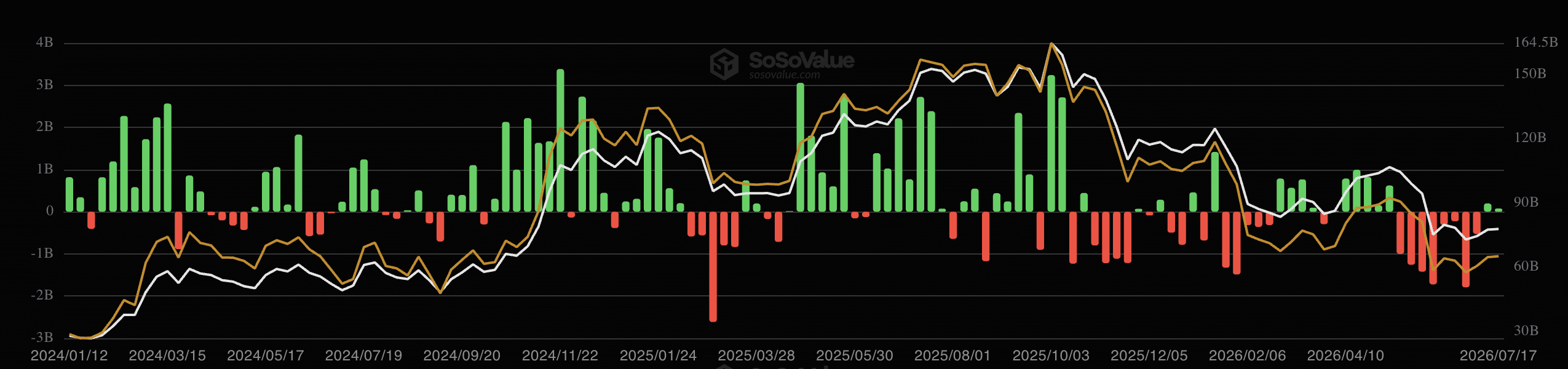
Source : SoSo Value

Quel avenir pour le Bitcoin ?

De plus, le rapport a mis en lumière le fait que le Bitcoin a probablement atteint son creux à court terme, mais qu'en l'absence d'un changement significatif de la politique de la Réserve fédérale, un solide marché haussier est peu probable.

Une économie légèrement plus faible pourrait donner un coup de pouce supplémentaire au bitcoin alors que nous observons une réévaluation des anticipations de taux d'intérêt.

En fait, plutôt que d'afficher une hausse soutenue, on anticipe que le Bitcoin va évoluer dans une fourchette relativement étroite jusqu'à ce qu'il y ait des indications claires d'un assouplissement monétaire. La fourchette projetée était de 120 000 $ à 60 000 $.

Nous nous attendons à des transactions en range, une rupture au-dessus de 80 000 $ étant improbable en l'absence d'un changement significatif dans les anticipations de politique monétaire.

Un récent article d'AMBCrypto notait également que le Bitcoin devrait poursuivre sa trajectoire baissière et chuter à 55 560 $ et 51 934 $ dans les prochaines semaines.

De plus, le rapport démontre que le sentiment des investisseurs reste prudent. En fait, un nombre croissant de personnes s'intéresse aux actions liées à la blockchain.

Cela a été confirmé par l'indice Crypto Fear and Greed, qui se trouvait dans la zone de "peur extrême".
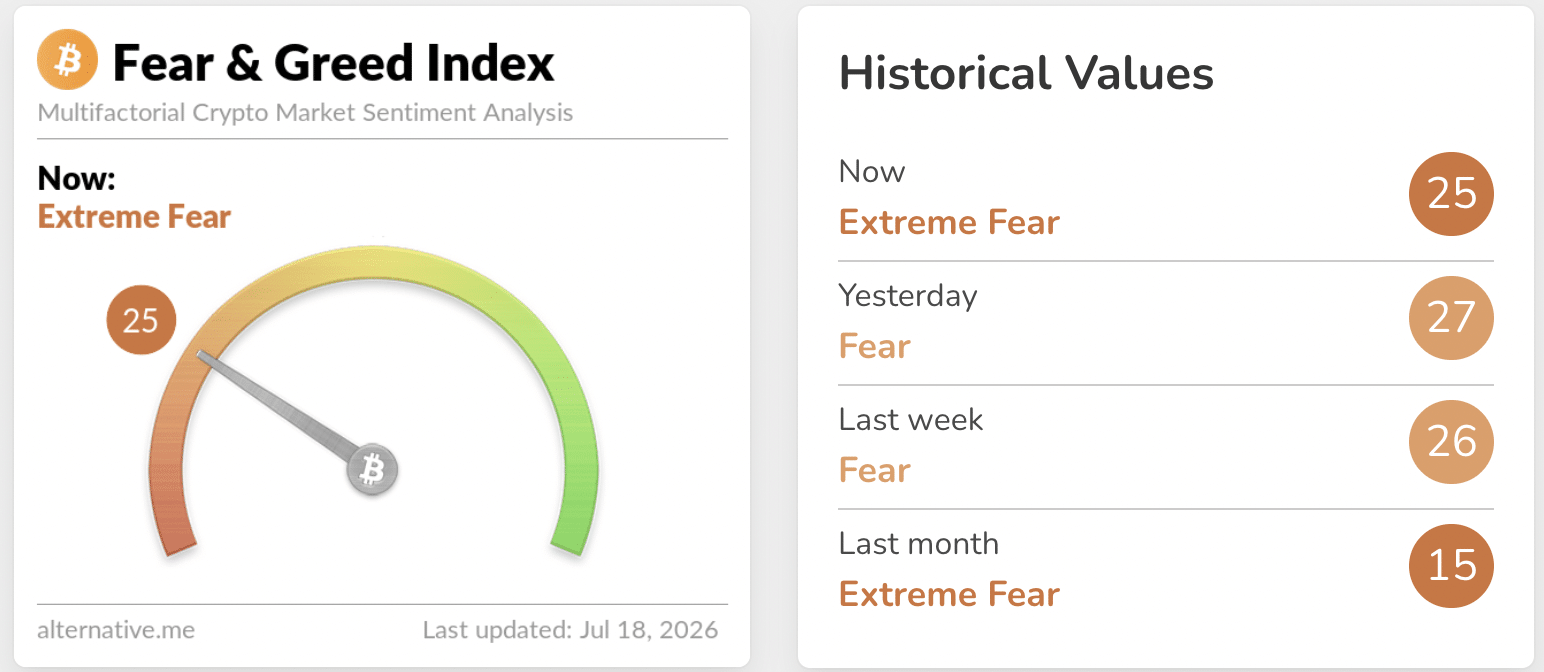
Source : Alternative

Résumé final

  • Les facteurs macroéconomiques façonnent le bitcoin plus que les simples métriques spécifiques aux cryptomonnaies.
  • Les investisseurs restent prudents à l'égard du Bitcoin et sont plus intéressés par les actions liées à la blockchain.


Trending Cryptos

Related Questions

QQuelle est la principale raison, selon le rapport de CoinShares, du récent rebond du Bitcoin ?

ASelon le rapport de CoinShares, le rebond récent du Bitcoin est davantage alimenté par des changements dans l'économie globale, en particulier la réaction à des données d'inflation américaine inférieures aux attentes, plutôt que par des développements propres à l'espace cryptographique.

QQuel événement spécifique a déclenché une modeste hausse du Bitcoin et des entrées de capitaux d'environ 250 millions de dollars le 14 juillet ?

ALa modeste hausse du Bitcoin et les entrées de capitaux d'environ 250 millions de dollars le 14 juillet ont été déclenchées par la publication de l'indice des prix à la consommation (IPC), qui a rapporté -0,4%, un chiffre inférieur aux -0,2% attendus.

QQuelle est la fourchette de prix dans laquelle le Bitcoin est censé évoluer selon le rapport, en l'absence d'un assouplissement monétaire significatif ?

ALe rapport prévoit que le Bitcoin évoluera dans une fourchette de prix relativement étroite entre 60 000 et 120 000 dollars, en l'absence d'indications claires d'un assouplissement monétaire de la part de la Réserve fédérale américaine.

QPourquoi un cours du Bitcoin supérieur à 80 000 dollars est-il jugé improbable dans le rapport ?

AUn cours du Bitcoin supérieur à 80 000 dollars est jugé improbable en l'absence d'un changement significatif dans les anticipations de politique monétaire, notamment un assouplissement clair de la part de la Réserve fédérale américaine.

QQuel indice mentionné dans l'article confirme que la prudence des investisseurs envers le Bitcoin reste élevée ?

AL'indice Crypto Fear and Greed, qui se trouvait dans la zone de 'peur extrême', confirme que la prudence des investisseurs envers le Bitcoin reste élevée.

Related Reads

Has the Crypto Utopia Collapsed? The Industry Reaches an Inflection Point After the Frenzy Subsides

Has the crypto utopia collapsed? The industry is at an inflection point as the hype fades. The prevailing view is that crypto has become an outlet for excess liquidity, with many participants leaving as financial returns have fallen short of past-decade expectations. The 2021 boom has been revealed as an illusion, placing the industry in the "trough of disillusionment" on Gartner's Hype Cycle. This forces a return to first principles: re-evaluating token value, securing DeFi protocols, and finding real-world applications. The core failure is a repetitive cycle of reflexive speculation, driven by the premature liquidity of tokens. The industry's incentives prioritized short-term gains over genuine innovation. While curiosity drives invention, recent DeFi hacks signal a need for engineering and iteration, including token models. The culture is shifting; the industry is no longer in its early stages. Positioned at a turning point on the technology adoption curve, crypto faces the immense challenge of rebuilding finance from scratch, a process of inevitable iteration and failure. Regarding crypto VC, claims of its death are overstated. The exceptional returns of 2016-2021 were an anomaly. The initial crypto-anarchist ethos has largely been co-opted by Wall Street and regulators. The utopian vision is over; the industry is being assimilated into the existing system, becoming a business. Current viable project categories include stablecoins, prediction markets, tokenized assets/RWA, perpetual contracts, and AI/agent integration. Crypto is converging with fintech, far from the envisioned DeFi revolution, and must find killer apps within regulatory boundaries. A reconciliation is possible: cryptocurrency may change value storage and transfer in subtle, imperceptible ways that integrate into existing systems, rather than through revolutionary fanfare. True creativity often emerges from adversity. There remains much to build for those driven by genuine curiosity.

marsbit14m ago

Has the Crypto Utopia Collapsed? The Industry Reaches an Inflection Point After the Frenzy Subsides

marsbit14m ago

Lei Jun Earns 7 Billion in One Day from CXMT's IPO? Xiaomi Executive Responds

On July 28th, Changxin Technology's stock price on the Sci-Tech Innovation Board experienced minor fluctuations. The company had made a historic market debut the previous day, becoming the first A-share stock to record a single-day trading volume exceeding 1 trillion yuan. This led to significant paper gains for its strategic investors. Among them, Xiaomi's wholly-owned subsidiary was allocated 18.24 million shares with an initial investment of approximately 158 million yuan. Reports estimated a paper profit of 717 million yuan for Xiaomi founder Lei Jun based on his shareholding structure. However, a Xiaomi executive clarified that this was a corporate investment and should not be conflated with personal wealth. Other major beneficiaries included Alibaba and Nio. Alibaba, an early investor, held nearly a 5% stake through two entities, with an estimated paper gain exceeding 160 billion yuan. Nio, participating in the strategic placement, also saw substantial paper returns. Additionally, state-owned banks and insurance institutions that invested in Changxin recorded potential gains in the hundreds of billions. Conversely, companies like Country Garden reportedly missed out on nearly 50 billion yuan in potential gains after divesting their stakes before the IPO due to liquidity pressures. The article notes that these are paper profits based on the listing price, as the allocated shares are subject to lock-up periods, and final realized gains will depend on future stock performance. An employee from Changxin Technology commented that ordinary staff remain focused on their salaries and benefits rather than the market hype.

marsbit23m ago

Lei Jun Earns 7 Billion in One Day from CXMT's IPO? Xiaomi Executive Responds

marsbit23m ago

Selling Tokens or Selling Outcomes: Several Paradoxes of the AI Business Model

"The Token vs. Outcome Sale: Key Paradoxes in the AI Business Model By mid-2026, the AI industry shows rapid growth in revenue and token usage, yet the underlying business models differ significantly. This article analyzes four structural paradoxes defining the current landscape, all pointing to the commoditization of intelligence and the concentration of profits in few segments. **The Cost Paradox: Cheaper Tokens, Heavier Bills** Despite a >95% price drop for equivalent AI capability since 2023, total spending has skyrocketed due to the Jevons Paradox: lower prices expand usage into previously uneconomical tasks. Furthermore, the shift to autonomous agents operating 24/7 multiplies consumption. However, efficiency gains often remain unrealized due to unchanged organizational workflows (the Solow Paradox). The focus is shifting from optimizing token price to optimizing the task itself. **The Hierarchy Paradox: The App is King vs. The App is Dead** While conventional wisdom holds that value accrues at the application layer, the AI stack is inverted. Infrastructure (chips) captures ~70% of industry revenue and ~80% of gross profit, while application-layer margins are thin (0-30%). Fast-evolving base models threaten "thin" apps. Sustainable applications are those that embed intelligence into specific contexts, possessing private data, workflows, or delivery capabilities that become more valuable as the base model improves. **The Responsibility Paradox: Profit Follows Accountability** Growth rates alone don't guarantee profit. A key differentiator is a company's willingness and ability to take responsibility for specific outcomes. Selling by the token competes for IT budgets; selling by the outcome (e.g., a resolved support ticket) taps into larger human labor budgets. Low-responsibility, high-volume tasks (e.g., generic客服) face commoditization. High-stakes, regulated domains (e.g., law, healthcare) where vendors assume heavier liability for results command higher margins, as seen with companies like Harvey in legal tech. **The Open-Source Paradox: Open Wins Traffic, Closed Wins Revenue** Open-source models dominate in usage share and developer adoption, often being 5-20x cheaper. However, closed-source models still capture the majority of enterprise spending (~89%). Enterprises pay a premium for closed-source reliability, support, compliance, and accountability. The total cost of ownership (TCO) is converging as closed-source prices fall faster than open-source builds trust, leading to hybrid deployments. Profit is migrating from the model layer itself to upstream (compute) and downstream (orchestration, data, services)."

marsbit24m ago

Selling Tokens or Selling Outcomes: Several Paradoxes of the AI Business Model

marsbit24m ago

Trading

Spot

Hot Articles

What is $BITCOIN

DIGITAL GOLD ($BITCOIN): A Comprehensive Analysis Introduction to DIGITAL GOLD ($BITCOIN) DIGITAL GOLD ($BITCOIN) is a blockchain-based project operating on the Solana network, which aims to combine the characteristics of traditional precious metals with the innovation of decentralized technologies. While it shares a name with Bitcoin, often referred to as “digital gold” due to its perception as a store of value, DIGITAL GOLD is a separate token designed to create a unique ecosystem within the Web3 landscape. Its goal is to position itself as a viable alternative digital asset, although specifics regarding its applications and functionalities are still developing. What is DIGITAL GOLD ($BITCOIN)? DIGITAL GOLD ($BITCOIN) is a cryptocurrency token explicitly designed for use on the Solana blockchain. In contrast to Bitcoin, which provides a widely recognized value storage role, this token appears to focus on broader applications and characteristics. Notable aspects include: Blockchain Infrastructure: The token is built on the Solana blockchain, known for its capacity to handle high-speed and low-cost transactions. Supply Dynamics: DIGITAL GOLD has a maximum supply capped at 100 quadrillion tokens (100P $BITCOIN), although details regarding its circulating supply are currently undisclosed. Utility: While precise functionalities are not explicitly outlined, there are indications that the token could be utilized for various applications, potentially involving decentralized applications (dApps) or asset tokenization strategies. Who is the Creator of DIGITAL GOLD ($BITCOIN)? At present, the identity of the creators and development team behind DIGITAL GOLD ($BITCOIN) remains unknown. This situation is typical among many innovative projects within the blockchain space, particularly those aligning with decentralized finance and meme coin phenomena. While such anonymity may foster a community-driven culture, it intensifies concerns about governance and accountability. Who are the Investors of DIGITAL GOLD ($BITCOIN)? The available information indicates that DIGITAL GOLD ($BITCOIN) does not have any known institutional backers or prominent venture capital investments. The project seems to operate on a peer-to-peer model focused on community support and adoption rather than traditional funding routes. Its activity and liquidity are primarily situated on decentralized exchanges (DEXs), such as PumpSwap, rather than established centralized trading platforms, further highlighting its grassroots approach. How DIGITAL GOLD ($BITCOIN) Works The operational mechanics of DIGITAL GOLD ($BITCOIN) can be elaborated on based on its blockchain design and network attributes: Consensus Mechanism: By leveraging Solana’s unique proof-of-history (PoH) combined with a proof-of-stake (PoS) model, the project ensures efficient transaction validation contributing to the network's high performance. Tokenomics: While specific deflationary mechanisms have not been extensively detailed, the vast maximum token supply implies that it may cater to microtransactions or niche use cases that are still to be defined. Interoperability: There exists the potential for integration with Solana’s broader ecosystem, including various decentralized finance (DeFi) platforms. However, the details regarding specific integrations remain unspecified. Timeline of Key Events Here is a timeline that highlights significant milestones concerning DIGITAL GOLD ($BITCOIN): 2023: The initial deployment of the token occurs on the Solana blockchain, marked by its contract address. 2024: DIGITAL GOLD gains visibility as it becomes available for trading on decentralized exchanges like PumpSwap, allowing users to trade it against SOL. 2025: The project witnesses sporadic trading activity and potential interest in community-led engagements, although no noteworthy partnerships or technical advancements have been documented as of yet. Critical Analysis Strengths Scalability: The underlying Solana infrastructure supports high transaction volumes, which could enhance the utility of $BITCOIN in various transaction scenarios. Accessibility: The potential low trading price per token could attract retail investors, facilitating wider participation due to fractional ownership opportunities. Risks Lack of Transparency: The absence of publicly known backers, developers, or an audit process may yield skepticism regarding the project's sustainability and trustworthiness. Market Volatility: The trading activity is heavily reliant on speculative behavior, which can result in significant price volatility and uncertainty for investors. Conclusion DIGITAL GOLD ($BITCOIN) emerges as an intriguing yet ambiguous project within the rapidly evolving Solana ecosystem. While it attempts to leverage the “digital gold” narrative, its departure from Bitcoin's established role as a store of value underscores the need for a clearer differentiation of its intended utility and governance structure. Future acceptance and adoption will likely depend on addressing the current opacity and defining its operational and economic strategies more explicitly. Note: This report encompasses synthesised information available as of October 2023, and developments may have transpired beyond the research period.

1.1k Total ViewsPublished 2025.05.13Updated 2025.05.13

What is $BITCOIN

Discussions

Welcome to the HTX Community. Here, you can stay informed about the latest platform developments and gain access to professional market insights. Users' opinions on the price of BTC (BTC) are presented below.

活动图片