Dolar Jaminan: Bagaimana 'Lapisan Kedua Dolar' di Atas Stablecoin Terbentuk?

链捕手Published on 2026-07-08Last updated on 2026-07-08

Abstract

Stablecoin memperkenalkan klaim dolar pribadi yang ditokenisasi. Meskipun penerbit, aset cadangan, dan bank penyelesaian utama berada dalam yurisdiksi AS, peredaran dan penggunaannya sebagai jaminan dapat menjadi "lepas pantai" secara ekonomi. Tulisan ini menjelaskan bahwa stablecoin terutama menggantikan fungsi saldo dolar operasional dalam sistem lepas pantai yang ada. Namun, yang lebih penting adalah pembentukan "Dolar Jaminan" (Collateral Dollar) — lapisan klaim dolar kedua yang diciptakan di atas stablecoin. Ketika stablecoin digunakan sebagai jaminan untuk pinjaman, itu membuka saluran kredit terjamin. Namun, peristiwa moneter sejati hanya terjadi ketika kewajiban (liabilitas) yang dikeluarkan terhadap token jaminan ini didanai, diperpanjang, atau diterima pada nilai mendekati pari oleh pihak ketiga. Inilah yang disebut Dolar Jaminan. Elastisitas sistem ini tidak berasal dari stablecoin itu sendiri, tetapi dari neraca keuangan yang bersedia membuka dan mempertahankan liabilitas lapisan kedua tersebut. Diskonto (haircut) mencerminkan jarak antara "kontrol efektif atas token" dan "kemampuan penukaran yang andal ke dolar bank". Tekanan dalam saluran jaminan ini bekerja secara terbalik dibanding sistem dolar lepas pantai tradisional. Kerapuhan muncul di lapisan kedua (klaim atas token) jauh sebelum ada penekan pada token dasar. Peningkatan diskonto dan pemberitahuan margin call dapat memicu lingkaran setan penjualan terpaksa dan kehilangan pendanaan. Kesimpulannya, Dol...

Penulis:neira, Arsitek Produk Keuangan Tokenisasi Tempo

Kompilasi:Jiahuan, ChainCatcher

Kebanyakan orang berpikir bahwa stablecoin sedang meniru fungsi dolar Eropa, dan mendorong ekspansi sistem dolar lepas pantai lebih lanjut.

Namun kenyataannya tidak demikian. Stablecoin terutama menggantikan hanya sebagian fungsi dari sistem yang ada, khususnya saldo dolar yang diperlukan untuk operasi sehari-hari dan penyelesaian; pada beberapa aspek yang paling diperhatikan oleh The Fed, ia bahkan mungkin menekan efek pengganda ekspansi kredit.

Pertanyaan yang benar-benar layak diajukan adalah: Apa yang terjadi ketika perantara keuangan menciptakan lapisan baru klaim dolar di atas stablecoin?

Artikel ini akan menjelaskan bagaimana saluran pembiayaan jaminan baru ini beroperasi, kondisi apa yang diperlukan untuk penskalannya, dan mengapa performanya di bawah tekanan memiliki struktur yang secara fundamental berbeda dengan sistem dolar Eropa tradisional.

Ringkasan

Stablecoin memperkenalkan klaim dolar pribadi yang ditokenisasi. Meskipun penerbit, aset cadangan, dan bank penyelesaian utama berada di dalam batas hukum AS, atau bergantung pada infrastruktur bank dan penyelesaian sekuritas yang terhubung dengan AS, klaim jenis ini dalam peredarannya dan penggunaan sebagai jaminan mungkin masih secara ekonomi menjadi "lepas pantai".

Hak kendali jaminan yang dapat diberlakukan membuka saluran kredit terjamin, tetapi tidak menciptakan klaim moneter. Peristiwa moneter yang sebenarnya hanya terjadi ketika lembaga keuangan lain membiayai, memperpanjang, atau menerima liabilitas yang dibuat atas token yang dikendalikan ini dengan harga yang mendekati nilai nominal.

Diskon menentukan harga untuk jarak antara "kendali efektif atas token" dan "konversi yang dapat diandalkan menjadi dolar bank". Sumber elastisitasnya berbeda: ia berasal dari neraca yang menerbitkan liabilitas atas token tersebut, dan juga dari kesediaan neraca pihak ketiga untuk memperlakukan liabilitas ini sebagai aset yang mendekati nilai nominal bahkan di bawah tekanan.

Variabel penentu meliputi: siapa yang memiliki kendali efektif atas token, melalui jalur hukum dan operasional apa ia dapat dikonversi menjadi dolar bank, berapa biaya aktualnya, berapa jangka waktunya, dan apakah klaim yang dihasilkan masih dapat dibiayai dengan cara yang mendekati nilai nominal jika jalur-jalur ini terhambat.

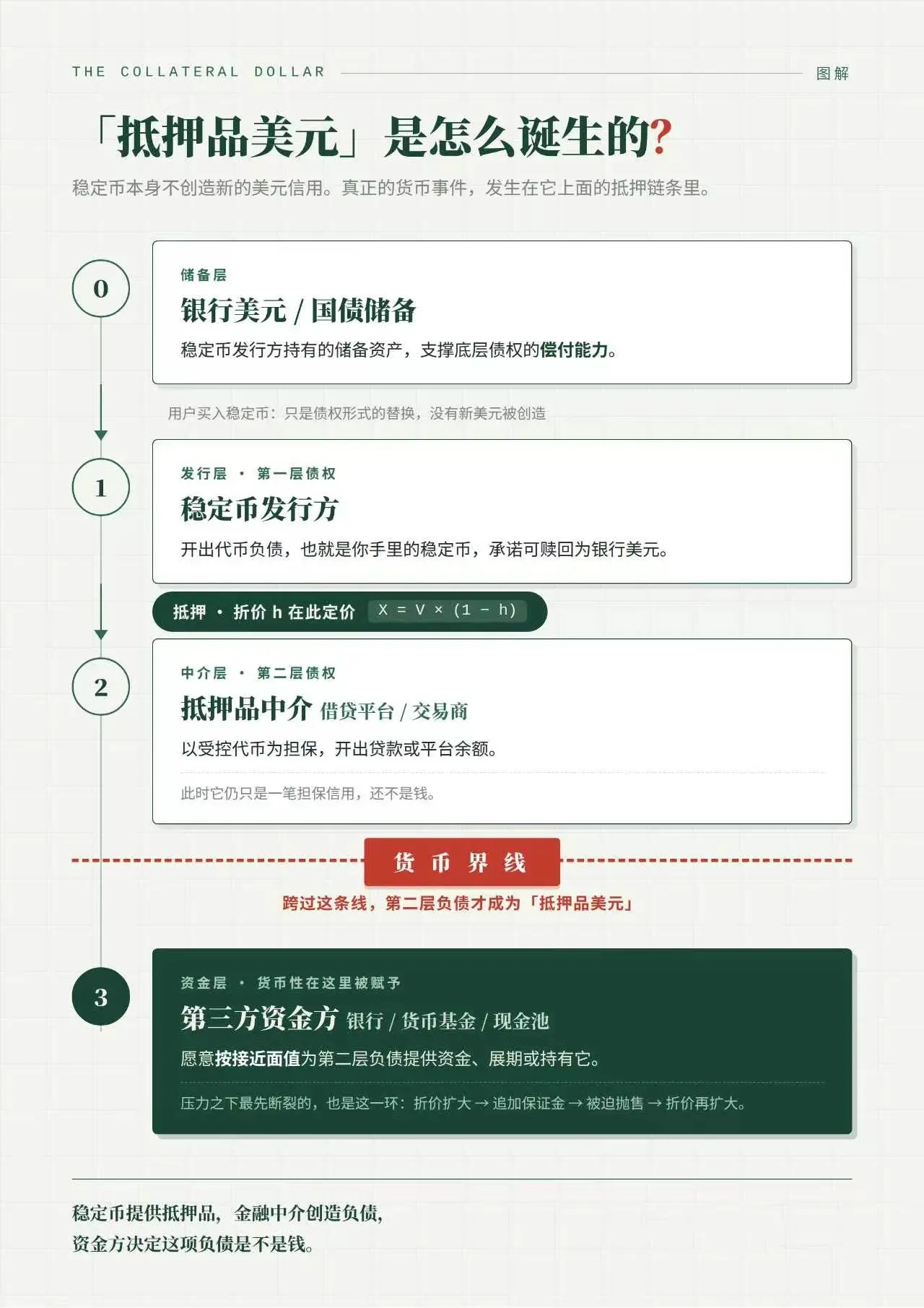
Dolar jaminan bukanlah stablecoin itu sendiri. Ia adalah liabilitas lapisan kedua yang diterbitkan, dibiayai, dan dipertahankan pada tingkat yang mendekati nilai nominal oleh lembaga keuangan lain atas saldo token yang dikendalikan.
1. Sistem Dolar Eropa adalah Struktur Hirarkis Klaim

Dolar Eropa dalam arti ketat adalah liabilitas bank berdenominasi dolar yang dicatat di luar yurisdiksi langsung The Fed: ia adalah komitmen pribadi untuk menyerahkan dolar, diterbitkan oleh sebuah lembaga bank, di mana lembaga ini memiliki tempat pendaftaran hukum, perlakuan regulasi, dan akses likuiditas yang berbeda dari bank dalam negeri AS.

Sistem dolar lepas pantai yang lebih luas juga mencakup klaim dolar yang diterbitkan oleh dealer dan perantara pasar berbasis jaminan dan derivatif. Satuan denominasi tetap dolar, sementara neraca yang menerbitkan klaim berada di luar yurisdiksi langsung bank sentral.

Pasar ini membentuk sistem neraca dolar pribadi. Sebuah lembaga lepas pantai hanya perlu mencatat liabilitas dan aset yang sepadan secara bersamaan untuk menciptakan klaim dolar. Penyelesaian akhir mungkin masih melalui sistem pembayaran AS, tetapi "penciptaan" dan "penyelesaian" dipisahkan dalam ruang kelembagaan.

Pemisahan ini memungkinkan lembaga non-AS membiayai posisi, melindungi eksposur, dan menyelesaikan transaksi dalam dolar tanpa harus selalu bergantung pada mata uang bank sentral domestik. Namun itu juga menciptakan ketergantungan: ketergantungan pada kemampuan perpanjangan, kredit antarbank, perantara dealer, dan konversi ke klaim yang lebih tinggi saat tekanan penyelesaian meningkat.

Klaim diurutkan berdasarkan: kekuatan komitmen nilai nominal, kualitas aset pendukung, tenor, likuiditas pasar, dan tingkat kedekatan akses ke mata uang yang lebih tinggi. Dalam kondisi normal, pembuatan pasar dan perpanjangan memampatkan struktur hirarki ini. Di bawah tekanan, kompresi ini berbalik: kuota pihak lawan dikencangkan, tenor dipersingkat, diskon melebar, struktur hirarki muncul kembali melalui berbagai kendala operasional.

Elastisitas berasal dari neraca yang bersedia memperluas liabilitas dolar sebelum kendala penyelesaian akhir diberlakukan.

Dalam saluran tidak terjamin, bank lepas pantai menerbitkan deposito, sertifikat deposito, atau liabilitas antarbank, lalu menginvestasikan dana yang dikumpulkan ke dalam aset dolar. Dalam saluran terjamin, dealer menerbitkan klaim dolar atas jaminan, dengan diskon menentukan berapa banyak pembiayaan yang dapat didukung oleh jaminan tersebut.

Dalam saluran derivatif, swap dan kontrak berjangka valuta asing menciptakan dana dolar bukan melalui deposito yang langsung terlihat, tetapi melalui komitmen melintasi waktu. Kaki berjangka memungkinkan bank dan lembaga non-bank mengubah kapasitas neraca di tingkat mata uang menjadi kapabilitas pembiayaan dolar. Sementara saldo stablecoin yang dapat dialihkan hanyalah klaim spot, tanpa pasar pembiayaan berjangka di belakangnya, sehingga sama sekali tidak dapat meniru fungsi di atas.

Dalam konteks dolar Eropa, "lepas pantai" terutama mengacu pada lokasi hukum dan posisi neraca penerbitan liabilitas. Jalur stablecoin memperoleh sifat "lepas pantai" berbeda, yaitu melalui cara penggunaan ekonomi: meskipun penerbit dan cadangannya tetap di dalam AS, atau bergantung pada infrastruktur bank dan penyelesaian sekuritas yang terhubung ke AS, rantai peredaran, penyimpanan, penjaminan, dan leverage-nya mungkin masih beroperasi di luar batas hukum AS.

Oleh karena itu, perbandingan yang benar-benar layak adalah kontras antara dua rantai: rantai jaminan stablecoin di satu sisi, dan rantai pembiayaan dolar lepas pantai di sisi lain. Membandingkan langsung "token" dengan "deposito dolar Eropa" adalah perbandingan yang tidak tepat.

Sebuah deposito dolar Eropa, sejak lahir, berada di neraca bank yang mampu memperluas kredit: ia memiliki elastisitas sejak entri pertama. Sedangkan sebuah stablecoin, lahir di neraca penerbit yang berjanji dengan cadangan pendukung, sehingga pada saat kelahirannya hanya membawa "penggantian"; elastisitas muncul kemudian, di tempat lain.

Baru ketika perantara lain menerbitkan liabilitas yang dapat dibiayai atas stablecoin tersebut, dan lebih banyak neraca yang menerima liabilitas ini dengan harga mendekati nilai nominal, stablecoin baru berhubungan dengan elastisitas.

2. Stablecoin Mengganggu Tingkat Tertentu dalam Sistem Dolar Lepas Pantai

Stablecoin mengubah komposisi klaim di dalam tingkat tertentu sistem dolar lepas pantai. Sistem itu sendiri tetap di tempatnya.

Penggantian paling jelas terjadi dalam situasi ini: pemegang menginginkan saldo dolar yang dapat dialihkan, bukan akses ke neraca dolar penuh. Bursa, broker, perusahaan pembayaran, dan departemen keuangan perusahaan tertentu dapat memegang stablecoin sebagai inventaris penyelesaian. Dalam penggunaan ini, token mengambil alih sebagian fungsi yang sebelumnya dilakukan oleh deposito operasional lepas pantai.

Perubahan neraca di sini langsung. Pengguna mengganti klaimnya terhadap bank lepas pantai dengan klaim terhadap penerbit stablecoin. Bank kehilangan liabilitas ini, penerbit mendapatkan liabilitas token baru yang dicocokkan dengan portofolio cadangannya.

Komposisi cadangan ini menentukan di mana permintaan dana yang tergeser itu akhirnya muncul. Jika cadangan tetap dalam bentuk deposito bank, sistem perbankan mendapatkan kembali sebagian dana tersebut. Jika cadangan dialihkan ke T-bills atau repo, tekanan beralih ke pasar jaminan berdaulat dan perantara dealer. Penggantian ini hanya mengalihkan "ketergantungan pada bank", bukan menghilangkannya.

Penggantian ini paling kuat di tingkat saldo operasional: inventaris bursa, saldo penyelesaian broker, float pembayaran, dan dana perputaran perusahaan. Di tingkat pembiayaan bank grosir, ia melemah, karena deposito berjangka, sertifikat deposito, dan pinjaman antarbank di tingkat ini membentuk struktur tenor.

Pada swap valuta asing, ia hampir tidak ada: komitmen berjangka dan kapasitas neraca lintas mata uang bersama-sama menciptakan dana dolar, di mana token spot tidak memiliki peran apa pun. Di tingkat dealer, stablecoin dapat menjadi aset yang memenuhi syarat, tetapi tetap tunduk pada kendala yang benar-benar penting: modal, kapasitas penyelesaian, kuota pihak lawan, inventaris jaminan. Kendala-kendala ini tidak dapat digantikannya.

Stablecoin yang diterima sebagai jaminan dapat mendukung klaim dolar lebih lanjut. Tetapi sebelum neraca lain bersedia membiayai klaim ini, memperpanjangnya, atau memegangnya dengan harga mendekati nilai nominal, ia tetap hanya kredit terjamin.

3. Sebuah Saldo Dolar Tidak Menciptakan Kapasitas Neraca Dolar

Sistem dolar lepas pantai melayani dua kebutuhan yang saling independen.

Pertama, kebutuhan akan "saldo dolar": sebuah klaim yang dapat disimpan dan dialihkan untuk pembayaran. Dalam skenario di mana friksi transfer adalah kendala utama, stablecoin sangat sesuai dengan kebutuhan ini.

Kedua, kebutuhan akan "kapasitas neraca dolar": yaitu kemampuan untuk mendapatkan pembiayaan, margin, lindung nilai, atau konversi tenor. Kemampuan ini berada di dalam bank, dealer, dan dana. Ia mengonsumsi modal, likuiditas, dan kuota pihak lawan, dan akan ditarik ketika kondisi mengencang.

Ada kebutuhan ketiga, yang melampaui keduanya: kebutuhan akan jenis klaim yang bersedia diperlakukan oleh neraca lain sebagai aset yang mendekati nilai nominal, tanpa harus setiap kali mengaudit ulang jaminan dasarnya. Pengguna membutuhkan saldo dolar. Dana leverage membutuhkan kapabilitas pembiayaan. Sedangkan kumpulan kas atau penyedia dana lapisan kedua membutuhkan klaim yang dapat dipegang mendekati nilai nominal. Saluran jaminan baru menjadi benar-benar penting ketika menyentuh kebutuhan ketiga ini.

Ada tiga tes yang membedakan lapisan-lapisan ini.

Dapat dialihkan. Pemegang dapat mentransfer klaim dolar ini. Stablecoin dengan mudah lulus tes ini.

Kapabilitas pembiayaan. Perantara bersedia memberikan pinjaman, margin, atau kredit terhadap klaim ini. Stablecoin hanya dapat lulus tes ini di bawah kendala kelayakan, kendali, dan diskon.

Penerimaan sebagai mata uang. Apakah klaim yang dibuat oleh perantara ini sendiri kemudian dapat dibiayai atau dipegang mendekati nilai nominal. Stablecoin baru memiliki signifikansi sistemik ketika mencapai tahap ini.

Penggantian di tingkat perusahaan juga mengikuti gradien yang sama: penggantian inventaris penyelesaian paling kuat, penggantian perbankan hubungan paling lemah. Saldo token dapat menggantikan bagian dari deposito operasional yang digunakan untuk mentransfer nilai. Tetapi apa pun yang berada di balik sebagian besar posisi kas perusahaan tidak dapat digantikannya: fasilitas overdraf, fasilitas valuta asing, bank koresponden, penyedia likuiditas intraday, antarmuka kepatuhan sanksi, hubungan kredit.

Token bertanggung jawab mentransfer klaim. Neraca bertanggung jawab menyediakan elastisitas.

4. Dari Elastisitas Deposito ke Elastisitas Diskon

Dalam saluran lepas pantai tradisional, elastisitas berasal dari liabilitas bank.

(Bank Lepas Pantai)

Deposan memegang klaim seperti mata uang, bank mendapatkan dana yang dapat digunakan. Elastisitas lahir di sisi liabilitas neraca yang dapat diperluas.

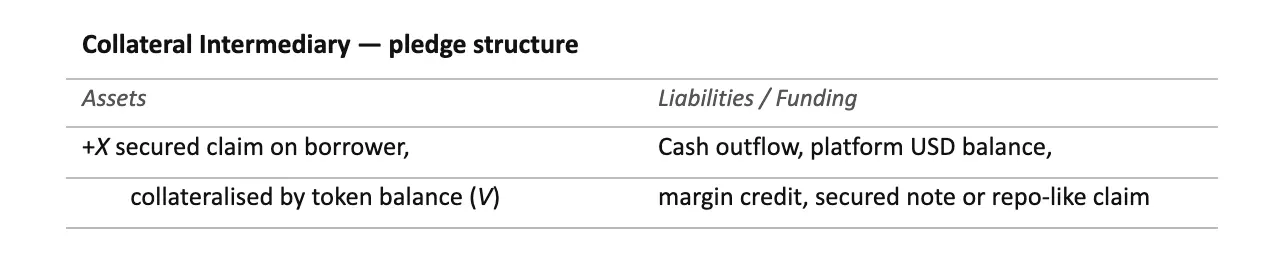
Penerbitan stablecoin menghasilkan struktur yang lebih sempit.

(Penerbit Stablecoin)

Pemegang mendapatkan klaim yang dapat dialihkan, penerbit memegang cadangan. Selama penerbit tetap "sempit", tidak ada klaim dolar pribadi kedua yang diciptakan: yang berubah hanyalah bentuk dan lokasi klaim pertama.

Saluran terjamin dimulai dari saat token digunakan untuk pembiayaan. Diskon menentukan berapa banyak pembiayaan yang dapat didukung oleh token yang dikendalikan:

X = V_token × (1 − h)

di mana X adalah kapabilitas pembiayaan lapisan kedua, V_token adalah nilai pasar token yang dikendalikan, h adalah tingkat diskon. Pencatatan di sini harus membedakan empat neraca.

Situasi perantara jaminan tergantung pada bentuk hukum kendali. Penjaminan (pledge) dan pengalihan hak milik (title transfer) bukanlah neraca yang sama.
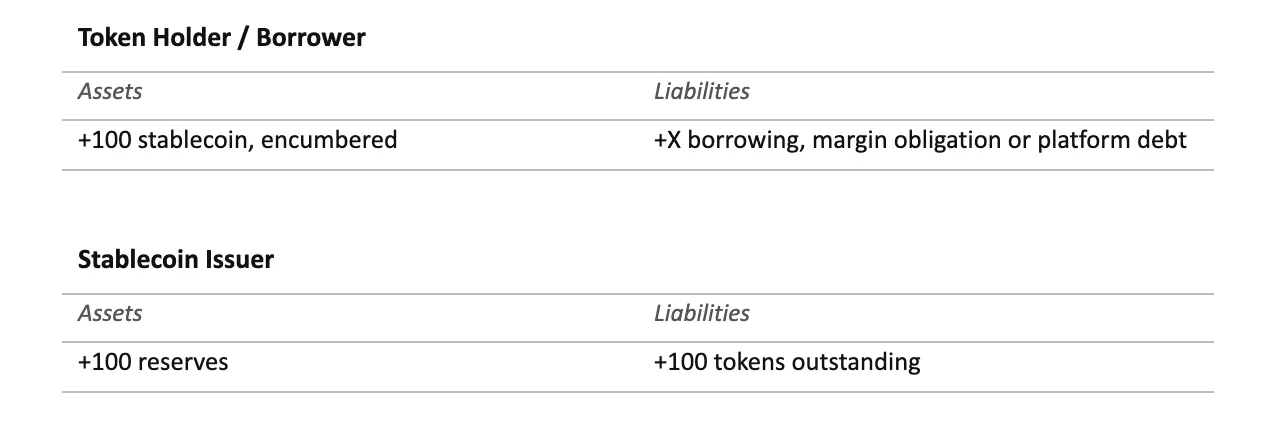
(Perantara Jaminan: Struktur Penjaminan)

Dalam struktur penjaminan, peminjam tetap pemilik token. Perantara tidak memiliki seluruh saldo token, ia memegang klaim terjamin sebesar X, dan memiliki kendali atau hak penegakan atas jaminan bernilai V. Eksposur neracanya adalah X, perlindungan hukum mencakup V. Bagian jaminan tambahan V − X, secara ekonomi masih milik peminjam, kecuali mekanisme likuidasi dan penyitaan menentukan sebaliknya.
(Perantara Jaminan: Struktur Pengalihan Hak Milik)

Dalam struktur pengalihan hak milik, perantara memegang token itu sendiri. Asumsikan token bernilai 100, pinjaman 90, maka perantara mengendalikan seluruh saldo token 100, sementara peminjam, melalui hak "untuk mengambil kembali jaminan setara atau nilai sisa setelah pembayaran kembali", mempertahankan bagian surplus ekonomi itu.

Kendali hukum total perantara adalah V, eksposur ekonomi nettonya adalah X. Selisih V − X bukanlah ekuitas yang dapat digunakan secara bebas. Ia adalah perlindungan sisa peminjam, tertanam dalam kewajiban "harus mengembalikan jaminan setara atau menyelesaikan surplus setelah likuidasi".

Jika pinjaman ini dibiayai dengan kas yang sudah ada, maka perantara belum tentu memperluas liabilitasnya sendiri, ia hanya menukar kas dengan eksposur terjamin atau eksposur pengalihan hak milik. Jika pinjaman ini dibiayai dengan menerbitkan saldo platform, nota, klaim seperti repo, atau liabilitas jangka pendek lainnya, maka perantara memperluas neracanya.

Oleh karena itu, masalah moneter tidak berhenti pada apakah hak milik dialihkan. Itu tergantung pada bagaimana pinjaman ini sendiri dibiayai, dan apakah liabilitas yang dihasilkan kemudian diterima mendekati nilai nominal.

Perbedaan ini penting karena mekanisme tekanan keduanya berbeda. Dalam penjaminan, penegakan oleh pemberi pinjaman bergantung pada hak penyempurnaan, prioritas, dan realisasi atas jaminan yang masih terkait dengan peminjam. Dalam pengalihan hak milik, perantara mungkin memiliki kendali yang lebih kuat, kemampuan penjaminan ulang, atau hak realisasi, tetapi juga memiliki kewajiban yang lebih jelas: harus mengembalikan jaminan setara atau nilai setelah eksposur terjamin diselesaikan.
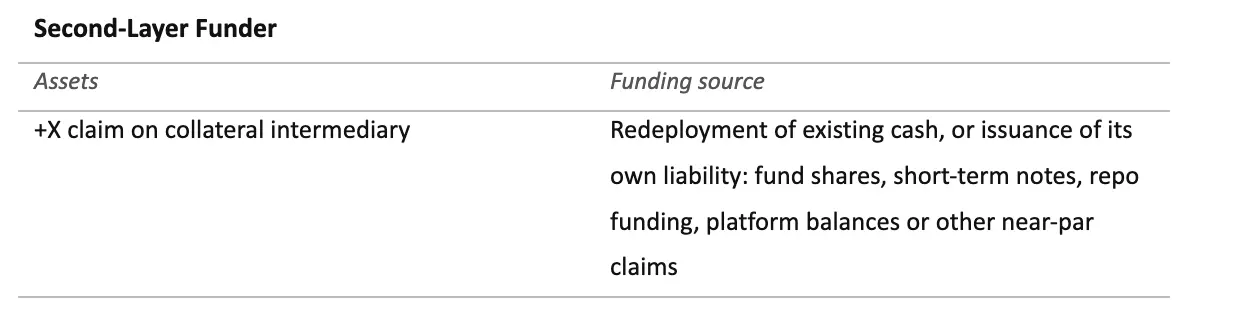
(Penyedia Dana Lapisan Kedua)

Elastisitas moneter paling kuat dalam skenario kedua: penyedia dana membiayai klaim ini dengan menerbitkan liabilitasnya sendiri yang mendekati nilai nominal. Dalam skenario pertama, sistem hanya mengalokasikan kembali kas yang sudah ada ke klaim yang didukung token, stok liabilitas dolar pribadi belum tentu diperluas.

Penerbitan itu sendiri tidak menciptakan apa pun selain token. Kredit jaminan mengeluarkan nilai terhadap token. Baru ketika klaim pemberi pinjaman menjadi aset yang dibiayai mendekati nilai nominal oleh lembaga keuangan lain, batas moneter itu dilewati. Langkah dari pemberian pinjaman terjamin menuju penciptaan uang terjadi di sini, tidak pernah sebelumnya.

Diskon menentukan harga untuk jarak antara "kendali efektif atas token" dan "konversi yang dapat diandalkan menjadi dolar bank", mengubah nilai jaminan menjadi kapabilitas pembiayaan. Dan elastisitas itu sendiri berasal dari liabilitas yang diterbitkan atas token, dan kesediaan lembaga keuangan lain untuk membiayai liabilitas ini mendekati nilai nominal.

5. Kondisi Kelembagaan Saluran Jaminan

Ada empat kondisi yang menentukan apakah klaim lapisan kedua dapat dibiayai mendekati nilai nominal.

Kendali hukum. Memiliki posisi prioritas yang dapat diberlakukan atas peminjam, kreditur peminjam, penyimpan, platform, dan harta kepailitan apa pun yang terlibat. Terhadap penerbit, pertanyaannya berbeda: kelayakan penebusan, dapat dialihkan, hak pembekuan, status akun, risiko daftar hitam, dan status hukum klaim pemegang token. Pemberi pinjaman harus jelas apakah pengaturan ini adalah penjaminan, pengalihan hak milik, kendali penyimpanan, penguncian kontrak pintar, atau klaim platform hibrida. Setiap bentuk menghasilkan hak yang berbeda pada saat default.

Kendali operasional. Jalur realisasi dan jalur penebusan harus dibedakan. Realisasi tergantung pada kedalaman pasar sekunder, neraca pembuat pasar, dan akses ke tempat perdagangan. Penebusan tergantung pada aturan penerbit, daftar putih, bank penyelesaian, jam operasional bank, dan waktu penebusan. Sebuah diskon yang menganggap kedua jalur keluar ini setara adalah tidak ketat.

Keketatan diskon. Diskon harus mencakup: risiko penerbit, komposisi cadangan, akses bank penyelesaian, kelayakan penebusan, struktur penyimpanan, dapat dilaksanakan secara hukum, kedalaman tempat, finalitas on-chain, hak penangguhan operasional, risiko salah arah dengan peminjam, konsentrasi pembuat pasar, dan waktu yang dibutuhkan untuk mengonversi token menjadi dolar bank.

Keberlanjutan pembiayaan. Pihak ketiga bersedia membiayai klaim pemberi pinjaman tanpa harus setiap kali mengaudit ulang dari nol token, peminjam, dan jalur realisasi lengkap. Apakah pemberi pinjaman asli nyaman dengan jaminan, bukanlah kriteria penilaian. Selama setiap penyedia dana harus menganalisis pinjaman jaminan ini secara individual, hasilnya adalah kredit terjamin bilateral, bukan klaim yang mendekati nilai nominal.

Pembiayaan mendekati nilai nominal terikat dengan tenor. Sebuah klaim yang dapat dipinjamkan semalam berbeda dengan klaim yang dapat bertahan melalui penundaan penebusan beberapa hari, penarikan dana berkala, atau penarikan investor. Sifat moneter bukan hanya masalah harga, juga masalah waktu.

Tes sesungguhnya adalah: setelah peminjam, penerbit, penyimpan, tempat perdagangan, dan bank penyelesaian masing-masing menjadi sumber risiko independen, apakah liabilitas yang diterbitkan atas token itu masih merupakan aset yang mendekati nilai nominal. Apakah token dapat digunakan sebagai jaminan, itu adalah bagian yang paling mudah.

6. Transmisi Tekanan dalam Saluran Jaminan

Tekanan dalam sistem dolar lepas pantai muncul sebagai pergerakan ke atas sepanjang struktur hirarki. Pihak lawan yang lebih lemah kehilangan pembiayaan. Pemberi pinjaman repo memperlebar diskon. Dealer mulai membatasi kapasitas neraca. Klaim yang sebelumnya dianggap seperti kas, sekarang membutuhkan dukungan likuiditas eksplisit.

Dalam saluran jaminan yang dibangun di atas stablecoin, klaim lapisan atas yang gagal terlebih dahulu. Token dasar adalah komitmen penerbit "untuk ditebus menjadi dolar bank". Klaim lapisan kedua adalah komitmen perantara "untuk menyediakan likuiditas mendekati nilai nominal dengan dukungan token tersebut". Yang pertama mungkin masih solvent, yang kedua sudah kehilangan status seperti mata uang.

Dalam kondisi normal, token diperdagangkan pada nilai nominal, diskon rendah, perantara memberikan kredit seperti biasa, klaim lapisan kedua dianggap seperti kas. Tidak ada yang akan menguji jalur realisasi dan penebusan lengkap secara bersamaan. Kerapuhan tersembunyi di lapisan di atas penerbit.

Yang pertama putus, sering kali adalah penyesuaian satu syarat jaminan, jauh sebelum penarikan terhadap token terjadi. Seorang pemberi pinjaman menaikkan diskon, peminjam mendapat panggilan margin. Seorang peminjam yang tidak memiliki kas dan tidak dapat menambah jaminan tambahan memaksa perantara untuk merealisasikan, menebus, atau membiayai posisi tersebut secara internal. Klaim lapisan kedua segera menjadi sangat menguras neraca.

Aritmetika di sini tanpa ampun. Saldo token yang dibiayai dengan diskon 2% dapat mendukung kredit 98:

100 × (1 − 0.02) = 98

Dan dengan diskon 15%, harga pasar sekunder 99 sen, nilai yang dapat dipinjamkan turun menjadi 84.15:

99 × (1 − 0.15) = 84.15

Kekurangan 13.85 harus ditutup dari suatu tempat:

98 − 84.15 = 13.85

Entah itu panggilan margin, penjualan terpaksa, penggunaan dana internal, atau klaim lapisan kedua yang putus.

Formula statis ini mengukur kerugian pertama kapabilitas pembiayaan. Mekanisme tekanan sebenarnya adalah dinamis. V_token dan h bukan variabel independen. Diskon yang lebih tinggi menekan nilai yang dapat dipinjamkan, dan memicu panggilan margin yang dapat memaksa token dijual. Penjualan terpaksa kemudian menekan harga pasar sekunder token. Harga yang lebih rendah membenarkan bahwa diskon harus dinaikkan lagi, menciptakan celah dana baru.

X_t = V_t (1 − h_t)

Untuk perubahan kecil:

ΔA ≈ (1 − h_t) ΔV − V_t Δh

Di bawah tekanan, kedua ini bergerak searah. Δh naik karena pemberi pinjaman meminta lebih banyak perlindungan; ΔV turun karena proses panggilan margin itu sendiri menciptakan penjual. Jadi, diskon bukan hanya ukuran risiko, ia bisa menjadi mekanisme transmisi risiko.

Jalur realisasi mengubah masalah pembiayaan menjadi masalah kedalaman pasar. Jalur penebusan mengubahnya menjadi masalah saluran perbankan. Pembiayaan internal membuatnya tetap menjadi masalah modal perantara, dan di sinilah ia menjadi mahal. Mengalihkan klaim ke penyedia dana lain hanya dapat dilakukan jika klaim masih diperdagangkan mendekati nilai nominal.

Keluar dari dealer atau platform menarik lembaga yang sebelumnya telah mengubah jaminan menjadi dana mendekati nilai nominal dengan "menyimpan" selisih waktu antara realisasi dan penebusan. Ini berbeda dengan penurunan likuiditas. Begitu penyimpanan ini berhenti, struktur hirarki segera muncul kembali.

Berbeda dengan sistem dolar lepas pantai yang matang, rantai jaminan stablecoin tidak memiliki mekanisme "dealer akhir" yang mapan atau arsitektur fasilitas swap bank sentral untuk liabilitas yang diterbitkan atas token. Token dasar mungkin memiliki cadangan. Sedangkan klaim lapisan kedua hanya memiliki pasar pembiayaannya sendiri.

Kualitas cadangan mendukung solvabilitas klaim dasar, tetapi begitu saluran penebusan, bank penyelesaian, atau kedalaman pasar sekunder gagal, ia tidak menjamin "likuiditas nilai nominal". Penerbit memiliki cadangan yang memadai, dan sistem kredit yang dibangun di atasnya dapat runtuh, keduanya dapat hidup berdampingan.

7. Kesimpulan

Analogi dolar Eropa hanya berlaku dalam batas tertentu. Stablecoin adalah klaim dolar pribadi yang ditokenisasi, meskipun penerbit dan cadangannya tetap di dalam batas hukum AS, atau bergantung pada infrastruktur bank dan penyelesaian sekuritas yang terhubung ke AS, penggunaannya mungkin masih secara ekonomi menjadi lepas pantai.

Kualitas cadangan mendukung solvabilitas klaim dasar. Sedangkan leverage, margin, kredit platform, dan liabilitas terjamin yang dibangun di atasnya harus menjawab serangkaian tes lain.

Kelayakan jaminan, belum mencapai penerimaan sebagai mata uang: sebelum klaim pemberi pinjaman menjadi aset yang mendekati nilai nominal di mata orang lain, pinjaman yang didukung token, tetaplah hanya pinjaman.

Saluran deposito sistem dolar Eropa dimulai dengan liabilitas bank, dan berkembang melalui penciptaan deposito, pembiayaan antarbank, dan pasar dolar berjangka. Saluran jaminan stablecoin dimulai dengan aset token yang dikendalikan, dan hanya berkembang ketika perantara menerbitkan liabilitas atas token tersebut, dan lembaga keuangan lain memperlakukan liabilitas ini seperti mata uang.

Penerbit mengelola komitmen dasar, perantara jaminan mengeluarkan komitmen kedua, dan penyedia dana menentukan apakah komitmen kedua ini memiliki sifat seperti mata uang. Diskon menentukan harga untuk jarak antara "kendali token" dan "konversi ke dolar bank". Dan di bawah tekanan, jarak inilah yang pertama kali melebar.

Hanya ketika klaim yang dibangun di atas stablecoin bertahan melalui lompatan dari "likuiditas token" ke "likuiditas dolar bank", dolar jaminan benar-benar ada.

Trending Cryptos

Related Questions

QApa yang dimaksud dengan 'Eurodollar' dan bagaimana ia berbeda dari stablecoin menurut artikel ini?

AMenurut artikel, Eurodollar adalah kewajiban bank berdenominasi dolar yang dicatat di luar yurisdiksi langsung Federal Reserve AS. Ini adalah janji pribadi untuk menyerahkan dolar yang dikeluarkan oleh lembaga perbankan yang terdaftar dan diatur secara berbeda dari bank dalam negeri AS. Stablecoin, di sisi lain, adalah klaim dolar pribadi yang ditokenisasi. Meskipun penerbit dan aset cadangannya mungkin berada dalam batas hukum AS, penggunaan, peredaran, penjaminan, dan rantai leverage-nya dapat beroperasi secara ekonomi 'lepas pantai' (offshore), memberikan sifat 'lepas pantai' melalui penggunaan ekonomi, bukan lokasi hukum.

QArtikel menyebutkan 'dolar jaminan' (collateral dollar). Apa itu dan bagaimana ia terbentuk?

ADolar jaminan bukanlah stablecoin itu sendiri. Menurut artikel, dolar jaminan adalah 'lapisan kedua' kewajiban yang dikeluarkan oleh neraca lain terhadap saldo token yang dikendalikan, yang bersedia diterbitkan, didanai, dan dipertahankan pada tingkat yang mendekati nilai pari. Ia terbentuk ketika perantara keuangan (seperti platform pinjaman atau dealer) menerima stablecoin sebagai jaminan dan kemudian mengeluarkan kewajiban baru (seperti pinjaman atau kredit) berdasarkan nilai token tersebut. Peristiwa moneter yang sebenarnya terjadi hanya ketika kewajiban ini didanai, diperpanjang, atau diterima oleh pihak ketiga pada nilai yang mendekati nilai pari.

QApa tiga ujian (tests) yang membedakan berbagai lapisan dalam sistem dolar lepas pantai dan penggunaan stablecoin?

AArtikel ini menguraikan tiga ujian yang membedakan lapisan-lapisan tersebut: 1. **Kemampuan Dipindahtangankan (Transferability)**: Pemegang dapat mentransfer klaim dolar ini. Stablecoin dengan mudah lulus ujian ini. 2. **Kemampuan Pendanaan (Funding Capacity)**: Perantara bersedia meminjamkan, memberikan margin, atau memberikan kredit terhadap klaim ini. Stablecoin hanya lulus ujian ini di bawah batasan kelayakan, kontrol, dan diskon (haircut). 3. **Penerimaan sebagai Alat Tukar (Moneyness Acceptance)**: Apakah kewajiban yang diciptakan oleh perantara tersebut sendiri dapat didanai atau dianggap sebagai aset yang mendekati nilai pari. Stablecoin hanya mencapai signifikansi sistemik pada tahap ini.

QBagaimana tekanan (stress) merambat berbeda dalam sistem Eurodollar tradisional dibandingkan dalam saluran jaminan yang dibangun di atas stablecoin?

ADalam sistem Eurodollar tradisional, tekanan muncul sebagai pergerakan ke atas dalam struktur hierarki. Pihak lawan yang lebih lemah kehilangan pendanaan, pemberi pinjaman repo memperbesar diskon, dan dealer mulai merasionalisasi kapasitas neraca mereka. Dalam saluran jaminan yang dibangun di atas stablecoin, menurut artikel, kewajiban 'lapisan kedua' (yang dikeluarkan oleh perantara terhadap token) gagal terlebih dahulu. Hal ini dapat terjadi jauh sebelum ada penarikan dana (run) pada token dasar itu sendiri. Mekanisme tekanan bersifat dinamis: peningkatan diskon (haircut) mengurangi nilai pinjaman, memicu panggilan margin yang dapat memaksa penjualan token, yang selanjutnya menekan harga pasar sekunder, yang kemudian 'membenarkan' diskon yang lebih tinggi lagi, menciptakan spiral deflasi.

QApa saja kondisi kelembagaan yang menentukan apakah kewajiban lapisan kedua dapat didanai mendekati nilai pari?

AArtikel ini mengidentifikasi empat kondisi utama: 1. **Kontrol Hukum (Legal Control)**: Hak yang dapat diberlakukan dan prioritas atas jaminan terhadap semua pihak yang terlibat (peminjam, kreditur, trustee, platform). 2. **Kontrol Operasional (Operational Control)**: Pembedaan yang jelas antara jalur likuidasi (melalui pasar sekunder) dan jalur penebusan (melalui penerbit ke dolar bank). 3. **Ketelitian Diskon (Rigor of the Haircut)**: Diskon harus mencakup semua risiko: risiko penerbit, komposisi cadangan, akses bank penyelesaian, kedalaman pasar, risiko hukum, dll. 4. **Keberlanjutan Pendanaan (Persistence of Funding)**: Pihak ketiga bersedia mendanai klaim pemberi pinjaman tanpa harus menganalisis ulang pinjaman bergaransi dari nol setiap kali. Pendanaan yang mendekati nilai pari terikat pada jangka waktu.

Related Reads

Trading

Spot

Hot Articles

What is LINON

Linde plc Tokenized Stock (Ondo): Revolutionizing Traditional Equity Access Through Blockchain Innovation The emergence of Linde plc Tokenized Stock (Ondo), represented by the ticker $LINON, signifies a monumental shift in the fusion of traditional financial structures and decentralized finance (DeFi). This innovative financial instrument showcases the tremendous potential of blockchain technology to democratize access to traditional equity markets while ensuring the security and regulatory compliance necessary for institutional-grade financial products. Through Ondo Finance's pioneering tokenization platform, $LINON provides a seamless pathway for global investors to engage with one of the world's leading industrial gas companies, Linde plc, creating a blockchain-native representation of the underlying equity. Introduction to Linde plc Tokenized Stock The landscape of financial markets is witnessing a groundbreaking transformation through the tokenization of real-world assets. Linde plc Tokenized Stock (Ondo) epitomizes this revolutionary approach by bridging the gap between conventional stock ownership and blockchain-enabled financial infrastructure. The $LINON token allows investors to gain exposure to one of the prominent industrial companies worldwide through decentralized technology. Operating within Ondo Finance's comprehensive ecosystem, $LINON symbolizes a practical application of tokenization technology that enhances accessibility, efficiency, and global connectivity in traditional financial markets. By leveraging blockchain infrastructure, this tokenized stock enables international investors to participate in U.S. equity markets, overcoming traditional barriers associated with cross-border investing. The significance of $LINON goes beyond technological innovation; it represents a fundamental shift in asset structuring, distribution, and trading in the digital age. This tokenized stock maintains all the economic benefits associated with traditional Linde plc shares while offering improved liquidity, programmable compliance features, and seamless integration with decentralized finance protocols. The development of $LINON indicates a growing acceptance of blockchain technology as a viable means for traditional finance, exemplifying how even well-established assets like Linde plc can integrate into blockchain systems. This approach preserves the core attributes that appeal to investors while introducing advanced capabilities that enhance the overall investment proposition. Project Overview and Objectives Linde plc Tokenized Stock (Ondo) encapsulates a strategic effort to democratize access to traditional equity markets through advanced blockchain technologies. The primary objective of $LINON is to provide approved global investors seamless access to the economic exposure associated with Linde plc shares, furthering an effort to create a more inclusive financial ecosystem. Beyond the digital representation of traditional assets, $LINON endeavors to eliminate barriers of geography and time zones that limit investor participation. Its design ensures that blockchain technology can elevate traditional investment vehicles without undermining the security or compliance requirements expected by investors. Key goals of the project include enhanced liquidity provision, programmable compliance mechanisms, and interoperability with other blockchain networks. Each $LINON token is fortified by actual Linde plc securities housed at U.S.-registered broker-dealers, allowing holders to reap economic advantages akin to traditional stockholders, such as dividend reinvestment. Furthermore, $LINON aims to establish new industry standards for institutional-grade tokenized securities, paving the way for traditional assets to embrace blockchain technology while remaining compliant with regulatory frameworks. By associating itself with a company as reputable as Linde plc, the project opens avenues for exploring tokenized equities catering to both conservative institutional players and daring retail investors. Project Creator and Development Team The vision for Linde plc Tokenized Stock (Ondo) comes from Nathan Allman, founder and CEO of Ondo Finance. His background in traditional finance coupled with expertise in blockchain technology positions him uniquely to navigate the complexities of asset tokenization. Allman's academic journey began at Brown University, focusing on Economics and Biology, equipping him with valuable analytical skills. His time at Goldman Sachs in the Digital Assets division strengthened his understanding of the interplay between financial institutions and emerging technologies, laying the groundwork for his later endeavors in alternative investment strategies. Under Allman's guidance, Ondo Finance has emerged as a leader in asset tokenization, launching $LINON as a flagship example of the company's larger mission towards revolutionizing traditional financial systems using blockchain technology. His commitment to leveraging blockchain for creating institutional-grade financial products has shaped the landscape of real-world asset tokenization. Investment and Funding Structure The growth of Ondo Finance, the platform powering Linde plc Tokenized Stock (Ondo), is bolstered by robust financial backing from prestigious venture capital firms and strategic investors. This strong investment foundation underpins the development of the key infrastructure essential for compliant tokenized securities like $LINON. In August 2021, Ondo Finance secured $4 million in seed funding led by a major venture capital firm, which enabled the company to commence platform development and establish the necessary regulatory processes for tokenizing real-world assets. This early investment cemented Ondo Finance's credibility within the industry. The Series A funding round followed, garnering $20 million with participation from renowned firms committed to transformative technology companies. This backing demonstrated substantial institutional confidence in Ondo Finance's vision, allowing it to hone its approach to asset tokenization through mechanisms that ensure compliance and accessibility. Noteworthy contributors, including institutional investors and experienced partners, have added significant value to Ondo Finance’s development efforts. Their involvement underscores the confidence across sectors in Ondo Finance's approach to bridging traditional finance with blockchain innovations. Technical Infrastructure and Innovation The technical architecture that underpins Linde plc Tokenized Stock (Ondo) represents a sophisticated melding of traditional finance systems and cutting-edge blockchain technology. The architecture's foundation is built on the Ethereum network, renowned for its security and programmability—both critical for intricate financial instruments. The $LINON tokenization process comprises creating a blockchain-native representation of Linde plc shares that preserves economic benefits while augmenting investor capabilities. Each token corresponds to actual shares held at U.S.-registered broker-dealers, creating a compliant custody structure that legitimizes the asset's existence and value. Automated compliance systems are integrated into the tokenization process, managing critical components such as know-your-customer (KYC) verification and anti-money laundering (AML) protocols. This incorporation of programmable compliance empowers $LINON to uphold regulatory standards essential for institutional proliferation. Cross-chain interoperability characterizes the advanced technical features of $LINON. While initially deployed on Ethereum, the framework is designed for expansion to other networks such as Solana and BNB Chain. This adaptability enhances liquidity and accessibility, allowing investors to select their preferred blockchain ecosystems. Historical Timeline and Development Crafting the history of Linde plc Tokenized Stock (Ondo) unfolds in parallel with the evolution of Ondo Finance's tokenization platform. The timeline's inception dates back to March 2021 when Nathan Allman laid the foundations for creating institutional-grade financial products on blockchain infrastructure. The initial funding round in August 2021 provided crucial resources for developing the platform and establishing partnerships necessary for effective tokenization. By January 2023, Ondo Finance launched its tokenized treasury products, establishing mechanisms that would facilitate future tokenized equities such as $LINON. A pivotal milestone arose in February 2025 when Ondo Chain—a Layer 1 blockchain designed specifically for asset tokenization—was introduced. This infrastructure enhances capabilities vital for institutional markets, demonstrating Ondo Finance's long-term commitment to tokenization. Subsequently, the launch of Ondo Global Markets in September 2025 marked the official debut of $LINON. This milestone showcased the successful transition from development to active trading, enabling investors around the world to access American financial markets seamlessly. Ongoing development plans include a targeted expansion of available tokenized assets to over 1,000 by the end of 2025, pointing to a bright future for Ondo Finance's ecosystem and its mission to broaden tokenized equity accessibility. Regulatory Compliance and Legal Framework The legal architecture governing Linde plc Tokenized Stock (Ondo) emphasizes a sophisticated approach to regulatory compliance, allowing tokenized securities to be implemented within a blockchain-based framework. The legal structure governing $LINON spans multiple jurisdictions while maintaining a robust legal footing. Compliance systems ensure that only eligible investors can access the token, enforced through automated verification that aligns with international regulations. This innovative regulatory technology promises real-time enforcement of complex requirements, considerably enhancing efficiency in operating within the regulatory landscape. The custody framework undergirding $LINON ensures that the underlying shares are securely held at U.S.-registered broker-dealers, complying with necessary regulations while delivering blockchain-driven access to investors. The token maintains its economic equivalency and security through this carefully structured custody arrangement. KYC and AML compliance systems are embedded within the smart contract architecture, ensuring integrity and adherence to regulatory practices while fostering transparency for investors. The jurisdictional restrictions mark a commitment to navigating the evolving landscape of international securities laws. Market Impact and Industry Significance The advent of Linde plc Tokenized Stock (Ondo) holds profound implications for the broader financial landscape, symbolizing a clear shift towards blockchain-enabled markets. $LINON serves as a proof-of-concept for integrating traditional companies into blockchain ecosystems, showcasing the potential benefits such as broader accessibility and improved efficiency. The market's response to $LINON indicates a growing acceptance of tokenization among institutional investors, contributing to the emergence of an expanding sector wherein traditional assets can be interconnected with blockchain innovations. The success of $LINON further solidifies market confidence, indicating an overarching shift towards recognizing asset tokenization as a transformative force in finance. Future Development and Expansion Plans The future trajectory for Linde plc Tokenized Stock (Ondo) centers around the expansion of the tokenization ecosystem and enhanced infrastructure supporting blockchain-enabled financial services. Plans for cross-chain integration usher in new opportunities for liquidity and flexibility within the investment framework, with existing capabilities poised for continuous enhancement. With the introduction of Ondo Chain, Ondo Finance aims to transition $LINON to an optimized blockchain environment specifically designed for asset tokenization. This new infrastructure heralds exciting prospects for the development of institutional-grade financial products, ensuring ongoing compatibility with contemporary investment strategies. Further integration with decentralized finance protocols signifies a commitment to empowering $LINON holders through advanced financial strategies. The anticipated expansion of available tokenized assets promises to broaden investor access, enhancing the utility and appeal of the platform. In alignment with ambitions for regulatory expansion, ongoing efforts to secure approvals for new jurisdictions will enhance investor access, further positioning $LINON at the forefront of the burgeoning tokenization market. Conclusion Linde plc Tokenized Stock (Ondo), as represented by the $LINON token, stands at the intersection of traditional finance and blockchain innovation. It embodies a transformative milestone in how financial assets are structured, distributed, and engaged within modern investment ecosystems. The technical sophistication behind $LINON, combined with its regulatory compliance framework, illustrates that asset tokenization can improve financial infrastructure rather than simply digitizing existing products. This pioneering effort not only enhances investor access to U.S. equity markets but also signifies an evolution of how traditional financial services can integrate blockchain technology. As the asset tokenization market grows exponentially, with prospects suggesting significant valuation increases, $LINON paves the way for a future where tokenized securities become standard fixtures in the financial landscape. The trajectory of $LINON will undoubtedly influence how traditional finance adapts to a transformed, blockchain-powered world.

3.4k Total ViewsPublished 2025.12.05Updated 2025.12.05

What is LINON

What is CRMON

Salesforce Tokenized Stock (Ondo): Revolutionising Traditional Equity Access Through Blockchain Innovation The emergence of Salesforce Tokenized Stock (CRMON) marks a pivotal advancement in integrating traditional financial markets with blockchain technology. This innovative approach offers investors unprecedented access to equity exposure through tokenisation. Developed by Ondo Finance, CRMON provides tokenholders with economic exposure equivalent to holding Salesforce stock (CRM) while automatically reinvesting dividends. This effectively bridges the gap between conventional equity markets and decentralised finance (DeFi). Introduction and Comprehensive Overview of Salesforce Tokenized Stock In recent years, the financial landscape has dramatically transformed due to blockchain technology, fundamentally altering how investors access and interact with traditional assets. The development of Salesforce Tokenized Stock (CRMON) is a prime example of this evolution, representing a sophisticated fusion of conventional equity markets with cutting-edge distributed ledger technology. CRMON is a tokenised version of Salesforce stock, emerging from the innovative work of Ondo Finance, a leading platform in the real-world asset tokenisation sector that positions itself as a bridge between traditional finance and decentralised systems. Designed to provide tokenholders with economic exposure that mirrors the performance of the underlying Salesforce stock, CRMON incorporates automatic dividend reinvestment mechanisms. This eliminates many traditional barriers associated with international equity investment, such as complex brokerage relationships, currency conversion challenges, and restricted trading hours. The tokenisation process reimagines stock ownership as a blockchain-native asset while maintaining its economic equivalence with the underlying security, offering enhanced portability and integration capabilities within decentralised finance ecosystems. CRMON transcends its individual utility as an investment instrument to represent a fundamental shift in how financial markets can operate in an increasingly digital world. By maintaining full backing through U.S.-registered broker-dealers and implementing robust compliance frameworks, CRMON demonstrates that tokenised securities can achieve the regulatory standards necessary for institutional adoption while delivering the technological advantages of blockchain infrastructure. Understanding Tokenized Real-World Assets and CRMON's Strategic Position Tokenised real-world assets signify one of the most significant innovations in modern finance, fundamentally reimagining how traditional securities are represented, traded, and utilised within digital ecosystems. CRMON operates as a tokenised equity instrument correlating directly with Salesforce stock while optimising accessibility and efficiency. This aligns with Ondo Finance's broader mission to democratise access to institutional-grade financial products through innovative tokenisation strategies. The tokenisation process guarantees complete economic equivalence with the underlying Salesforce equity. Each CRMON token represents a proportional claim on Salesforce stock held by qualified custodians, with dividend payments automatically reinvested to maintain continuous exposure to total return performance. This structure simplifies dividend management and ensures that tokenholders receive the full economic benefit of their equity exposure, encompassing both capital appreciation and income generation. Ondo Finance's strategy in tokenising Salesforce stock demonstrates its expertise in creating compliant, institutional-grade products that meet traditional financial markets' stringent requirements. The platform’s focus on merging regulatory compliance with blockchain benefits positions it at the forefront of decentralised finance, captivating both institutional and retail investors seeking blockchain-native solutions. The Technology and Innovation Framework Behind CRMON The technological infrastructure supporting CRMON integrates blockchain technology with traditional financial mechanisms, delivering institutional-grade security and compliance while maintaining the operational advantages of decentralised systems. Built on the Ethereum blockchain, CRMON utilises robust smart contract capabilities to ensure transparent, secure operations. The smart contract architecture incorporates layered security and compliance mechanisms, enabling automated compliance checks and real-time asset backing verification. Integration with oracle services maintains accurate pricing and dividend information, ensuring CRMON reflects the underlying Salesforce stock's accurate performance. This architecture delivers automated dividend reinvestments and other corporate actions, eliminating manual processing requirements and directly enhancing tokenholder benefits. Ondo Finance ensures CRMON's security structure includes daily third-party verification of holdings, independent collateral agents, and a multiple-layer custody system through partnerships with established financial institutions. This framework safeguards tokenholder interests against operational risks while providing robust asset backing. The user interface enhances integration capabilities, allowing seamless interaction between CRMON and various decentralised finance protocols, as well as cryptocurrency exchanges. This interoperability enables users to leverage their tokenised equity across multiple platforms, creating sophisticated investment strategies that marry traditional equity characteristics with blockchain-native innovation. Leadership and Corporate Structure of Ondo Finance The leadership team behind CRMON and Ondo Finance blends expertise from traditional finance and blockchain technology, presenting a robust combination of skills essential for successfully bridging conventional markets with decentralised finance. Nathan Allman, the founder and CEO, emerged from a distinguished financial background before establishing Ondo Finance in 2021. Allman's experience includes notable roles at major financial institutions, including significant contributions to developing cryptocurrency market services. His insights into regulatory compliance were paramount in developing products like CRMON that successfully unify traditional securities with blockchain technology. With a team of professionals boasting substantial experience in both conventional finance and blockchain sectors, Ondo Finance's leadership comprises diverse expertise that covers every aspect of tokenised asset development. Justin Schmidt serves as President and COO, contributing unique operational expertise, while Chris Tyrell brings essential compliance knowledge. Investment Landscape and Funding History The investment landscape surrounding Ondo Finance reflects significant institutional confidence in its mission to tokenise real-world assets. The company has raised substantial funds through various investment rounds, attracting leading venture capital firms and strategic investors that recognise the transformative potential of tokenised securities like CRMON. Notably, Ondo Finance completed a successful Series A funding round in 2022, led by well-known venture capital firms. This funding success validates Ondo Finance's innovative approach to creating compliant, institutional-grade tokenised products. In total, Ondo Finance has successfully secured substantial funding, raising significant capital for product development and market expansion, including a noteworthy token sale that reinforced its governance structure through the establishment of the ONDO token. The diverse composition of investors reflects broad market confidence in Ondo Finance's business model, demonstrating support from both traditional and blockchain-native organisations. Operational Mechanics and Technical Implementation The operational framework supporting CRMON exemplifies sophisticated integration of traditional financial mechanisms with blockchain technology. The technical implementation introduces multiple layers of security, compliance, and operational efficiency to meet institutional standards while enhancing accessibility. The tokenisation process begins by acquiring actual Salesforce stock through U.S.-registered broker-dealers, ensuring each CRMON token maintains direct correlation with the underlying equity performance. Smart contracts automate operational processes, including dividend reinvestment and corporate action processing, facilitating a streamlined user experience. The Minting and redemption processes allow authorised participants to manage CRMON tokens effectively. During U.S. trading hours, institutions can mint new tokens by depositing stablecoins that are used to purchase corresponding Salesforce equity. This structure maintains a tight correlation with underlying assets, enhancing liquidity and price discovery. Additionally, the infrastructure supports twenty-four-hour token transfer capabilities, providing CRMON holders with operations outside traditional market hours. This represents a significant advantage over conventional securities ownership, thus promoting integration with decentralised finance applications. Plans for cross-chain compatibility through partnerships signal further ambitions for CRMON's market reach. By expanding to other blockchain networks, Ondo Finance aims to enhance accessibility and user engagement with tokenised equity products. Timeline and Historical Development of Tokenized Equity Innovation The timeline of CRMON's development and Ondo Finance's broader tokenised capabilities demonstrates a systematic innovation process beginning with the company's founding in 2021. 2021: Ondo Finance is founded by Nathan Allman and co-founders, launching initial products focused on structured vault offerings on the Ethereum blockchain. 2022: The company completes substantial funding rounds—both equity and token sales—totaling significant capital and launching initial tokenised U.S. Treasury products. 2023-2024: Ondo Finance experiences substantial growth, establishing partnerships with major financial institutions while expanding its product offerings beyond fixed-income securities. February 2025: Ondo Global Markets is announced, marking the transition into equity tokenisation with plans for accessing over one hundred U.S. stocks and ETFs. September 2025: The official launch of Ondo Global Markets includes CRMON alongside other tokenised equity offerings, marking a significant evolution in Ondo Finance's product ecosystem. This timeline highlights the organisation's rapid growth and its capability to adapt its technological and compliance frameworks to accommodate different asset classes effectively while maintaining security and regulatory integrity. Regulatory Framework and Compliance Approach Ondo Finance's regulatory framework showcases a sophisticated compliance strategy, essential for achieving institutional adoption in the tokenised securities market. The company's strong partnerships with U.S.-registered broker-dealers promote adherence to Securities and Exchange Commission regulations and apply robust investor protections. Acquisitions, such as Oasis Pro—a registered broker-dealer—significantly enhance Ondo Finance's compliance capabilities, ensuring thorough alignment with existing regulatory structures. The company employs independent verification procedures that foster transparency, aiming for a solid performance standards reputation. Furthermore, Ondo Finance's commitment extends to international regulatory compliance, ensuring token access remains restricted to eligible investors while adhering to pertinent cross-border securities regulations. Comprehensive attention to tax implications and reporting requirements fortifies the security and compliance landscape of CRMON, ensuring that investor obligations remain manageable. Future Prospects and Market Positioning The forward-looking landscape for CRMON and Ondo Finance illustrates substantial growth opportunities driven by institutional adoption of blockchain technology and escalating demand for efficient alternatives to conventional securities ownership. Market projections indicate the tokenised asset sector could value multiple trillion dollars by 2030. With plans to scale CRMON offerings significantly and integrate it with a dedicated blockchain infrastructure—Ondo Chain—Ondo Finance aims to elevate its institutional-grade tokenised asset operations. Additionally, the development of strategic partnerships enhances distribution capabilities while establishing the company's credibility in the financial market. Furthermore, the integration of tokenised equity with decentralised finance protocols offers new potential for innovative financial products and strategies previously impossible with traditional securities. These factors underscore CRMON's positioning to effectively capture increased market share and deliver innovative solutions for international investment exposure. Conclusion Salesforce Tokenized Stock (CRMON) symbolises a transformative development within financial markets, successfully bridging traditional equity ownership with blockchain technology to create unprecedented accessibility for global investors. Through Ondo Finance's sophisticated tokenisation framework, CRMON provides complete economic exposure to Salesforce equity performance while enhancing operational advantages that exceed traditional ownership. The launch of CRMON reflects the broader evolution of financial markets towards blockchain infrastructures that maintain regulatory compliance while delivering increased efficiency. Ondo Finance's extensive approach to regulatory adherence, institutional-grade security, and technological innovation solidifies CRMON as a model for future tokenised securities, delivering access previously unattainable in conventional brokerage structures. As the tokenised asset sector continues to develop, CRMON is well-positioned to address historical inefficiencies in capital markets while providing investors with innovative solutions for accessing traditional securities. The outlook for CRMON looks exceptionally promising, supported by ambitious expansion plans, technological innovations, and strategic partnerships, thereby representing a pioneering model of modern financial infrastructure evolving through blockchain integration.

3.5k Total ViewsPublished 2025.12.05Updated 2025.12.05

What is CRMON

What is SHOPON

Shopify Tokenized Stock (Ondo): A Comprehensive Analysis of Real-World Asset Tokenization in Web3 This article delves into the Shopify Tokenized Stock (Ondo), recognised by its ticker symbol $SHOPON, exploring its implications at the intersection of traditional finance and blockchain technology. As a part of Ondo Finance's tokenized securities platform, Shopify’s tokenized stock exemplifies advancements in democratizing access to global capital markets through innovative digital assets. Introduction and Overview of Shopify Tokenized Stock (Ondo) Shopify Tokenized Stock (Ondo), or $SHOPON, portrays a pivotal innovation in the realm of tokenized securities, allowing investors to gain economic exposure akin to directly owning shares of Shopify Inc. This token, developed under the umbrella of Ondo Finance, not only provides investors with the ability to hold digital representations of the company’s stock but also integrates features such as automatic reinvestment of dividends. This advancement represents a substantial shift in the landscape of decentralized finance (DeFi), linking conventional equity markets with blockchain solutions designed to enhance accessibility, transparency, and liquidity. By eliminating geographical barriers and enabling 24/7 trading capabilities, $SHOPON is positioned as a bridge connecting traditional financial instruments and the emerging Web3 ecosystem. What is Shopify Tokenized Stock (Ondo), $SHOPON? The $SHOPON token serves as a digital manifestation of Shopify Inc.'s shares, engineered to provide a direct correlation to the underlying asset's performance. Through the utilization of blockchain technology, the token gives holders a mechanism to participate in the economic benefits associated with equity ownership, including capital appreciation and dividend distribution. The unique aspect of $SHOPON lies in its automatic dividend reinvestment mechanism, which allows returns to compound without necessitating active management by the investor. This feature inherently enhances its attractiveness as an investment vehicle, particularly for individuals seeking passive income growth alongside exposure to high-performing equities. The tokenization process is facilitated by the custody of actual Shopify shares through regulated intermediaries, ensuring that every $SHOPON token is verifiably backed by real equity. This structure empowers investors with the dual advantages of both traditional financial characteristics and the innovative benefits tied to blockchain technology. Who is the Creator of Shopify Tokenized Stock (Ondo)? The creator of Shopify Tokenized Stock (Ondo), Nathan Allman, is an experienced figure in the finance sector, formerly associated with Goldman Sachs. His rich background includes significant expertise in digital asset development, bridging the gap between traditional finance and cryptocurrencies. Allman’s educational journey, marked by studies at Brown University, provided him with a deep understanding of economics and biology, equipping him with analytical skills that inform his strategic vision. In 2021, he founded Ondo Finance, committing to developing tokenized securities that meet institutional-grade standards while leveraging blockchain's transformative capabilities. Under Allman's leadership, Ondo Finance has focused on creating compliant and innovative financial products that empower a diverse investor base. Who are the Investors of Shopify Tokenized Stock (Ondo)? The investment landscape surrounding Shopify Tokenized Stock (Ondo) is notably robust, underpinned by significant institutional support. Primarily, Pantera Capital stands out as a strategic partner through the Ondo Catalyst initiative, a $250 million commitment aimed at accelerating the development of on-chain capital markets. This partnership not only signifies institutional confidence in the potential of tokenized assets but also reinforces Ondo Finance's operational capabilities and market positioning. The funding pathways have included earlier rounds that amassed millions in seed funding and further structural investments, solidifying relationships with both venture capital firms and private investors. Moreover, the financial framework is complemented by strategic partnerships with established financial institutions and technology companies, enhancing Ondo’s infrastructure and operational expertise. How Does Shopify Tokenized Stock (Ondo), $SHOPON Work? At the core of $SHOPON's operational framework is a sophisticated system integrating traditional finance mechanisms with blockchain technology. The custody of actual Shopify shares ensures that token holders retain authentic economic exposure, safeguarding their investments in line with recognized legal structures. The smart contracts employed in managing $SHOPON handle various functions, including automatic dividend reinvestment and ownership transfer, offering instant settlement and increased liquidity, marking a significant departure from conventional trading systems plagued by multi-day settlement delays. By providing interoperability with other decentralized finance applications, $SHOPON empowers holders with potentially lucrative opportunities for advanced investment strategies, including lending and automated market making. This complex integration presents a unique value proposition, catering to both traditional and crypto-native investors. The innovative structure of $SHOPON also allows for real-time settlements and transactions documented on the blockchain, delivering unparalleled transparency and security—a major advancement over standard equity trading practices. Timeline of Shopify Tokenized Stock (Ondo) March 2021: Nathan Allman establishes Ondo Finance, initially focusing on decentralized finance yield optimization. August 2021: Completion of a $4 million seed funding round led by Pantera Capital. January 2023: Launch of initial tokenized treasury security products, laying the groundwork for future equity tokenization. July 2025: Announcement of the Ondo Catalyst initiative, a strategic investment program valued at $250 million, aimed at propelling the development of tokenization in capital markets. September 3, 2025: Launch of Ondo Global Markets featuring over 100 tokenized U.S. stocks and ETFs, including $SHOPON. Technical Implementation and Blockchain Infrastructure Shopify Tokenized Stock (Ondo) operates on a technical architectural framework that marries blockchain protocols with traditional financial custody arrangements. The ecosystem leverages Ethereum's smart contract capabilities, providing seamless transaction management while ensuring compliance with regulatory standards through established financial custodians. Central to this architecture are security measures and transparent transaction records that affirm the legitimacy of each tokenholder's economic stake. With automated features managed by intricate smart contracts, $SHOPON not only streamlines ownership transfers but also allows for the tactical reinvestment of dividends—a hallmark of modern investment strategies. Moreover, the incorporation of LayerZero technology facilitates cross-chain interoperability, making $SHOPON accessible across multiple blockchain environments while preserving its functional robustness. This forward-thinking technical design positions $SHOPON as an adaptable asset within the larger DeFi milieu. Regulatory Framework and Compliance Architecture $SHOPON's regulatory framework is built upon the meticulous navigation of existing financial regulations that govern securities. The custody arrangements for the underlying Shopify shares are managed by U.S.-regulated broker-dealers, ensuring compliance and protection for investors. By maintaining a separation between the blockchain tokenization process and traditional custody, $SHOPON adheres to legal requirements while offering innovative functionalities that challenge conventional constraints. This dual-layered compliance approach enhances investor confidence and underscores Ondo Finance's commitment to regulatory integrity. Notably, the availability of $SHOPON is tailored to international investors from regions such as Asia-Pacific, Europe, and Africa, as regulatory parameters in the U.S. and U.K. present challenges in accessing tokenized securities. Market Access and Global Distribution Strategy The distribution strategy of $SHOPON is keenly designed to optimize global access while conforming to regulatory standards. The platform aims to establish comprehensive coverage for eligible investors across multiple regions, effectively dismantling traditional barriers through the implementation of blockchain technology. Integration with various cryptocurrency wallets and exchanges also promotes user-friendliness and accessibility, establishing a streamlined experience for investors to manage their holdings. Moreover, the 24/7 trading capabilities afforded by the tokenized model allow participants to react promptly to market shifts, fundamentally transforming how global equities are accessed and traded. Technology Integration and Cross-Chain Functionality The remarkable technological underpinnings of $SHOPON propagate its multi-chain functionality, set to expand its reach beyond Ethereum to networks such as Solana and BNB Chain. Such cross-chain capabilities allow users flexibility when navigating between blockchains, concurrently leveraging distinct network attributes to optimize their trading experience. LayerZero serves as the backbone for ensuring decentralized transfers between networks while providing the requisite security and speed, quintessential for maintaining investor trust. This comprehensive interoperability illustrates $SHOPON's commitment to being a versatile, user-centric asset in the evolving investment landscape. Ecosystem Integration and DeFi Compatibility Incorporating $SHOPON into broader DeFi protocols signifies its potential beyond traditional stock ownership. Token holders can leverage their holdings for various sophisticated strategies and applications, enhancing investment returns and liquidity management. By establishing a presence in lending protocols and automated trading systems, $SHOPON effectively democratizes access to advanced financial strategies previously limited to institutional investors. Such integration contributes to a more competitive and dynamic financial landscape, where individual investors can capitalize on tools typically reserved for larger entities. Risk Management and Security Framework Security remains paramount in the operational infrastructure of $SHOPON. The tokenization framework employs multiple layers of protection—beginning with regulated custody of the underlying Shopify shares. The operational protocols establish rigorous auditing, key management, and transaction monitoring standards, thus safeguarding against potential vulnerabilities. Moreover, meticulous adherence to evolving regulatory requirements provides an extra layer of security, fortifying investor protections and institutional compliance. Market Impact and Industry Implications The introduction of Shopify Tokenized Stock (Ondo) heralds a transformative shift in how financial markets operate, emphasizing the potential of tokenized securities to reshape traditional investment paradigms. The successful integration of $SHOPON encapsulates the efficiencies inherent in blockchain technology and opens avenues for new user demographics previously barred from extensive market participation. The impact extends beyond the immediate benefits to token holders, indicating broader trends that may challenge the status quo of investment services, particularly in addressing geographic restrictions and operational costs typically associated with traditional brokerage platforms. Undeniably, $SHOPON encapsulates the potential for traditional institutions to innovate further, leveraging the increasing demand for seamless blockchain access to complement existing financial infrastructure. Future Development Roadmap and Strategic Vision As Ondo Finance looks forward, the trajectory of $SHOPON rests on ambitious goals aimed at broadening the spectrum of available tokenized assets significantly. Over the next few years, plans are in place to expand to more than 1,000 tokenized securities, further enhancing market participation and investment options for individuals worldwide. Continued integration with traditional financial actors, development of specialized institutional products, and enhancements in automated trading capabilities will ensure that $SHOPON maintains its position at the forefront of financial innovation. Regulatory collaboration will also remain a focal point, establishing a framework that not only supports the compliance requirements but also promotes a healthy environment for tokenized asset proliferation. Conclusion and Market Significance In summary, Shopify Tokenized Stock (Ondo), represented by the ticker $SHOPON, is more than merely a tokenized equity offering; it embodies the innovation possible when traditional finance collides with modern blockchain applications. With a robust technical architecture, a commitment to compliance, and a clear strategic vision, $SHOPON exemplifies the potential for tokenized assets to enhance liquidity, accessibility, and functionality in capital markets. As the global investment landscape evolves, the transformative implications of $SHOPON extend beyond individual investors to revolutionize how financial instruments are perceived, traded, and utilized within both traditional and decentralized frameworks.

3.4k Total ViewsPublished 2025.12.05Updated 2025.12.05

What is SHOPON

Discussions

Welcome to the HTX Community. Here, you can stay informed about the latest platform developments and gain access to professional market insights. Users' opinions on the price of LAYER (LAYER) are presented below.

活动图片