[Insights] AI can now write CUDA code from scratch to fully utilize GPUs! Fable 5 soars with 18.7x speedup, leaving GPT-5.5 trailing by over 4 times. Anthropic co-founder declares: The RSI self-evolution has begun.
AI has written the fastest kernel in history!
In the latest round of the GPU operator benchmark KernelBench-Mega, Fable 5 stands out as a clear leader.
On the RTX PRO 6000, it wrote CUDA code entirely "from scratch," achieving a staggering 18.7x speedup.

In comparison, even the powerful Claude Opus 4.8 only managed 14.4x, while GPT-5.5 achieved merely 4.34x.
Fable 5 leads by a margin of over 4 times, establishing a commanding lead.
The final word on this came from Anthropic co-founder Jack Clark.
His assessment is succinct: this marks the beginning of the "Recursive Self-Improvement (RSI) cycle."

Fable 5 Surges 18.7x, Crushes GPT-5.5
AI has written the world's fastest low-level code, not only outperforming humans in speed but also achieving peak "purity" in the code itself.
It's important to note that KernelBench-Mega is no ordinary benchmark.

It no longer tests minor tweaks to single, isolated operators. Instead, it forces an entire model's computational block into a single kernel, performing deep operator fusion—
The hardcore challenge this time is 02_kimi_linear_decode, a mixed decoding task for Kimi-Linear W4A16 (4-bit weights, bf16 activations).
The rules are extremely strict: each model gets only one autonomous session and is pushed to the limit within a 3-hour real-time constraint.
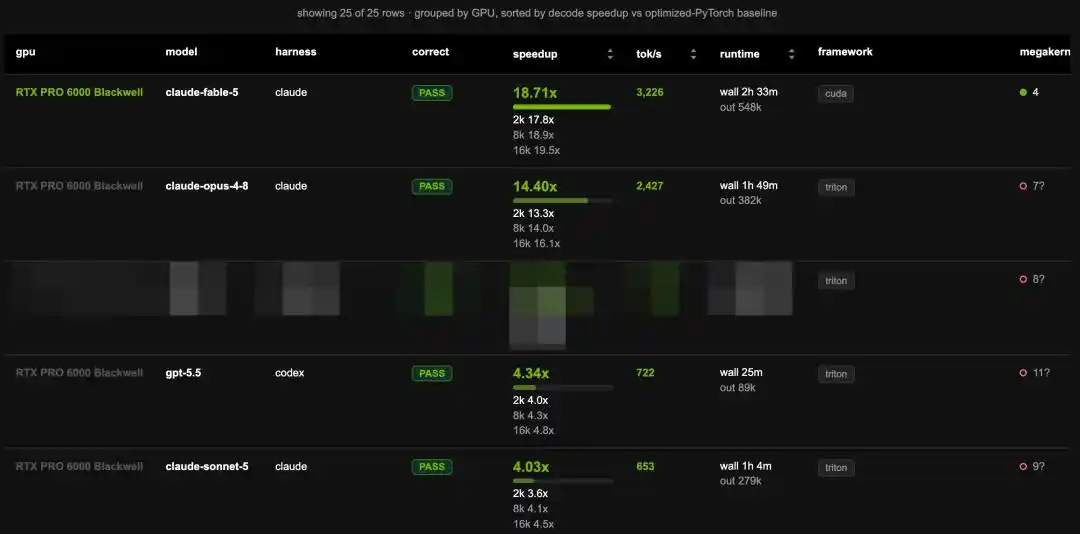
The result sheet delivered by Fable 5 seems to slam the physical limits right into the faces of its competitors:
Fable 5: 18.71x
Opus 4.8: 14.4x
GPT-5.5: 4.34x
Sonnet 5: 4.0x
Even more counter-intuitively, its performance *increases* with longer context length!
At 2K context, it led by 17.8x. At 8K, it expanded to 18.9x. When stretched to 16K, it soared directly to 19.5x.
It's important to understand that as context length increases, the KV Cache inevitably swells, and the attention computation per token surges dramatically.

This is typically the critical area where decoding kernel performance "bleeds out."
But Fable 5, with extreme hardcore tactics, forcibly crammed all calculations into a single "kernel launch," greatly amortizing the fixed barrier synchronization overhead.
Simultaneously, its int4 computational efficiency clung tightly to the hardware's memory bandwidth limit.
The result is that while others hit bottlenecks, its lead over the baseline not only didn't shrink but actually widened under increasing pressure.
The First True "Megakernel" in History
However, what truly sends shivers down the spines of industry insiders isn't just this speed.
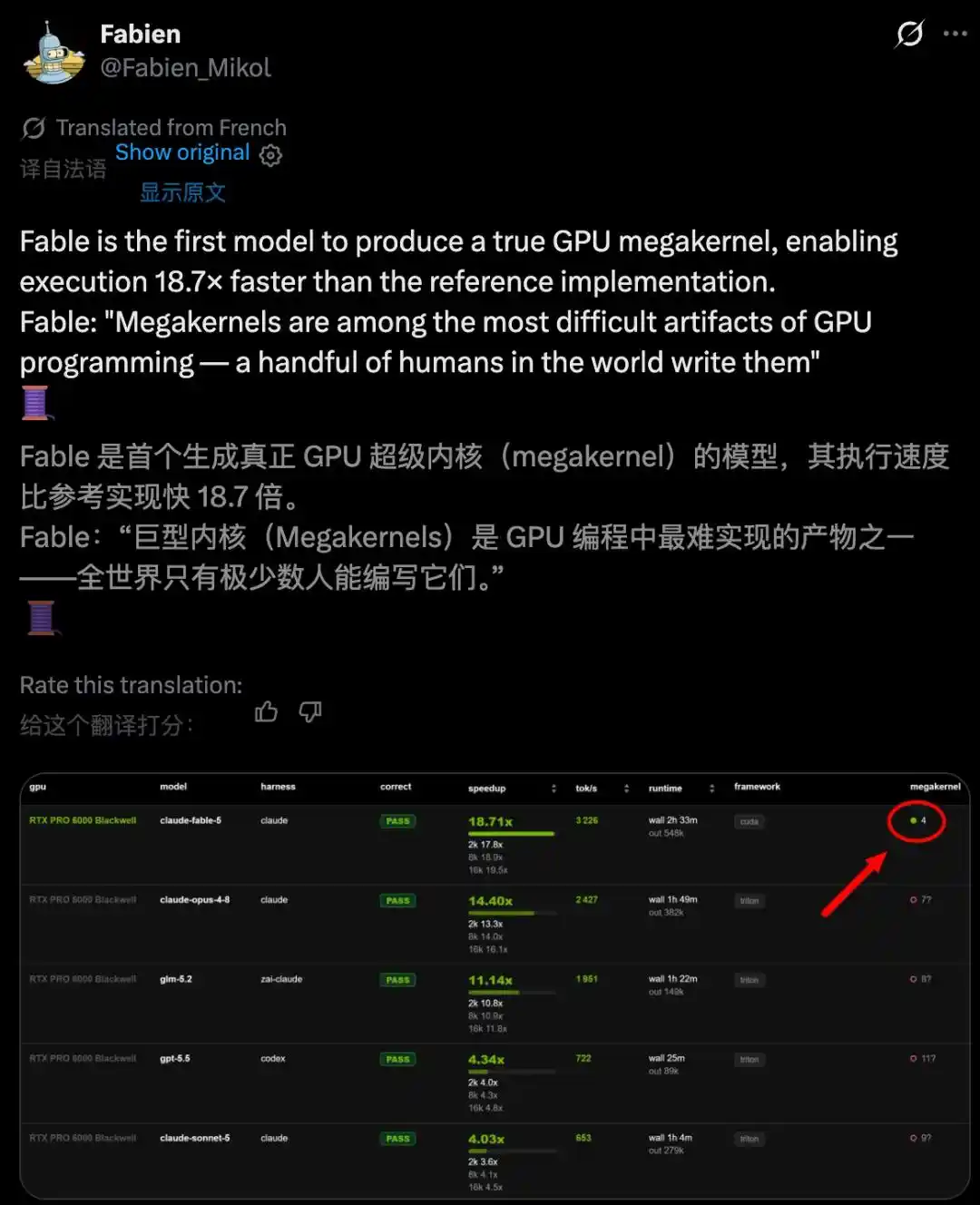
What Fable 5 wrote is the first true "megakernel" in the history of KernelBench-Mega.
A "megakernel" refers to compressing the entire inference pipeline into a single kernel to run in one go, with no intermediate stops or context switches.
This is one of the most notoriously difficult styles of GPU programming.
Even human engineers find it daunting, and no model had ever truly achieved it on the leaderboard before.
So, what makes it so "pure"?
Using torch.profiler reveals a startling detail:
When decoding each token, Fable 5's kernel initiates cooperation "exactly once."
int4 dequantization, convolution, SiLU, KDA gated delta state, MLA hidden state attention absorption, MoE routing with top-8 experts, various RMSNorm, even KV cache writes—
All crammed into this single launch, completed in stages via 14 grid barriers.
All other high-scoring models have to split the problem into 4-14 separate kernel launches to barely finish the run.
Once, versus fourteen times.
This difference isn't theoretical. Each kernel launch forces the GPU to pause, hand over control; the idle time in between is wasted potential.
While others split the work dozens of times, Fable 5 bundles all tasks into a single execution. What's saved is pure performance.
2.5 Hours, 550k Tokens Written in One Go
Fable 5's process of writing the kernel didn't start with frantic coding.
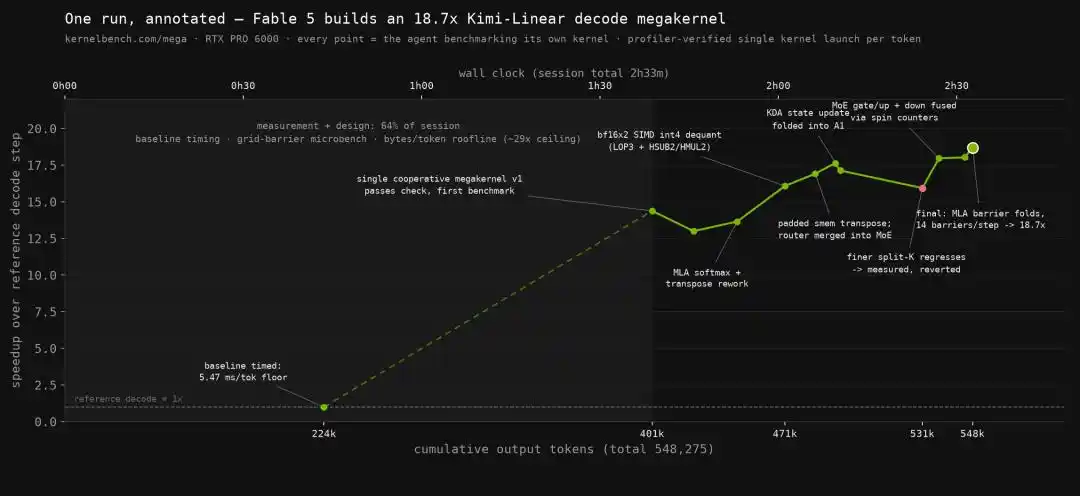
During the entire session, it spent 64% of the time in silence—quietly timing the baseline, micro-benchmarking grid barriers, deriving a "roofline" upper limit of about 29 bytes per token.

Address: https://huggingface.co/datasets/Infatoshi/kernelbench-mega-traces/blob/main/20260701_172615_claude_claude-fable-5_02_kimi_linear_decode.jsonl
After this groundwork, it wrote the entire kernel in one go. The first benchmark run directly hit 14.4x.
Then, in the final hour, it deleted barriers, squeezed int4 dequantization to near "free," pushing itself all the way to 18.7x.
It attempted one negative optimization mid-way, reverted immediately after testing, with no self-justification, only data mattered.
The entire process: 2.5 hours, approximately 550k tokens.
Here, the most easily overlooked point is—
Fable 5 is merely the "safety-aligned version" of Anthropic's internal model, Claude Mythos.

The "AI Self-Evolution" Cycle Begins
Precisely because of this, Anthropic co-founder Jack Clark, in the latest issue of Import AI, directly issued a weighty judgment—
This marks the formal commencement of the "Recursive Self-Improvement" (RSI) cycle.
For the subtitle of this issue, he left only one sentence: Is this the start of a new world?
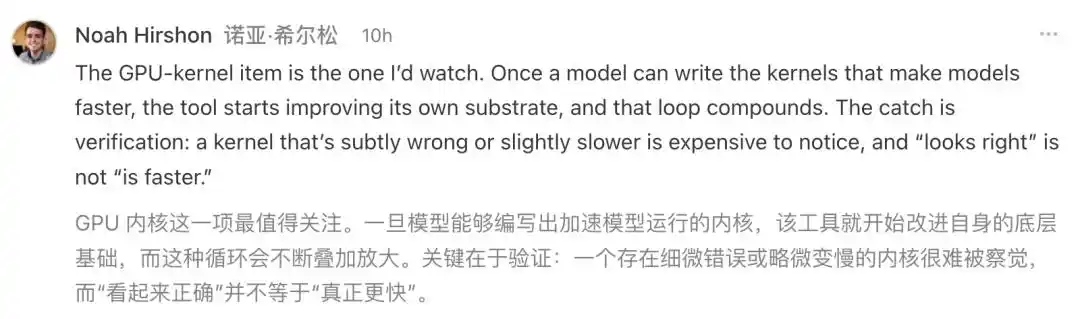
His logic is straightforward: the ability to autonomously develop and optimize kernels is one of the most foundational input tasks for AI R&D.
The better AI becomes at writing kernels, the faster training and inference become; the faster they are, the stronger the next generation becomes; the stronger it is, the more powerfully it writes kernels—
Once this flywheel starts spinning, it no longer requires much human pushing.

Fable 5 isn't just leading in "building itself"; it's starting to take on human jobs.
Recently, on the Remote Labor Index, AI's completion rate has climbed from 2.5% at launch in October 2025 to July 2026.
In less than eight months, the cutting-edge level has more than quadrupled.
Clark indicates that the rate at which AI is expanding its own economic boundaries is now comprehensively surpassing the speed at which humans can reconstruct their "comparative advantage."

Half Sprint, Half Awe
Interestingly, in the very same issue of Import AI, Jack Clark concludes with a piece of science fiction—
A world in 2050 where "universal computers" have been banned by humanity due to their extreme danger.
In the post-"Great Collapse" world, only analog computers, clumsily built from water pipes, containers, and brass gears, remain in operation—
To predict the weather, you have to encode mountain ranges into fixed impedance structures within the hardware;
To simulate floods, you have to weave electronic circuits into the actual terrain of riverbeds.

The person who wrote "The RSI cycle has begun" immediately turns to imagine a world where universal computation is locked in a cage.
This probably captures the most genuine "sense of rift" of this moment: half sprint, half awe.
A little over a year ago, when KernelBench was first released, the then strongest model, OpenAI o1, only managed 4% on the hardest task.
Today, AI is already writing its own drivers.
Humanity spent decades squeezing GPU limits to where they are today. Fable 5 did it in just 2.5 hours.
The countdown may have quietly begun.
References:
https://x.com/elliotarledge/status/2072814573753975266?s=20
https://www.reddit.com/r/singularity/comments/1uowkp0/fable_5_sits_at_the_top_of_kernelbench_jack_clark/
https://importai.substack.com/p/import-ai-464-fables-writes-gpu-kernels
This article is from the WeChat public account "AI Era Insights"; author: ASI Apocalypse; editor: Peach