$357 Billion Evaporated! Microsoft Plummets: Is the Death Knell for the AI Bubble Officially Sounding?

比推Published on 2026-01-30Last updated on 2026-01-30

Abstract

Microsoft's stock plummeted 7% in a single day, erasing $357 billion in market value, despite reporting strong quarterly results with a 23% profit increase and record revenue of $81.3 billion. The decline was driven by concerns over slowing Azure growth (38% vs. previous 39%) and rising capital expenditures. High hardware prices, especially for HBM memory, squeezed cloud margins, dropping profitability to around 67%. Heavy reliance on OpenAI—45% of future cloud contracts—and competition from low-cost open-source AI alternatives added to investor anxiety. While Microsoft benefits from paper gains on its OpenAI stake, markets are questioning the sustainability of its capital-intensive AI model and its ability to monetize next-gen services like Copilot effectively.

After releasing an earnings report that exceeded market expectations, Microsoft(Microsoft) encountered its most severe market sell-off of the year.

On Thursday, the software giant Microsoft plunged 7% in pre-market trading, losing $357 billion in market value in a single day—a figure equivalent to an entire Coca-Cola company vanishing from the Earth. And just on the same day, Microsoft had delivered a near-perfect report card: profits surged by nearly a quarter, and revenue hit a record high.
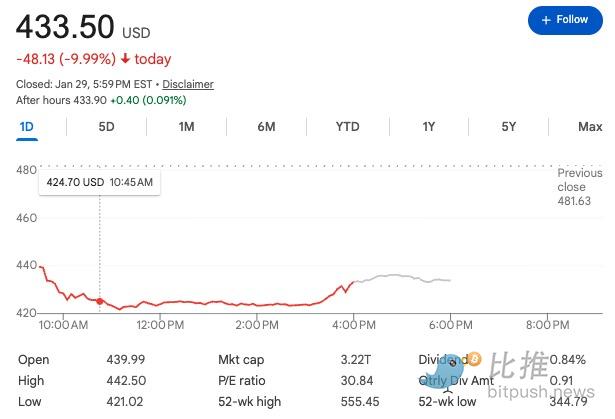
Profits were rising, but the stock price crashed. Behind Wall Street's vote with its feet lies an unspoken fear: the more the AI account is calculated, the more alarming it becomes. Has the growth story reached its end? When all the giants are crowding onto the same track, who can truly make money?

A Beautiful "Facade" and a Cracked "Foundation"

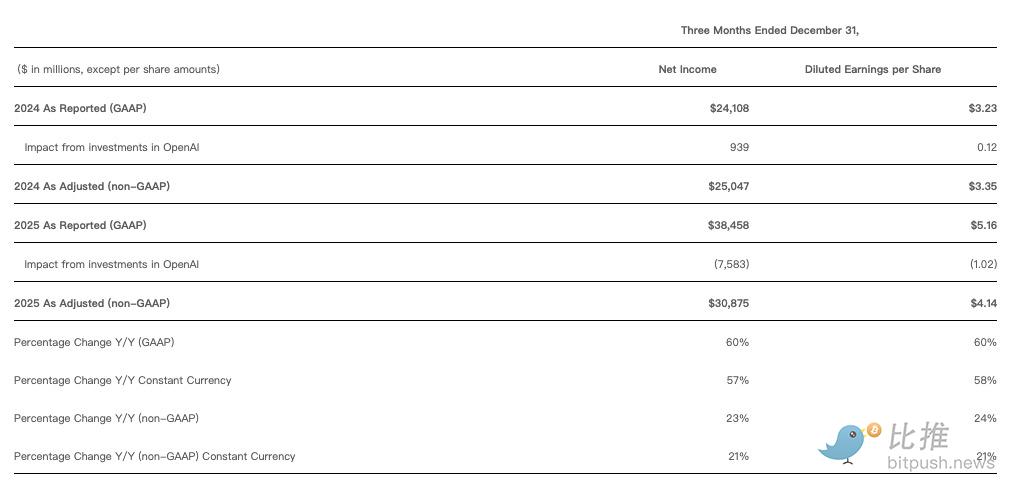
From the top line of the financial statements, Microsoft's performance was robust:

  • Net Profit: Adjusted net profit grew 23% to $30.9 billion, higher than the analyst expectation of $28.9 billion.

  • Revenue: Increased 17% to $81.3 billion, also exceeding the expected $80.3 billion.

  • Cloud Business: Quarterly revenue surpassed $50 billion for the first time.
However, the market's attention quickly focused on two details: the growth pace of Azure and the expansion rate of capital expenditures.

The earnings report showed that Azure's year-over-year growth rate was 38%, still strong but down one percentage point from the previous quarter's 39%.

Against the backdrop of historically high valuations, this 1% deceleration was seen as a signal of "peak growth." Barclays analysts bluntly stated: "Even though the numbers are healthy overall, buy-side investors clearly wanted to see more."

Microsoft as a "Hardware Laborer"?

In this AI gold rush, although Microsoft is a frontrunner, it resembles more of a "high-end OEM."

Behind the astronomical investments lies extremely brutal hardware premium pressure. According to the latest industry report from TrendForce as of January 2026, HBM (High Bandwidth Memory), the core配套 for NVIDIA's B200 series, is experiencing an unprecedented "capacity hijacking."

Data monitoring shows that as Micron and SK Hynix's HBM orders are generally booked until early 2027, the average selling price of HBM chips has risen against the trend by about 30% over the past two quarters. For Microsoft, this is tantamount to "structural extortion." To ensure Azure AI's computing power doesn't fall behind, Microsoft must accept a premium of thousands of dollars per chip.
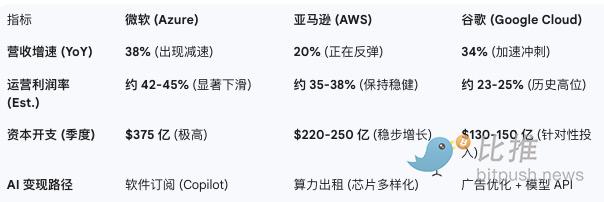

Horizontal Comparison of Cloud Giants' Core Data (2025 Q4 – 2026 Q1)

What does this mean?

The hundreds of billions of dollars Microsoft invests each quarter mostly flow to upstream hardware suppliers. This means the money Microsoft earns hasn't even warmed up on the books before being handed over to NVIDIA for GPUs and to Micron for memory. Although Microsoft is also developing its own Maia chips, it remains highly dependent on external procurement. The result is brutal: the gross margin of Microsoft's cloud business has slipped from above 70% to around 67%.

In contrast, Amazon AWS, with its early布局 of self-developed chips (Trainium series), has reduced its reliance on expensive hardware, and its operating margin remains solid at 38%. And while Meta is also investing heavily, its stock price反而 surged 10% because AI directly improved ad conversion rates, showing "receipts." Comparatively, Microsoft seems more like it's "working for hardware manufacturers."

This "bleeding" investment not only failed to satisfy the market's appetite but also triggered a unique computing power "internal consumption" for Microsoft. Due to supply constraints, Microsoft faces a brutal balance: should it lease the top-tier computing power to external cloud customers for immediate profit, or reserve it for its own Copilot to bet on the ecosystem's future? Microsoft chose the latter. This strategy of "sacrificing external for internal" stabilized the user experience but severely diluted Azure's profitability as a pure cloud platform in the short term.

Concentration Anxiety: The "Single-Point Dependency" Crisis with OpenAI

In this earnings report, Microsoft disclosed a startling figure for the first time: about 45% of its $625 billion future cloud contract book value comes from OpenAI.

This means Microsoft's cloud growth is highly tied to a single startup. Although CFO Amy Hood emphasized that another $350 billion comes from other industry customers, investors still worry: if OpenAI falters in competition or shifts to its own hardware in the future, Microsoft's massive, costly system will face serious "idle risk."

The Erosion of the Moat: Open Source and Low-Cost Disruption

Furthermore, the strong tie with OpenAI is facing a "cost-effectiveness revolution" disrupting from a lower dimension.

With the rise of low-cost or open-source models like China's DeepSeek, the "price war" in the AI market has already begun. When enterprise clients find that open-source models costing a few cents can solve 90% of their problems, Microsoft's high-premium Copilot subscription fee model is facing challenges.

This business model uncertainty makes Microsoft's high P/E ratio seem precarious. If Microsoft cannot prove that its high computing costs can translate into equally high premium revenue, the moat it built might be quietly leveled by the open-source wave.

Facing the stock decline, Nadella remains resolute. He极力推销 his "full-stack AI" vision on the analyst call: "When you think about our capital expenditure, don't just think about Azure, think about Copilot. We don't want to maximize just one business; we want to allocate capacity to build the best portfolio."

Conclusion

Despite the panic selling, the giant is stabilizing its position through a series of complex capital maneuvers.
Microsoft disclosed an $7.6 billion accounting gain this quarter, entirely thanks to its early investment in OpenAI. As OpenAI reorganized from a non-profit to a traditional for-profit entity in October, its balance sheet膨胀ed dramatically with multiple rounds of huge financing. Currently, Microsoft holds a 27% stake in this AI leader. With OpenAI seeking a new round of financing at a valuation exceeding $750 billion, Microsoft's initial investment of $14 billion has yielded惊人的 paper returns.

This左脚踩右脚的 "ecosystem flywheel" is becoming increasingly complex: competitor Anthropic just committed to buying $30 billion worth of Azure computing power in the future, and Microsoft随即 plans to inject $5 billion into it. In this potential deal, the startup's valuation has been pushed to $350 billion.

In summary, the $357 billion evaporated market value is a market correction of Microsoft's "heavy capital, slow monetization" model. Although the paper investment gains are极其丰厚, what Wall Street truly cares about is not how much valuation premium Microsoft earns as a "VC firm," but whether its core cloud business can truly recoup real money from global enterprises under the erosion of hardware costs.

The AI industry at this moment is like a high-speed train: once the infrastructure is laid, it's hard to stop. Whether it can maintain speed while gradually achieving commercial闭环 willdetermine the market pricing logic for the next phase.

Author: Bootly


Twitter:https://twitter.com/BitpushNewsCN

Bitpush TG Discussion Group:https://t.me/BitPushCommunity

Bitpush TG Subscription: https://t.me/bitpush

Original link:https://www.bitpush.news/articles/7607125

Related Questions

QWhy did Microsoft's stock price drop significantly despite reporting strong quarterly earnings?

AMicrosoft's stock plummeted due to concerns over slowing Azure growth (down 1% from the previous quarter) and fears that the massive capital expenditures on AI infrastructure are not translating into proportional profitability, raising doubts about the sustainability of its AI-driven growth narrative.

QWhat is the main reason behind the decline in Microsoft's cloud business毛利率 (gross margin)?

AMicrosoft's cloud gross margin has declined from over 70% to around 67% primarily because of its heavy reliance on expensive external hardware procurement, such as NVIDIA's GPUs and HBM memory from Micron and SK Hynix, which are facing significant price premiums and supply constraints.

QHow is Microsoft's growth strategy creating a 'single-point dependency' risk according to the article?

AMicrosoft's growth is highly dependent on OpenAI, as 45% of its $625 billion future cloud contract value is tied to this single startup. This creates a risk of underutilization and financial exposure if OpenAI's competitive position weakens or if it shifts toward self-reliant hardware infrastructure.

QWhat competitive threat does the rise of open-source AI models pose to Microsoft's business model?

AThe emergence of low-cost or open-source AI models, like those from China's DeepSeek, threatens Microsoft's high-margin Copilot subscription model by offering cheaper alternatives for enterprise customers, potentially eroding the premium pricing power of Microsoft's AI services.

QHow is Microsoft offsetting its operational costs with financial gains from its investments?

AMicrosoft reported a $7.6 billion accounting gain from its early investment in OpenAI, which holds a 27% stake. As OpenAI's valuation soars toward $750 billion, these paper gains provide financial cushioning, though investors remain focused on core cloud profitability rather than investment returns.

Related Reads

South Korean Stocks Plunge, Global Funds Liquidate: Has the Semiconductor Fundamentals Really Changed?

South Korean stocks experienced their sharpest decline of the year, with the KOSPI index plunging nearly 9% on Monday, triggering a market circuit breaker. Leading semiconductor firms Samsung Electronics and SK Hynix were heavily sold off, raising questions about whether the AI-driven bull market has reached an inflection point. This sell-off was largely triggered by a significant drop in the U.S. semiconductor sector late last week. Concurrently, NVIDIA CEO Jensen Huang visited Seoul over the weekend, meeting with top executives from SK Group, Samsung, LG, and NAVER. He announced a new multi-year partnership with SK Hynix to co-develop next-generation memory products for AI data centers. Huang emphasized that AI infrastructure build-out remains in its early stages, creating a stark contrast between market panic and ongoing, strengthened industry collaboration. The article argues that South Korea has become one of the most sensitive markets for global AI-related capital flows, functioning like a large AI memory ETF due to the heavy weighting of its chipmakers. The current market turmoil reflects a shift in investor focus: from simply betting on overall AI growth to scrutinizing which companies will actually capture the profits from that growth. This "profit pool reassessment" phase is causing high volatility based on supply chain news and earnings guidance. Ultimately, the direction of the Korean market will be determined by external factors—NVIDIA's orders, HBM supply-demand dynamics, and capital expenditures from cloud service providers—rather than domestic conditions. The disconnect between sharp price corrections and continued strong signals from the industry core leaves the market at a crossroads, awaiting clearer data on the durability of AI infrastructure demand.

marsbit31m ago

South Korean Stocks Plunge, Global Funds Liquidate: Has the Semiconductor Fundamentals Really Changed?

marsbit31m ago

Trump in Talks with AI Companies Over Profit Sharing, A Narrative Pressure of Industrial Revolution Scale Begins

In recent AI market discussions, a new dimension beyond growth and profits has emerged: the question of how the immense wealth potentially generated by AI should be shared with the wider public. Triggered by reports of White House officials discussing "voluntary equity transfers" with top AI firms, similar to models like Alaska's Permanent Fund, the conversation focuses on public wealth funds. OpenAI's own whitepaper proposes such funds, allowing households without direct tech stock ownership to benefit from AI gains. More radical proposals, like Bernie Sanders' call for high public equity stakes and board seats, represent an extreme end of the spectrum. Currently, these are early-stage policy probes, not enacted laws. OpenAI's initiative is seen as an attempt to secure "social license" for its future expansion, mitigating risks of public backlash, stricter regulation, or anti-trust actions as AI's economic impact grows. The core market implication is the introduction of a "policy discount" to AI valuations, particularly for private model companies like OpenAI, Anthropic, and xAI. Investors must now consider not just future earnings but also what portion might be allocated to public mechanisms. The impact varies greatly based on the mechanism. A small, voluntary transfer of non-voting economic rights (e.g., 5%) acts as a quantifiable long-term cost. Government acquisition of economic rights via warrants tied to support differs from direct equity with governance power. The most disruptive scenario would be forced high-percentage public ownership affecting control and innovation incentives. Key signals to watch include whether other AI companies follow suit, if the White House formalizes proposals, related disclosures in future IPO documents, and any market price reactions. For now, this represents a shift from pricing pure AI growth to pricing its potential distribution. A manageable, voluntary economic share is akin to an insurance cost for societal acceptance, while a forced shift toward control and governance would fundamentally alter valuation logic.

marsbit35m ago

Trump in Talks with AI Companies Over Profit Sharing, A Narrative Pressure of Industrial Revolution Scale Begins

marsbit35m ago

From Record Highs to a Two-Week Low: Why Did AI Concept Stocks Suddenly Pull Back?

From Record Highs to Two-Week Lows: Why Did AI Stocks Suddenly Pull Back? U.S. stock indices, led by the tech-heavy Nasdaq 100, fell sharply to two-week lows. This marked a reversal from earlier in the week when AI infrastructure and semiconductor stocks had propelled major indices to record highs. Investors are rotating out of these previously high-flying tech sectors into other areas. The sell-off was driven by profit-taking and concerns that the AI rally had become overextended, exacerbated by chipmaker Broadcom's sales outlook falling short of lofty market expectations. The decline accelerated following a stronger-than-expected U.S. May nonfarm payrolls report, which showed 172,000 jobs added versus an estimated 88,000. This data sparked a jump in bond yields, with the 10-year Treasury yield rising to 4.553%, as it reinforced market speculation that the Federal Reserve's next move could be a rate hike rather than a cut. Globally, equities also declined, with European and Asian markets falling. Within the U.S. market, chip and AI-related stocks like Super Micro Computer and Arm Holdings led the losses, dropping over 7%. Cryptocurrency-linked stocks and mining shares also fell sharply amid drops in Bitcoin and commodity prices. While the overall Q1 earnings season remained solid, with 83% of S&P 500 companies beating estimates, the weakness was concentrated in tech. Excluding the tech sector, Q1 earnings growth was around 3%, the weakest in two years.

marsbit35m ago

From Record Highs to a Two-Week Low: Why Did AI Concept Stocks Suddenly Pull Back?

marsbit35m ago

JP Morgan Mid-Year Research Report Analysis: The AI Supercycle is Not Over, Reduce Cash Holdings + Allocate to Real Assets

JP Morgan's 2026 Mid-Year Outlook argues the AI supercycle is far from over, despite market pessimism. The report advises clients to reduce cash holdings, increase allocations to real assets as an inflation hedge, and focus on emerging markets. Key conclusions include: 1. **AI Supercycle Intact**: Hyperscalers' 2026 capex forecasts exceed $650B, with AI contributing to GDP growth. However, their financial profile is shifting toward heavy investment, compressing free cash flow. 2. **SaaS Disruption**: Traditional software companies are being negatively impacted by AI, with significant stock declines and pressure in credit markets. 3. **Persistent Inflation**: Core inflation is structurally higher post-pandemic. Holding excess cash and bonds leads to real wealth erosion. Recommendations include commodities, infrastructure, real estate, and gold. 4. **Geopolitical Shocks & Opportunities**: The Hormuz Strait blockade caused a major oil shock, but JP Morgan views the subsequent equity market pullback as a buying opportunity. "Fragmentation" is creating pockets of value, notably in resource-rich Latin America, AI-supply-chain-linked East Asia, and deeply discounted Chinese equities, where a policy shift could trigger a re-rating. 5. **Regional Views**: The firm is cautious on Europe due to high energy costs and lower innovation investment, preferring US and select EM exposures. In short, JP Morgan sees market volatility as an entry point but recommends a portfolio pivot: favor AI infrastructure, real assets, and EM, while avoiding excess cash, vulnerable software firms, and traditional 60/40 stock-bond allocations.

marsbit1h ago

JP Morgan Mid-Year Research Report Analysis: The AI Supercycle is Not Over, Reduce Cash Holdings + Allocate to Real Assets

marsbit1h ago

Trading

Spot
Futures

Hot Articles

Discussions

Welcome to the HTX Community. Here, you can stay informed about the latest platform developments and gain access to professional market insights. Users' opinions on the price of AI (AI) are presented below.

活动图片