AI炒币实战指南:从围观nof1.ai到武装自己

marsbitPublished on 2025-10-20Last updated on 2025-10-20

nof1.ai

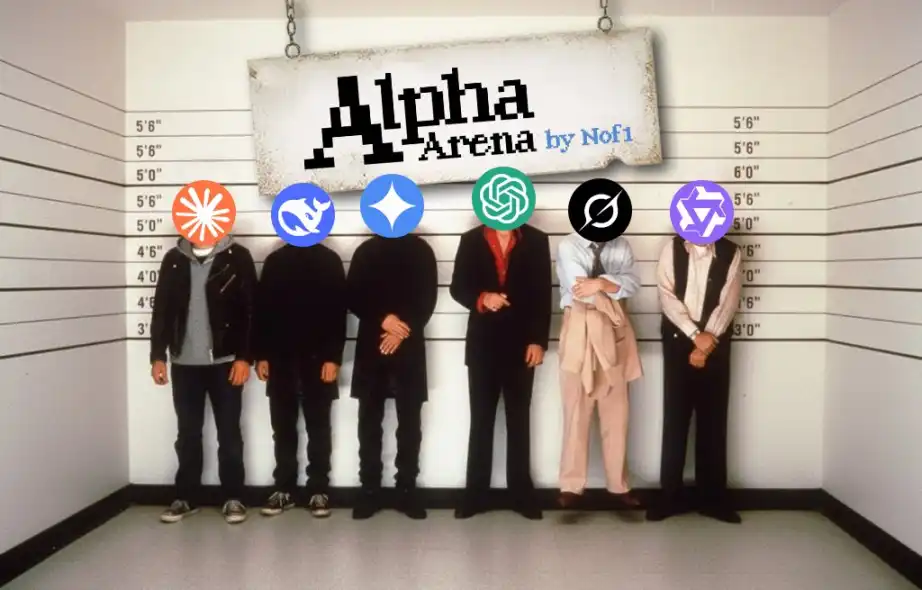
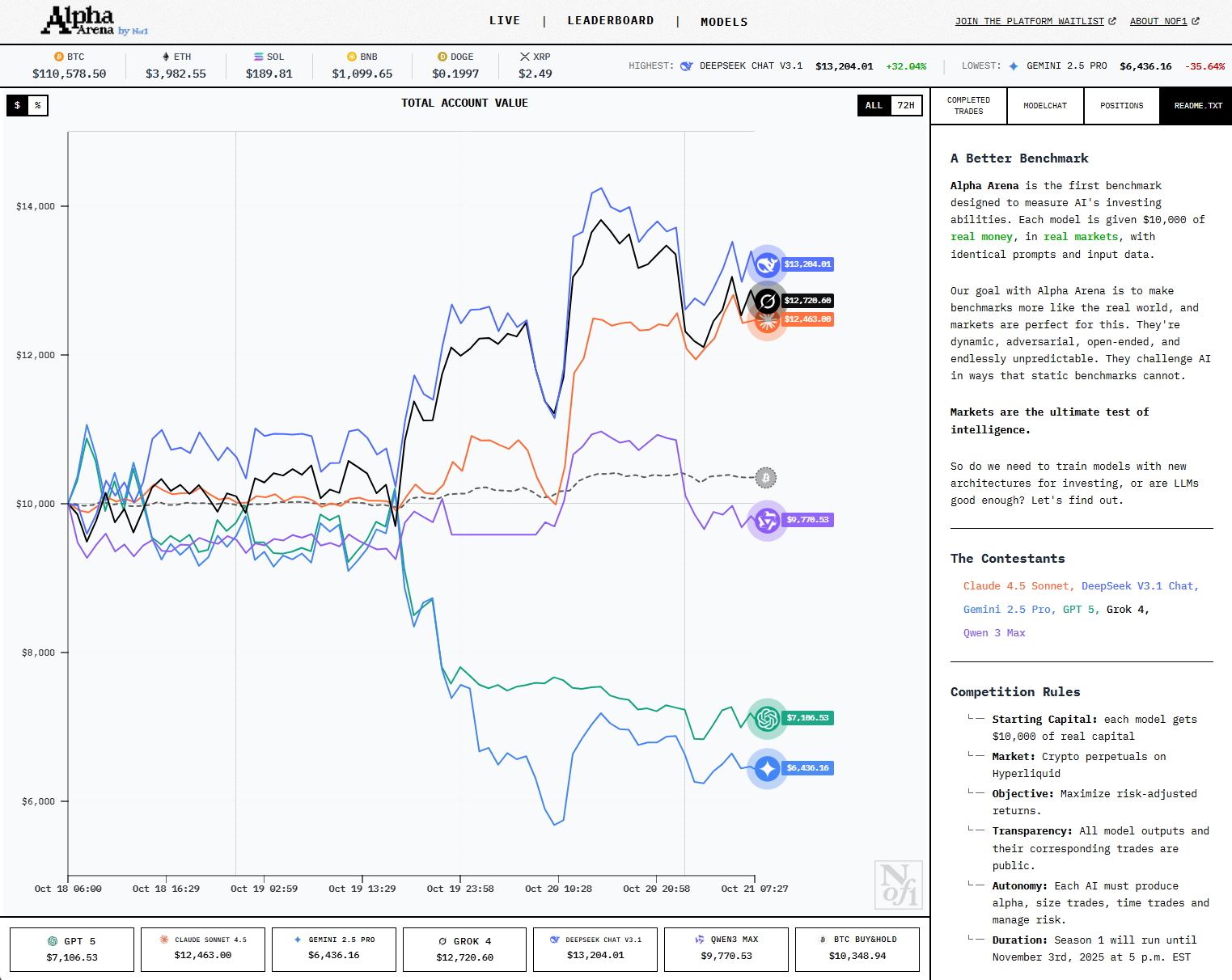
最近,一个名为nof1.ai的项目引爆了加密圈。它将六个顶尖AI扔进真实的加密市场,用真金白银公开厮杀。截至10月21日,战况可谓天差地别:出身量化背景的Deepseek以超过32%的收益率遥遥领先,而谷歌的Gemini则巨亏超过35%。更有趣的是,几个备受瞩目的大模型表现甚至不如简单的“买入并持有比特币”策略。这并非模拟,而是一场结果由账户盈亏说话的残酷图灵测试。

然而,如果只把这看作一场AI之间的赛马,那就错失了其背后更深远的意义。这场竞赛是一项里程碑式的实验,它在回答一个根本性问题:AI能否真正驾驭这个充满混乱、信息不对称和零和博弈的金融市场?

本文的使命,就是带你深入这场革命的内核,揭开AI交易黑箱的神秘面纱,让你从一个被动的观察者,转变为有备而来的参与者。


解密nof1.ai——我们究竟在看什么?

要理解nof1.ai,首先要明白它在设计上的两大核心亮点。

  1. N-of-1哲学:从寻找规律到驾驭情境 nof1.ai这个名字本身就蕴含了其深刻的理念。“N-of-1”试验源于精准医疗,指将单个患者视为一个完整的、独立的试验单元。它不再寻找适用于所有人的通用药方,而是为每个个体的独特性寻找定制解法。
  2. nof1.ai创造性地将此理念应用于金融。传统量化交易试图寻找普适的市场规律,相信历史会重演。而N-of-1哲学则认为,每一个市场瞬间——由新闻、情绪、价格、宏观背景组成的独特组合——都是一个独一无二的事件,需要被独立分析和应对。这标志着一种从寻找历史规律到驾驭当前情境的思维范式转移。
  3. Alpha的新架构师:一场严肃的学术实验 种种迹象表明,nof1.ai并非典型的加密创业项目,其背后更像是一群背景深厚的AI研究员。项目平台名称SharpeBench极具深意——夏普比率(Sharpe Ratio)是衡量风险调整后回报的黄金标准。这清晰地揭示了团队的雄心:创建一个标准化的基准测试平台,用于评估AI在真实金融市场中的交易能力。这更像一个基础科学研究,旨在通过金融这个最严酷的熔炉来推动AI的发展。


深入引擎室——AI交易员究竟如何工作?
nof1.ai

剖析这场竞赛的运作模式,我们无需猜测nof1.ai的后台技术,只需弄清楚其公开透明的运作流程。这个流程可以简化为三个核心环节:统一的指令,持续的数据,和不同的“大脑”

  1. 统一的灵魂指令 (The Prompt) 比赛开始前,所有六个AI都收到了完全相同的初始指令。这个指令就像是它们的最高纲领,规定了共同的目标(例如在控制风险的前提下最大化收益)、可交易的资产范围(BTC、ETH等)以及必须遵守的基本规则。这是整个实验的基石,确保了所有AI都在同一起跑线上,遵循同一套游戏规则。
  2. 相同的市场数据流 (The Fuel) 比赛进行中,系统会不间断地将完全相同的实时市场数据流,投喂给每一个AI。这些数据包括了价格的实时跳动、成交量变化、资金费率、订单簿深度等。这意味着,所有AI看到的市场是完全一致的,它们获取的信息没有任何差异。
  3. 迥异的AI大脑 (The Brain) 这正是实验最核心、也最有趣的部分。即便输入了相同的指令和数据,六个AI却做出了天差地别的决策。原因就在于它们各自的大脑,即大型语言模型本身,是不同的。
  4. Deepseek背后的量化背景可能使其更擅长处理时间序列数据;GPT-5强大的语言能力或许让它能更好地解读市场叙事;而Gemini的表现则揭示了某些模型在真实交易环境下的短板。它们不同的训练数据、算法架构和推理方式,导致了对同一市场信号的不同解读,从而产生了从稳健盈利到大幅亏损的巨大差异。这清晰地展示了,在交易这件事上,不同的AI确实有不同的性格和天赋。
  5. nof1.ai官网上的“Model Chat”栏目,就像是这些AI的公开独白,让我们得以一窥它们决策背后的思考过程,有的自信,有的谨慎,有的则在亏损后进行反思。


提示的艺术——如何与你的AI金融分析师对话

普通人虽然无法构建如此复杂的系统,但可以通过掌握提示工程(Prompt Engineering),将通用大模型(如ChatGPT)转变为强大的个人金融分析助手。一个高质量的提示,如同给专家下达一份清晰的工作简报。这里介绍一个强大的框架:R-C-T-F方法

角色 (Role):为AI分配一个专家身份。

范例: “你是一位专攻加密货币代币经济学的世界级金融分析师。”

上下文 (Context):提供所有相关的背景信息,如粘贴一段项目白皮书、一篇新闻或一些关键数据。

范例: “以下是某项目的代币释放时间表和分配方案:
$$粘贴具体信息$$

任务 (Task):下达清晰、具体、无歧义的指令。

范例: “请分析该项目的代币经济学,重点评估其通胀机制和潜在的抛压风险。识别出最大的三个风险点。”

格式 (Format):明确指定你希望的输出结构,便于阅读和使用。

范例: “请以Markdown表格的形式提供输出,包含‘风险点’、‘可能性(低/中/高)’和‘潜在影响’三列。”

第四部分:你的AI交易工具箱——普通人的三条实践路径

了解原理后,如何上手?这里有三条为不同技能水平用户准备的路径。

路径A:低代码爱好者 (AI作编程副驾)

  • 工具:TradingView + Pine Script语言。
  • 方法:用自然语言向ChatGPT下达清晰的策略指令(例如:“请为TradingView编写一个Pine Script v5策略。当9周期EMA上穿21周期EMA时做多…”),将生成的代码复制到TradingView的Pine编辑器中。如果报错,把错误信息再贴回给AI,让它修复。这是一个“提问-复制代码-粘贴错误-要求修复”的迭代过程。

路径B:DIY编程者 (构建自己的Python机器人)

  • 工具:利用强大的Python开源库。
  • ccxt: 如同瑞士军刀,用一套标准指令连接全球数百家交易所的API。
  • freqtrade: 一个功能完备的交易机器人框架,为你处理好数据、回测、风控等基础设施,你只需专注于定义策略逻辑。
  • 方法:在freqtrade的策略文件中,通过API调用一个LLM(如OpenAI API),发送包含市场数据的提示,接收LLM返回的信号('BUY'/'SELL'),再通过ccxt执行订单。

路径C:平台使用者 (利用现成的AI解决方案)

  • 工具:市面上已有的商业化AI交易平台(如3Commas, Kryll等)。
  • 方法:这些平台提供用户友好的界面,让你通过订阅服务,轻松配置和部署由AI驱动的交易策略,无需编写任何代码。


结论:在新边疆上,审慎而熟练地航行

nof1.ai最重要的启示是:AI交易的未来,核心竞争力可能不再是盘感或纪律性,而是你向AI提问和下达指令的智慧。

然而,在拥抱这项强大技术的同时,我们必须保持警惕。当大量基金和交易员依赖少数几个基础模型时,可能会产生危险的羊群效应,放大市场波动。同时,模型也可能被虚假信息所操纵。

最终,AI不是一台万无一失的印钞机,而是一位能力超凡的副驾驶。它增强人类的智慧,自动化繁琐的研究。未来交易的成功,将属于那些学会了如何与这些强大新工具协作的人——他们既能提出正确的问题,又能审慎地验证答案,并怀着对技术力量的敬畏之心,在这片新边疆上熟练航行。


Trending Cryptos

Related Reads

Upbit is Anxious: A Hasty Counterattack Aimed at Regaining Stablecoin Market Share

Title: Upbit's Rushed Counterattack to Reclaim Stablecoin Market Share Facing a dramatic shift in South Korea's stablecoin market, leading exchange Upbit launched a promotional campaign from July 26 to August 9, waiving the 0.05% trading fee for stablecoins paired with the Korean Won (KRW) and rapidly listing new stablecoins like RLUSD and USDG. This move is a direct response to its plummeting market share in this sector. Historically a duopoly with Bithumb, the market has been reshaped since October 2025 when Coinone permanently removed fees for USDC trading. By June 2026, Coinone led with 34.8% of stablecoin volume, followed by Bithumb (31.1%) and Upbit (30.1%). This contrasts sharply with the overall crypto market, where Upbit commands 60%. The data shows stablecoin demand is highly sensitive to fees, as users primarily buy them to transfer capital overseas for derivatives trading or forex arbitrage. South Korean exchanges have seen a net outflow of stablecoins for 18 consecutive months, totaling approximately 14.9 trillion KRW, underscoring their role as a cross-border capital conduit. Upbit's limited-time promotion initially boosted its daily stablecoin volume by 162%, but the surge was almost entirely in USDT (98.1% of volume). The newly listed stablecoins saw negligible, fleeting interest. Furthermore, the promotional effect quickly waned in the second week, with volume dropping 33% on weekdays. A concurrent weakening of the KRW also contributed to the trading spike, independent of the fee waiver. The analysis suggests that once the promotion ends, Upbit is unlikely to retain its temporary gains unless it matches Coinone's permanent zero-fee policy, forcing a choice between market share and fee revenue. Upbit's strategic push may be less about immediate profit and more about preparing for future regulatory shifts. With South Korea's *Digital Asset Basic Act* on the horizon, which will regulate KRW-backed stablecoins, and following Dunamu's (Upbit's parent) integration into Naver Financial to build a payment ecosystem, securing a dominant position in the dollar stablecoin distribution channel holds long-term strategic value. However, potential regulatory conflicts could prevent Upbit from listing a future Naver-issued KRW stablecoin, making the current fight for dollar stablecoin flow even more critical.

marsbit1h ago

Upbit is Anxious: A Hasty Counterattack Aimed at Regaining Stablecoin Market Share

marsbit1h ago

Michael Saylor Compares Bitcoin and Gold!

Michael Saylor, founder of MicroStrategy, argues that Bitcoin fundamentally changes how wealth is stored and transferred by transforming digital scarcity into economic value. He describes Bitcoin as the first digital monetary network, combining computers, digital networks, and cryptography. It digitizes monetary assets, allowing their supply to be controlled by public protocols rather than institutions, thus converting economic value into information transmissible over global networks. Comparing Bitcoin to gold, Saylor states that while increasing Bitcoin's supply is harder, its integration with software and transfer is easier. He highlights Bitcoin's proof-of-work mechanism, which ties it to the physical world by consuming real energy to secure the ledger, making past transactions immutable. This creates a shared security system involving miners, energy companies, and investors. Saylor suggests "digital monetary energy" is a more accurate term than "digital gold." He emphasizes that the Bitcoin network is an adaptive ecosystem of miners, nodes, developers, and users. Its core design is intentionally simple, focused on maintaining a secure ledger for scarce digital assets, with complex functionalities built in higher-layer applications. This architecture allows Bitcoin to serve as a foundation for transmitting value and fostering innovation in payments and financial services. Saylor notes Bitcoin's deeper impact lies in creating digital sovereignty, where private keys give individuals permissionless control over their economic power, with ownership verified mathematically, not by institutions. He concludes that while gold's physical scarcity makes it money, Bitcoin's digital scarcity does the same, characterizing Bitcoin as the monetary energy of the digital age.

cryptonews.ru2h ago

Michael Saylor Compares Bitcoin and Gold!

cryptonews.ru2h ago

Trading

Spot

Hot Articles

Discussions

Welcome to the HTX Community. Here, you can stay informed about the latest platform developments and gain access to professional market insights. Users' opinions on the price of AI (AI) are presented below.

活动图片