SHIB价格大揭秘:8 月中旬将迎来巨涨还是大跌?

金色财经Published on 2024-08-13Last updated on 2024-08-13

?url=http%3A%2F%2Fdingyue.ws.126.net%2F2024%2F0813%2Fb7d12ec8j00si4wlj00and000fa008qp.jpg&thumbnail=660x2147483647&quality=80&type=jpg

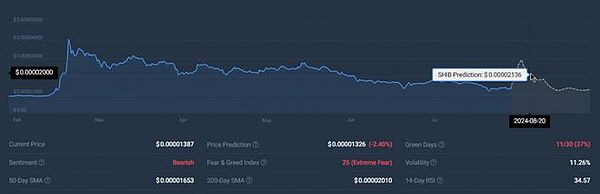
Shiba Inu 再次成为头条新闻。SHIB 目前正在回溯其步伐,交易价格低至 0.0000136 美元。随着伊朗-以色列战争的新闻不断传出,比特币可能会在此过程中下跌,从而严重影响山寨币的价格。以下是 Shiba Inu 在 2024 年 8 月中旬的表现。

柴犬:技术分析

?url=http%3A%2F%2Fdingyue.ws.126.net%2F2024%2F0813%2F87e3be33j00si4wlv002td000sg00g9m.jpg&thumbnail=660x2147483647&quality=80&type=jpg

以色列-伊朗战争的影响

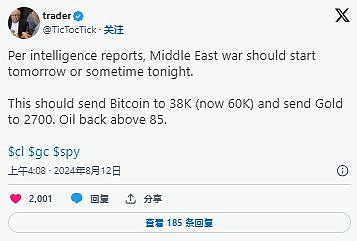
酝酿中的以伊战争正在加速进行,随着新情报的出炉,比特币跌至新低的消息在互联网上疯传,投机浪潮如火如荼地涌动。

一位著名的 X-handle 交易员发文称,如果战争形势恶化,比特币的价格可能会大幅下跌。BTC 的价格可能会跌至 38,000 美元,对山寨币市场造成重大影响。这种情况可能会促使 SHIB 创下新低,而代币可能需要一段时间才能恢复并赎回。

?url=http%3A%2F%2Fdingyue.ws.126.net%2F2024%2F0813%2Fa3da211bj00si4wm6000od0009x006pp.jpg&thumbnail=660x2147483647&quality=80&type=jpg

CoinCodex 分析

?url=http%3A%2F%2Fdingyue.ws.126.net%2F2024%2F0813%2F437b7fe8j00si4wmg008sd000sg0095m.jpg&thumbnail=660x2147483647&quality=80&type=jpg

然而,技术平台却讲述了一个不同的故事。据CoinCodex称,SHIB 的价格可能会大幅上涨。根据 CC 的数据,SHIB 的价格可能在 8 月 20 日达到 0.00002136 美元,上涨 57%。

“未来 30 天的柴犬价格预测是基于过去 30 天的正向和负向趋势的预测。根据这些柴犬预测,SHIB 将于 2024 年 8 月 19 日以 0.00002152 美元的价格易手,在此过程中上涨 58.35%。”

Changelly 的 SHIB 技术分析

?url=http%3A%2F%2Fdingyue.ws.126.net%2F2024%2F0813%2F5505f787j00si4wmf000od000sg009om.jpg&thumbnail=660x2147483647&quality=80&type=jpg

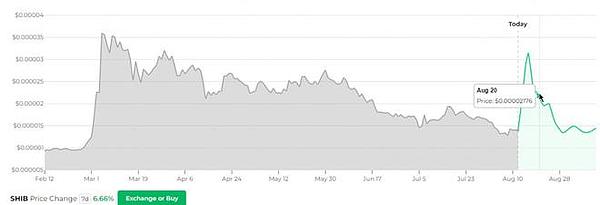
据Changelly称,SHIB 可能会在 8 月 20 日达到 0.00002176 美元的价格标记。

到本月底,SHIB 的交易价格可能达到 0.0000224 美元的峰值。

“加密分析师预计,到 2024 年夏季末,SHIB 的价格将在 0.0000224 美元左右。2024 年 8 月,柴犬的价格可能会降至最低 0.0000135 美元。预计峰值可能是 2024 年 8 月的 0.0000314 美元。潜在投资回报率:124.3%”

Trending Cryptos

Related Reads

White-Label Stablecoins: More Than Just a Logo Change

"White-Label Stablecoins: Beyond a Logo Change" The article clarifies the often-misunderstood concept of "white-label stablecoins," which refers to businesses leveraging established providers like Circle or Coinbase to offer stablecoin functionality under their own brand. It details four distinct models, emphasizing that this is not a simple branding exercise but involves complex legal and operational responsibilities split across issuance, reserves, custody, and distribution. The four primary models are: 1. **Circle xReserve**: Enables blockchains (L1/L2) to launch their own stablecoin backed 1:1 by USDC locked in a Circle smart contract. The chain deploys and operates the token contract. 2. **Circle Partner Stablecoins**: Connects existing regional stablecoin issuers to Circle's global payment and liquidity network (e.g., StableFX). The local issuer remains responsible for issuance, reserves, and compliance. 3. **Circle Digital Asset Accounts**: Provides businesses with branded digital asset accounts where users hold established stablecoins (like USDC). Circle handles custody, conversion, and compliance; the business manages the front-end user experience. 4. **Coinbase Custom Stablecoins**: The model closest to a true "white-label" stablecoin. Coinbase manages the issuance, reserves, smart contracts, and redemption for a new, custom-branded stablecoin (e.g., Flipcash's USDF), while the partner business handles branding, distribution, and user-facing scenarios. The article stresses that legal and regulatory risks depend heavily on the specific model and the partner's role. Key concerns include clear user disclosure about the issuer and redemption rights, managing consumer perceptions, careful structuring of any revenue-sharing or yield features, and navigating local regulatory frameworks for payments, distribution, and marketing—responsibilities that cannot be outsourced simply by using a "white-label" service.

marsbit7m ago

White-Label Stablecoins: More Than Just a Logo Change

marsbit7m ago

Farewell to Speculation: The Graham Moment of the Crypto Industry

"Farewell to Speculation: The Graham Moment for the Crypto Industry" The article draws a parallel between today's cryptocurrency market and the speculative, unregulated US stock market of the 1920s. That era lacked mandatory corporate disclosure, enabling rampant manipulation and turning stocks into gambling tools. The 1929 crash led to foundational reforms: the Securities Acts of 1933/34 mandated transparent, audited financial reporting, and Benjamin Graham's "Security Analysis" provided a framework for fundamental valuation. Together, they created modern investing, requiring both reliable data and a methodology to value assets. Similarly, the crypto market is currently driven by narratives and speculation. However, it possesses a key advantage: unlike 1920s corporations, blockchain protocols have inherently transparent, on-chain data for revenue, treasury, and activity. The core obstacle is not transparency, but the lack of legal claim to that value. Due to regulatory uncertainty (primarily the Howey Test), most tokens are deliberately stripped of economic rights like profit-sharing to avoid being classified as securities. This creates a paradox where protocols generate revenue, but token holders have no right to it. The turning point, argues the author, is imminent US legislation. The already-passed GENIUS Act provides a framework for stablecoins. The crucial CLARITY Act, currently in advanced legislative stages, aims to clearly categorize digital assets and define their regulatory treatment (SEC vs. CFTC). This would allow developers to legally design tokens with enforceable economic rights, such as profit distribution. If passed, this would enable a shift from speculation to fundamental investment. Analysis would focus on protocol revenue sustainability, network effects, valuation multiples, and the specific rights encoded in a token's contract—mirroring traditional equity analysis. The article notes significant legislative hurdles and timelines (1-3 years for rulemaking post-passage), but emphasizes the direction is set. A deeper challenge remains: building decentralized, legally enforceable governance and ownership structures to protect token holder rights, akin to corporate law. This will be a core development focus. The transformation applies mainly to revenue-generating protocol tokens, not to assets like Bitcoin (digital gold). The article concludes that the industry's question has evolved from "can tokens create value?" to "who gets to allocate that value?". Solving the latter, as in the 1920s, will mark crypto's transition to a legitimate asset class for fundamental investment.

Foresight News29m ago

Farewell to Speculation: The Graham Moment of the Crypto Industry

Foresight News29m ago

Quantum Computing "Manhattan Project" Unveiled: Is the Encryption Industry at a Critical Turning Point?

"Quantum Computing 'Manhattan Project' Launched: Is the Crypto Industry at a Critical Juncture?" On June 22, former U.S. President Donald Trump signed two executive orders. The first mandates all federal agencies upgrade their cryptographic systems to new, quantum-resistant standards by 2030. The second orders the Department of Energy to lead the development of a national quantum computer, signaling a shift from laboratory research to a state-enforced national agenda. This creates a hard deadline. A powerful quantum computer could break current encryption. The threat is compounded by "harvest now, decrypt later" attacks, where encrypted data is stored today for future decryption. Federal agencies must appoint migration officers and complete post-quantum cryptography (PQC) upgrades for key establishment by 2030 and digital signatures by 2031. Procurement rules will also be changed, forcing government contractors to comply. The crypto industry faces a direct threat. Bitcoin's ECDSA signatures are theoretically vulnerable. Research indicates millions of Bitcoin with exposed public keys are at risk if quantum computers advance. While projects like Bitcoin Quantum testnets and efforts by Ethereum, Solana, NEAR, and Zcash are exploring quantum-resistant solutions, achieving consensus in decentralized networks remains a major challenge. The centralized U.S. government has started a 5-year countdown. For decentralized crypto networks, the real test is whether they can complete this anti-quantum upgrade before the theoretical threat becomes a practical reality.

Foresight News51m ago

Quantum Computing "Manhattan Project" Unveiled: Is the Encryption Industry at a Critical Turning Point?

Foresight News51m ago

Coin Stock Barometer丨BitMine's Total Assets and Investment Reach $10.7 Billion, Exceeding ~$9.3 Billion Floating Loss; Strategy Buys Only 520 BTC, Strive Adds Positions Against the Trend (June 23)

This article provides a weekly market update on "coin-equity" trends, focusing on listed companies holding major cryptocurrencies. Key highlights include: **General Market Trends:** Global equities, particularly in the US, Japan, and South Korea, faced significant sell-offs, led by large tech and AI-related stocks. Analysts cite profit-taking and a shift from hype-driven to performance-driven valuation for AI companies. Market focus is on upcoming Micron Technology's earnings. **Cryptocurrency Treasury Updates:** * **Bitcoin (BTC):** Net weekly BTC purchases by listed companies (excluding miners) totaled approximately $86 million, down 13.97% from the prior week. Strategy (formerly MicroStrategy) purchased only 520 BTC for ~$34.9 million, while Strive Asset Management increased its holdings by 759 BTC for ~$50 million. Other notable actions include Mara Holdings adding 1,000 BTC and Capital B shareholders approving a massive financing plan (up to ~$1.2 trillion) to potentially expand its Bitcoin reserves. * **Ethereum (ETH):** BitMine emerged as the largest corporate ETH treasury, holding 5.67 million ETH (4.7% of supply). It purchased an additional 52,203 ETH ($92 million) in the past week. Sharplink completed a $75 million private placement to fund further ETH accumulation and stock buybacks. * **Solana (SOL):** The top five listed companies hold over 15.7 million SOL combined. However, Solmate Infrastructure, a SOL treasury firm, faces a lawsuit from its largest external shareholder alleging board misconduct and self-dealing. * **Other:** Updates include Canton Strategic's $50 million stock buyback plan and Lite Strategy's $1 million strategic investment in LitVM, a Layer-2 network for Litecoin. The article notes that while crypto treasury firms continue fundraising and accumulation, their stocks may struggle to rise against the broader market downturn until Q4.

marsbit1h ago

Coin Stock Barometer丨BitMine's Total Assets and Investment Reach $10.7 Billion, Exceeding ~$9.3 Billion Floating Loss; Strategy Buys Only 520 BTC, Strive Adds Positions Against the Trend (June 23)

marsbit1h ago

Trading

Spot
Futures

Hot Articles

How to Buy SHIB

Welcome to HTX.com! We've made purchasing SHIBA INU (SHIB) simple and convenient. Follow our step-by-step guide to embark on your crypto journey.Step 1: Create Your HTX AccountUse your email or phone number to sign up for a free account on HTX. Experience a hassle-free registration journey and unlock all features.Get My AccountStep 2: Go to Buy Crypto and Choose Your Payment MethodCredit/Debit Card: Use your Visa or Mastercard to buy SHIBA INU (SHIB) instantly.Balance: Use funds from your HTX account balance to trade seamlessly.Third Parties: We've added popular payment methods such as Google Pay and Apple Pay to enhance convenience.P2P: Trade directly with other users on HTX.Over-the-Counter (OTC): We offer tailor-made services and competitive exchange rates for traders.Step 3: Store Your SHIBA INU (SHIB)After purchasing your SHIBA INU (SHIB), store it in your HTX account. Alternatively, you can send it elsewhere via blockchain transfer or use it to trade other cryptocurrencies.Step 4: Trade SHIBA INU (SHIB)Easily trade SHIBA INU (SHIB) on HTX's spot market. Simply access your account, select your trading pair, execute your trades, and monitor in real-time. We offer a user-friendly experience for both beginners and seasoned traders.

11.1k Total ViewsPublished 2024.03.29Updated 2026.06.02

How to Buy SHIB

Discussions

Welcome to the HTX Community. Here, you can stay informed about the latest platform developments and gain access to professional market insights. Users' opinions on the price of SHIB (SHIB) are presented below.

活动图片