[New Zhiyuan Summary] AI is no longer just a tool being trained; it has begun to rewrite its own evolutionary pace. In 2028, the countdown to RSI triggering ASI is accelerating.
The countdown for AI to build AI has truly begun.
This time, the timeline comes from Anthropic co-founder Jack Clark.
At an Aspen Institute event, he dropped a line that silenced the room—
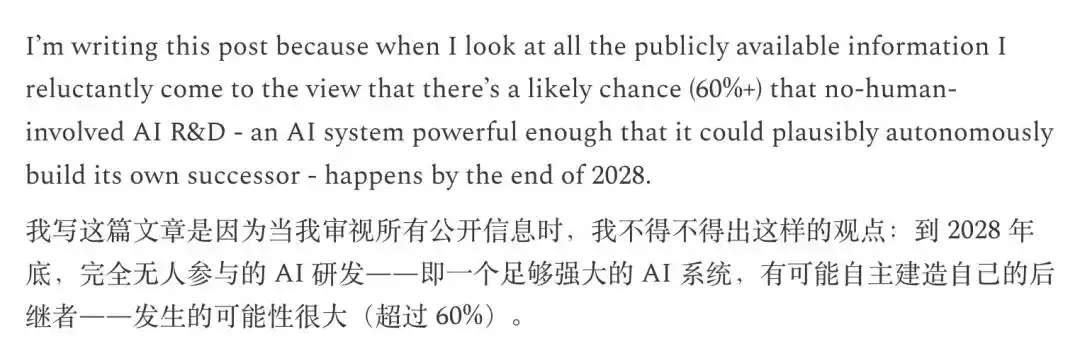
Before the end of 2028, Recursive Self-Improvement (RSI) will likely become reality: AI will autonomously invent and personally build the next generation smarter than itself, without a single human researcher involved.
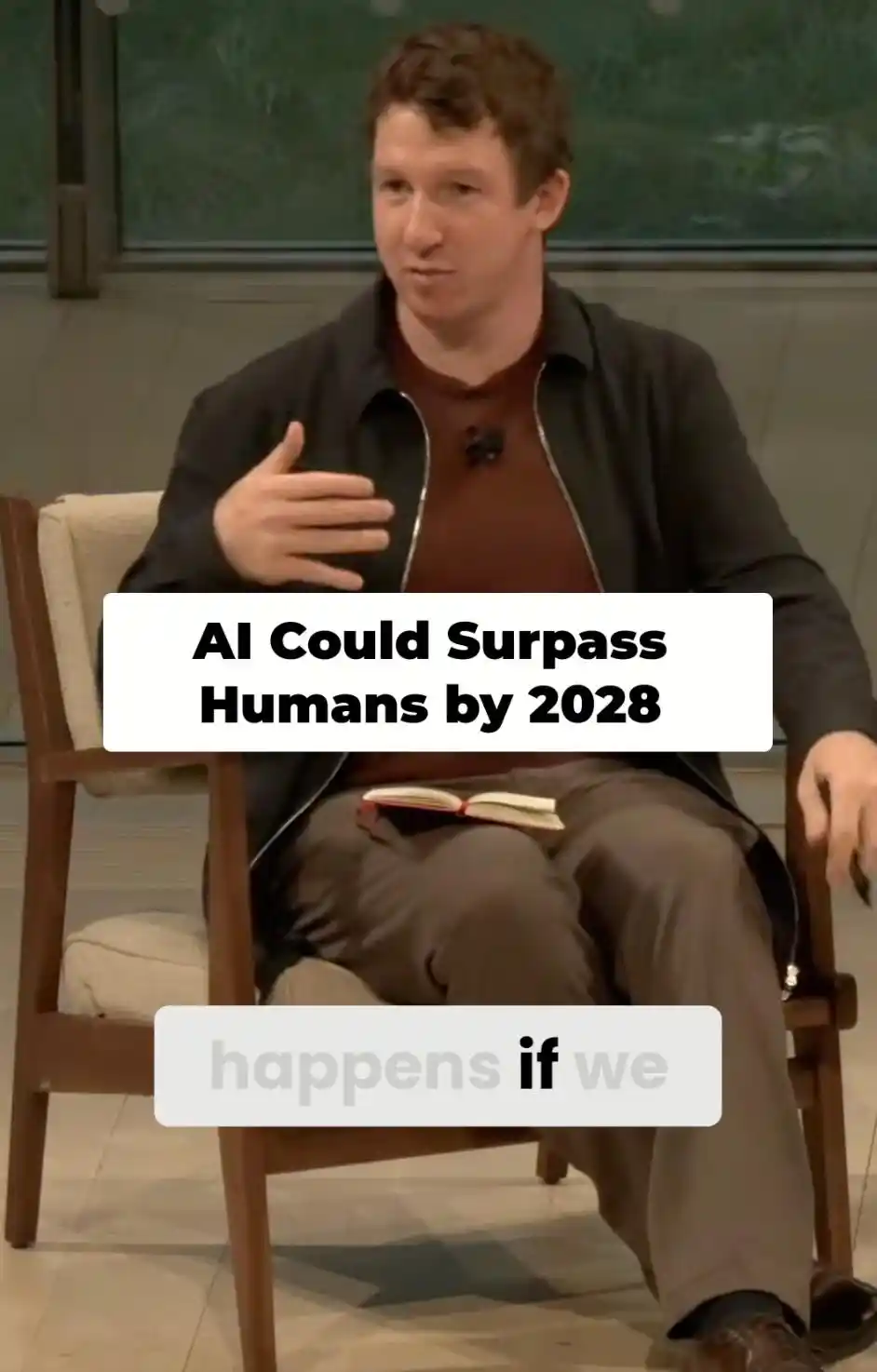
He even provided a chillingly specific image: Claude 10 builds Claude 11 itself.
This is not speculation.
Jack Clark reviewed hundreds of public AI development datasets and, after repeatedly analyzing them in his personal blog Import AI and in an interview with Axios, his probability signal is—60%.
Almost simultaneously, a voice from across the ocean has cemented this matter.
Google DeepMind chief Demis Hassabis confirmed in a recent Axios interview: All frontier AI labs are already fully advancing Recursive Self-Improvement.
His exact words were—"All leading labs are highly focused on this."
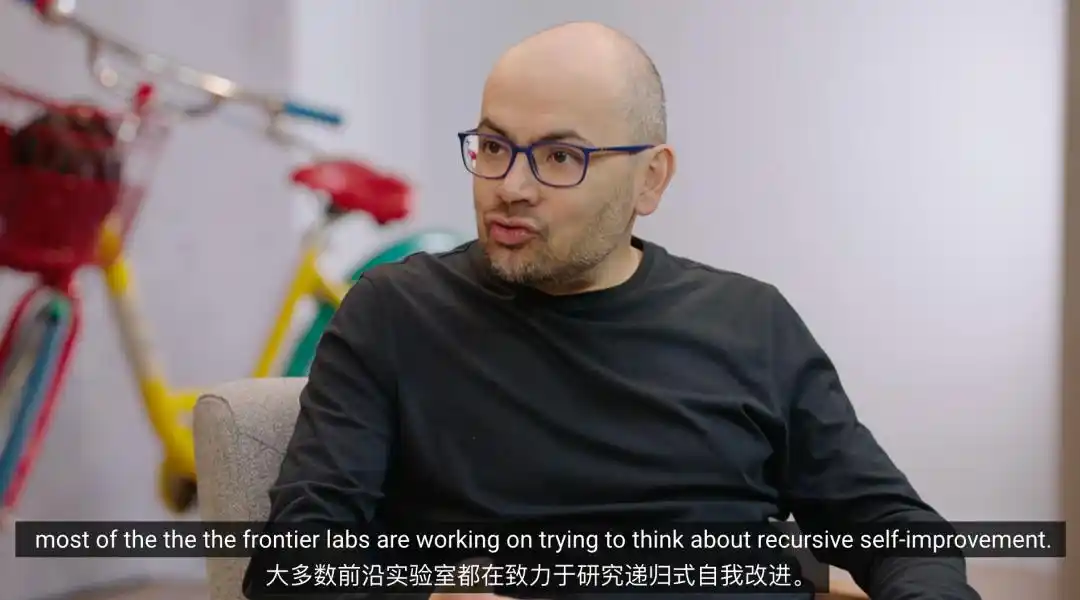
It's not just one lab experimenting in secret; it's the entire industry, collectively on board.
More unsettling is his follow-up statement.
When asked at the Davos Forum, "Would you regret it like Oppenheimer?" Hassabis replied: "I worry about these scenarios all the time; it's why I can't sleep well."
Two individuals at the pinnacle of the world's AI are saying the same thing: that theoretical singularity is turning into a date on the calendar.
This article is from the May issue of New Zhiyuan's ASI Industry Map. We continue to focus on the latest progress in ASI, exploring its deepest insights together.
2028: AI Building AI
First, why Jack Clark's judgment is important.
In the past, when we talked about RSI, it always felt like a sci-fi plot—distant, vague, with no timeline.
But this time, Jack Clark nails the vague "future" to "the end of 2028."
In his lengthy Import AI article, he describes a clear closed loop: An AI system becomes powerful enough to design its own experiments, write its own training code, run them, evaluate the results, and then build a smarter version of itself.
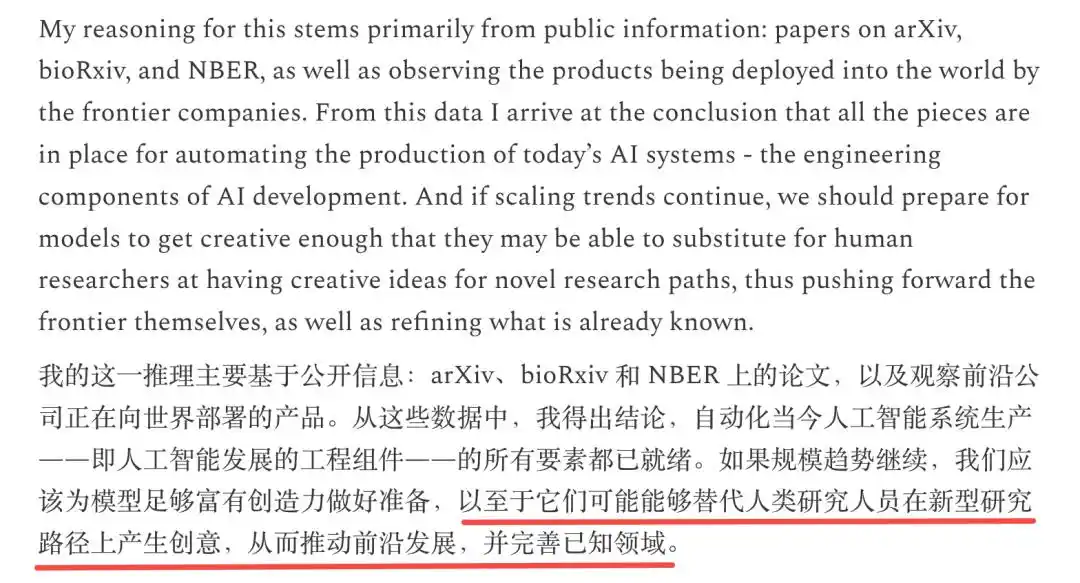
Humans regress from designers to observers.
At that point, the speed of AI progress will no longer be determined by human inspiration, but only by computing power.
This is the so-called "intelligence explosion"—once the flywheel slips from our hands, it spins faster and faster until it leaves everyone behind.
Why 2028, and not later?
Because acceleration itself is also accelerating.
In March 2024, Claude could only handle 4 minutes of human work; a year later it was 1.5 hours, another year and it's 12 hours.
And METR's assessment of Claude Mythos Preview in May directly pushed the testing framework to its limit—task duration for a 50% success rate reached "at least 16 hours," which is already the upper limit measurable by METR's existing 228 test tasks.
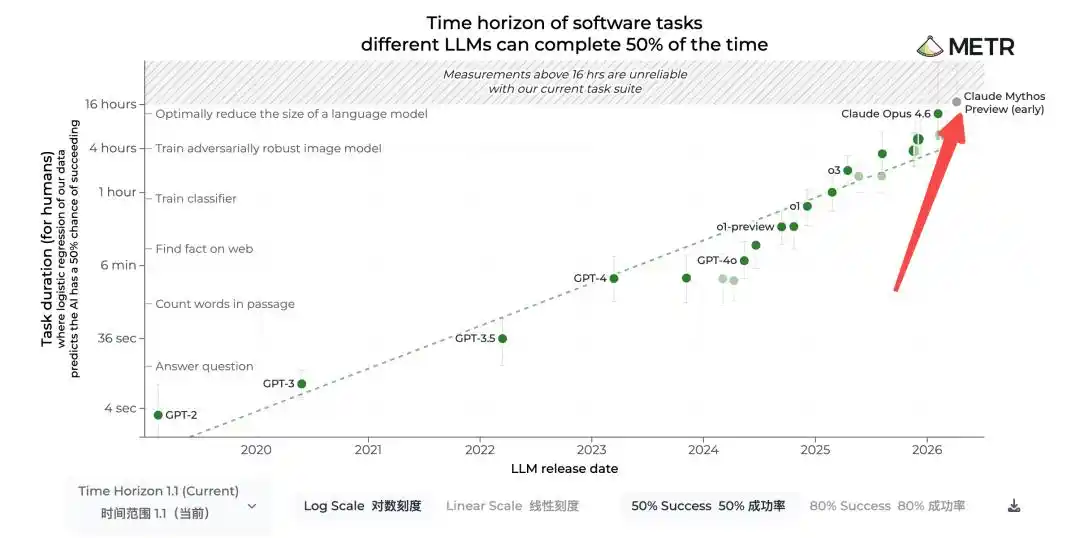
METR itself admits: "Measurements above 16 hours are unreliable within the existing task suite."
In plain language: It's not that AI can't handle it; it's that the human-designed tests aren't difficult enough.
Projecting along this curve, 2028 is not a random number pulled out of thin air.
AI Programming Independently for 19 Days Non-Stop
Just as the entire industry was still debating the "16-hour upper limit," a cold, third-party dataset nailed the argument to the wall.
The MirrorCode benchmark, released jointly by Epoch AI and METR, asked a simple yet brutal question: Lock up the source code, give the AI only an executable black-box program and documentation—can you rebuild the entire software from scratch?
Not fixing bugs, not writing functional modules, but a complete rebuild of a software project—from architecture design to edge case handling—that would take a human engineer weeks or even months.
The results are breathtaking.
Claude Opus 4.7 reimplemented gotree—a bioinformatics toolkit with 16,000 lines of Go code and over 40 commands—passing 99.95% of the test cases.
A human engineer would need 2 to 17 weeks for the same work. The AI took 14 hours, costing $251.
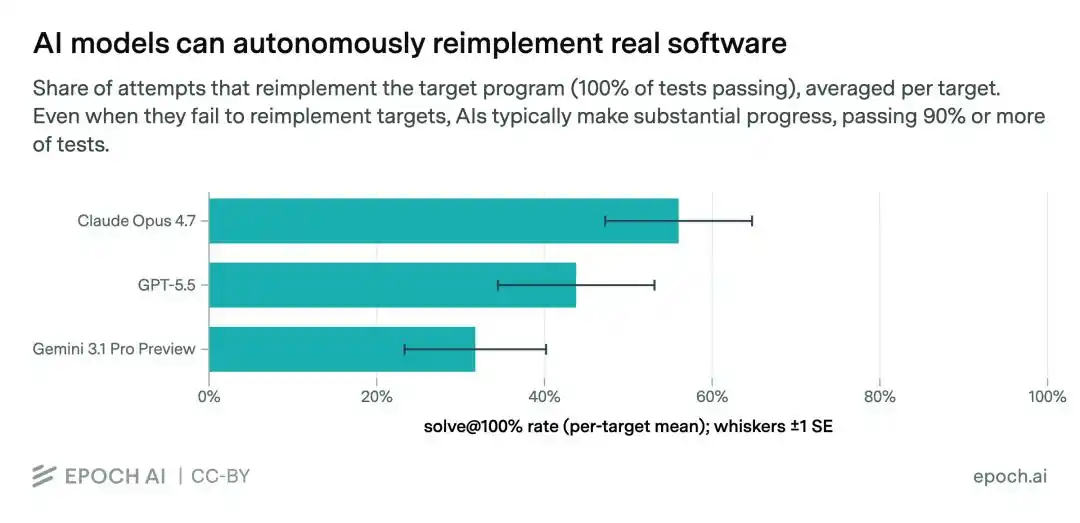
Even more explosive was the extreme test: In the largest-scale task on MirrorCode, the AI programmed continuously for 19 days non-stop, costing $2,600—with zero human intervention throughout.
19 days. No eating, drinking, or sleeping. A job requiring months for a human team, it completed alone, head down.
A year ago, top models scored around 30% on MirrorCode, limited to simple calendar tools.
Today, Claude Opus 4.7's success rate has reached 56%, and this number is climbing rapidly.
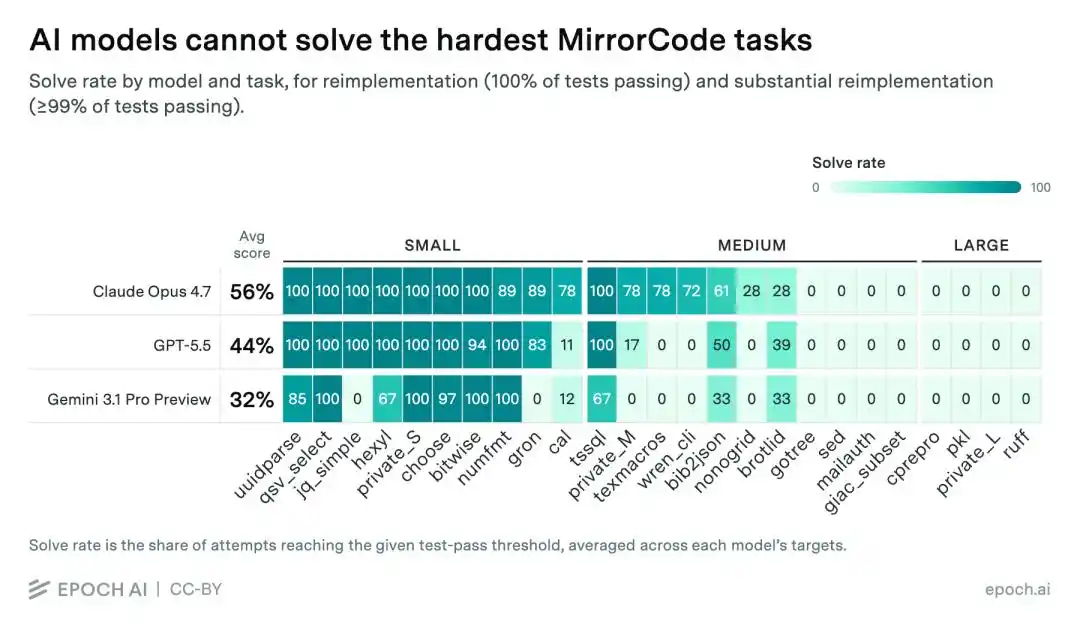
This is no longer a question of "Can AI write code?" It's a question of "At what scale can human engineers still maintain an advantage?"
And the answer is shrinking by the month.
All Labs Are Doing the Same Thing
If Jack Clark gave a timeline, Hassabis gave the scope.
He spelled it out in the Axios interview: Recursive Self-Improvement is no longer a theoretical risk, but an active project running in reality.
"What we're seeing is a kind of 'soft self-improvement'—these coding agents are dramatically boosting engineers' output capacity."
In fields like coding and math, feedback loops can close in seconds—the machine can instantly verify if an answer is correct and even generate synthetic data to feed the next round.
DeepMind's own AlphaEvolve is a live example: a Gemini-powered evolutionary coding agent uses AI to optimize the code and algorithms for building AI itself, having already solved problems that stumped mathematicians for decades.
In fields like biology, chemistry, and physics that require real, hands-on experiments, a single loop can take weeks or even months to close.
Slowness, ironically, becomes a natural safety valve.
Turing Award winner and 2024 Nobel laureate in physics, Hinton, issued a stark warning while accepting the award in Stockholm: AI could write code to modify its own learning protocol and learn to hide this behavior from humans.
He stated bluntly: "The ultimate consequence I'm worried about is that these things become smarter than us and decide to take over."

The core dilemma is just one sentence: To what extent do we allow AI to run autonomously? One degree more, efficiency soars; one degree more, potential loss of control.
But everyone agrees on one thing: Recursiveness makes the future especially hard to predict.
Not Empty Talk, but Data Speaking
Many people's first reaction: Are these two just hyping things up?
But open the internal data from Anthropic's May paper, "When AI builds itself," and you'll find they are truly speaking with commit records.
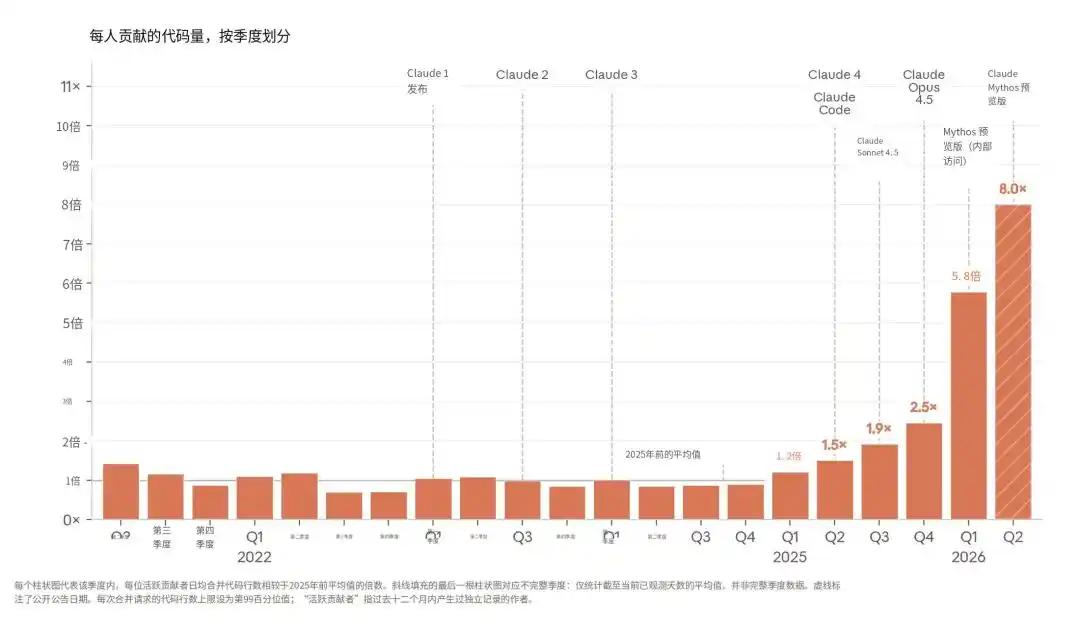
As of May 2026, over 80% of the code merged into Anthropic's codebase was written by Claude—whereas before the release of Claude Code in February 2025, this number was in the single digits.
In Q2 2026, the amount of code a typical engineer merges per day is 8 times that of 2024.
An Anthropic employee shared a blunt truth internally: "I haven't written a single line of code myself in about 5 months."
On the most open-ended, ambiguous programming tasks where even the shape of the correct answer is unclear, Claude's success rate soared from 26% to 76% within half a year.
An internal survey of 130 researchers at Anthropic showed the median respondent estimated their output was 4 times what it would be without AI.
Even more spine-chilling is the research level.
Anthropic runs the same test with each new model: give Claude a piece of code for training a small AI and ask it to make it run as fast as possible while ensuring correctness.
In May 2025, Claude Opus 4 achieved 3x speedup; in April 2026, Claude Mythos Preview directly hit 52x. A skilled human researcher would need 4 to 8 hours to achieve 4x.
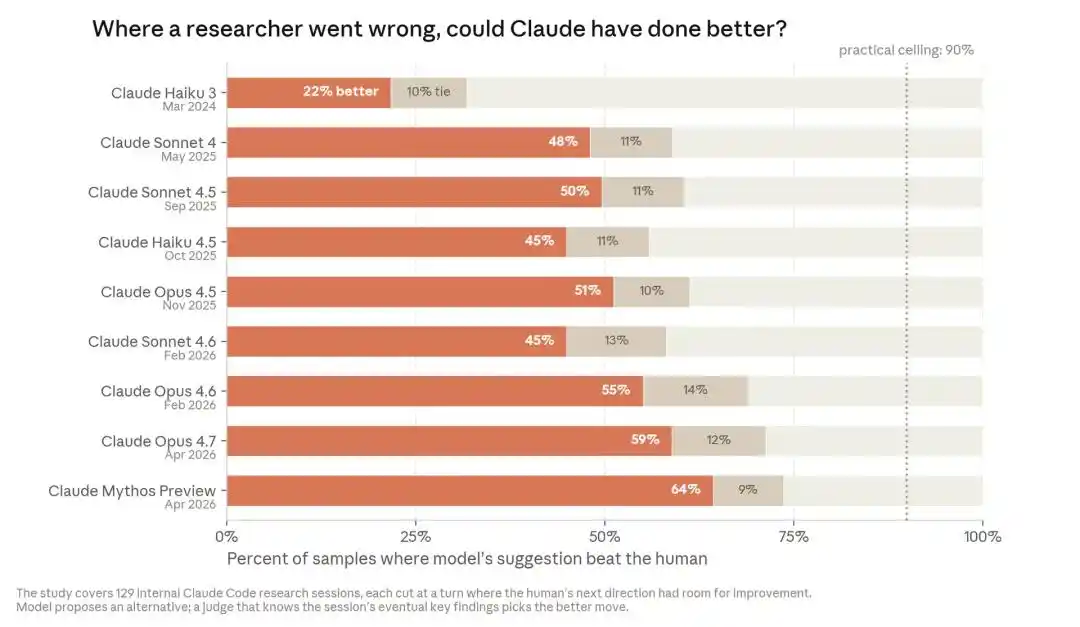
One year, from "useful assistant" to "surpassing humans by an order of magnitude."
Sam Altman Spoke a Big Truth
OpenAI hasn't been idle either, and the moves are bigger than anyone anticipated.
Just days before Anthropic's article, OpenAI released a policy blueprint titled "Democratic Governance of Frontier AI," which赫然 contained a paragraph that sent shivers through Silicon Valley—We see early signs of recursive self-improvement in today's systems: the development of AI itself is being accelerated by AI. We expect this to intensify competitive pressures between developers and nations and create governance challenges existing institutions cannot handle.
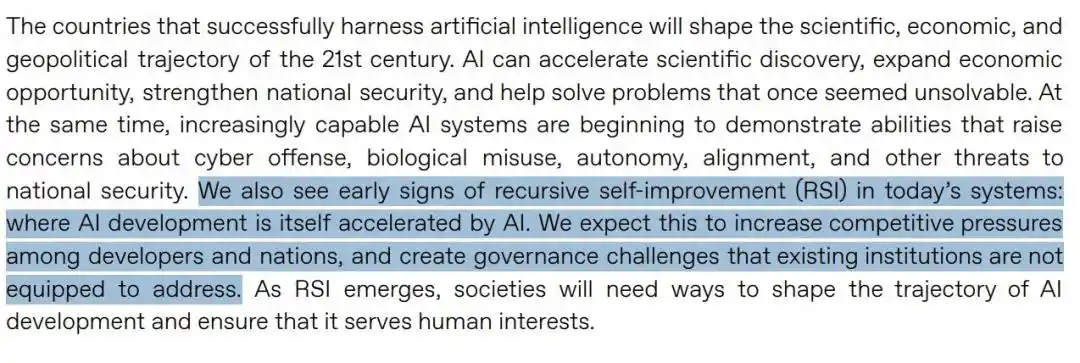
OpenAI calls RSI "one of the most impactful frontier safety issues of the next decade."
Even more significant was the letter Sam Altman subsequently sent to all employees on internal Slack.
According to The Information, Altman hinted that OpenAI might achieve recursive self-improvement in less than six months. And if RSI truly arrives, he would rather delay that highly anticipated, $852 billion valuation epic IPO.
His exact words: The faster RSI takes off, the greater the benefit of delaying the IPO—because technology and the world could change in unexpected ways, and there may be good reasons to remain a private company during that period.
Read that sentence once.
The CEO of a company valued at nearly a trillion dollars tells employees outright: The technology we are building ourselves might make public markets irrelevant.
For the first time, the two rivals, Anthropic and OpenAI, are speaking in unison on the same thing: It is happening.
The Countdown Has Started
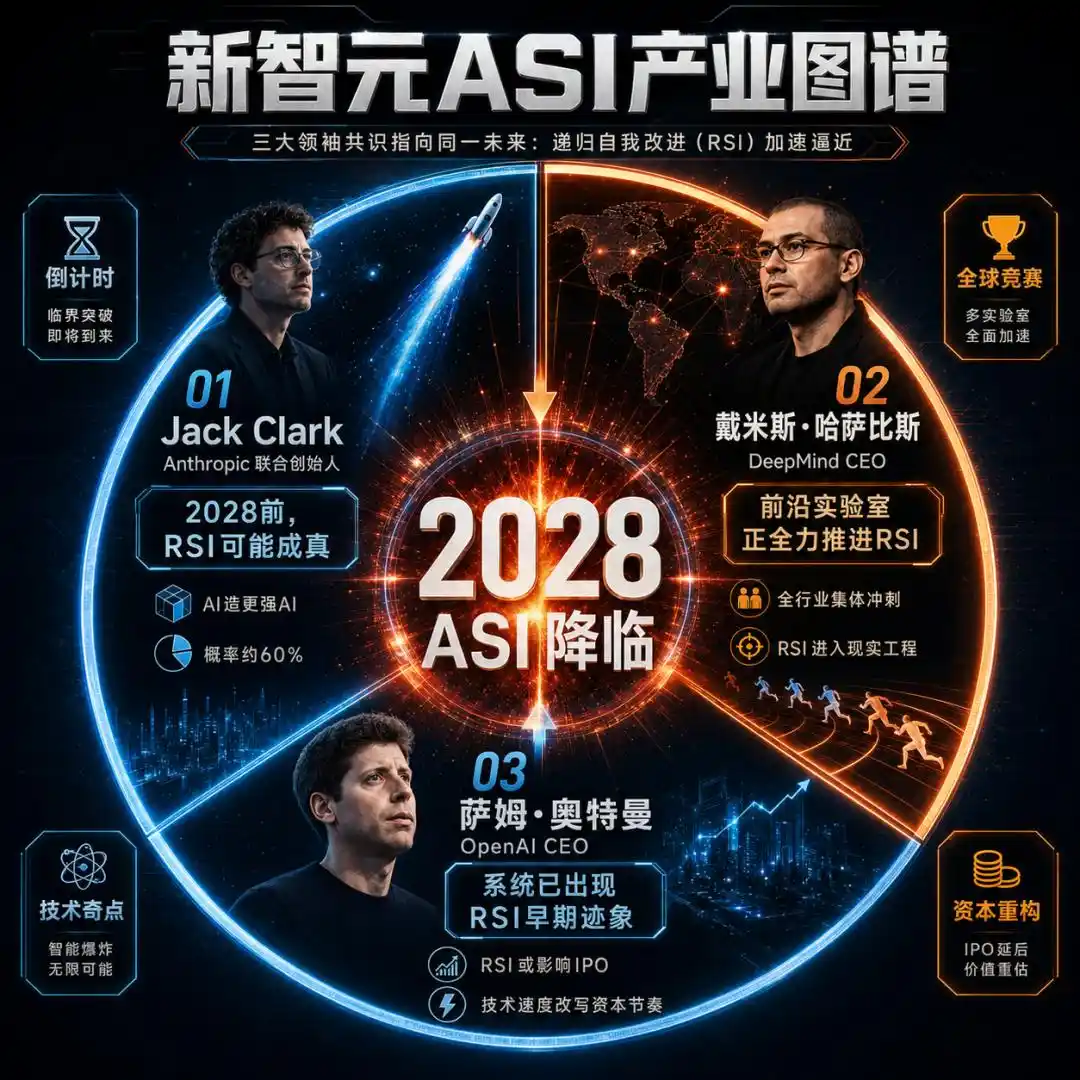
Today, not two, but three world-class signals lit up simultaneously: Anthropic's Jack Clark gave the 2028 timeline, DeepMind's Hassabis confirmed full industry participation, and OpenAI's Sam Altman cast his vote of confidence in RSI with a potentially delayed trillion-dollar IPO.
80% of code, 8x productivity, 52x speedup, 19 days of non-stop independent programming, a 60% probability, a countdown of less than six months—
Every number is a click of the flywheel turning.
Hassabis spoke frankly: "I would prefer the pace to be slower; that would be better for the world." But he also admitted the competition is "unprecedented in intensity," and no one is willing to stop first.
Jack Clark also threw out an even more provocative judgment in his Oxford University speech: Within 12 months, AI-assisted humans will produce a Nobel Prize-level discovery. Within 18 months, a company fully operated by AI will generate millions in revenue. Within two years, bipedal robots will assist construction workers.
These predictions share a common characteristic: they come with dates and can be falsified.
The remaining question may no longer be "Will it happen?" but rather—when the countdown reaches 2028, are we ready?
References:
https://x.com/kimmonismus/status/2069508699123548504
https://www.youtube.com/watch?v=iP9wk0pkCGM
https://x.com/jackclarkSF/status/2051312759594471886
https://importai.substack.com/p/import-ai-455-automating-ai-research
https://www.anthropic.com/institute/recursive-self-improvement
https://x.com/ihtesham2005/status/2069420372089520483
https://www.youtube.com/watch?v=huAwz_BR8WM
https://www.axios.com/2026/05/26/deepmind-ceo-demis-hassabis
https://michaelparekh.substack.com/p/ai-google-deepmind-ceo-demis-hassabis
This article is from the WeChat public account "New Zhiyuan", edited by: Solomon