12.11 Today's Market: Why the Drop? BTC\SOL\ETH\BNB\ASTER\LUNA\AVAX\ENA\FIL Trading Analysis

金色财经Published on 2025-12-11Last updated on 2025-12-11

Abstract

The cryptocurrency market experienced significant liquidations in the past 24 hours, with 155,332 traders liquidated totaling $514 million. The largest single liquidation occurred on Hyperliquid’s BTC-USD pair at $23.185 million. Market sentiment remains stable, with price movements largely driven by economic data and expectations around interest rate cuts. Key technical levels were highlighted for major cryptocurrencies: - **BTC** is consolidating near the $88,700–$89,000 support zone, with a critical resistance at $92,500. - **SOL** is testing support at $129, with further downside target at $125.3 if broken. - **ETH** faces resistance at $3,338, with key support near $3,130–$3,110. - **BNB** shows weakness, with resistance at $873 and support levels at $861 and $846. Altcoins like SOL, AVAX, and ENA are testing monthly support levels, suggesting potential rebound opportunities, though market sentiment remains cautious. Leverage structure varies across tokens: HYPE, XMR, and ASTER face long-side liquidation risks, while VIRTUAL, FIL, BON, and PEPE may see short squeezes. Notable mentions: - **LUNA** is showing signs of a rebound, but a bearish outlook remains. - **ASTER** is hovering near a psychological support at $0.90; a break below could trigger further decline. - Meme token **BudgyBenguin** saw high volatility but may have completed its correction phase. Three new tokens launched: $CYS (ZK + AI infrastructure), $BTX (music copyright RWA), and $U...

? In the past 24 hours, 155,332 people were liquidated globally, with a total liquidation amount of $514 million. The largest single liquidation occurred on Hyperliquid - BTC-USD, worth $23.185 million.
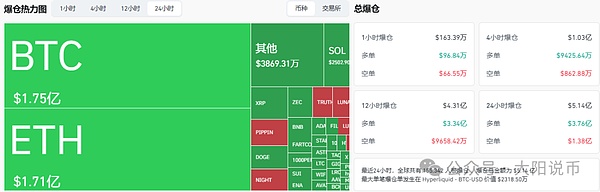
? Market sentiment is stable; the next move will be driven by data and rate cut expectations.

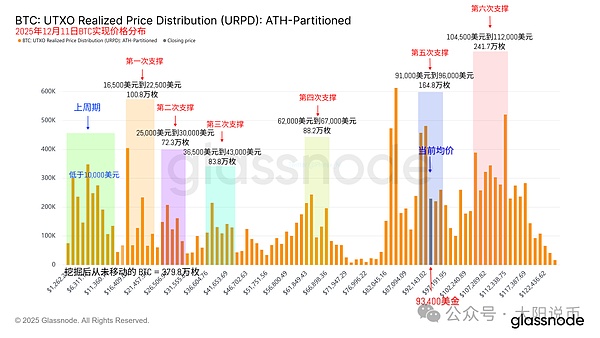
Current turnover rates are relatively high, mainly reflecting investor trading games at a critical stage. Turnover is expected to gradually decline after today. Data also indicate that recent turnover primarily comes from short-term investors who bought at low levels, with relatively significant reductions by new investors whose costs are below 90k.

The current chip structure of the market is generally normal, stability shows no abnormalities, and no panic selling is seen among high-position holders. The subsequent trend needs to pay attention to various economic data in December. If expectations for a January rate cut continue to strengthen, market热度 (heat) is expected to continue.
If you don't understand or are unsure of the direction, remember to follow me?

✅ Today's Market Analysis:

BTC

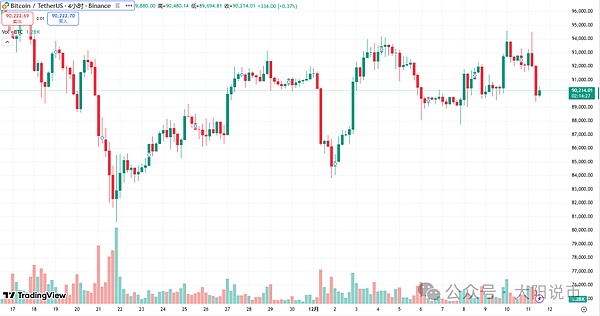
Bitcoin's key support today remains near 88700, with the pinning point focusing on the 86200-86700 range, though the probability of a pin is small. It is more likely to consolidate in the 89000-88000 zone, building strength for a rebound next week. In terms of operation, just reserve funds for potential pinning. Short-term pressure focuses on 92500, which is the bull-bear dividing line; the trend will be difficult to strengthen before breaking above this level.
SOL

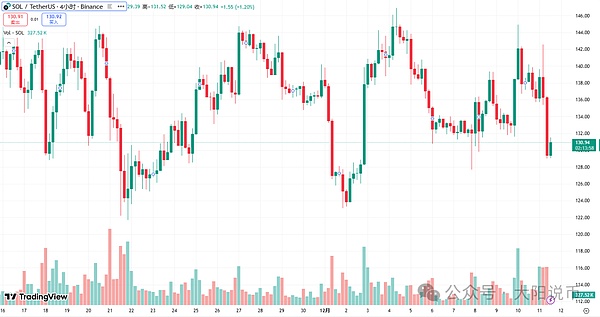
The 129 support mentioned yesterday will be tested today. If lost, the next watch is 125.3. Before breaking through the short-term pressure at 137.7, the行情 (market/price action) can hardly be called strong.
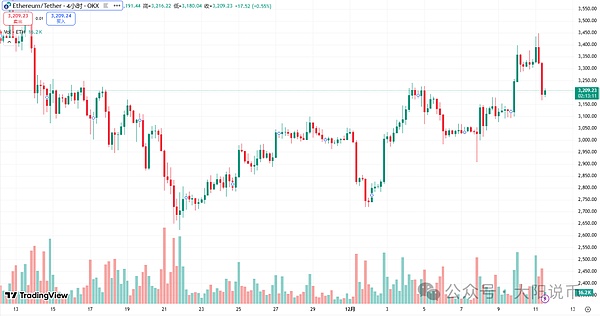
ETH

Ethereum's pressure at 3444 was validated effectively yesterday, with a high touch of 3446. Today, the pressure has moved down to 3338; it will be difficult to have strong performance before breaking above this level. Lower support first looks at the 3130-3110 range, with the pinning point留意 (watch/note) 2940.
BNB

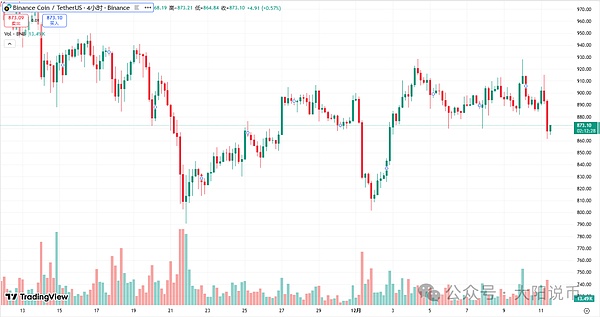
BNB is currently the weakest on the board. Watch the 873 position this afternoon. If the hourly candle closes above this level, then pressure依次 (in turn) looks at 882, 898, 915; if it cannot hold 873, support关注 (focus on) 861, 846, 830.
? Is it time to buy the dip in the altcoin market?

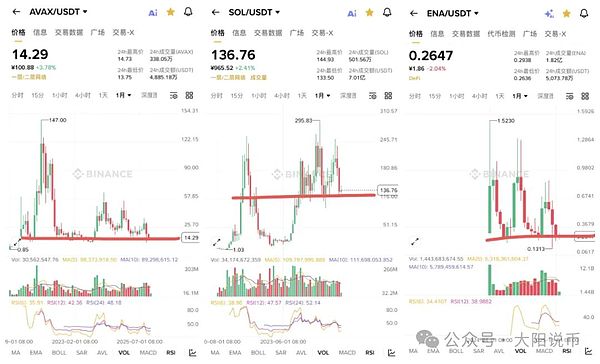
Observing the monthly chart trends of SOL, AVAX, and ENA, it can be seen that they have touched key monthly support levels. These represent the movements of mainstream coins, established public chain coins, and new coins from this bull cycle, respectively, also broadly reflecting the overall situation of the current altcoin market.

From a technical perspective, the current position already具备 (possesses/has) certain conditions for buying the dip, but market sentiment still seems cautious, with many investors still watching from the sidelines. If even monthly-level support cannot trigger an effective rebound, then the prospects for some altcoins may face more severe tests.
? The leverage structure in the recent altcoin market has shown significant分化 (differentiation/divergence).

Short positions in coins like HYPE, XMR, ASTER have been largely liquidated. The leverage piled up on the board now is mainly on the long side, which can easily trigger连环 (chain) long liquidations later, so the short-term trend for these coins is relatively weak.

Whereas VIRTUAL, FIL, BON, PEPE present the opposite pattern, with leverage concentrated on the short side, making the market more prone to short squeeze行情 (market moves/conditions), so their potential for subsequent rebounds should be greater.

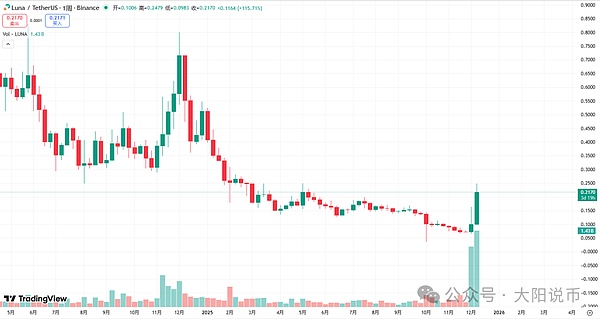
$LUNA

This LUNA is also starting to rebound; it seems this market move is getting livelier. Wait for a good position, then you can go short on LUNA. I believe the final destination for this coin will most likely be to return from whence it came.
$BudgyBenguin

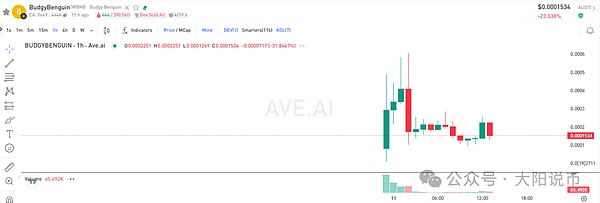
BudgyBenguin the tiger-striped penguin topped the热度 (heat/hype) charts last night and got an official interaction from BNBCHAIN. The first wave ATH was only 500k, bottoming out around 100k+. The first wave was mainly due to密集 (dense/frequent) KOL shilling, and historical experience shows that BSC热点 (hot topics/hypes) often deep wash first (this round saw an 80% drop on the hourly level, from 500k to 100k), not letting retail easily get筹码 (chips/positions). The wash might be over now, the走势 (trend/price action) is basically clear.
$ASTER

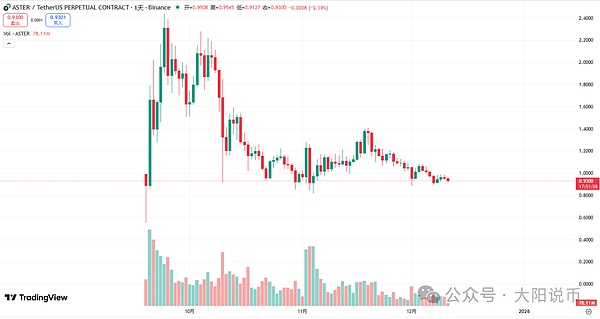
The manipulation手法 (technique/method) of this coin is very precise; the 0.9 level was tested several times without a real break, even briefly breaking it was immediately pulled back. The key is CZ has a position at this level, which became a psychological barrier and retail's defense line. It looks highly likely to break now; closely watch the 0.9 position. If it breaks effectively, go short directly.
Today's three Alpha

$CYS (ZK+AI infrastructure) will be listed at 4 PM, raised $21.85 million, operated by a domestic team, KuCoin同步 (simultaneously/sync).

$BTX (Music copyright RWA) will be listed at 6 PM, raised $6-9 million, Gate同步 (simultaneously/sync).

$US (SUI ecosystem stablecoin) open for claiming (5-10 $US per person), Bitget同步 (simultaneously/sync).

All projects hope to quickly land借助 (with the help of/riding on) the warming market.

Trending Cryptos

Related Questions

QWhat was the total liquidation amount in the crypto market in the past 24 hours according to the article?

AThe total liquidation amount was $514 million, with 155,332 people liquidated.

QWhat is the key support level for Bitcoin (BTC) mentioned in the analysis?

AThe key support level for Bitcoin is around 88,700, with a potential dip zone between 86,200 and 86,700.

QWhich cryptocurrencies are mentioned as having greater rebound potential due to concentrated short leverage?

AVIRTUAL, FIL, BON, and PEPE are mentioned as having greater rebound potential because leverage is concentrated on the short side, making them prone to short squeeze rallies.

QWhat is the outlook for LUNA according to the author?

AThe author believes LUNA will eventually return to its origins (likely implying a significant decline) and suggests waiting for a good position to short it.

QWhich new tokens are scheduled to launch on the same day as the article, and what are their themes?

A$CYS (ZK + AI infrastructure) launching at 4 PM, $BTX (music copyright RWA) at 6 PM, and $US (SUI ecosystem stablecoin) is available for claiming, with distributions on KuCoin, Gate, and Bitget respectively.

Related Reads

19 New Decacorns in Half a Year: Why is the Primary Market Chasing 'Certainty'?

In the first half of 2026, China’s primary market saw a notable increase in unicorns, adding 19 new companies each valued over 100 billion RMB, particularly in sectors like embodied AI and large language models (LLMs). Firms such as Galaxy General, Zibian, and ZhiPingFang even surpassed 200 billion RMB valuations within months. Moonshot AI's valuation surged from around $10 billion to $35 billion by July 2026, with a pre-IPO target of $50 billion. This concentration of capital into a few "certain" sectors highlights a market shift. The driving force is not a general abundance of capital but a chase for "certainty"—primarily clearer exit pathways like imminent IPOs. Companies with defined public listing timelines attract intense investment despite higher valuations, as they reduce exit uncertainty for investors. Secondary market valuations of listed peers also serve as new anchors, boosting the perceived value of private companies in similar fields, though this creates dependency on public market sentiment. Another form of certainty comes from the expectation of rising valuations in subsequent funding rounds. The investment logic has shifted in some cases from assessing long-term fundamental value to betting on the next round attracting higher prices. This dynamic is also seen in deep-tech areas like nuclear fusion, where firms like NeoFusion secured a 10.6 billion RMB valuation despite early commercial stages, driven by scarcity and strategic bets. However, this trend signals a risk transfer: technical uncertainties remain but are temporarily masked by valuation inflation. As valuations climb—50 billion to 200 billion or 500 billion RMB—companies face increasing pressure to demonstrate real revenue, profit, and sustainable business models. The danger lies not in the rise of unicorns itself, but if valuations become detached from value creation and rely merely on the expectation of future funding or exits. Ultimately, the surge reflects investors seeking perceived safety in shorter-term exit certainty and transactional momentum, rather than a renewed appetite for risk. The true test will come when the market inevitably refocuses on fundamentals, questioning how many of today’s high valuations are backed by genuine economic value.

marsbit20m ago

19 New Decacorns in Half a Year: Why is the Primary Market Chasing 'Certainty'?

marsbit20m ago

Just Now, Sam Altman Blasts Dario Amodei as 'Anti-Human', Secret Model Exposed the Same Day

Just now, Sam Altman strongly criticized Dario (Amodei, co-founder of Anthropic), denouncing his "doomsday marketing" as "anti-human dictator rhetoric." This came alongside the accidental exposure of OpenAI's next-generation model, codenamed "gpt-nathree," hinting at the imminent release of GPT-6 Astra. The leak occurred when an OpenAI employee's public GitHub commit mentioned the codename. Combined with previous leaks of "gpt-mewfour," it suggests these are iterative checkpoints for OpenAI's upcoming agent model, Astra. Astra is known for multi-agent collaboration and long-duration task handling, having reportedly solved previously unsolved mathematical problems. Meanwhile, two new Anthropic model codenames, "claude-marshmallow-eap" and "claude-melon-eap," were also exposed but are believed to be iterations of the Claude 5 series, not a new flagship. In a wide-ranging podcast interview, Altman admitted he was wrong about the speed of AI-driven disruption, acknowledging societal inertia slows adoption. He fiercely criticized rivals' marketing that simultaneously promises immense benefits (like curing cancer) and warns of existential risk, calling it a dangerous "benevolent dictator" narrative that seeks to concentrate power. He emphasized that people are the ultimate purpose of AI. Altman also revealed OpenAI's unconventional, consensus-defying path: spending four and a half years in the "dark" without a public product before ChatGPT's breakthrough, driven by scaling laws rather than early customer feedback. He concluded that even with superintelligent AI, genuine human connection will remain irreplaceably valuable.

marsbit1h ago

Just Now, Sam Altman Blasts Dario Amodei as 'Anti-Human', Secret Model Exposed the Same Day

marsbit1h ago

The 'Saving U.S. Treasuries' Baton Pass: Bessent Fumbled Last Week, This Week It's Wash's Turn

"Rescuing US Treasuries" Relay: After Bessent's Miss, All Eyes Are on Walsh Last week, US Treasury Secretary Bessent's announcement to at least double long-term Treasury buybacks failed to sustainably lower yields, which quickly rebounded. The market response saw a drop in the dollar alongside surges in gold and Bitcoin, interpreted as a "pressure release valve" for anxiety. The focus now shifts to Fed Chairman Walsh's upcoming Jackson Hole speech. Markets are highly sensitive to his message, seeking clarity on the Fed's policy response to stubborn inflation and worsening fiscal conditions. Analysts warn that a lack of new guidance could disappoint markets and worsen the sell-off in long-dated bonds. Analysts question the scale of Bessent's operations, noting they are too small relative to the overall debt market and do not constitute quantitative easing. A key issue is the Fed's massive holdings of long-term bonds, which distorts the market. With the Fed holding low-yielding short-term bonds that are losing money relative to its policy rate, discussion is growing around a potential Fed-led "Operation Twist." This would involve selling short-term bonds to buy long-term ones, aiming to lower long-end yields without expanding the balance sheet. The upcoming PCE inflation data will set the stage for Walsh's speech. However, the window for action is narrowing amid political pressures. A critical threshold is the 30-year yield at 5%; holding above it could increase stress on the dollar and leveraged sectors. Overall, the article suggests that without coordinated Fed action to anchor inflation expectations, Treasury interventions may ultimately fail, with investors increasingly looking to assets like gold as hedges.

marsbit1h ago

The 'Saving U.S. Treasuries' Baton Pass: Bessent Fumbled Last Week, This Week It's Wash's Turn

marsbit1h ago

Hyperliquid's Compliance Journey: From Permissionless to Permissioned via HIP-3

Hyperliquid’s Compliance Path: From Permissionless to Permissioned HIP-3 Hyperliquid currently blocks U.S. access because its permissionless, on-chain infrastructure conflicts with U.S. market structure laws, which restrict futures trading to registered exchanges, clearinghouses, and brokers. Through its Hyperliquid Policy Center (HPC), the project is advocating for regulatory modernization, proposing that regulated entities be allowed to build products on HyperCore (its exchange and clearing layer) while fulfilling their compliance obligations. The platform’s modular stack separates roles like a traditional exchange (DCM), clearinghouse (DCO), and broker (FCM), but reconstructs them on-chain with code. This enables permissionless access, self-custody, and 24/7 global trading, but clashes with U.S. rules requiring KYC, specific margin models, and custodial arrangements. To resolve this, HPC is engaging with U.S. regulators (CFTC, SEC) to seek clarity that deploying on-chain software does not itself trigger licensing, and to establish exemptions allowing non-custodial wallets to route users to regulated derivatives. Recent political signals suggest openness to this approach. On the technical side, Hyperliquid Labs has introduced permissioned HIP-3 deployers on testnet. These allow regulated entities to launch markets, perform KYC, and whitelist compliant users. While these create separate order books, whitelisted market makers can bridge liquidity between them, ensuring deep, shared liquidity across the same L1. Features like payload-based “PA” permissions enable DEX-level account controls (e.g., reduce-only orders), mirroring traditional broker authorities. The strategy is not to open the native, permissionless front-end to U.S. users, but to position Hyperliquid as neutral infrastructure that U.S. regulated firms can use while meeting their legal duties. This paves a compliant path for U.S. investor access while preserving the protocol’s core, permissionless nature.

marsbit1h ago

Hyperliquid's Compliance Journey: From Permissionless to Permissioned via HIP-3

marsbit1h ago

Trading

Spot

Hot Articles

What is $BITCOIN

DIGITAL GOLD ($BITCOIN): A Comprehensive Analysis Introduction to DIGITAL GOLD ($BITCOIN) DIGITAL GOLD ($BITCOIN) is a blockchain-based project operating on the Solana network, which aims to combine the characteristics of traditional precious metals with the innovation of decentralized technologies. While it shares a name with Bitcoin, often referred to as “digital gold” due to its perception as a store of value, DIGITAL GOLD is a separate token designed to create a unique ecosystem within the Web3 landscape. Its goal is to position itself as a viable alternative digital asset, although specifics regarding its applications and functionalities are still developing. What is DIGITAL GOLD ($BITCOIN)? DIGITAL GOLD ($BITCOIN) is a cryptocurrency token explicitly designed for use on the Solana blockchain. In contrast to Bitcoin, which provides a widely recognized value storage role, this token appears to focus on broader applications and characteristics. Notable aspects include: Blockchain Infrastructure: The token is built on the Solana blockchain, known for its capacity to handle high-speed and low-cost transactions. Supply Dynamics: DIGITAL GOLD has a maximum supply capped at 100 quadrillion tokens (100P $BITCOIN), although details regarding its circulating supply are currently undisclosed. Utility: While precise functionalities are not explicitly outlined, there are indications that the token could be utilized for various applications, potentially involving decentralized applications (dApps) or asset tokenization strategies. Who is the Creator of DIGITAL GOLD ($BITCOIN)? At present, the identity of the creators and development team behind DIGITAL GOLD ($BITCOIN) remains unknown. This situation is typical among many innovative projects within the blockchain space, particularly those aligning with decentralized finance and meme coin phenomena. While such anonymity may foster a community-driven culture, it intensifies concerns about governance and accountability. Who are the Investors of DIGITAL GOLD ($BITCOIN)? The available information indicates that DIGITAL GOLD ($BITCOIN) does not have any known institutional backers or prominent venture capital investments. The project seems to operate on a peer-to-peer model focused on community support and adoption rather than traditional funding routes. Its activity and liquidity are primarily situated on decentralized exchanges (DEXs), such as PumpSwap, rather than established centralized trading platforms, further highlighting its grassroots approach. How DIGITAL GOLD ($BITCOIN) Works The operational mechanics of DIGITAL GOLD ($BITCOIN) can be elaborated on based on its blockchain design and network attributes: Consensus Mechanism: By leveraging Solana’s unique proof-of-history (PoH) combined with a proof-of-stake (PoS) model, the project ensures efficient transaction validation contributing to the network's high performance. Tokenomics: While specific deflationary mechanisms have not been extensively detailed, the vast maximum token supply implies that it may cater to microtransactions or niche use cases that are still to be defined. Interoperability: There exists the potential for integration with Solana’s broader ecosystem, including various decentralized finance (DeFi) platforms. However, the details regarding specific integrations remain unspecified. Timeline of Key Events Here is a timeline that highlights significant milestones concerning DIGITAL GOLD ($BITCOIN): 2023: The initial deployment of the token occurs on the Solana blockchain, marked by its contract address. 2024: DIGITAL GOLD gains visibility as it becomes available for trading on decentralized exchanges like PumpSwap, allowing users to trade it against SOL. 2025: The project witnesses sporadic trading activity and potential interest in community-led engagements, although no noteworthy partnerships or technical advancements have been documented as of yet. Critical Analysis Strengths Scalability: The underlying Solana infrastructure supports high transaction volumes, which could enhance the utility of $BITCOIN in various transaction scenarios. Accessibility: The potential low trading price per token could attract retail investors, facilitating wider participation due to fractional ownership opportunities. Risks Lack of Transparency: The absence of publicly known backers, developers, or an audit process may yield skepticism regarding the project's sustainability and trustworthiness. Market Volatility: The trading activity is heavily reliant on speculative behavior, which can result in significant price volatility and uncertainty for investors. Conclusion DIGITAL GOLD ($BITCOIN) emerges as an intriguing yet ambiguous project within the rapidly evolving Solana ecosystem. While it attempts to leverage the “digital gold” narrative, its departure from Bitcoin's established role as a store of value underscores the need for a clearer differentiation of its intended utility and governance structure. Future acceptance and adoption will likely depend on addressing the current opacity and defining its operational and economic strategies more explicitly. Note: This report encompasses synthesised information available as of October 2023, and developments may have transpired beyond the research period.

2.1k Total ViewsPublished 2025.05.13Updated 2025.05.13

What is $BITCOIN

Discussions

Welcome to the HTX Community. Here, you can stay informed about the latest platform developments and gain access to professional market insights. Users' opinions on the price of BTC (BTC) are presented below.

活动图片