Ethereum Shanghai upgrade on Sepolia set for February 28, ETH price surge in March?

FinboldPublished on 2023-02-22Last updated on 2023-02-22

Abstract

Shanghai upgrade of the Ethereum (ETH) network on the Sepolia testnet has been officially scheduled for the end of the month.

After the Zhejiang testnet went live in early February, the Shanghai upgrade of the Ethereum (ETH) network on the Sepolia testnet has been officially scheduled for the end of the month and is expected to have an impact on the price of the protocol’s native cryptocurrency before the long-awaited mainnet launch.

As it happens, the Shanghai/Capella upgrade, also called ‘Shapella,’ is set for deployment on the Ethereum testnet Sepolia network at epoch 56832, which is scheduled for 4:04:48 AM UTC on February 28, the core blockchain development team said in a blog post on February 21.

What does this mean?

According to the team, this means that “withdrawals are coming (…) after months of testing and an ephemeral devnet launch,” as the upgrade combines the execution and consensus layers. Specifically:

“This upgrade follows The Merge and enables validators to withdraw their stake from the Beacon Chain back to the execution layer. It also introduces new functionality to both the execution and consensus layer.”

The execution layer – Shanghai – introduces warm Coinbase, PUSH0 instruction, limit and meter initcode, deprecate SELFDESTRUCT, and Beacon chain push withdrawals as operations, while the consensus layer – Capella – enables full and partial withdrawals for validators, as well as introducing independent state and block historical accumulators and a prerequisite for withdrawals.

Meanwhile, this is the second public testnet launch before the Shanghai hard fork goes live on the mainnet after the prior stress tests on Zhejiang revealed some minor bugs that have since been addressed and will not affect the timeline for further updates.

Notably, the Shapella upgrade arrives a little later than expected, as the platform’s developer Barnabas Busa previously announced it would be implemented six days after the Zhejiang public staking testnet, which took place on February 1, as Finbold reported.

Ethereum price analysis

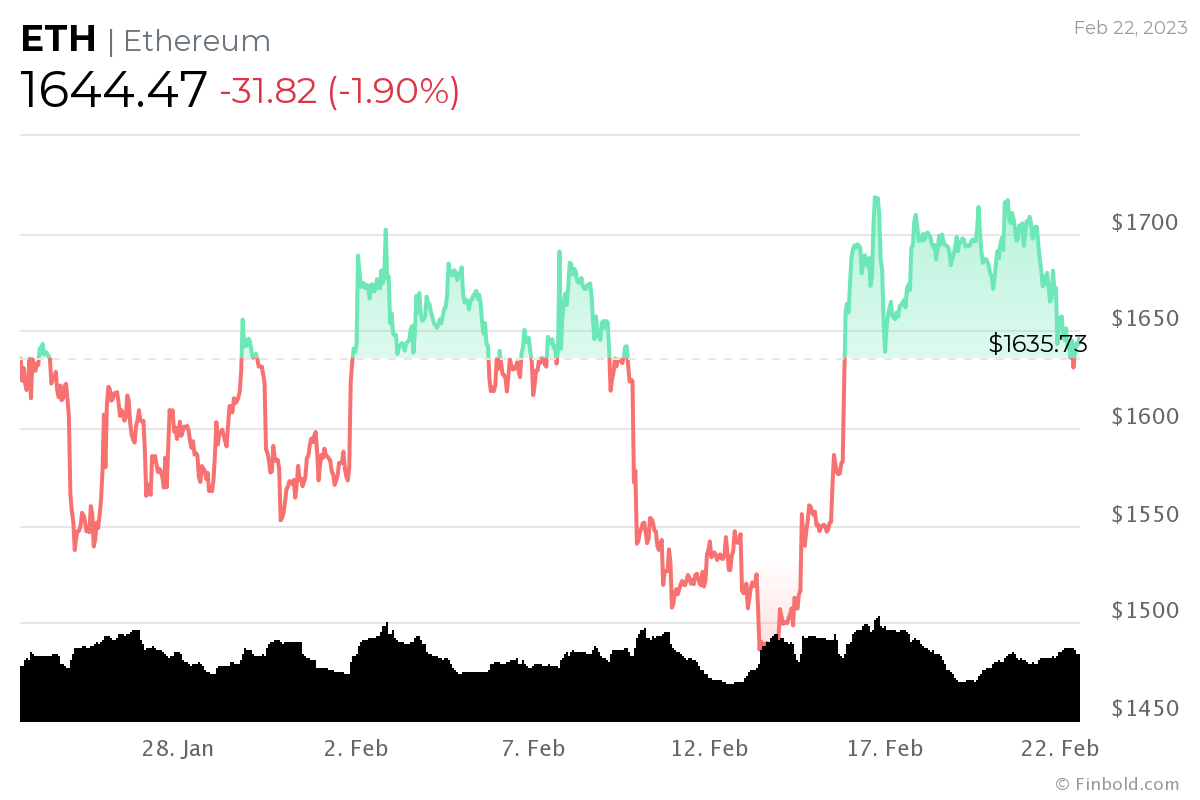
As things stand, Ethereum is at press time changing hands at the price of $1,644, down 1.9% in the last 24 hours but still recording increases of 5.62% over the previous week, as well as being up 0.84% on its monthly chart, according to the data retrieved on February 22.

Ethereum 30-day price chart. Source: Finbold

Considering that the price of Ethereum had soared immediately after the Zhejiang testnet was triggered, upward price action can be expected upon the launch of the Shapella testnet as well. However, the continuation of a bullish rally will depend on further developments on the blockchain, as well as on the wider crypto and macro scene.


Trending Cryptos

Related Reads

OpenRouter: How Did This 'AI Model Relay Station' Achieve a $10 Billion Valuation?

OpenRouter: The Model Router Building a $10B+ Company This article explores OpenRouter, a platform that aggregates access to over 400 AI models from 70+ providers (like OpenAI, Claude, Gemini) through a single API. It has grown into a unicorn with a $1.3B valuation by 2026, processing massive scale—reaching 100 trillion tokens monthly. Its core value isn't just being a "model supermarket." For developers building real-world AI applications, managing multiple models for different tasks (e.g., cheap models for titles, powerful ones for long articles) is complex. OpenRouter acts as a critical "model scheduling layer," handling routing, failover between providers, cost optimization, and enterprise features like zero-data-retention policies and budget controls. OpenRouter's business model is a "toll fee": it charges a small platform fee (5.5%) on purchased credits while passing model costs directly to users. Its revenue scales with the tokens flowing through its system, which saw explosive growth as AI apps evolved. Key growth drivers include: 1) The explosion of specialized models, increasing choice complexity; 2) AI apps shifting focus from performance to cost optimization; 3) The rise of AI agents that require more reliable, multi-step model calls. However, risks remain. Large enterprises or cloud providers (AWS, Google Cloud) could build similar internal gateways. Its position between model suppliers and developers could also create future tension over pricing and data control. To stay ahead, OpenRouter must deepen its enterprise features and prove it's more than just a request forwarder.

marsbit12m ago

OpenRouter: How Did This 'AI Model Relay Station' Achieve a $10 Billion Valuation?

marsbit12m ago

Bitcoin Falls Below $60,000 Again; After 20 Months, We've Reached a New Low

Bitcoin Drops Below $60,000, Hitting a 20-Month Low Bitcoin fell below the key $60,000 psychological level again, reaching a low of $59,023—its lowest point in approximately 20 months, dating back to October 2024. While it later recovered slightly to around $60,600, this marks its third significant breach of $60,000 this year. The downturn is attributed to two primary factors. First, U.S. spot Bitcoin ETFs are experiencing their longest streak of net outflows since launch, with nearly $5.94 billion withdrawn over 30 days. This creates sustained selling pressure as Authorized Participants sell Bitcoin to meet redemptions. Second, shifting macroeconomic expectations are adding pressure. Strong U.S. job data and hawkish remarks from Fed officials have increased market pricing for potential rate hikes, reversing the earlier liquidity-driven bullish sentiment and prompting a shift away from risk assets like Bitcoin. Analyst views are mixed. 21Shares maintains a bullish long-term outlook, expecting prices to recover towards $100,000, citing historical post-halving cycles and substantial ETF holdings as a base. In contrast, Arthur Hayes predicts a potential bottom around $40,000 within six months due to persistent Fed hawkishness. CryptoQuant suggests, based on on-chain data, that the market may not find a bottom until prices fall below the average investor cost basis around $53,000, potentially extending the bearish phase into late 2026 or early 2027. The immediate focus is on upcoming U.S. inflation data and Fed signals. Lower-than-expected CPI could offer relief, but confirmation of sticky inflation or continued ETF outflows may lead to further downside pressure. Bitcoin's ability to hold above $60,000 remains a critical test for the near-term market direction.

Odaily星球日报52m ago

Bitcoin Falls Below $60,000 Again; After 20 Months, We've Reached a New Low

Odaily星球日报52m ago

When Billions Begin to Operate Everything by Voice, How Far is ‘All Assets on Chain’?

In June 2026, WeChat began a limited rollout of "Xiaowei," its native AI assistant. This move is more than an upgrade to a smarter chatbot; it signals a crucial step from "universal internet access" toward the broader vision of "full asset tokenization." Xiaowei, powered primarily by WeChat's in-house WeLM model, demonstrates four key capabilities: 1) direct voice/web chat control of app functions, 2) automated access to mini-programs for services, 3) instant comprehension and summarization of complex documents like PDFs, and 4) generating functional mini-program prototypes from simple natural language requests. This represents a fundamental shift from GUI (Graphical User Interface) to LUI (Language User Interface), eliminating friction in human-digital interaction. The rollout is pivotal because it brings AI Agents to China's massive user base with zero friction—no new app downloads or accounts needed. This "seamless access" mirrors past platform revolutions like the App Store or WeChat Mini-Programs, potentially unlocking a global AI Agent market projected to grow from $7.92 billion in 2025 to nearly $295 billion by 2035. The article argues that China's internet evolution has moved from "connecting everyone" to "putting all services online." The next phase is "tokenizing all assets"—a concept broader than just Real World Assets (RWA) like real estate. It encompasses tokenizing personal assets like social influence, attention, and credit history. RWA tokenization itself is forecast to explode from $35 billion in 2025 to over $500 billion in 2026. The convergence of ubiquitous AI Agents and rapidly tokenizing assets points to a future paradigm for wealth management. Your AI Agent could autonomously manage a globally diversified, tokenized portfolio based on your preferences. Initiatives like EXIO Group's full-stack RWA services aim to lower investment barriers, paralleling WeChat's democratization of AI access. In conclusion, the launch of Xiaowei is not merely a technical upgrade but a historic inflection point. It marks AI Agents' transition from niche tools to essential utilities and accelerates the movement toward a future where voice commands seamlessly interact with tokenized value, redefining humanity's relationship with the digital and financial worlds.

marsbit2h ago

When Billions Begin to Operate Everything by Voice, How Far is ‘All Assets on Chain’?

marsbit2h ago

Trading

Spot
Futures

Hot Articles

Discussions

Welcome to the HTX Community. Here, you can stay informed about the latest platform developments and gain access to professional market insights. Users' opinions on the price of ETH (ETH) are presented below.

活动图片