Bitcoin Falls Below $60,000 Again; After 20 Months, We've Reached a New Low

Odaily星球日报Published on 2026-06-25Last updated on 2026-06-25

Abstract

Bitcoin Drops Below $60,000, Hitting a 20-Month Low Bitcoin fell below the key $60,000 psychological level again, reaching a low of $59,023—its lowest point in approximately 20 months, dating back to October 2024. While it later recovered slightly to around $60,600, this marks its third significant breach of $60,000 this year. The downturn is attributed to two primary factors. First, U.S. spot Bitcoin ETFs are experiencing their longest streak of net outflows since launch, with nearly $5.94 billion withdrawn over 30 days. This creates sustained selling pressure as Authorized Participants sell Bitcoin to meet redemptions. Second, shifting macroeconomic expectations are adding pressure. Strong U.S. job data and hawkish remarks from Fed officials have increased market pricing for potential rate hikes, reversing the earlier liquidity-driven bullish sentiment and prompting a shift away from risk assets like Bitcoin. Analyst views are mixed. 21Shares maintains a bullish long-term outlook, expecting prices to recover towards $100,000, citing historical post-halving cycles and substantial ETF holdings as a base. In contrast, Arthur Hayes predicts a potential bottom around $40,000 within six months due to persistent Fed hawkishness. CryptoQuant suggests, based on on-chain data, that the market may not find a bottom until prices fall below the average investor cost basis around $53,000, potentially extending the bearish phase into late 2026 or early 2027. The immediate focus is on ...

Original | Odaily Daily Planet(@OdailyChina)

Author|jk

Bitcoin once again breached the key psychological support level of $60,000 during today's session, hitting a low of $59,023, marking its lowest point since October 2024, a near 20-month low. At the time of writing, BTC has recovered slightly from the low, trading around $60,600, with the 24-hour decline narrowing to approximately 3%, and down about 9% over the past seven days.

This latest dip marks the third time Bitcoin has fallen below the $60,000 threshold this year. Unlike the previous two occasions, this decline occurred against a backdrop of sustained institutional capital outflows and a sharp reversal in macro policy expectations, resulting in a systemic shock to market confidence.

What are the reasons?

Reason 1: Spot ETFs Experience Longest Net Outflow Streak on Record

US Bitcoin spot ETFs have been the core driver of this decline. Since mid-May, ETFs have recorded net outflows for six consecutive weeks, with a cumulative loss of approximately $5.94 billion over 30 days, marking the largest wave of institutional withdrawal since their launch in January 2024.

Among them, BlackRock's IBIT saw a single-day net outflow of $528 million on May 28th, setting a post-launch record. The total assets under management for Bitcoin ETFs have fallen from around $113 billion at the beginning of the year to about $77.5 billion, evaporating over 30%. Notably, according to The Block data, on June 23rd, ETFs still recorded a single-day net outflow of approximately $113.8 million, indicating the institutional selling pressure has not substantially reversed. Whether this institutional selling pressure will ease in the future will be a key observation window for the market.
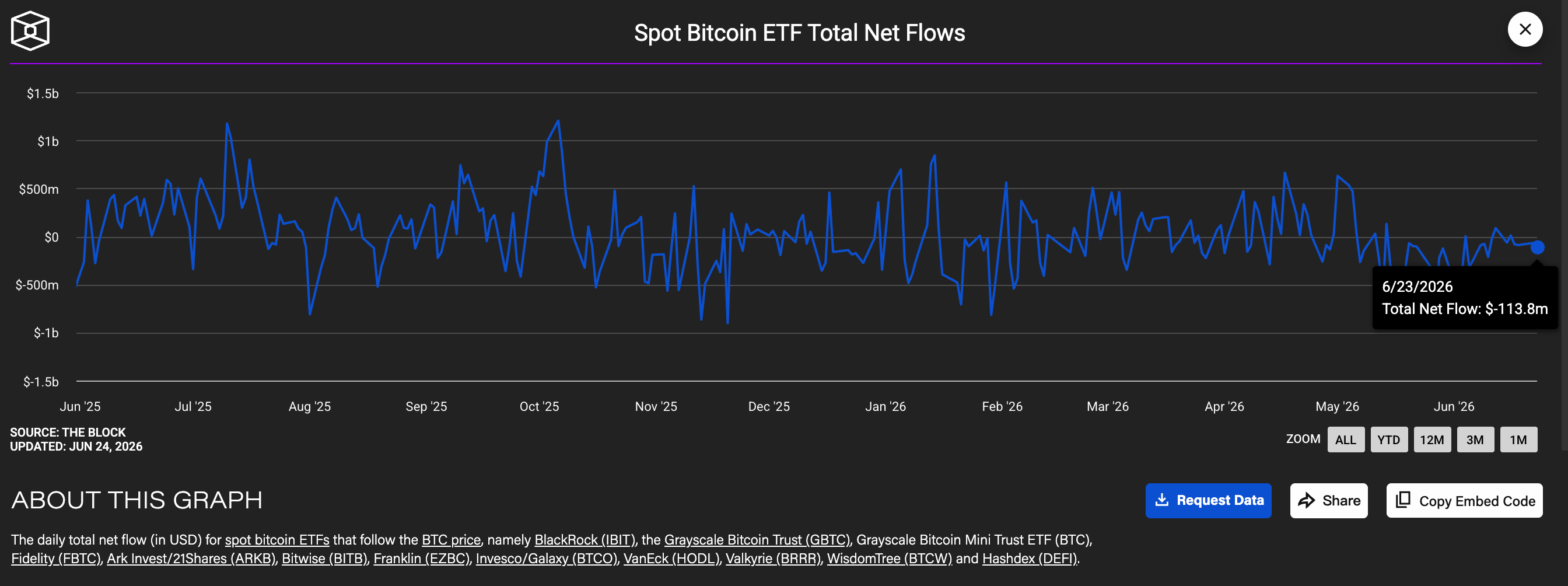
ETF Net Outflows, Source: The Block

The problem with ETFs is the cycle: when institutions redeem shares, authorized participants must directly sell the corresponding Bitcoin in the secondary market, creating sustained spot selling pressure. CoinShares has characterized the current situation as a "sentiment shock," suggesting it is not a structural collapse of the crypto market's fundamentals.

Reason 2: Fed Rate Hike Expectations Rekindled, Macro Pressure Surges

Macro factors have also exerted significant pressure on Bitcoin. The number of US job openings in April rose to 7.62 million, far exceeding market expectations and hitting the highest level in nearly two years, directly pushing the 10-year Treasury yield back above 4.45%.

Subsequently, Cleveland Fed President Beth Hammack publicly stated that if inflation remains persistently high, the Fed may need to restart rate hikes. Data from CME FedWatch shows the market's pricing probability of a rate hike before year-end has risen to over 50%.

Conversely, the strong 2025 bull run was built on the liquidity expectation of "Fed rate cuts." Once the rate cut expectation reverses and real interest rates rise, institutional capital tends to shift towards lower-risk assets like bonds and cash, making Bitcoin, as a high-risk asset, particularly vulnerable.

What Do Different Analysts Say?

  • 21Shares: In their latest "State of the Crypto Market" report, 21Shares points out that the trajectory of this decline closely aligns with historical post-halving correction cycles. Although they initially anticipated the potential end of Bitcoin's four-year cycle earlier this year, the current price action suggests the cycle persists. The firm maintains its year-end target of $100,000, believing the massive base of approximately $53 billion in cumulative ETF net inflows will form an effective bottom support.
  • Arthur Hayes: Holds a more pessimistic view, expecting Bitcoin to bottom at $40,000 within the next six months, with the core logic being the Fed's hawkish stance will continue to suppress market liquidity. Hayes stated he maintains long positions but has hedged downside risks using options.
  • CryptoQuant: Citing on-chain data, they point out that the average investor cost basis is currently around $53,000, and historically, bear market bottoms typically occur after the price falls below the "realized price." The institution believes this bear market may persist until late 2026 or even early 2027, with no clear signal yet of a sustained demand recovery.

In the short term, market focus will center on upcoming US inflation data and the Fed's next policy signals. If CPI data comes in lower than expected, it could provide Bitcoin a breathing window; if it confirms persistent inflation again, pressure for further declines will continue to build. Before the extreme panic sentiment dissipates and ETF fund flows show a clear inflection point, whether Bitcoin can hold the critical $60,000 defense line will likely determine the next phase of this bear market.


Trending Cryptos

Related Questions

QWhat key psychological support level did Bitcoin break through again recently, and what new low did it hit?

ABitcoin recently broke through the key psychological support level of $60,000 again, hitting a low of $59,023, which is a nearly 20-month low dating back to October 2024.

QAccording to the article, what are the two main reasons cited for Bitcoin's decline?

AThe two main reasons are: 1) US spot Bitcoin ETFs experiencing their longest streak of net outflows since launch, leading to institutional selling pressure. 2) A resurgence in market expectations for Federal Reserve interest rate hikes, increasing macro pressure and driving capital away from high-risk assets like Bitcoin.

QWhat is the primary mechanism by which ETF redemptions create selling pressure on Bitcoin's spot price?

AWhen institutions redeem ETF shares, the Authorized Participants (APs) are required to sell the corresponding Bitcoin directly in the secondary market, creating ongoing selling pressure on the spot price.

QWhat is the bullish year-end price target for Bitcoin maintained by 21Shares, and what is their reasoning for the potential support?

A21Shares maintains a bullish year-end price target of $100,000 for Bitcoin. They argue that the massive underlying holding of approximately $53 billion in cumulative net inflows into ETFs will provide effective bottom support.

QWhat is the more pessimistic price target proposed by Arthur Hayes for Bitcoin in the coming months, and what is the core logic behind his view?

AArthur Hayes predicts Bitcoin could bottom around $40,000 within the next six months. The core logic is that the Federal Reserve's hawkish stance will continue to suppress market liquidity, putting pressure on asset prices.

Related Reads

Deciphering the Ethereum Foundation's New Structure: Reaffirming Self-Sovereignty Amid Institutionalization Trends

Summary: The Ethereum Foundation (EF) has announced a major restructuring, laying off 20% of its staff and introducing a new five-layer operational framework. This move aims to clarify the EF's mission and reaffirm Ethereum's core principle of self-sovereignty amidst growing institutionalization in the crypto space. The five layers are: 1. **Protocol Layer**: Focuses on maintaining Ethereum's foundational "CROPS" values—Censorship-resistant, Robust, Open, Private, and Secure. This involves core technical work like secure hard forks and mitigating toxic MEV. 2. **Access Layer**: Ensures users can practically exercise self-sovereignty through actions like reading the chain and making transactions. A key principle is the "zero option," meaning a trusted, non-intermediated path must always exist as an alternative to any centralized service. 3. **User Layer**: Bridges the protocol and access layers by grounding EF's work in the real needs of users and organizations. This is seen as crucial for moving beyond a purely research-driven approach and ensuring development effectively serves the ecosystem. 4. **Community Layer**: Responsible for building and maintaining consensus around Ethereum's core values both internally and externally. This involves guarding against centralization, upholding technological neutrality, and preventing short-term commercial interests from undermining CROPS principles. 5. **Institutional Layer**: Manages EF's engagement with institutions, but with the precondition of self-sovereignty. The goal is not to make it easier for institutions to control users, but to demonstrate how Ethereum's technology can enable better integrations. The article argues that while institutional adoption brings legitimacy, it also risks diluting crypto's foundational ethos of decentralization. The new structure represents EF's effort to navigate this tension, upholding its core mission while actively engaging with a broader, more complex ecosystem.

marsbit12m ago

Deciphering the Ethereum Foundation's New Structure: Reaffirming Self-Sovereignty Amid Institutionalization Trends

marsbit12m ago

OpenRouter: How Did This 'AI Model Relay Station' Achieve a $10 Billion Valuation?

OpenRouter: The Model Router Building a $10B+ Company This article explores OpenRouter, a platform that aggregates access to over 400 AI models from 70+ providers (like OpenAI, Claude, Gemini) through a single API. It has grown into a unicorn with a $1.3B valuation by 2026, processing massive scale—reaching 100 trillion tokens monthly. Its core value isn't just being a "model supermarket." For developers building real-world AI applications, managing multiple models for different tasks (e.g., cheap models for titles, powerful ones for long articles) is complex. OpenRouter acts as a critical "model scheduling layer," handling routing, failover between providers, cost optimization, and enterprise features like zero-data-retention policies and budget controls. OpenRouter's business model is a "toll fee": it charges a small platform fee (5.5%) on purchased credits while passing model costs directly to users. Its revenue scales with the tokens flowing through its system, which saw explosive growth as AI apps evolved. Key growth drivers include: 1) The explosion of specialized models, increasing choice complexity; 2) AI apps shifting focus from performance to cost optimization; 3) The rise of AI agents that require more reliable, multi-step model calls. However, risks remain. Large enterprises or cloud providers (AWS, Google Cloud) could build similar internal gateways. Its position between model suppliers and developers could also create future tension over pricing and data control. To stay ahead, OpenRouter must deepen its enterprise features and prove it's more than just a request forwarder.

marsbit32m ago

OpenRouter: How Did This 'AI Model Relay Station' Achieve a $10 Billion Valuation?

marsbit32m ago

When Billions Begin to Operate Everything by Voice, How Far is ‘All Assets on Chain’?

In June 2026, WeChat began a limited rollout of "Xiaowei," its native AI assistant. This move is more than an upgrade to a smarter chatbot; it signals a crucial step from "universal internet access" toward the broader vision of "full asset tokenization." Xiaowei, powered primarily by WeChat's in-house WeLM model, demonstrates four key capabilities: 1) direct voice/web chat control of app functions, 2) automated access to mini-programs for services, 3) instant comprehension and summarization of complex documents like PDFs, and 4) generating functional mini-program prototypes from simple natural language requests. This represents a fundamental shift from GUI (Graphical User Interface) to LUI (Language User Interface), eliminating friction in human-digital interaction. The rollout is pivotal because it brings AI Agents to China's massive user base with zero friction—no new app downloads or accounts needed. This "seamless access" mirrors past platform revolutions like the App Store or WeChat Mini-Programs, potentially unlocking a global AI Agent market projected to grow from $7.92 billion in 2025 to nearly $295 billion by 2035. The article argues that China's internet evolution has moved from "connecting everyone" to "putting all services online." The next phase is "tokenizing all assets"—a concept broader than just Real World Assets (RWA) like real estate. It encompasses tokenizing personal assets like social influence, attention, and credit history. RWA tokenization itself is forecast to explode from $35 billion in 2025 to over $500 billion in 2026. The convergence of ubiquitous AI Agents and rapidly tokenizing assets points to a future paradigm for wealth management. Your AI Agent could autonomously manage a globally diversified, tokenized portfolio based on your preferences. Initiatives like EXIO Group's full-stack RWA services aim to lower investment barriers, paralleling WeChat's democratization of AI access. In conclusion, the launch of Xiaowei is not merely a technical upgrade but a historic inflection point. It marks AI Agents' transition from niche tools to essential utilities and accelerates the movement toward a future where voice commands seamlessly interact with tokenized value, redefining humanity's relationship with the digital and financial worlds.

marsbit2h ago

When Billions Begin to Operate Everything by Voice, How Far is ‘All Assets on Chain’?

marsbit2h ago

Trading

Spot
Futures

Hot Articles

What is $BITCOIN

DIGITAL GOLD ($BITCOIN): A Comprehensive Analysis Introduction to DIGITAL GOLD ($BITCOIN) DIGITAL GOLD ($BITCOIN) is a blockchain-based project operating on the Solana network, which aims to combine the characteristics of traditional precious metals with the innovation of decentralized technologies. While it shares a name with Bitcoin, often referred to as “digital gold” due to its perception as a store of value, DIGITAL GOLD is a separate token designed to create a unique ecosystem within the Web3 landscape. Its goal is to position itself as a viable alternative digital asset, although specifics regarding its applications and functionalities are still developing. What is DIGITAL GOLD ($BITCOIN)? DIGITAL GOLD ($BITCOIN) is a cryptocurrency token explicitly designed for use on the Solana blockchain. In contrast to Bitcoin, which provides a widely recognized value storage role, this token appears to focus on broader applications and characteristics. Notable aspects include: Blockchain Infrastructure: The token is built on the Solana blockchain, known for its capacity to handle high-speed and low-cost transactions. Supply Dynamics: DIGITAL GOLD has a maximum supply capped at 100 quadrillion tokens (100P $BITCOIN), although details regarding its circulating supply are currently undisclosed. Utility: While precise functionalities are not explicitly outlined, there are indications that the token could be utilized for various applications, potentially involving decentralized applications (dApps) or asset tokenization strategies. Who is the Creator of DIGITAL GOLD ($BITCOIN)? At present, the identity of the creators and development team behind DIGITAL GOLD ($BITCOIN) remains unknown. This situation is typical among many innovative projects within the blockchain space, particularly those aligning with decentralized finance and meme coin phenomena. While such anonymity may foster a community-driven culture, it intensifies concerns about governance and accountability. Who are the Investors of DIGITAL GOLD ($BITCOIN)? The available information indicates that DIGITAL GOLD ($BITCOIN) does not have any known institutional backers or prominent venture capital investments. The project seems to operate on a peer-to-peer model focused on community support and adoption rather than traditional funding routes. Its activity and liquidity are primarily situated on decentralized exchanges (DEXs), such as PumpSwap, rather than established centralized trading platforms, further highlighting its grassroots approach. How DIGITAL GOLD ($BITCOIN) Works The operational mechanics of DIGITAL GOLD ($BITCOIN) can be elaborated on based on its blockchain design and network attributes: Consensus Mechanism: By leveraging Solana’s unique proof-of-history (PoH) combined with a proof-of-stake (PoS) model, the project ensures efficient transaction validation contributing to the network's high performance. Tokenomics: While specific deflationary mechanisms have not been extensively detailed, the vast maximum token supply implies that it may cater to microtransactions or niche use cases that are still to be defined. Interoperability: There exists the potential for integration with Solana’s broader ecosystem, including various decentralized finance (DeFi) platforms. However, the details regarding specific integrations remain unspecified. Timeline of Key Events Here is a timeline that highlights significant milestones concerning DIGITAL GOLD ($BITCOIN): 2023: The initial deployment of the token occurs on the Solana blockchain, marked by its contract address. 2024: DIGITAL GOLD gains visibility as it becomes available for trading on decentralized exchanges like PumpSwap, allowing users to trade it against SOL. 2025: The project witnesses sporadic trading activity and potential interest in community-led engagements, although no noteworthy partnerships or technical advancements have been documented as of yet. Critical Analysis Strengths Scalability: The underlying Solana infrastructure supports high transaction volumes, which could enhance the utility of $BITCOIN in various transaction scenarios. Accessibility: The potential low trading price per token could attract retail investors, facilitating wider participation due to fractional ownership opportunities. Risks Lack of Transparency: The absence of publicly known backers, developers, or an audit process may yield skepticism regarding the project's sustainability and trustworthiness. Market Volatility: The trading activity is heavily reliant on speculative behavior, which can result in significant price volatility and uncertainty for investors. Conclusion DIGITAL GOLD ($BITCOIN) emerges as an intriguing yet ambiguous project within the rapidly evolving Solana ecosystem. While it attempts to leverage the “digital gold” narrative, its departure from Bitcoin's established role as a store of value underscores the need for a clearer differentiation of its intended utility and governance structure. Future acceptance and adoption will likely depend on addressing the current opacity and defining its operational and economic strategies more explicitly. Note: This report encompasses synthesised information available as of October 2023, and developments may have transpired beyond the research period.

446 Total ViewsPublished 2025.05.13Updated 2025.05.13

What is $BITCOIN

Discussions

Welcome to the HTX Community. Here, you can stay informed about the latest platform developments and gain access to professional market insights. Users' opinions on the price of BTC (BTC) are presented below.

活动图片