
Bitcoin Drops Below $60,000 Again; After 20 Months, What We've Waited For Is a New Low

marsbitPublished on 2026-06-25Last updated on 2026-06-25

Abstract

Bitcoin has once again fallen below the key $60,000 psychological support level, hitting a low of approximately $59,023—its lowest point in nearly 20 months since October 2024. The price has since partially recovered to around $60,600. This decline is driven by two main factors. First, U.S. spot Bitcoin ETFs have experienced a historic wave of net outflows, losing roughly $5.94 billion over 30 days. Sustained institutional redemptions create direct selling pressure in the spot market. Second, shifting macroeconomic expectations are adding pressure. Strong U.S. job data and hawkish signals from the Federal Reserve have increased market pricing for potential rate hikes, undermining the liquidity-driven bullish thesis for Bitcoin. Analyst views are mixed. 21Shares maintains a year-end target of $100,000, citing historical post-halving patterns and strong ETF accumulation. In contrast, Arthur Hayes predicts a potential drop to $40,000 within six months due to persistent Fed pressure. CryptoQuant notes that the average investor cost basis is around $53,000 and suggests the bear market could extend into 2026/2027 without clear signs of renewed demand. Market focus now turns to upcoming U.S. inflation data and Fed signals. Bitcoin's ability to hold the $60,000 level is seen as critical for determining the near-term market direction.

Author | jk

Bitcoin breached the key psychological support level of $60,000 again during trading today, briefly falling to $59,023, marking its lowest point since October 2024, a nearly 20-month low. As of this writing, BTC has slightly recovered from the low, trading around $60,600, with its 24-hour loss narrowing to about 3%, and down approximately 9% over the past seven days.

This latest decline marks the third time Bitcoin has fallen below the $60,000 mark this year. Unlike the previous two instances, this drop occurred against a backdrop of sustained institutional capital outflows and a sharp turn in macro policy expectations, systematically impacting market confidence.

What are the reasons?

Reason One: Spot ETFs Experience Longest-Ever Net Outflow Streak

U.S. Bitcoin spot ETFs have become the core driver of this decline. Since mid-May, ETFs have recorded net outflows for six consecutive weeks, with a cumulative loss of approximately $5.94 billion over 30 days, representing the largest wave of institutional withdrawals since their launch in January 2024.

Among them, BlackRock's IBIT saw a single-day net outflow of $528 million on May 28, setting a record high since its listing. The total assets under management for Bitcoin ETFs have shrunk from about $113 billion at the beginning of the year to approximately $77.5 billion, evaporating over 30%. Notably, according to The Block data, ETFs still recorded a single-day net outflow of about $113.8 million on June 23, indicating no substantial reversal in the institutional withdrawal trend yet. Whether institutional selling pressure will begin to ease hereafter will be a key observation window for the market.
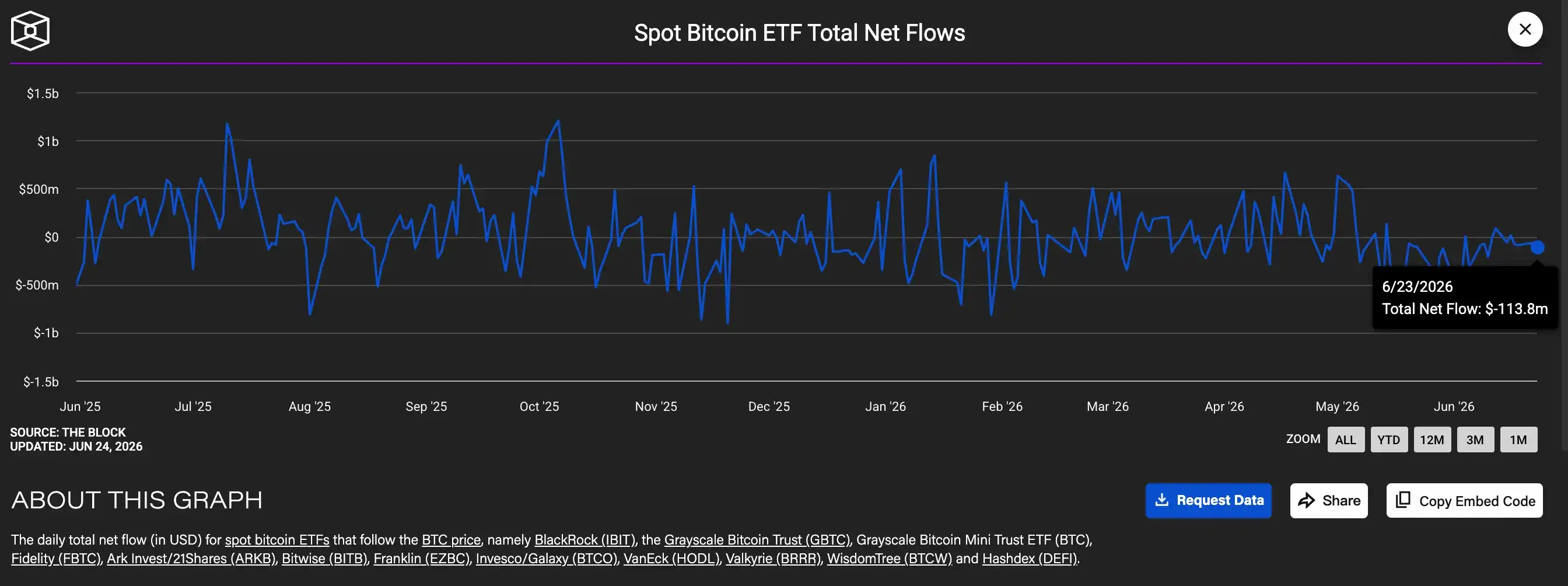
ETF Net Outflows, Source: The Block

The problem with ETFs is the cycle: when institutions redeem shares, authorized participants must sell the corresponding Bitcoin directly in the secondary market, creating sustained spot selling pressure. CoinShares characterizes the current situation as a "sentiment shock," arguing it is not a structural collapse of the crypto market fundamentals.

Reason Two: Fed Rate Hike Expectations Reignite, Macro Pressure Soars

The macro landscape has also created significant pressure on Bitcoin. U.S. job openings in April rose to 7.62 million, far exceeding market expectations and reaching the highest level in nearly two years, directly pushing the 10-year Treasury yield back above 4.45%.

Cleveland Fed President Beth Hammack subsequently stated publicly that if inflation persists, the Federal Reserve may need to restart rate hikes. CME FedWatch data shows the market's probability pricing for a rate hike before year-end has risen to over 50%.

Conversely, the robust bull market in 2025 was built on the liquidity expectation of "Fed rate cuts." Once the rate cut expectation reverses and real interest rates rise, institutional capital tends to shift towards lower-risk assets like bonds and cash, with Bitcoin as a high-risk asset bearing the brunt.

What Are Different Analysts' Views?

  • 21Shares: In its latest "State of Crypto" report, 21Shares notes that the trajectory of this decline closely aligns with historical post-halving correction cycles. Although it had earlier speculated that Bitcoin's four-year cycle might be ending, the current price action suggests the cycle remains intact. The firm maintains its expectation for a price recovery to $100,000 before year-end, believing the massive base of roughly $53 billion in cumulative net inflows into ETFs will provide solid bottom support.
  • Arthur Hayes: Holds a more pessimistic outlook, expecting Bitcoin to bottom around $40,000 within the next six months, with the core logic being the Fed's hawkish stance will continue to suppress market liquidity. Hayes states that while maintaining long positions, he has hedged downside risk with options.
  • CryptoQuant: Citing on-chain data, it points out that the current average investor cost basis is around $53,000, and historically bear market bottoms typically occur after the price falls below the "Realized Price." The institution believes this bear market may extend into late 2026 or even early 2027, with no clear signals yet of a sustained resurgence in demand.

In the short term, market focus will center on upcoming U.S. inflation data and the Fed's next policy signals. If CPI data falls below expectations, it could provide a breathing window for Bitcoin; if it confirms persistent inflation again, the pressure for further declines will continue to build. With extreme panic sentiment not yet dissipated and a clear turning point in ETF fund flows not yet in sight, whether Bitcoin can hold the $60,000 key support line may determine the next direction of this bear market.


Trending Cryptos

Related Questions

QWhat is the current price of Bitcoin and why did it drop significantly?

ABitcoin briefly dropped to a low of $59,023, hitting a near 20-month low since October 2024, before slightly recovering to around $60,600 at the time of publication. The primary reasons for the drop are a record-long period of net outflows from US spot Bitcoin ETFs and renewed expectations of potential interest rate hikes by the Federal Reserve, which put pressure on high-risk assets like Bitcoin.

QWhat has been the trend with US Bitcoin spot ETFs recently?

AUS Bitcoin spot ETFs have been experiencing net outflows for six consecutive weeks since mid-May. Over a 30-day period, they have lost approximately $5.94 billion, marking the largest wave of institutional withdrawals since their launch in January 2024. Notably, BlackRock's IBIT saw a single-day net outflow of $528 million on May 28, a record high.

QHow has the macroeconomic environment contributed to Bitcoin's decline?

AThe macroeconomic environment has turned less favorable. Strong US job vacancy data reignited concerns about persistent inflation, leading to increased expectations that the Federal Reserve might resume raising interest rates. Higher interest rates make safe-haven assets like bonds more attractive, diverting capital away from high-risk assets like Bitcoin.

QWhat are the different price predictions for Bitcoin from analysts mentioned in the article?

AAnalysts have differing views: 21Shares maintains a year-end target of $100,000, believing the ETF holdings provide a strong base. Arthur Hayes is more pessimistic, predicting a bottom of $40,000 within six months due to Fed pressure. CryptoQuant suggests the average investor cost basis is around $53,000 and that bear markets typically end when the price falls below this 'realized price', potentially extending into late 2026 or early 2027.

QWhat key factors will determine Bitcoin's short-term price movement according to the article?

AAccording to the article, Bitcoin's short-term movement depends on key upcoming events: the release of US inflation (CPI) data and the Federal Reserve's subsequent policy signals. Lower-than-expected inflation could provide relief, while high inflation could lead to further declines. Additionally, the market is watching for a clear reversal in the net outflow trend from Bitcoin ETFs.

Related Reads

Vitalik Updates Ethereum Roadmap: From Merge to 'Lean Refactoring', with STARK, AI, and Privacy Reshaping the Technical Foundation

Vitalik Buterin has updated Ethereum's long-term roadmap, outlining a major shift from the post-Merge evolution toward a "Lean Ethereum" vision. The update builds on the 2023 framework but reorders priorities and introduces new concepts. Key continuations include improving consensus (single-slot finality), scaling data availability (larger blobs), simplifying light client verification with SNARKs/STARKs, and protocol simplification. Major adjustments involve significantly prioritizing quantum resistance due to heightened perceived threats, while deprioritizing items like VDFs and some EVM improvements. Technical replacements are planned, such as moving from Verkle trees to a unified Binary Tree and eventually PBTs, and rethinking state management with "New State Types." Notable new additions are: 1. Making **privacy a top-tier priority**, aiming to build it natively into the protocol. 2. **Radical scaling under post-quantum conditions**, using techniques like leanSPHINCS signatures and zkzk frames. 3. **Protocol "Lean-ification" and formal verification**, leveraging modern AI tools to make full formal verification feasible. 4. Exploring **Blob and Gas futures** for future capacity. 5. Developing **Native Rollups**, deeply integrating rollup capabilities into the protocol. 6. **Reimagining the EVM's future**, potentially exposing a simpler, modern instruction set (e.g., leanISA or RISC-V), with EVM becoming a compatibility layer. The core philosophy shifts toward specializing mechanisms for high-load activities (transfers, swaps, privacy) to gain scalability, rather than attempting to infinitely scale all activities. It also elevates **recursive STARKs and AI-assisted formal verification** as foundational infrastructure. In summary, Ethereum is embarking on a systemic "third-generation" redesign—Lean Ethereum—involving replacements or rewrites of major components. The goal is to achieve a quantum-safe, privacy-first, secure, decentralized, and highly scalable network while maintaining a lean and verifiable protocol.

marsbit15m ago

Vitalik Updates Ethereum Roadmap: From Merge to 'Lean Refactoring', with STARK, AI, and Privacy Reshaping the Technical Foundation

marsbit15m ago

China Monopolizes the Humanoid Market: The U.S. Is Forced to Defend Itself

China's Humanoid Robot Market Domination and US Response According to a report by Smart Analytics Global (SAG), Chinese manufacturers supplied over 97% of the global humanoid robot shipments (approximately 19,100 units) in the first half of 2026, a 272% year-on-year increase. Shanghai-based AGIBOT led with a 44% market share, followed by Unitree Robotics with 31%. Together, these two firms accounted for about 75% of global shipments. China itself represented over 85% of global demand for these devices, with industrial and commercial applications now comprising more than 70% of shipments. Key factors driving China's leadership include strong state support, abundant funding, expanding production capacity, IPO waves for developers, and a vast manufacturing ecosystem for rapid testing and deployment. Furthermore, over 90% of key components for humanoid robots are now sourced domestically. In response, the US Federal Communications Commission (FCC) banned federal agencies and subsidy recipients from purchasing or using foreign "advanced robotic devices," including humanoid and quadruped robots, citing national security concerns in July 2026. SAG forecasts global shipments to approach 60,000 units for full-year 2026, with industry revenue around $1.6 billion, projecting 500,000 units by 2030. The analysis notes potential challenges for Chinese expansion, such as reputational risks from alleged ties to China's defense sector and the precedent of trade disputes seen in solar panels and batteries, potentially triggered by the current low average robot price.

cryptonews.ru34m ago

China Monopolizes the Humanoid Market: The U.S. Is Forced to Defend Itself

cryptonews.ru34m ago

What's New in Ethereum's Roadmap: Privacy, Quantum Security, Native Rollup?

On August 10, 2024, Ethereum co-founder Vitalik Buterin revealed an updated technical roadmap, highlighting significant changes in priorities and new focus areas. Key new additions include: - **Strong Privacy Protection**: Elevated to a top-tier protocol concern. Proposals like EIP-8250 (keyed nonces for concurrency), EIP-8272 (recent roots for verification), and EIP-8182 (shared protocol-level privacy pools) aim to enable private transfers of ETH and ERC-20s, moving toward default private accounts. - **Quantum Resilience**: Priority increased. The plan addresses risks to ECDSA/BLS signatures, KZG commitments, and ZK systems, exploring solutions like leanSPHINCS signatures, STARK proofs (considered quantum-resistant), and streamlined verification processes. A full L1 upgrade is tentatively targeted for ~2029. - **Native Rollups**: A novel concept where rollups could reuse Ethereum's core validation infrastructure via a new EXECUTE precompile (EIP-8079 draft). This aims to reduce custom code and enhance security for certain L2s, while specialized chains will continue to exist. - **Protocol Simplification & Formal Verification**: Leveraging AI tools to make full-protocol formal verification feasible, aiming for more rigorous and machine-verifiable specifications. Other notable shifts: - State storage is evolving from Verkle trees to a Partitioned Binary Tree (PBT, EIP-8347 draft). - Some 2023 items like VDFs and certain EVM improvements were deprioritized. - Long-term discussions include blob/gas futures and non-EVM instruction sets (e.g., RISC-V). The "Strawmap" outlines potential upgrades through ~2029 but is a directional guide, not a firm timeline. Key milestones to watch include the Glamsterdam (Q4 2026) and Hegotá (2027) forks. Many proposals remain in draft or research phases.

marsbit55m ago

What's New in Ethereum's Roadmap: Privacy, Quantum Security, Native Rollup?

marsbit55m ago

Hyperliquid Trading Volume Soars, So Why Are Profits Falling?

Hyperliquid, a leading decentralized perpetuals trading platform, has seen its open interest surge to a record high above $11 billion, capturing roughly 9% of the global market share. Trading volume remains robust, nearing $178 billion over 30 days, driven largely by the explosive growth of third-party markets offering tokenized real-world assets (RWAs) like stocks and commodities. Despite this growth, the platform's protocol revenue has declined for four consecutive quarters, falling 43% from its Q3 2025 peak of $357 million to approximately $202 million in Q2 2026. This divergence is primarily attributed to the HIP-3 governance proposal, which allows external developers to launch their own markets and keep up to half of the generated fees. These third-party markets now account for nearly 50% of total volume. Consequently, the share of revenue redistributed to developers, market makers, and the treasury has tripled from 6% to 18% in a year. This directly reduces the funds allocated to the platform's buyback-and-burn mechanism for its native HYPE token, weakening a key price support. HYPE's price has fallen 28% from its all-time high. The platform's growth is also heavily concentrated, with a single entity, Trade.xyz, responsible for over 90% of HIP-3 open interest, introducing systemic risk. Additionally, the ecosystem lacks diversity beyond HYPE, faces ongoing token unlocks adding sell pressure, and is encountering increased regulatory scrutiny and new competition from platforms like Robinhood Chain. While still a major revenue generator in crypto, Hyperliquid's model of sharing fees to fuel expansion is currently compressing its own earnings and token economics.

marsbit55m ago

Hyperliquid Trading Volume Soars, So Why Are Profits Falling?

marsbit55m ago

Trading

Spot

Hot Articles

What is $BITCOIN

DIGITAL GOLD ($BITCOIN): A Comprehensive Analysis Introduction to DIGITAL GOLD ($BITCOIN) DIGITAL GOLD ($BITCOIN) is a blockchain-based project operating on the Solana network, which aims to combine the characteristics of traditional precious metals with the innovation of decentralized technologies. While it shares a name with Bitcoin, often referred to as “digital gold” due to its perception as a store of value, DIGITAL GOLD is a separate token designed to create a unique ecosystem within the Web3 landscape. Its goal is to position itself as a viable alternative digital asset, although specifics regarding its applications and functionalities are still developing. What is DIGITAL GOLD ($BITCOIN)? DIGITAL GOLD ($BITCOIN) is a cryptocurrency token explicitly designed for use on the Solana blockchain. In contrast to Bitcoin, which provides a widely recognized value storage role, this token appears to focus on broader applications and characteristics. Notable aspects include: Blockchain Infrastructure: The token is built on the Solana blockchain, known for its capacity to handle high-speed and low-cost transactions. Supply Dynamics: DIGITAL GOLD has a maximum supply capped at 100 quadrillion tokens (100P $BITCOIN), although details regarding its circulating supply are currently undisclosed. Utility: While precise functionalities are not explicitly outlined, there are indications that the token could be utilized for various applications, potentially involving decentralized applications (dApps) or asset tokenization strategies. Who is the Creator of DIGITAL GOLD ($BITCOIN)? At present, the identity of the creators and development team behind DIGITAL GOLD ($BITCOIN) remains unknown. This situation is typical among many innovative projects within the blockchain space, particularly those aligning with decentralized finance and meme coin phenomena. While such anonymity may foster a community-driven culture, it intensifies concerns about governance and accountability. Who are the Investors of DIGITAL GOLD ($BITCOIN)? The available information indicates that DIGITAL GOLD ($BITCOIN) does not have any known institutional backers or prominent venture capital investments. The project seems to operate on a peer-to-peer model focused on community support and adoption rather than traditional funding routes. Its activity and liquidity are primarily situated on decentralized exchanges (DEXs), such as PumpSwap, rather than established centralized trading platforms, further highlighting its grassroots approach. How DIGITAL GOLD ($BITCOIN) Works The operational mechanics of DIGITAL GOLD ($BITCOIN) can be elaborated on based on its blockchain design and network attributes: Consensus Mechanism: By leveraging Solana’s unique proof-of-history (PoH) combined with a proof-of-stake (PoS) model, the project ensures efficient transaction validation contributing to the network's high performance. Tokenomics: While specific deflationary mechanisms have not been extensively detailed, the vast maximum token supply implies that it may cater to microtransactions or niche use cases that are still to be defined. Interoperability: There exists the potential for integration with Solana’s broader ecosystem, including various decentralized finance (DeFi) platforms. However, the details regarding specific integrations remain unspecified. Timeline of Key Events Here is a timeline that highlights significant milestones concerning DIGITAL GOLD ($BITCOIN): 2023: The initial deployment of the token occurs on the Solana blockchain, marked by its contract address. 2024: DIGITAL GOLD gains visibility as it becomes available for trading on decentralized exchanges like PumpSwap, allowing users to trade it against SOL. 2025: The project witnesses sporadic trading activity and potential interest in community-led engagements, although no noteworthy partnerships or technical advancements have been documented as of yet. Critical Analysis Strengths Scalability: The underlying Solana infrastructure supports high transaction volumes, which could enhance the utility of $BITCOIN in various transaction scenarios. Accessibility: The potential low trading price per token could attract retail investors, facilitating wider participation due to fractional ownership opportunities. Risks Lack of Transparency: The absence of publicly known backers, developers, or an audit process may yield skepticism regarding the project's sustainability and trustworthiness. Market Volatility: The trading activity is heavily reliant on speculative behavior, which can result in significant price volatility and uncertainty for investors. Conclusion DIGITAL GOLD ($BITCOIN) emerges as an intriguing yet ambiguous project within the rapidly evolving Solana ecosystem. While it attempts to leverage the “digital gold” narrative, its departure from Bitcoin's established role as a store of value underscores the need for a clearer differentiation of its intended utility and governance structure. Future acceptance and adoption will likely depend on addressing the current opacity and defining its operational and economic strategies more explicitly. Note: This report encompasses synthesised information available as of October 2023, and developments may have transpired beyond the research period.

1.7k Total ViewsPublished 2025.05.13Updated 2025.05.13

What is $BITCOIN

Discussions

Welcome to the HTX Community. Here, you can stay informed about the latest platform developments and gain access to professional market insights. Users' opinions on the price of BTC (BTC) are presented below.

活动图片