Vivek Ramaswamy's Strive to raise $500M to buy Bitcoin

cointelegraphPublished on 2025-12-10Last updated on 2025-12-10

Abstract

Strive Asset Management, co-founded by Vivek Ramaswamy, has announced a $500 million stock sales program to raise funds for purchasing Bitcoin and Bitcoin-related products. The firm, currently the 14th largest corporate holder of Bitcoin with 7,525 BTC worth approximately $694 million, intends to use the proceeds for general corporate purposes, including expanding its BTC treasury and acquiring income-generating assets. This strategy mirrors the approach pioneered by Michael Saylor’s MicroStrategy. Following the announcement, Strive’s shares (ASST) rose 3.6% to $1.02, more than doubling since the start of the year. The company also recently urged index provider MSCI to reconsider excluding Bitcoin-heavy firms from passive investment products.

Publicly traded asset manager and Bitcoin treasury company Strive has announced a $500 million stock sales program to raise funds for additional BTC purchases.

The firm, which was co-founded in 2022 by American entrepreneur and politician Vivek Ramaswamy, stated on Tuesday that it intends to use the net proceeds from the sale for “general corporate purposes, including, among other things, the acquisition of Bitcoin and Bitcoin-related products and for working capital.”

It also intends to purchase “income-generating assets” to grow the company’s business, but did not specify which.

The move represents another significant public company using capital markets to accumulate Bitcoin (BTC), a strategy pioneered by Michael Saylor’s Strategy.

Strive is the 14th largest holder of Bitcoin

Strive is the fourteenth-largest corporate holder of Bitcoin, with 7,525 BTC worth approximately $694 million at current market prices.

The firm announced its pivot to a Bitcoin treasury through a public reverse merger in May. In September, Strive agreed to acquire Semler Scientific in a move that positioned the combined entity as one of the largest corporate holders of BTC.

Related: Strive calls on MSCI to rethink its ‘unworkable’ Bitcoin blacklist

Since launching its first exchange-traded fund in August 2022, Strive Asset Management has grown to manage over $2 billion in assets.

Strive shares (ASST) gained 3.6% on Tuesday to end the day trading at $1.02, according to Google Finance. Its stock has more than doubled since the beginning of the year.
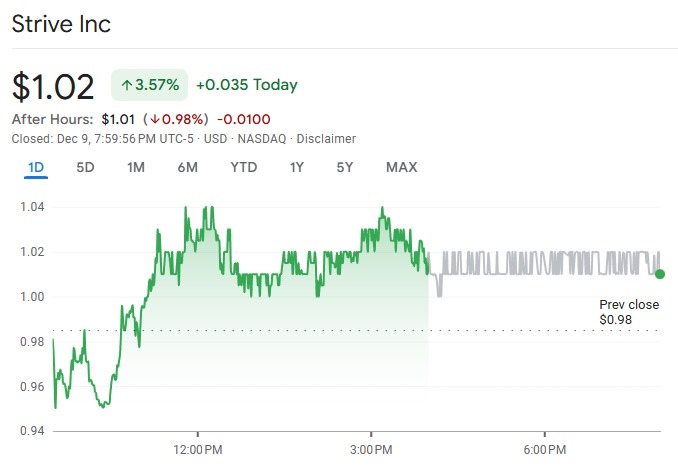
Strive shares gain following the announcement. Source: Google News

Stive urges MSCI to include Bitcoin treasuries

Earlier this month, Strive CEO Matt Cole urged stock market index MSCI to “let the market decide” whether they want to include Bitcoin-holding companies in their passive investments.

The move follows MSCI consultations with the investment community about whether to exclude Bitcoin and other digital asset treasury companies (DATs) that have a balance sheet with more than 50% crypto assets.

Magazine: XRP’s ‘now or never’ moment, Kalshi taps Solana: Hodler’s Digest

Related Reads

When Hyperliquid Takes Away Solana's "Internet Capital Markets" Script

The article discusses how Solana's vision of becoming the "Internet Capital Markets" is being challenged, primarily by the rise of Hyperliquid. While Solana positioned itself as a high-performance blockchain for tokenizing all global assets, its native token SOL has significantly underperformed, and its core narrative faces pressure. Hyperliquid, initially a perpetual contracts platform, has evolved into a specialized Layer 1 financial network. Its focused, trading-optimized design is attracting users and capital, suggesting a vertical L1 may be better suited for a core capital market than a general-purpose chain like Solana. This external competition was compounded by an internal $200M+ exploit on Solana's key derivatives protocol, Drift, creating a strategic vacuum. In response, Solana founder Anatoly Yakovenko heavily promoted the Phoenix protocol as a decentralized, composable alternative. However, Phoenix's trading volume remains far behind leading platforms. Solana supporters also launched critiques against Hyperliquid's decentralization, citing its limited validators and closed-source code. Critics countered that Solana's own decentralization metrics have weakened, and the foundation's overt backing of Phoenix caused friction with other ecosystem builders. The piece concludes that Solana risks losing the "Internet Capital Markets" race if it cannot regain dominance in derivatives, potentially remaining a meme coin hub rather than achieving its grand ambition of hosting all global assets.

marsbit1h ago

When Hyperliquid Takes Away Solana's "Internet Capital Markets" Script

marsbit1h ago

Trump Signs Executive Order, Kraken, Coinbase and Others May Gain Access to Fed Payment Channels

President Trump has signed an executive order, "Incorporating Financial Technology Innovation into the Regulatory Framework," pressuring the Federal Reserve to reassess its rules on granting non-bank financial companies—including crypto and fintech firms—access to its payment systems, specifically master accounts that connect to the Fedwire settlement system. Currently, such accounts are primarily reserved for depository institutions. The order mandates a review to determine if broader access is permissible and to establish an application process. This move, supported by figures like Senator Cynthia Lummis, aims to reduce barriers to innovation and lower public payment costs by fostering fairer competition. It does not grant immediate access but could pave the way for companies like Kraken, Coinbase, Ripple, and Circle to reduce reliance on intermediary banks, lowering costs and speeding up settlements. A key precedent is the Kansas City Fed granting Kraken's parent company a restricted master account in March, offering limited payment services without interest or credit privileges. This model is seen as a potential template for allowing controlled access while mitigating systemic risk. Other firms like Anchorage, Paxos, and BitGo, which hold specialized banking charters, are also well-positioned to apply. The banking industry, represented by the American Bankers Association, opposes easing access, arguing any institution handling bank-like payments must meet the same stringent regulatory, consumer protection, and risk-management standards as traditional banks. Their core concerns include potential systemic risks, compliance gaps in areas like anti-money laundering, and the diversion of liquidity from the traditional banking system. The outcome of the Fed's review will be crucial in determining whether and how crypto and fintech firms can integrate more directly into the core U.S. financial infrastructure, balancing innovation with financial stability.

marsbit1h ago

Trump Signs Executive Order, Kraken, Coinbase and Others May Gain Access to Fed Payment Channels

marsbit1h ago

The First Large-Scale Strike in the AI Era Comes from the Factories That Build AI

The article describes a potential large-scale strike at Samsung Electronics, narrowly averted in May 2026 after a temporary agreement. The strike, planned by the company's union, would have been the first major labor action in the AI era targeting a core AI supply chain player. Samsung, alongside SK Hynix, produces roughly two-thirds of the world's memory chips, critical components for AI training and data centers like HBM. An 18-day strike could have disrupted global supply, affecting prices and production for tech companies and cloud providers. For South Korea, where semiconductors constitute about 35% of exports and Samsung represents a quarter of the stock market's value, such an action threatens national economic stability. The union's demands include a 7% base wage increase and, crucially, a clear, substantial profit-sharing model. They want 15% of annual operating profit as an employee bonus pool and the removal of the existing cap (about 50% of annual salary). This frustration is amplified by seeing rival SK Hynix successfully negotiate a deal granting employees 10% of operating profit as bonuses, with reports suggesting some workers could receive bonuses equivalent to hundreds of thousands of dollars. The conflict stems from deeper issues in South Korea's chaebol (conglomerate) system, where rapid national industrialization often prioritized corporate growth over labor rights. Samsung long maintained a "no union" policy until a 2020 apology from its leader. The article argues this strike highlights a fundamental tension in the AI age: as technology advances and corporate profits soar—often driven by AI—the workers who build the infrastructure are demanding a fair share and dignity, rejecting the notion that they are mere expendable components in a machine that "must not stop." The piece concludes that the true test of the AI era isn't just computational power, but whether the people who build the future can secure a stable and valued place within it.

marsbit2h ago

The First Large-Scale Strike in the AI Era Comes from the Factories That Build AI

marsbit2h ago

Ripple’s Fed Master Account Bid Gains Momentum After Trump Order

President Donald Trump has signed an executive order directing financial regulators and the Federal Reserve to review expanding fintech and crypto firms' access to core payment infrastructure. This order significantly advances the industry's push for direct Fed connectivity, a central issue for Ripple. The company has been seeking a Federal Reserve master account as part of its strategy for its RLUSD stablecoin, which would allow it to hold reserves directly with the central bank and access its payment rails. The order, titled "Integrating Financial Technology Innovation into Regulatory Frameworks," mandates a Fed review within 120 days on allowing access for entities like uninsured depository institutions and non-bank financial companies, including those in digital assets. This creates a formal policy timeline for resolving whether crypto payment firms must rely on traditional bank intermediaries. Ripple's application for a national bank charter and a master account is part of this broader landscape. The issue gained precedent when Kraken Financial received a limited-purpose master account, while Custodia Bank's application was denied after a legal battle. The Fed has also proposed a more restricted "payment account" option. Trump's order does not guarantee approval for Ripple but forces a high-level examination of the regulatory barriers, bringing the company's long-running effort to the forefront of Washington's financial policy agenda.

bitcoinist2h ago

Ripple’s Fed Master Account Bid Gains Momentum After Trump Order

bitcoinist2h ago

Trading

Spot
Futures

Hot Articles

Discussions

Welcome to the HTX Community. Here, you can stay informed about the latest platform developments and gain access to professional market insights. Users' opinions on the price of S (S) are presented below.

活动图片