‘No Time To Experiment’: Russia To Establish Strict Crypto Regulations In 2026

bitcoinistPublished on 2025-12-12Last updated on 2025-12-12

Vladimir Chistyukhin, First Deputy Chairman of the Central Bank of Russia (CBR), has shared crucial details of Russia’s upcoming crypto regulations. The framework is expected to amend key laws related to digital financial assets and the securities market, while potentially prohibiting new digital asset purchases for most investors.

New Crypto Framework Could Ban New Purchases

On Thursday, Vladimir Chistyukhin told Russian news media outlet RIA Novosti that the Central Bank of Russia, the Ministry of Finance, Rosfinmonitoring, and other federal agencies have been discussing proposals to regulate the crypto market.

The executive affirmed that the new framework will provide rules on how and through whom crypto transactions will be carried out. He detailed that these will likely be executed only by existing market participants under existing licenses.

As reported by Bitcoinist, CBR’s First Deputy Chairman previously announced that local banks would be allowed to engage in limited crypto operations under strict regulatory conditions.

Nonetheless, the executive has noted that they will need to consider whether exchanges should be included in a separate category that enables them to be eligible for a new license.

In the case of investors, he informed that they are stepping away from their initial Experimental Legal Regime (EPR), introduced at the start of the year. The EPR proposed allowing only “highly qualified investors” to transact directly with digital assets.

Currently, cryptocurrencies are used not only as an investment but also as a means of cross-border payments. This is a very important point that cannot be ignored. Of course, we want to protect Russian retail investors as much as possible from transactions with such a risky asset. On the other hand, we understand that in the current circumstances, in some cases, international payments can only be made using cryptocurrencies. Therefore, the discussion continues.

Now, they are looking to allow qualified investors into the market after passing certain tests, although discussions are not final. There are only about one million qualified investors in Russia, Chistyukhin added, which could place millions of retail investors in the country in a “gray” zone.

Unqualified investors who already acquired cryptocurrencies “will be able to either keep them, sell them, or exchange them for some fiat currency or other assets. There are no restrictions on exiting crypto assets – neither in terms of time nor volume. Only new purchase transactions will be restricted,” he stated.

Russia To Adopt Regulations ‘As Quickly As Possible’

Chistyukhin affirmed that the Russian financial market has “all the necessary infrastructure to work with cryptocurrencies.” Although it will be “essential to amend the laws on digital financial assets, the securities market, and banking legislation.”

Chistyukhin explained that the authorities believe it is “fundamentally important” to legitimize the crypto sector and ensure that it is compliant with the law. To achieve this, regulators are considering establishing strict restrictions and prohibitions. “Anything that falls outside this framework will be considered illegal activity.”

Discussing why the financial authorities decided not to experiment with and test crypto rules, he noted that the country needs to adopt regulations quickly due to “international attention” and “scrutiny.”

The issue of cryptocurrency regulation is attracting serious international attention, primarily from the FATF. (...) We need to adopt regulations as quickly as possible. (...) We simply do not have the time to experiment first and then spend several years analyzing it and launching something permanent.

Therefore, the executive revealed that the legislation could be passed during the spring of 2026 and be enacted before the end of next year. However, Russian watchdogs are preparing transitional periods to give market participants time to move out of the regulatory “gray” zone and into the new legal framework. Liability for illegal operations is expected to come into effect in mid-2027.
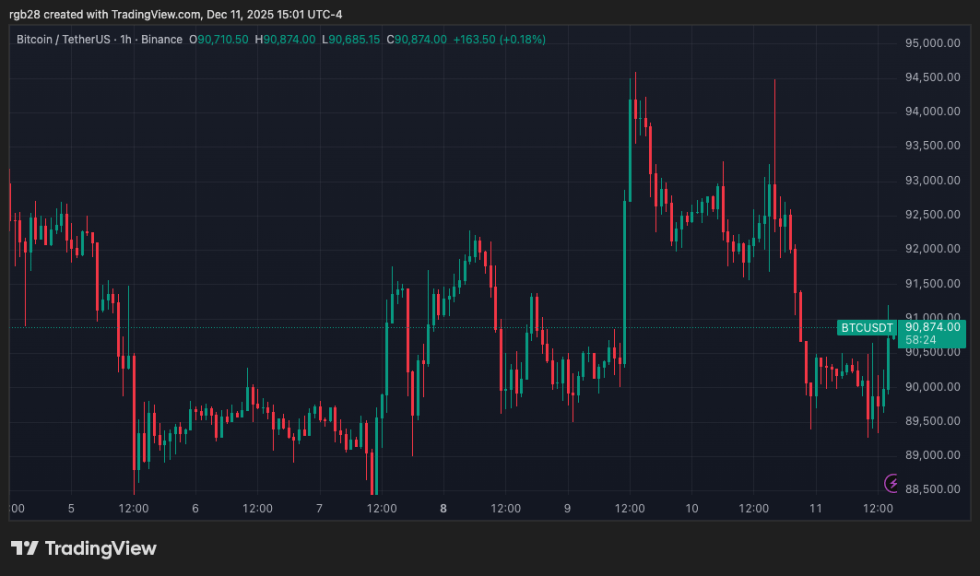
Bitcoin (BTC) trades at $90,874 in the one-week chart. Source: BTCUSDT on TradingView

Related Reads

IOSG Founder: Web3 Is 'Losing Blood,' How Can Practitioners Survive Better?

IOSG Founder: Web3 Is "Bleeding Out" – How Can Practitioners Survive Better? In a candid reflection, the founder of IOSG Ventures voices deep concerns about the current state of Web3, describing an ecosystem experiencing severe "blood loss." Despite the recent MuShanghai event showcasing a successful pivot towards a more diverse, global community, a somber reality persists: many crypto-native attendees were there exploring exits or new labels in biotech, AI, and robotics. The core issue is identified as a breakdown in the ecosystem's positive feedback loop. Alarmingly, underestimated "low-probability bad events" are occurring simultaneously: a significant brain drain of Chinese developers to AI, a lack of breakout applications despite massive funding, and a widening credibility gap for practitioners globally, often stigmatized as scam artists. This has created a dire接班人 (successor) problem, with the next generation seeing little professional prestige or financial upside in crypto compared to fields like AI. A significant portion of the critique focuses on Ethereum and Vitalik Buterin. While not pessimistic about Ethereum's technology, the founder worries that critical development windows were missed by focusing on niche technical narratives like ZK and L2 instead of mass-market applications. A more urgent concern is that Vitalik may be isolated in an "information bubble," shielded from the grassroots community's hardships by layers of intermediaries, preventing crucial feedback from reaching him. The call is for Vitalik to return to a founder's mindset, re-engage directly with the community, and rally efforts for the next decade. The divergence between U.S. and Chinese OG (Original Gangster) ecosystems is stark. While many U.S. builders reinvest their wealth into the ecosystem, the Chinese scene suffers from a severe lack of "造血能力" (blood-making ability), with most market-driven funds struggling and many early success stories cashing out entirely. This threatens the entire Asian Web3 ecosystem's survival. For individual practitioners, survival advice is pragmatic: find your core "why," maintain life balance beyond token prices, continuously learn new skills (like AI), form small, trusted alliances for mutual support, and practice self-compassion. The industry's greatest need is not money or tech, but lighthouses—individuals at all levels who offer mentorship, grants, referrals, and honest reflection to guide others. The piece concludes with a direct appeal: OGs must pay forward the opportunities the industry gave them; founders must not struggle alone; and builders must continue their work, ensuring it remains a viable profession. The survival of Web3's "cathedral" depends not on any single leader but on the collective responsibility of everyone who remains.

marsbit20m ago

IOSG Founder: Web3 Is 'Losing Blood,' How Can Practitioners Survive Better?

marsbit20m ago

Deficits, Inflation, and the New Fed: The Deep Logic Behind US Bond Yields Breaking 5% and the Market Reset

In the week of May 15-19, 2026, U.S. long-term Treasury yields surged to multi-year highs, with the 30-year yield hitting 5.2%, a level unseen since 2007, and the 10-year yield climbing to 4.687%. Equity markets declined in response. Four primary factors are driving the rise in yields. First, stubborn inflation persists, with April wholesale prices rising 6% year-over-year, fueling expectations of potential future Fed rate hikes instead of cuts. Second, newly confirmed Fed Chair Kevin Warsh inherits a complex inflation battle, with markets closely awaiting his first FOMC meeting. Third, deteriorating U.S. fiscal health, marked by large deficits and rising debt servicing costs, is eroding the traditional "safe-haven" premium for Treasuries. Fourth, the "One Big Beautiful Bill" tax cuts are projected to add trillions to the national debt, contributing to Moody's recent credit rating downgrade. Rising yields pressure stocks through several channels: a higher discount rate reduces the present value of future earnings (especially for growth stocks); rising risk-free rates compress equity risk premiums, making bonds relatively more attractive; higher borrowing costs impact consumers and corporations; and a stronger dollar affects multinational earnings. For investors, the environment favors value and financial stocks over long-duration growth stocks. Bond investors find attractive yields in short to intermediate maturities, while income investors see the best fixed-income opportunities in over a decade. Key developments to watch include Chair Warsh's first FOMC meeting, upcoming inflation data, Treasury auction demand, and whether the 30-year yield approaches 6%, a level that could trigger a more sustained equity valuation reset. The bond market's message is clear: the era of cheap government borrowing is over, posing a central challenge for markets in late 2026.

marsbit22m ago

Deficits, Inflation, and the New Fed: The Deep Logic Behind US Bond Yields Breaking 5% and the Market Reset

marsbit22m ago

Is MicroStrategy Selling Bitcoin Not a Bearish Signal? Deconstructing the 5 Financial Logics Behind Corporate Bitcoin Divestment

The article "Is Strategy Selling Bitcoin Not a Bearish Signal? Decoding 5 Financial Logics Behind Corporate Bitcoin Divestment" analyzes why companies might sell their bitcoin holdings, arguing it's not necessarily negative. It begins by noting the market's surprise at Strategy's potential sale, contrasting its previous "never sell" stance. The core argument is that corporate decisions prioritize shareholder value, and selling bitcoin can be a rational strategic choice. The article outlines five key financial reasons for such sales: 1. **Increase Bitcoin Holdings Per Share:** Companies can use proceeds from bitcoin sales to repurchase shares when the stock price is undervalued relative to its bitcoin assets. This reduces the outstanding share count, potentially increasing the bitcoin amount backing each remaining share. 2. **Optimize Capital Structure & Reduce Financing Costs:** Building cash reserves through bitcoin sales can improve credit ratings (as favored by agencies like S&P), leading to lower future borrowing costs. Repaying debt with sale proceeds also reduces financial leverage. 3. **Legitimate Tax Planning:** In the absence of wash-sale rules for bitcoin in the US, companies can sell to realize capital losses, then repurchase, lowering the tax basis of their holdings and creating tax offsets. 4. **Counter Negative Market Narratives:** A controlled, non-disruptive sale could demonstrate market resilience and disprove fears that corporate selling would crash the market, thereby normalizing bitcoin as a corporate treasury asset. 5. **Repurchase Preferred Stock at a Discount:** If a company's preferred stock trades significantly below its face value, using bitcoin sale proceeds to repurchase it can retire expensive liabilities at a profit, saving on future dividend payments. The conclusion emphasizes that bitcoin's monetary properties offer flexibility. Strategic sales can protect corporate and shareholder interests, making asset utilization more important than rigid "hold" mandates.

marsbit51m ago

Is MicroStrategy Selling Bitcoin Not a Bearish Signal? Deconstructing the 5 Financial Logics Behind Corporate Bitcoin Divestment

marsbit51m ago

Why Did Zhipu Surge Nearly 30% in a Single Day?

"Global AI Model Unicorn" Zhipu's stock surged nearly 30% in a single day, reaching a new market cap high. The catalyst was the launch of its GLM-5.1-highspeed API, boasting a generation speed of **400 tokens per second**, setting a new global benchmark. This speed, roughly 3-5 times faster than industry leaders like OpenAI's GPT-4o and Anthropic's Claude, is achieved **without compromising the full-scale model's capabilities**. In the era of AI Agents requiring dozens of self-calls, such latency reduction is critical, transforming speed from a system metric into a determinant of intelligence limits. The breakthrough stems from a three-layer technical overhaul: 1. **TileRT Inference Engine**: Compiles the entire model into a continuous, always-on computation pipeline using "Warp Specialization," minimizing GPU idle time by having different processor groups handle data loading, computation, and communication in parallel. 2. **Heterogeneous Parallelism for MLA**: To efficiently run the GLM-5.1 model using the MLA attention mechanism, TileRT employs a heterogeneous strategy. One GPU handles sparse indexing/routing, while the others perform dense computation, optimizing for MLA's unique workflow. 3. **ZCube Network Architecture**: Replaces the standard Spine-Leaf (ROFT) network topology with a flat, dual-group interconnect. This design creates a single optimal path between any two GPUs, eliminating network congestion at scale and reducing latency. The business impact is significant: a 15% increase in cluster throughput (free extra capacity), a 40.6% reduction in tail latency (improved stability), and a one-third cut in networking hardware costs. Long-term, this innovation challenges the dominance of NVIDIA's integrated hardware-software stack (GPU+NVLink+InfiniBand), potentially benefiting manufacturers of high-density Leaf switches and optical modules while lowering the software barrier for domestic AI chips like Huawei's Ascend. The innovation proves that more can be achieved with the same compute, reshaping the infrastructure beyond just GPUs.

marsbit2h ago

Why Did Zhipu Surge Nearly 30% in a Single Day?

marsbit2h ago

Trading

Spot
Futures

Hot Articles

What is $BANK

Bank AI: A Revolutionary Step in the Future of Banking Introduction In an era marked by rapid advancements in technology, Bank AI stands at the intersection of artificial intelligence (AI) and banking services. This innovative project seeks to redefine the financial landscape, enhancing operational efficiency, security measures, and customer experiences through the power of AI. As we embark on this exploration of Bank AI, we will delve into what the project entails, its operational dynamics, its historical context, and significant milestones. What is Bank AI? At its core, Bank AI represents a transformative initiative aimed at integrating artificial intelligence into various banking operations. This project harnesses the capabilities of AI to automate processes, improve risk management protocols, and enhance customer interaction through personalized services. The primary objectives of Bank AI include: Automation of Banking Functions: By leveraging AI technologies, Bank AI aims to automate routine tasks, reducing the burden on human resources and enhancing efficiency. Enhanced Risk Management: The project utilises AI algorithms to predict and identify risks, thereby fortifying security measures against fraud and other threats. Personalization of Banking Services: Bank AI focuses on offering tailored financial products and services by analysing customer data and behaviours. Improving Customer Experience: The implementation of AI-driven solutions, such as chatbots and virtual assistants, aims to provide users with more human-like interactions, revolutionising the way customers engage with banks. With these goals, Bank AI positions itself as a crucial player in rendering banking more efficient, secure, and user-centric. Who is the Creator of Bank AI? Details regarding the creator of Bank AI remain unknown. As such, no specific individual or organisation has been identified in the available information. The anonymity surrounding the project's inception raises questions but does not detract from its ambitious vision and objectives. Who are the Investors of Bank AI? Similar to the project's creator, specific information regarding the investors or supporting organisations of Bank AI has not been disclosed. Without this information, it is challenging to outline the financial backing and institutional support that might be propelling the project forward. Nevertheless, the importance of having a robust investment foundation is pivotal for sustaining development in such an innovative field. How Does Bank AI Work? Bank AI operates on several innovative fronts, focusing on unique factors that differentiate it from traditional banking frameworks. Below are key operational features: Automation: By applying machine learning algorithms, Bank AI automates various manual processes within banks. This results in reduced operational costs and allows human workers to redirect their efforts towards more strategic activities. Advanced Risk Management: The integration of AI into risk management practices equips banks with tools to accurately predict potential threats such as fraud, ensuring that customer information and assets remain secure. Tailored Financial Recommendations: Through continuous learning from customer interactions, the AI systems develop a nuanced understanding of user needs, enabling them to offer tailored advice on financial decisions. Enhanced Customer Interactions: Utilizing chatbots and virtual assistants powered by AI, Bank AI enables a more engaging customer experience, allowing users to have their queries resolved quickly, thus reducing wait times and improving satisfaction levels. Together, these operational features position Bank AI as a pioneer in the banking sector, establishing new benchmarks for service delivery and operational excellence. Timeline of Bank AI Understanding the trajectory of Bank AI requires a look at its historical context. Below is a timeline highlighting important milestones and developments: Early 2010s: The conceptualization of AI integration into banking services began to gain attention as banking institutions recognised the potential benefits. 2018: A marked increase in the implementation of AI technologies occurred when banks started using AI tools like chatbots for basic customer service and risk management systems for improved security handling. 2023: The sophistication of AI continued to advance, with generative AI being introduced for more complex tasks such as document processing and real-time investment analysis. This year marked a significant leap in the capabilities afforded to banks by AI technology. 2024-Current Status: As of this year, Bank AI is on an upward trajectory, with ongoing research and developments poised to further enhance capabilities in banking operations. Continued exploration of AI applications hints at exciting developments yet to come. Key Points About Bank AI Integration of AI in Banking: Bank AI focuses on adopting artificial intelligence to streamline banking processes and improve user experiences. Automation and Risk Management Focus: The project strongly emphasizes these areas, aiming to shift the burden of routine tasks while enhancing security frameworks through predictive analytics. Personalized Banking Solutions: By harnessing customer data, Bank AI enables tailored banking services that cater to individual user needs. Commitment to Development: Bank AI remains committed to ongoing research and development efforts, ensuring its adaptability and ongoing relevance as technology continues to evolve. Conclusion In summary, Bank AI exemplifies a crucial step forward in the banking industry, leveraging artificial intelligence to reshape operational paradigms, enhance security, and promote customer satisfaction. Despite gaps in information surrounding the creator and investors, the clear objectives and functional mechanisms of Bank AI provide a strong foundation for its ongoing evolution. As AI technology continues to advance and merge with the banking sector, Bank AI is well-positioned to significantly impact the future of financial services, enhancing the way we understand and interact with banking.

953 Total ViewsPublished 2024.04.05Updated 2024.12.03

What is $BANK

How to Buy BANK

Welcome to HTX.com! We've made purchasing Lorenzo Protocol (BANK) simple and convenient. Follow our step-by-step guide to embark on your crypto journey.Step 1: Create Your HTX AccountUse your email or phone number to sign up for a free account on HTX. Experience a hassle-free registration journey and unlock all features.Get My AccountStep 2: Go to Buy Crypto and Choose Your Payment MethodCredit/Debit Card: Use your Visa or Mastercard to buy Lorenzo Protocol (BANK) instantly.Balance: Use funds from your HTX account balance to trade seamlessly.Third Parties: We've added popular payment methods such as Google Pay and Apple Pay to enhance convenience.P2P: Trade directly with other users on HTX.Over-the-Counter (OTC): We offer tailor-made services and competitive exchange rates for traders.Step 3: Store Your Lorenzo Protocol (BANK)After purchasing your Lorenzo Protocol (BANK), store it in your HTX account. Alternatively, you can send it elsewhere via blockchain transfer or use it to trade other cryptocurrencies.Step 4: Trade Lorenzo Protocol (BANK)Easily trade Lorenzo Protocol (BANK) on HTX's spot market. Simply access your account, select your trading pair, execute your trades, and monitor in real-time. We offer a user-friendly experience for both beginners and seasoned traders.

4.5k Total ViewsPublished 2025.05.09Updated 2026.05.19

How to Buy BANK

Discussions

Welcome to the HTX Community. Here, you can stay informed about the latest platform developments and gain access to professional market insights. Users' opinions on the price of BANK (BANK) are presented below.

活动图片