If You’re Waiting For The Bitcoin Bottom, This Pundit Says You Should Be Looking At This Quarter

bitcoinistPublished on 2026-06-05Last updated on 2026-06-05

Abstract

Bitcoin is currently testing the $60,000 support level, with market sentiment in "extreme fear." Crypto analyst Ardi points to a historical pattern where Bitcoin has bottomed in the fourth quarter during previous bear market cycles (e.g., November 2014, December 2018, November 2022). Given that it's only the second quarter of 2026, this suggests the current correction may not yet be over. The current correction is 245 days old, shorter than previous cycles. Other analysts like Benjamin Cowen, Ali Martinez, and CryptoQuant also align on a late 2026 bottom (around October-December), citing cycle durations and technical indicators. BTC is currently trading near $63,000, down over 6% in 24 hours and at risk of breaking below $60,000 due to ongoing ETF outflows.

Bitcoin is steadily pushing towards $60,000 and is trading close to its February 6 wick bottom. The crypto market sentiment is now back in extreme fear, and there have been multiple questions on when Bitcoin will eventually register a correction bottom.

Crypto pundit Ardi believes the answer may be found less in the current candle and more in the calendar, especially since we are still in the second quarter of the year, while past bear market lows have usually arrived much later in the year.

Bitcoin’s Bottom History Has A Favourite Season

Crypto pundit Ardi, posting on X alongside a weekly Bitcoin chart that encompasses over a decade of price history, laid out a pattern that has held without exception across every prior market cycle.

According to the pundit, Bitcoin has always bottomed in the fourth quarter during its bear market years, and that makes the current price action more difficult for bulls to defend from registering another bottom. The point is that the year is still in the second quarter, meaning Bitcoin would need to hold above the $60,000 region for another six months to break from the historical pattern.
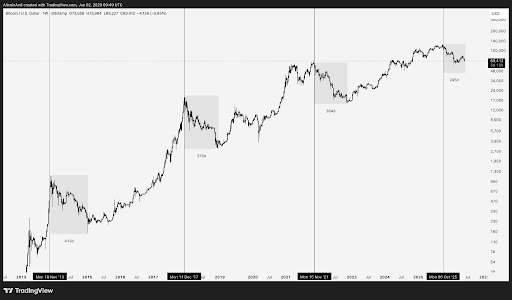
Source: Chart from Ardi on X

The Bitcoin weekly candlestick chart below captures this trend very clearly. Bitcoin’s 2013 cycle correction lasted 413 days before bottoming in November 2014, the 2017 bear cycle correction lasted 378 days before the December 2018 low, and the 2021 cycle bear market lasted 364 days before BTC bottomed in November 2022.

The current correction is at 245 days from the October 2025 high of $126,000, leaving room for more time if the market continues to mirror previous bear-market structures.

Consensus On Q4 2026

Ardi is not the only market watcher pointing to late 2026 as the more likely period for a cycle bottom. Popular crypto analyst and founder of Into the Cryptoverse, Benjamin Cowen, also noted that Bitcoin’s four-year cycle is still in play, given that the current cycle top in October 2025 arrived within one week of when it historically does. His base case for the current cycle low is October 2026.

Other analysts have reached similar conclusions through different methodologies. Ali Martinez pins October 2026 as the likely bottom based on the average duration of prior bear markets. Xanrox places the bottom in September or October, with recovery expected to begin in November or December.

CryptoQuant points to October through December, coinciding with what would be a sub-zero MVRV Z-Score, while technical signals, including the Bitcoin Repetition Fractal Cycle, are also pointing to October 2026 as the month everything will change.

At the time of writing, BTC is trading at $62,950 after a 6.2% decline over the past 24 hours. The drop has pushed BTC to its lowest level in four months, leaving the cryptocurrency at risk of losing the $60,000 support as outflows from Spot Bitcoin ETFs continue to weigh on market sentiment.

BTC trading at $62,570 on the 1D chart | Source: BTCUSDT on Tradingview.com

Related Questions

QAccording to crypto pundit Ardi, in which quarter has Bitcoin historically bottomed during bear markets?

AAccording to crypto pundit Ardi, Bitcoin has historically always bottomed in the fourth quarter during its bear market years.

QWhat is the current status of the Bitcoin price and market sentiment as mentioned in the article?

ABitcoin is trading around $62,950, having declined over 6% in 24 hours, and is at risk of losing the $60,000 support. The overall crypto market sentiment is back in 'extreme fear'.

QHow long has the current Bitcoin correction lasted from its October 2025 high, and how does it compare to past cycles?

AThe current correction has lasted 245 days from the October 2025 high of $126,000. This is shorter than previous cycles, which lasted 413 days (2014), 378 days (2018), and 364 days (2022) before bottoming.

QWhich month does analyst Benjamin Cowen identify as his base case for the current cycle low, and why?

ABenjamin Cowen's base case for the current cycle low is October 2026. He notes that Bitcoin's four-year cycle is still in play, as the October 2025 cycle top arrived within one week of its historical timing.

QWhat are some other methodologies or indicators mentioned that point to a late 2026 bottom for Bitcoin?

AOther methodologies pointing to a late 2026 bottom include: Ali Martinez's analysis based on average prior bear market durations, Xanrox's technical signals pointing to September/October, CryptoQuant's expectation of a sub-zero MVRV Z-Score in Q4, and the Bitcoin Repetition Fractal Cycle.

Related Reads

UBS: The Crowdedness of A-Share Tech Stocks Is Far From Reaching Historical Peaks

UBS: A-share tech stocks still far from peak crowding levels A-shares' technology sector has seen a strong rebound, with trading activity hitting record highs, raising concerns about market crowding. However, UBS Securities argues that a key indicator of institutional positioning suggests the current crowding level remains well below historical peaks. While the large-cap tech sector's share of total A-share trading volume and market capitalization have reached historical highs, the overweight ratio of domestic mutual funds in this sector stood at 9.9% in Q1 2026. This is down from 11.6% in Q3 2025 and significantly lower than the historical peak of 14.1% in Q4 2015. It also pales in comparison to the historical peak overweight of 18.7% for the consumer sector. UBS notes that typical cycles from a low to a peak in fund overweighting last about three years, and the current outperformance of the tech/growth style has lasted less than two years since the policy pivot in September 2024. UBS expects A-share earnings recovery to accelerate, providing fundamental support. It forecasts 2026 A-share profit growth to rise to 11% from 3.9% in 2025. Non-financial A-share profits grew 11.8% YoY in Q1 2026, with gross and net profit margins at their highest since 2023. Persistent fund inflows, the expansion of thematic ETFs, and a recovery in private fund issuance are supporting market liquidity. In tactical allocation, UBS favors growth and cyclical styles under its "slow bull" base case, with overweight ratings on six sectors: Electronics (benefiting from semiconductor inventory recovery and AI innovation), Communications (driven by AI computing demand), Machinery (aided by domestic capex recovery), Non-ferrous Metals (due to rising copper/aluminum prices), Chemicals (supported by anti-involution policies), and Electrical Equipment (driven by policy support and AI data center power demand).

marsbit1h ago

UBS: The Crowdedness of A-Share Tech Stocks Is Far From Reaching Historical Peaks

marsbit1h ago

Should You Buy SpaceX Stock at $1.7 Trillion? Here's What the Market Is Worried About

SpaceX is preparing for a massive IPO aiming to raise around $75 billion at a valuation of approximately $1.75 trillion. While its achievements in reusable rockets and the profitable Starlink satellite internet service are clear, the market is concerned about the aggressive valuation. Key issues include: the current $1.75 trillion valuation, which is about 94 times 2025 revenue, seems to price in not just existing businesses but also unproven future ventures like AI infrastructure and orbital data centers. Financially, while Starlink is profitable, the AI division, bolstered by the acquisition of xAI, is incurring massive losses and consuming the majority of capital expenditures. This acquisition also introduced complex related-party financing arrangements and debt onto SpaceX's balance sheet. Furthermore, corporate governance poses a challenge. SpaceX's dual-class share structure ensures founder Elon Musk retains absolute control, limiting ordinary shareholders' influence over high-risk, long-term strategic decisions. The future success of ambitious projects like the Starship rocket—critical for lowering costs and enabling new services—remains a significant variable for the valuation. In summary, the market's apprehension (FUD) centers not on doubting SpaceX's past technological triumphs but on questioning how much premium public investors should pay for a future that combines proven profits with highly speculative and capital-intensive new ventures, all under a governance structure that offers limited shareholder oversight.

marsbit2h ago

Should You Buy SpaceX Stock at $1.7 Trillion? Here's What the Market Is Worried About

marsbit2h ago

Trading

Spot
Futures

Hot Articles

What is $BITCOIN

DIGITAL GOLD ($BITCOIN): A Comprehensive Analysis Introduction to DIGITAL GOLD ($BITCOIN) DIGITAL GOLD ($BITCOIN) is a blockchain-based project operating on the Solana network, which aims to combine the characteristics of traditional precious metals with the innovation of decentralized technologies. While it shares a name with Bitcoin, often referred to as “digital gold” due to its perception as a store of value, DIGITAL GOLD is a separate token designed to create a unique ecosystem within the Web3 landscape. Its goal is to position itself as a viable alternative digital asset, although specifics regarding its applications and functionalities are still developing. What is DIGITAL GOLD ($BITCOIN)? DIGITAL GOLD ($BITCOIN) is a cryptocurrency token explicitly designed for use on the Solana blockchain. In contrast to Bitcoin, which provides a widely recognized value storage role, this token appears to focus on broader applications and characteristics. Notable aspects include: Blockchain Infrastructure: The token is built on the Solana blockchain, known for its capacity to handle high-speed and low-cost transactions. Supply Dynamics: DIGITAL GOLD has a maximum supply capped at 100 quadrillion tokens (100P $BITCOIN), although details regarding its circulating supply are currently undisclosed. Utility: While precise functionalities are not explicitly outlined, there are indications that the token could be utilized for various applications, potentially involving decentralized applications (dApps) or asset tokenization strategies. Who is the Creator of DIGITAL GOLD ($BITCOIN)? At present, the identity of the creators and development team behind DIGITAL GOLD ($BITCOIN) remains unknown. This situation is typical among many innovative projects within the blockchain space, particularly those aligning with decentralized finance and meme coin phenomena. While such anonymity may foster a community-driven culture, it intensifies concerns about governance and accountability. Who are the Investors of DIGITAL GOLD ($BITCOIN)? The available information indicates that DIGITAL GOLD ($BITCOIN) does not have any known institutional backers or prominent venture capital investments. The project seems to operate on a peer-to-peer model focused on community support and adoption rather than traditional funding routes. Its activity and liquidity are primarily situated on decentralized exchanges (DEXs), such as PumpSwap, rather than established centralized trading platforms, further highlighting its grassroots approach. How DIGITAL GOLD ($BITCOIN) Works The operational mechanics of DIGITAL GOLD ($BITCOIN) can be elaborated on based on its blockchain design and network attributes: Consensus Mechanism: By leveraging Solana’s unique proof-of-history (PoH) combined with a proof-of-stake (PoS) model, the project ensures efficient transaction validation contributing to the network's high performance. Tokenomics: While specific deflationary mechanisms have not been extensively detailed, the vast maximum token supply implies that it may cater to microtransactions or niche use cases that are still to be defined. Interoperability: There exists the potential for integration with Solana’s broader ecosystem, including various decentralized finance (DeFi) platforms. However, the details regarding specific integrations remain unspecified. Timeline of Key Events Here is a timeline that highlights significant milestones concerning DIGITAL GOLD ($BITCOIN): 2023: The initial deployment of the token occurs on the Solana blockchain, marked by its contract address. 2024: DIGITAL GOLD gains visibility as it becomes available for trading on decentralized exchanges like PumpSwap, allowing users to trade it against SOL. 2025: The project witnesses sporadic trading activity and potential interest in community-led engagements, although no noteworthy partnerships or technical advancements have been documented as of yet. Critical Analysis Strengths Scalability: The underlying Solana infrastructure supports high transaction volumes, which could enhance the utility of $BITCOIN in various transaction scenarios. Accessibility: The potential low trading price per token could attract retail investors, facilitating wider participation due to fractional ownership opportunities. Risks Lack of Transparency: The absence of publicly known backers, developers, or an audit process may yield skepticism regarding the project's sustainability and trustworthiness. Market Volatility: The trading activity is heavily reliant on speculative behavior, which can result in significant price volatility and uncertainty for investors. Conclusion DIGITAL GOLD ($BITCOIN) emerges as an intriguing yet ambiguous project within the rapidly evolving Solana ecosystem. While it attempts to leverage the “digital gold” narrative, its departure from Bitcoin's established role as a store of value underscores the need for a clearer differentiation of its intended utility and governance structure. Future acceptance and adoption will likely depend on addressing the current opacity and defining its operational and economic strategies more explicitly. Note: This report encompasses synthesised information available as of October 2023, and developments may have transpired beyond the research period.

363 Total ViewsPublished 2025.05.13Updated 2025.05.13

What is $BITCOIN

Discussions

Welcome to the HTX Community. Here, you can stay informed about the latest platform developments and gain access to professional market insights. Users' opinions on the price of BTC (BTC) are presented below.

活动图片