BitMine Copies Saylor’s Strategy Playbook With Ethereum Preferred Stock Offering

bitcoinistPublished on 2026-06-04Last updated on 2026-06-04

Abstract

BitMine Immersion Technologies is following a strategy similar to Michael Saylor's MicroStrategy, but for Ethereum. The company has filed for a public offering of 3 million shares of 9.50% Series A Perpetual Preferred Stock, with a stated value of $100 per share, to raise capital for expanding its Ethereum holdings and staking infrastructure. Proceeds are earmarked for acquiring ETH and other digital assets, expanding its "MAVAN" validator network, and other corporate purposes. The preferred stock will pay cumulative dividends at 9.50% annually and includes provisions for dividend penalties and company redemption options. BitMine has applied to list the shares on the NYSE under the ticker BMNP.

BitMine Immersion Technologies is moving deeper into the public-market crypto treasury trade, filing for a preferred stock offering that could help fund additional Ethereum purchases and validator infrastructure. The structure puts the company closer to the capital-markets model popularized by Michael Saylor’s Strategy, but with ETH rather than Bitcoin as the core reserve asset.

The Norwalk, Connecticut-based company said it intends to offer 3,000,000 shares of 9.50% Series A Perpetual Preferred Stock in a public offering registered under the Securities Act. The preferred shares carry a stated amount of $100 per share, implying a potential $300 million stated-value issuance if sold at that level, though the company said the deal remains subject to market and other conditions.

BitMine Files Yield Offering As It Builds Ethereum Treasury

BitMine framed the proceeds broadly, but Ethereum sits at the center of the filing. The company said it intends to use net proceeds “for general corporate purposes, which may include the acquisition of additional ETH and other digital assets; the expansion of the Company’s staking and validator infrastructure, including through MAVAN; working capital; strategic investments aligned with the Ethereum ecosystem and broader digital asset adoption; and/or repurchases of the Company’s common stock under its share repurchase program.”

BitMine has committed to ETH as its primary treasury reserve asset and says it is using native protocol-level activity, including staking and decentralized finance mechanisms, as part of that strategy. In 2026, the company launched MAVAN, or Made-in America VAlidator Network, as dedicated staking infrastructure for BitMine assets.

The comparison with Saylor’s Strategy comes from the financing mechanism. Strategy built its Bitcoin treasury model not only through common stock and convertible debt, but also through preferred equity products (STRC and STRF) designed to attract yield-oriented investors while raising capital for digital asset accumulation.

BitMine is now applying a similar template to Ethereum: issue a yield-bearing security in the public markets, use the proceeds flexibly, and route part of the capital toward a crypto treasury asset with institutional-market packaging around it.

The preferred stock itself is structured as a cash-paying instrument. BitMine said the Series A Preferred Stock will accumulate cumulative dividends at a fixed rate of 9.50% per year on the $100 stated amount, whether or not dividends are declared or funds are legally available for payment. “Regular dividends on the Series A Preferred Stock will be payable when, as and if declared by BMNR’s board of directors, out of funds legally available for their payment, weekly in arrears,” the company said. “Declared regular dividends on the Series A Preferred Stock will be payable solely in cash.”

The filing also includes a penalty mechanism if dividends are not paid on schedule. Any unpaid accumulated regular dividend would itself begin accumulating additional dividends, compounded weekly. The compounded dividend rate initially equals 9.50% plus 5 basis points, based on a weekly regular dividend period, and increases by another 5 basis points for each subsequent period until paid in full, capped at 15% per year.

BitMine will retain redemption flexibility. The company can redeem the preferred stock in whole or in part for cash at 110% of stated amount during the first 18 months after issuance, 105% from 18 months to three years, and 100% after three years, plus accumulated and unpaid dividends. It can also redeem all outstanding preferred shares if the total remaining falls below 25% of the original issuance, or if certain tax events occur.

Holders also receive protection in the event of a “fundamental change.” If such an event occurs under the certificate of designations, preferred shareholders can require BitMine to repurchase some or all of their shares for cash at the stated amount, plus accumulated and unpaid regular dividends.

BitMine has applied to list the preferred stock on the New York Stock Exchange under the ticker BMNP. If approved, the company expects trading to begin within 30 days after the shares are first issued. Moelis & Company and Cantor are acting as joint lead bookrunners.

At press time, Ethereum traded at $1,793.
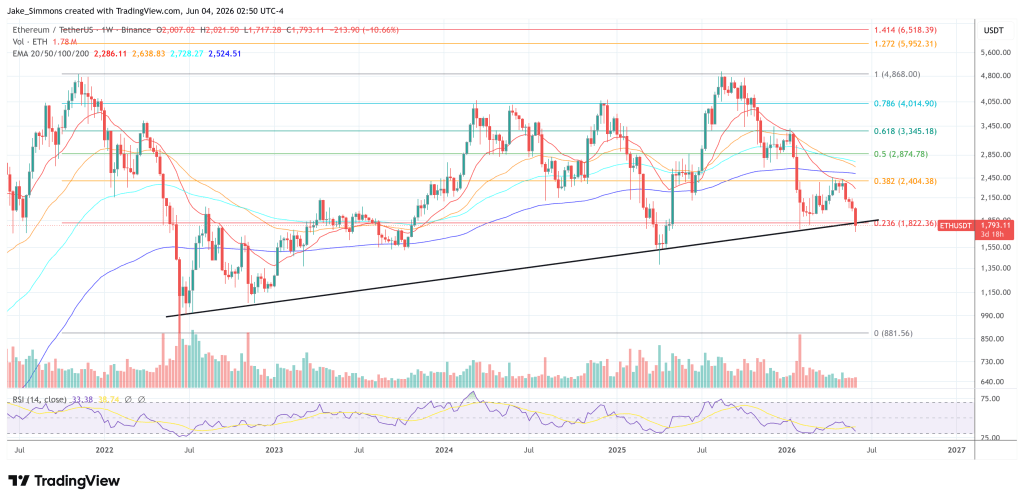
Ethereum bulls must defend the multi-year uptrend, 1-week chart | Source: ETHUSDT on TradingView.com

Related Questions

QWhat type of securities offering is BitMine Immersion Technologies filing for, and what is its primary purpose?

ABitMine is filing for a public offering of 3,000,000 shares of 9.50% Series A Perpetual Preferred Stock. The primary purpose of the proceeds is for general corporate purposes, which include the acquisition of additional Ethereum, the expansion of its staking and validator infrastructure (including through MAVAN), working capital, strategic investments in the Ethereum ecosystem, and/or repurchases of the company's common stock.

QHow does BitMine's strategy compare to Michael Saylor's approach, and what is the key difference?

ABitMine's strategy is compared to Michael Saylor's capital-markets model, which uses financial instruments to raise capital for acquiring a crypto reserve asset. The key difference is that while Saylor's company, MicroStrategy, focuses on Bitcoin as its core reserve asset, BitMine is applying a similar template to Ethereum.

QWhat are the key financial terms of BitMine's Series A Perpetual Preferred Stock?

AThe Series A Perpetual Preferred Stock has a stated amount of $100 per share and accumulates cumulative dividends at a fixed annual rate of 9.50% on that amount. Dividends are payable weekly in arrears, in cash, when declared. If dividends are not paid, they compound weekly with a penalty rate that starts at 9.55% and can increase, capped at 15% per year.

QUnder what conditions can BitMine redeem the preferred shares, and what are the redemption prices?

ABitMine can redeem the preferred stock for cash at 110% of the stated amount within the first 18 months after issuance, at 105% from 18 months to three years, and at 100% after three years, plus any accumulated and unpaid dividends. The company can also redeem all outstanding shares if the total remaining falls below 25% of the original issuance or if certain tax events occur.

QWhat exchange does BitMine plan to list its preferred stock on, and what is the proposed ticker symbol?

ABitMine has applied to list the preferred stock on the New York Stock Exchange (NYSE) under the ticker symbol BMNP.

Related Reads

Probability in the Price: How World Cup Odds Are Calculated

**The Probability in the Price: How World Cup Odds Are Calculated** Two major systems released their "championship probabilities" before the 2026 World Cup, and they disagreed on the favorite. Prediction market aggregators listed France at around **17%**, while the Opta supercomputer gave European champion Spain **16.1%**. These numbers look similar, but their production methods are fundamentally different. The market's **17%** is the **price** that clears after hundreds of millions of dollars in trading across platforms like Polymarket and Kalshi, where contracts trade between 0 and 100 cents, directly representing implied probability. This liquidity is provided by crypto-native market makers like Wintermute, though the market still has "the liquidity profile of an early-stage" asset class. In contrast, Opta's **16.1%** is a **simulated frequency**. Its model uses team data (including betting market odds as an input) to estimate match probabilities, then runs **10,000 full tournament simulations**, counting how often each team wins. Which is more accurate? There is **no rigorous, cross-tournament academic study** directly comparing their track records. However, a persistent **longshot bias**—where low-probability outcomes are systematically overvalued—observed in traditional betting for nearly a century, has also been found in modern crypto prediction markets. Research shows low-price contracts on Kalshi/Polymer less likely to pay out than their implied odds suggest. Unlike traditional bookmakers, prediction markets operate on **public blockchain ledgers**, making every transaction auditable and enabling such research. However, price formation is also influenced by **regulatory uncertainty**, as seen in recent US state-level bans and legal battles over jurisdiction. In summary, the "probability" you see is either a **market-clearing price** subject to behavioral biases and liquidity constraints, or a **model-simulated frequency** that partially incorporates market data. The question of which method is more reliable remains open, highlighting the importance of asking: **How was this number produced?**

marsbit18m ago

Probability in the Price: How World Cup Odds Are Calculated

marsbit18m ago

Trading

Spot
Futures

Hot Articles

Discussions

Welcome to the HTX Community. Here, you can stay informed about the latest platform developments and gain access to professional market insights. Users' opinions on the price of S (S) are presented below.

活动图片