Housing Price "Shorting Tool" Emerges as Polymarket Launches Real Estate Prediction Market

marsbit發佈於 2026-01-06更新於 2026-01-06

文章摘要

Polymarket, a prediction market platform, has partnered with real estate data provider Parcl to launch a new prediction market for US housing prices. The collaboration will utilize Parcl’s daily housing price indices as a verifiable and transparent data source to settle market outcomes on Polymarket. Users can trade on whether prices in specific high-liquidity U.S. cities—such as New York, Miami, and San Francisco—will rise or fall over monthly, quarterly, or annual periods. All trading is done using USDC on the Polygon blockchain. This initiative effectively creates a “shorting tool” for real estate, allowing participants to hedge against or speculate on local housing market downturns without needing to buy or sell physical property. The move introduces a liquid, crypto-native trading layer for real estate price expectations—a market traditionally known for its illiquidity and high transaction costs. The launch has positively impacted Parcl’s native token PRCL, which saw a price increase of over 150% following the announcement.

Author | Asher(@Asher_ 0210)

The credibility of "everything is predictable" continues to rise.

On the evening of January 5th, the on-chain real estate platform Parcl announced a collaboration with the prediction market Polymarket, aiming to introduce Parcl's daily housing price index into Polymarket's new real estate prediction market. Following this news, Parcl's token PRCL saw a short-term surge of over 150%, currently retracting slightly to $0.042, with a market cap of $19 million.
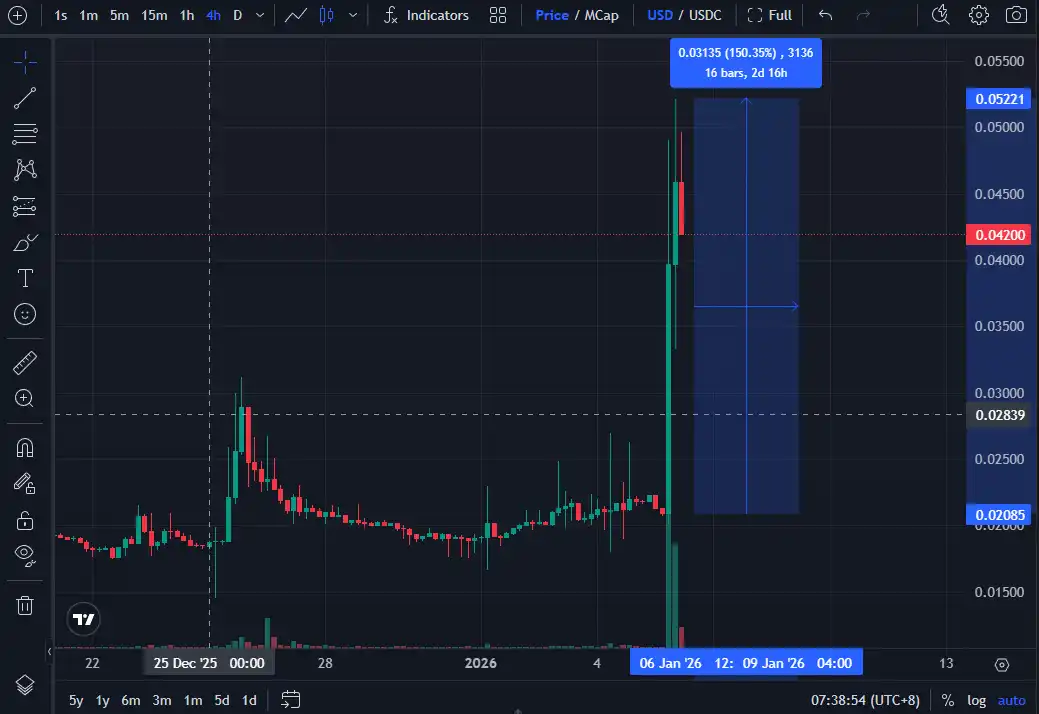
PRCL Price Chart

Operational Details of Polymarket's Real Estate Prediction Market Section

Collaboration Details:

  • Parcl provides daily housing price indices as an independent, transparent reference data for market settlement;
  • Polymarket is responsible for listing and operating the markets, where users can trade using USDC on the Polygon chain;
  • Market settlements are based on Parcl's publicly verifiable index, avoiding the delays (typically monthly) and subjectivity of traditional real estate data.

Market Types:

  • Predicting whether housing prices will rise/fall within a month, quarter, or year;
  • Threshold markets: e.g., whether housing prices exceed a specific level;
  • Each market is linked to Parcl's dedicated settlement page, displaying final values, historical data, and index calculation methods.

Coverage:

  • Initially starting with high-liquidity U.S. cities, such as New York, Miami, San Francisco, Austin, etc.;
  • Subsequently expanding to more cities and market types based on user demand.

Example Display:

Currently, this section has only listed 7 monthly real estate prediction events, with low liquidity. The event with the highest trading volume, "U.S. Los Angeles Housing Agent Price on February 1st," has only $3,700.
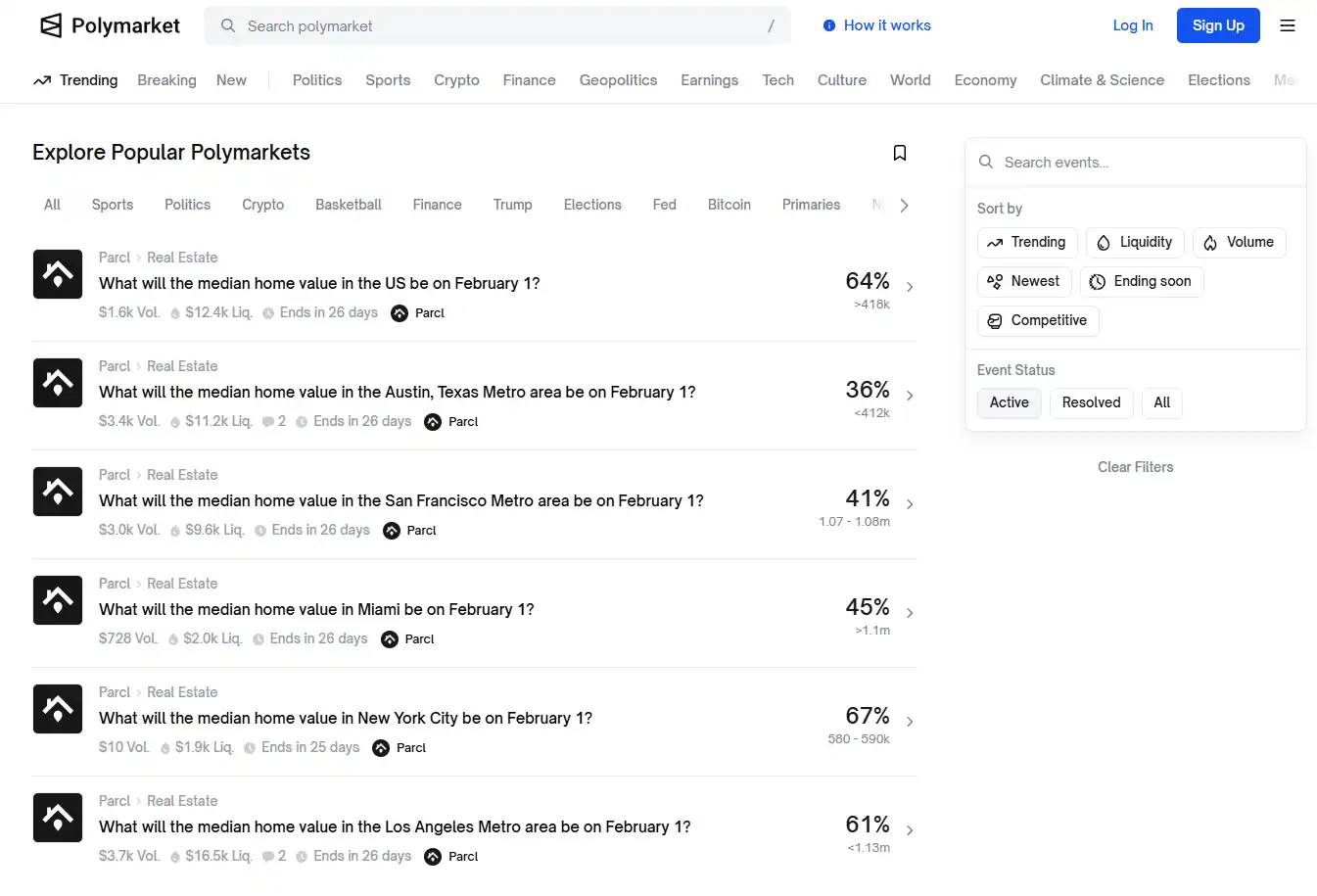
Polymarket's New Real Estate Prediction Market Section

In traditional real estate markets, whether bullish or bearish, such expectations are difficult to express directly, let alone form continuous market signals. Polymarket's introduction essentially separates "judgments on housing prices" from asset transactions. As long as there is a clear settlement standard, expectations themselves can be priced independently.

The Real Estate Market Finally Sees a "Shorting Tool"

An easily overlooked fact is that the potential demand for real estate-related markets does not only come from native speculators.

In the traditional financial system, "falling housing prices" are almost a risk that cannot be directly hedged. Whether holding property or having asset structures and income sources highly dependent on a city's real estate cycle, the practical response is often to continue holding or directly sell physical assets—high transaction costs, long cycles, and a lack of flexible intermediate options. As KOL 0xMarioNawfal (@RoundtableSpace) stated: "This is far more than just betting; it's about bringing liquidity to one of the world's most illiquid markets. Imagine housing prices are at historic highs, and you expect a crash but can't sell your house—now you can hedge and short the market."

The introduction of prediction markets abstracts the decline in housing prices into a tradable risk judgment. When housing prices are high and market expectations begin to weaken, the trend of real estate prices itself can be priced separately without having to dispose of underlying assets for risk management.

Through Polymarket, the downside risk of real estate prices is abstracted into a tradable judgment rather than requiring the disposal of physical assets. From this perspective, Polymarket's real estate prediction market is closer to a simplified macro hedging mechanism than a mere speculative game around rises and falls. It does not change the liquidity structure of real estate assets themselves but provides a tradable layer that can reflect expectations in real-time for a long-term illiquid market.

Polymarket CMO Matthew Modabber stated: "Prediction markets are best suited for events with clear, verifiable data. Parcl's daily housing price index provides us with a transparent, consistent settlement foundation. Real estate should become a first-class category in prediction markets."

The collaboration between Polymarket and Parcl also introduces traditional real estate price signals into the crypto system: Originally low-frequency, closed, and high-barrier assets are broken down into settleable, verifiable, and tradable index results, resembling stock indices or crypto derivatives. This may be a more practical and demand-aligned implementation path in the RWA narrative.


相關問答

QWhat is the main purpose of the collaboration between Parcl and Polymarket?

AThe collaboration aims to introduce Parcl's daily housing price indices into Polymarket's new real estate prediction markets, providing an independent and transparent reference for market settlements.

QHow does the real estate prediction market on Polymarket function in terms of settlement?

AMarket settlements are based on Parcl's publicly verifiable index data, which avoids the delays (typically monthly) and subjectivity of traditional real estate data.

QWhat types of markets are available in Polymarket's real estate prediction section?

AThe markets include predicting whether housing prices will rise or fall within monthly, quarterly, or annual periods, as well as threshold-based markets, such as whether prices will exceed specific levels.

QWhy is the introduction of real estate prediction markets significant for risk management?

AIt allows users to hedge against or speculate on housing price declines without needing to dispose of physical assets, providing a tool to directly trade and price the risk of falling real estate values.

QWhich US cities are initially covered in Polymarket's real estate prediction markets?

AThe initial coverage includes high-liquidity US cities such as New York, Miami, San Francisco, and Austin, with plans to expand to more cities based on user demand.

你可能也喜歡

AI Agent 也要查"征信"了:ERC-8126 正在补上链上信任这块空白

AI Agent上链后,其可信度成为关键问题。ERC-8126协议旨在为AI Agent建立一套标准化的验证层,以补充ERC-8004的身份注册功能。它并非提供永久可信认证,而是定义了如何对Agent进行多维度检查、如何表达结果以及如何让其他系统(如钱包、市场)消费这些风险信号。 ERC-8126的核心是引入开放的第三方验证提供商(Verification Providers)市场,对已注册的Agent进行五类标准化检查: 1. **ETV(代币/合约验证)**:检查关联的链上资产或合约的真实性与风险。 2. **MCV(媒体内容验证)**:核查头像、图片等内容是否被伪造或篡改。 3. **SCV(Solidity代码验证)**:检查关联的智能合约代码是否存在常见安全漏洞。 4. **WAV(Web应用验证)**:评估网站、API等链下入口的安全性。 5. **WV(钱包验证)**:分析关联钱包地址的历史交易记录与风险关联。 验证结果会转化为0-100的统一风险评分,并提供可验证的证明(如零知识证明),以便钱包、应用市场等在不公开敏感细节的前提下进行风险决策。该标准与ERC-8004(身份)、ERC-8183(商业与结算)共同构成AI Agent经济的基础设施方向,致力于将信任判断转化为可组合、可消费的标准化信号,降低用户和生态系统的信任成本。目前,ERC-8126是一套已确定的标准框架,其实际效果取决于后续生态的广泛采用。

marsbit12 分鐘前

AI Agent 也要查"征信"了:ERC-8126 正在补上链上信任这块空白

marsbit12 分鐘前

租来的信仰:比特币 ETF 资金流里,有多少是真钱

比特币ETF资金流常被视为机构信心的指标,但分析显示,其每周波动主要由一笔隐藏的套利交易驱动,而非真正的信仰。这笔交易是期现套利,交易者买入ETF现货同时在CME做空期货,锁定期货高于现货的价差(基差)作为利润,对冲了价格风险。数据显示,每周约一半的资金流波动与对冲基金新增的期货空头高度相关(相关性0.70),而当周比特币价格涨跌几乎无法解释资金流变化。 然而,这笔套利交易主导的是短期“波动”,并非长期“存量”的主体。自ETF推出以来累计约550亿美元流入中,套利交易当前净额仅占约10亿美元;其余是稳定的方向性买盘,平均每周约4亿美元,构成了资金积累的“山体”。因此,ETF资金流高估了信仰的“波动率”,而非其“水平”。 目前,这笔套利交易正在持续离场。杠杆基金的期货空头头寸已从2024年底约140亿美元稳步回落至约45亿美元。当基差收益压缩至无利可图时,资金流入与空头头寸会同步消退。因此,不应将这种因套利平仓导致的资金流出简单误读为市场看空比特币。 总之,解读ETF资金流时,应关注基差收益与无风险利率的对比,以及CME杠杆基金的净空头数据,以分辨其中有多少是“租来的”套利资本,多少是“自有的”方向性投资。

链捕手29 分鐘前

租来的信仰:比特币 ETF 资金流里,有多少是真钱

链捕手29 分鐘前

两大巨头“信贷”狂奔:贷款余额 99 亿 vs 146 亿美元,巴西已成主战场

文章对比了Sea集团旗下Monee与Mercado Libre旗下Mercado Pago两大金融科技巨头2026年第一季度的信贷业务表现。两者均在海外市场,尤其是东南亚和拉美(以巴西为主)高速扩张,与国内信贷市场增长放缓形成对比。 截至2026年一季度末,Monee贷款余额达99亿美元(同比增长71%),Mercado Pago达146亿美元(同比增长87%)。金融科技收入在各自集团总收入中占比持续提升。 文章重点分析了双方在巴西市场的竞争与发展: 1. **Monee方面**:巴西是其增长最快市场,Q1贷款规模超10亿美元(同比增长250%),并成功获得巴西金融信贷牌照(SCFI),为未来多元化业务奠定合规基础。其信贷增长主要来自深耕存量用户、获取高质量新用户及拓展Shopee生态外场景。 2. **Mercado Pago方面**:巴西市场贡献了集团超一半收入,其信贷收入(主要来自信用卡、消费者贷款等)首次超过金融服务收入,成为金融科技板块最大引擎。尽管因信用卡业务占比提升导致净息差有所收窄,但仍保持约17.8%的高水平。巴西市场信贷收入达11.24亿美元,同比增长89%,占集团总收入12.7%。 总结指出,巴西已成为两大巨头信贷业务的关键增长战场,增速迅猛。但这种增长高度依赖其原有的电商生态、支付闭环和用户数据,对于缺乏场景和生态的其他互金玩家而言,进入门槛极高,难以复制。

链捕手51 分鐘前

两大巨头“信贷”狂奔:贷款余额 99 亿 vs 146 亿美元,巴西已成主战场

链捕手51 分鐘前

交易

現貨
合約
活动图片