Original | Odaily Planet Daily (@OdailyChina)
Author | Ethan (@ethanzhang_web3)

Late one night, I witnessed an interesting debate in a crypto trader group.
It started when someone posted a screenshot of NVIDIA's stock price breaking $190, with the caption: "Told you to get some US stocks, regret it now, don't you?" The group instantly exploded. Some complained about the hassle of opening brokerage accounts, others grumbled about the painfully slow cross-border fund transfers, and some simply said: "My USDT is sitting in my wallet, I can't buy even if I want to."
Behind this debate lies a deeper contradiction: When macro markets fluctuate wildly, with US stocks and gold hitting new highs in turn, crypto traders holding digital assets are trapped within the 'walled garden' of the crypto ecosystem by the invisible barrier of the 'account system'.
This is not an isolated case. Over the past two months, I've spoken with over a dozen crypto traders, and almost all mentioned similar pain points. The traditional 'cross-border' path is simply too torturous: selling coins, withdrawing fiat (T+1), currency exchange, wiring funds to a broker, waiting for the funds to arrive – the entire process takes at least three to five days, sometimes a week. Each step comes with fee erosion and exchange rate fluctuations. By the time the funds arrive, the market opportunity has often passed.
But recently, the winds seem to be shifting. Even before Binance re-entered the stock contract arena, leading exchanges were racing down the 'multi-asset trading' fast lane. From US stock contracts to RWA, this race also confirms the industry consensus that Web3 platforms are evolving into 'super accounts' connecting global financial markets, and the boundaries of tradable assets are being completely erased.
In this race, the moves of one exchange are particularly noteworthy – Gate.
Unlike the 'launch first, ask questions later' strategy of competitors, Gate's multi-asset layout seems more like a planned, systematic project. From陆续 (progressively) listing metals, indices, stocks, and other assets last year to recently launching the TradFi section integrating traditional financial CFD trading, Gate is building a complete trading ecosystem covering both Crypto and TradFi.
As one user put it: "The macro environment is frantically chasing stocks and gold due to uncertainty, and major exchanges are actively integrating. But so far, Gate seems to be the most comprehensive and the fastest one."
Is this evaluation objective? To what extent has Gate's multi-asset trading developed? As a journalist long focused on Web3 infrastructure, I decided to experience it deeply.
Industry Observation: The Three Thresholds of Multi-Asset Trading
Before diving into Gate, I conducted some industry research.
In terms of product forms, the current 'multi-asset trading' solutions on the market can be roughly divided into three categories:
- Tokenized Asset Spot: Allows users to trade traditional assets (e.g., stocks, gold) on-chain by issuing tokens that represent them. Advantages include 24/7 trading and support for fractional shares, but liquidity is generally poor, and prices can easily depeg.
- Crypto Derivatives Expansion: Adds perpetual contracts for stocks, etc., to the existing contract system. The advantage is a familiar trading interface for users, but it's essentially still the crypto market玩法 (playstyle), and there might be deviations from real market prices.
- Traditional CFD Access: Directly connects to traditional financial market CFDs (Contracts for Difference), providing trading based on real market prices. Advantages are accurate prices and good depth, allowing simultaneous long and short positions, but it requires handling traditional financial rules like market closing times and swap fees.
Most exchanges choose one of these paths. Gate's strategy is: Do all three paths, and build a complete, ecological system.
This sounds somewhat radical, but based on actual experience, this 'comprehensive coverage' strategy does address user needs in different scenarios. Next, I'll break down Gate's multi-asset trading capabilities from three key dimensions.
Dimension 1: The 'Breadth' and 'Depth' of Asset Coverage
First, an interesting discovery.
I searched for 'Gold' on Gate and found 12 different trading entry points: including 4 different spot tokens like XAUT, PAXG; 4 different perpetual contracts like XAUUSDT, XAUTUSDT; and 4 different CFD types for gold with varying leverage in the TradFi section. At first, I thought this was product redundancy, but after actual experience, I found each method has its specific use case.
For example, holding XAUT tokens is equivalent to holding 'on-chain gold,' suitable for long-term allocation; perpetual contracts support 24/7 trading and leverage, suitable for short-term speculation; while TradFi gold CFDs are based on real traditional market prices, closer to the玩法 of traditional finance.
This design of 'one asset, multiple玩法' is rare on other exchanges. Most platforms either only have tokenized spot or only have contracts; few have built out the entire trading chain.
In terms of asset classes, Gate currently covers:
- Metals: 10 metal contracts (Gold, Silver, Platinum, Palladium, Aluminum, Copper, etc.), one of the platforms with the most variety in the industry.
- Stocks: 72 stock tokens + 45 stock contracts, covering mainstream sectors like tech, consumer, finance.
- Indices: 19 global indices, including Nasdaq 100, S&P 500, Hang Seng Index, etc. Notably, Gate was the first platform globally launch index perpetual contracts, introducing traditional market sentiment indicators into crypto derivatives.
- Forex: 48 forex pairs, covering major currency pairs.
- Commodities: Energy assets like Crude Oil, Natural Gas.
Based on the data, Gate's asset coverage is indeed leading in the industry.
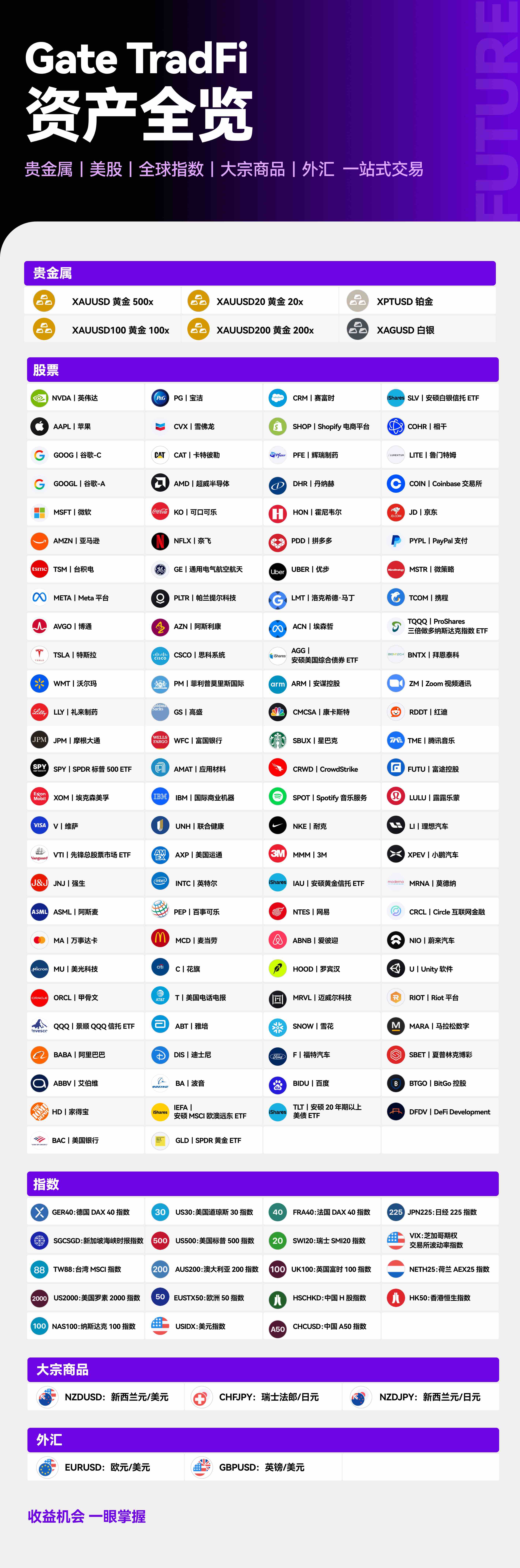
But a point needs to be made here: Having many assets doesn't mean each asset has good liquidity. I actually tested some niche contracts and found that the daily trading volume for some标的 (underlyings) is indeed low, with larger bid-ask spreads than mainstream contracts. For large-volume traders, it's better to prioritize actively traded varieties, like gold, the Nasdaq index, mainstream stocks, etc.
Dimension 2: Testing Capital Efficiency
To test capital turnover efficiency, I did a simple comparative experiment.
Assume I have 10,000 USDT and want to quickly establish a position when gold prices break a certain key level. Using a traditional broker, the process is: Sell USDT for fiat → Withdraw to bank card (T+1) → Wire transfer to broker account → Wait for funds to arrive and purchase gold ETF or futures. Conservatively estimated, the entire cycle takes at least 3-5 working days.
On Gate, I just need: Open the App → Select gold contract or TradFi CFD → Open position directly with USDT (account shows as USDx balance, pegged 1:1). The whole process takes no more than 30 seconds.
More crucially is the 'reusability' of capital. In Gate's multi-asset system, USDT is both the计价单位 (unit of account) in the crypto market and the margin for traditional asset trading. When you transfer USDT to the TradFi sub-account, the system automatically converts it to USDx (pegged 1:1 to USDT), no additional exchange needed, no custody fees.
This means you could be trading BTC contracts in the morning and directly switch to NVIDIA stock or gold in the afternoon, with funds transferring instantly between different accounts with one click. This efficiency is completely incomparable to traditional financial accounts.
But a reminder here: The TradFi section uses cross-margin mode, and leverage is fixed for different assets (Forex, Indices up to 500x, Stocks up to 5x). This means you cannot freely adjust leverage like in crypto contracts. For users accustomed to flexible leverage, it might take some time to adapt.
Dimension 3: The Devilish Details of Transaction Costs
Fees are a primary concern for most traders. I spent some time comparing Gate's fee structure with several mainstream platforms.
Conclusion first: Gate's fees are indeed competitive in the industry, especially for VIP users and large-volume traders.
Taking VIP Level 5 and above users as an example (usually requiring a certain 30-day trading volume or holding platform tokens), the fee for Forex类 (Forex category) TradFi contracts is $5.4 per lot, while the competitors I surveyed are generally above $6; the fee for US stock CFDs is only $0.018 per lot, compared to $0.02 for competitors.
This difference might seem small on its own, but for high-frequency traders, the costs saved over dozens or even hundreds of trades a day are quite substantial. (Refer to announcement documentation )
However, during testing, I found a more noteworthy point: The cost difference between TradFi and traditional contract trading. I did a simple calculation. Assuming trading 1 lot of gold (approximately $500,000 USDT trading volume at current prices):
- Using TradFi: Only pay an opening fee of $5.4, no fee when closing.
- Using traditional contracts (even for VIP users, fee 0.03%): Open $150 + Close $150, total $300.
$300 vs $5.4 – a difference of over 50 times. I thought I miscalculated at first and checked several times. This cost difference is almost a dimensional reduction attack for intraday traders. If you trade 10 lots a day, you could save nearly $3,000 just on fees.
The table below is a fee comparison (Gate VIP5+ vs Competitors):
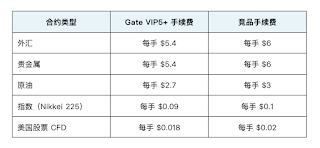
But there are a few details that require special attention:
- Swap Fee (Overnight Financing Fee)
Contracts in the TradFi section have market closing times (unlike the 24/7 crypto market). If you hold a position during the closed market, a swap fee will be charged. The calculation of this fee is complex, with three different formulas depending on the contract type. I tested a few varieties and found that swap fees for holding over the weekend are settled for three days at once (because there's no trading on Saturday and Sunday). It doesn't affect short-term traders much, but if you plan to hold long-term, you must calculate this cost. (Refer to announcement documentation )
- Liquidity Differences
Although Gate's asset coverage is broad, not every标的 (underlying) has the same liquidity. Popular varieties like gold, the Nasdaq index, mainstream stocks have good trading volume and depth (e.g., XAUT gold contract 24h trading volume broke $489 million, ranking third globally), but the bid-ask spread for some小众 (niche) contracts is significantly larger. It is recommended to优先选择 (prioritize) actively traded varieties.
- Leverage is a Double-Edged Sword
The TradFi section offers leverage up to 500x, which is a very attractive tool for professional traders. But high leverage means high risk – slight market fluctuations can trigger liquidation. During my testing, I encountered a significant intraday fluctuation in US stocks, and several high-leverage positions were liquidated. If you are a beginner, it is recommended to start with low leverage and gradually increase it after familiarizing yourself with the rules.
Hands-On Test: How I Traded Gold with USDT
Knowledge from paper is shallow. To truly understand Gate's multi-asset trading experience, I decided to实际操作 (operate) myself.
I chose gold as the test标的 because: 1) Gold is one of the most liquid traditional assets; 2) Gate offers multiple ways to trade gold, perfect for a comprehensive experience; 3) Recent gold market volatility is suitable for short-term operations.
Step 1: Product Selection – Multiple Ways to Play Gold
I found there are several ways to trade gold on Gate, suitable for different risk preferences:
- Spot Tokens: XAUT, PAXG, and other gold tokens, each token fully backed by corresponding physical gold, suitable for long-term holding.
- Perpetual Contracts: XAU/USDT, XAUT/USDT, and other metal perpetual contracts, support 7x24 hour trading, up to 100x leverage[a], suitable for users hoping to use price fluctuations for short-term operations.
- TradFi CFD: CFD based on real traditional financial market gold prices, up to 500x leverage, trading follows TradFi market hours (has closing times), suitable for advanced traders.
Here, the difference between perpetual contracts and TradFi CFDs needs special explanation: The former are USDT-denominated crypto contracts, can be traded 24x7, with relatively moderate leverage (up to 100x)[b]; the latter are CFDs based on real traditional financial market gold prices, trading follows TradFi market rules, with higher leverage (up to 500x), more suitable for professional traders with a deep understanding of traditional financial markets.
Step 2: Placing an Order – Surprises and Minor Pitfalls
I chose the gold CFD in the TradFi section for my first try (mainly wanting to experience this latest feature).
The operation process is indeed very simple:
- Open Gate App → Enter TradFi tab → Complete KYC (process is quick, I had done it before, skipped directly) → Transfer USDT from spot account to TradFi sub-account.
A small detail worth mentioning here: After USDT is transferred to the TradFi account, it displays as USDx balance (pegged 1:1). I was initially worried about exchange loss, but found it was unnecessary; this is just an internal计价单位 (unit of account) conversion, the actual asset value does not change.
Next is selecting the trading标的. The interface design of the TradFi section continues Gate's consistent style – K-line chart, depth chart, order placement area, almost identical to the regular contract trading interface. For seasoned crypto users, there's zero learning curve.
But here I encountered the first 'minor pitfall': Leverage in TradFi is fixed (500x for gold), cannot be freely adjusted like in crypto contracts. For someone like me used to flexible leverage, it was initially quite不适应 (uncomfortable) – I needed to calculate the position size based on the margin ratio, rather than setting the leverage first and then deciding the position.
However, after adapting, I found this 'fixed leverage' design is actually closer to the logic of traditional financial markets. For users operating on both traditional brokers and Gate, it might反而 (instead) reduce mental burden.
Placing the order itself was smooth. I opened a small long position near $5030 gold price, and the order was filled almost immediately. The K-line smoothness and depth were good, with no significant slippage.
Step 3: Settlement – Fast but Attention to Detail Needed
I held the position for about 6 hours, the gold price rose about $15, making a small profit. Closing the position was as simple as opening it – click the close button, and the order was同样 (also) filled immediately.
The profit went directly back to the USDx balance, which I then transferred back to the USDT in the spot account. The entire capital闭环 (closed loop) was indeed very fast – from placing the order to closing the position and the funds returning to the account, it took less than 10 seconds.
This efficiency is like a different dimension compared to traditional brokers. With a traditional broker, even if you make money, withdrawing to a bank card takes T+1 or even longer; on Gate, funds can be immediately投入 (put into) the next trade or withdrawn to an on-chain wallet.
But two reminders here:
- Impact of Swap Fees: Because I closed within the day, not跨越 (crossing) the market close, no swap fee was generated. But if you plan to hold overnight or over the weekend, be sure to calculate the swap fee cost in advance – especially holding over the weekend from Friday, which settles three days of swap fees at once.
- Market Closing Time Restrictions: Contracts in the TradFi section follow the trading hours of the real market, with clear closing schedules. During my test, I正好 encountered (happened to encounter) the US stock market closing time and found I couldn't place orders for some US stock CFDs. This is noticeably different from the 24/7 trading of the crypto market and requires understanding the trading hours of various markets in advance.
Overall, Gate's multi-asset trading experience is smooth, especially in terms of capital turnover efficiency and interface friendliness. But as a newly launched feature section, users still need to spend some time familiarizing themselves with the rules – especially characteristics of traditional financial markets like swap fees, market hours, leverage mechanisms, etc.
A Question: How Were 144 Assets Created?
After experiencing the entire process, I had this question in my mind.
You must know, multi-asset trading is not simply 'listing coins' – each additional asset category means connecting to different data sources, handling different trading rules, and bearing different risk exposures. Binance underwent cautious iteration and compliance打磨 (polishing) when restarting stock perpetual contracts; OKX至今仍 (still至今) focuses mainly on Crypto derivatives and RWA exploration, with relatively restrained TradFi asset coverage. Yet Gate launched 144 TradFi assets in one go, covering five major categories: Forex, Stocks, Indices, Metals, Commodities.
This is either blind confidence or coming prepared. I looked into Gate's historical moves and found some interesting clues.
First, Gate didn't suddenly enter the multi-asset track. As early as early 2025, it陆续 (progressively) launched metal perpetual contracts (10 metals), index contracts (19 global indices), and even globally pioneered the index perpetual contract category – many people didn't realize the significance of this move at the time.
By December last year, when the TradFi section launched, Gate had already completed the full architecture build from a 'crypto derivatives platform' to a 'multi-asset trading platform'. This wasn't a spur-of-the-moment follow-the-trend, but a提前布局 (pre-arranged) systematic project.
Secondly, Gate chose a 'lighter' path.
The TradFi section runs on the MT5 (MetaTrader 5) trading system – a mature system proven in the traditional forex market for over a decade. By integrating MT5, Gate avoided the huge cost of building a traditional asset trading system from scratch, while also quickly connecting to the data and orders of global major liquidity providers.
This is a smart choice, but also a double-edged sword. The benefits are fast launch speed, controllable costs, mature risk control (MT5's margin mechanism and liquidation logic have been tested countless times by the market). The downside is limited flexibility – e.g., fixed leverage (cannot adjust freely like crypto contracts), must follow traditional market trading hours (with closing schedules), complex swap fee calculations, etc. These characteristics are familiar to traditional forex traders but require adaptation for crypto users.
Third, and most easily overlooked: Liquidity.
According to official data, Gate TradFi's total trading volume has reached $33 billion, with daily trading volume exceeding $6 billion on peak days. Among them, gold (XAUUSD) cumulative trading volume ranks first, followed by silver (XAGUSD) and the Nasdaq 100 index (NAS100).
What does this number indicate? It indicates that Gate's multi-asset trading is not 'idling' – real users are trading with real money.
More interestingly, Gate's gold contract (XAUT) ranks third globally in Coinglass's exchange rankings, with a 24-hour trading volume of $489 million. Behind this ranking is real liquidity support. When I tested orders, even几千美元 (a few thousand dollar) orders were filled immediately with very low slippage.
But there is a problem: Uneven liquidity.热门品种 (Hot varieties) (gold, silver, Nasdaq index, mainstream stocks) indeed have good depth, but the trading volume for some小众标的 (niche underlyings) is quite dismal. I randomly tested some less mainstream forex pairs and small-cap stock CFDs and found significantly larger bid-ask spreads, sometimes even having to wait several minutes for挂单 (orders) to fill.
This is normal – any platform expanding into new categories encounters this problem. The key is whether Gate can build up the liquidity of these long-tail assets in the coming months. If not, the 'comprehensive coverage' of 144 assets is just a nice number, with only a dozen or twenty actually usable.
Finally, a personal observation: Gate's fee structure is very friendly to large players.
Taking VIP Level 5+ users as an example (usually requiring a certain 30-day trading volume threshold or holding platform tokens), the fee for Forex类 (Forex category) TradFi contracts is $5.4 per lot, while competitors are generally above $6; the fee for US stock CFDs is only $0.018 per lot, compared to $0.02 for competitors.
Does the difference seem small? But for high-frequency traders executing dozens or hundreds of trades daily, this cost difference forms a significant compound effect over long-term trading.
In other words, Gate's multi-asset trading is more like a tool for 'professional players,' not an entry-level product for beginners.
If you are an ordinary user who occasionally trades coins with low trading volume, Gate's multi-asset trading might not mean much to you – after all, the fee difference for small trades isn't obvious, and you还需要花时间学习 (still need to spend time learning) traditional financial rules like swap fees and market hours.
But if you are a mature trader with substantial capital looking to allocate assets in global markets, Gate's multi-asset ecosystem is indeed worth your serious study.
In Conclusion: The Reconstructed Exchange
After experiencing Gate's multi-asset trading, one question kept coming to mind: What is the endgame for crypto exchanges?
Five years ago, the core competitiveness of exchanges was 'fast listing' – whoever could list hot projects fastest got the traffic红利 (dividend). Three years ago, the competitive focus shifted to 'derivatives' – perpetual contracts, options, leveraged tokens, all sorts of financial tools emerged. Now, the rules of the game have changed again.
From Binance, OKX to Gate, leading exchanges are all rushing in one direction: Turning themselves into 'financial supermarkets'. Crypto, stocks, forex, gold, oil... any tradable asset is being stuffed onto the platform.
The business logic behind this is clear: The best way to retain users is to give them no reason to leave.
When a user trades coins, buys US stocks, and trades gold all on your platform, their capital is沉淀 (sedimented) within your system, and their dependence on other platforms decreases. More crucially, multi-asset trading can significantly提升 (increase) user LTV (Lifetime Value) – a user only doing spot might trade a few times a year, but a user simultaneously trading crypto, stocks, and gold could have trading frequency and fee contributions several times or even dozens of times higher.
But there's a fatal question here: When a crypto exchange starts selling stocks, gold, forex, is it still a 'crypto exchange'?
Going further, if traditional brokers also start supporting USDT deposits, enabling crypto asset trading, where will the boundary between the two be?
This is not alarmist. Robinhood has been doing crypto trading for a long time, eToro also supports BTC, ETH. The barrier for traditional financial institutions to enter the crypto market is rapidly lowering, while the compliance壁垒 (barrier) for crypto exchanges to enter the traditional market remains high.
Gate's TradFi section uses the CFD (Contract for Difference) model – users are not trading real stocks or gold, but contracts on price fluctuations. The advantage of this model is low compliance cost and fast launch speed, but the disadvantage is also obvious: It is essentially still 'circle-jerking' within the 'crypto ecosystem,' unable to truly打通 (connect) the capital flow of TradFi.
In other words, current multi-asset trading is more like 'simulating' traditional financial markets within the crypto market, not true integration.
So the question is: If this is just a transitional product, what's next?
I can think of two directions:
First, wait for a clearer regulatory framework to emerge, allowing crypto exchanges to合规地 (compliantly) provide real asset trading (not CFDs, but real stocks, bonds, ETFs). But this path might take 5-10 years, or even longer.
Second, crypto exchanges give up the 'all-powerful' illusion and return to their core advantage – becoming the 'trading hub for on-chain assets.' The focus is not on replicating traditional financial玩法, but on promoting the tokenization (RWA) of more traditional assets, letting真正的链上资产 (real on-chain assets) circulate.
Gate's current strategy is clearly finding a balance between the first and second paths. It has both tokenized assets (stock tokens, gold tokens), CFD-modeled TradFi, and pure crypto derivatives.
This 'do everything' strategy can eat the红利 (dividend) of multi-asset trading in the short term, but whether it can succeed in the long run depends on three things:
- Will regulatory attitudes become more tolerant (or more stringent);
- How long user acceptance of 'simulated asset trading' will last;
- When traditional financial institutions will enter the crypto market en masse, and how much生存空间 (living space) will be left for Gate and others then.
Ultimately, multi-asset trading is not the终点 (end point), but a signal – it marks that the crypto market is transitioning from a 'closed subcultural circle' to 'part of the global financial system'.
Is this change good or bad? I don't know.
But I do know that the moment you use USDT on Gate to buy gold or trade US stocks, you are no longer a 'crypto person' – you are just an ordinary trader seeking opportunities in the global financial market.
And this, perhaps, is the deepest meaning of multi-asset trading.




















