Ethereum Finally 'Bounces Back'! ETH Returns to the Golden Line, What's Different About This Rally?

marsbit發佈於 2026-08-21更新於 2026-08-21

文章摘要

Ethereum has surged above $2,300, a level not seen in over three months, marking a significant recovery and technical breakthrough by reclaiming key resistance levels, including the weekly EMA50 for the first time in the current bear market. The rally has been fueled by a combination of factors: improved market risk appetite, positive regulatory sentiment, and a major short squeeze where over 88% of recent ETH liquidations were short positions. The ETH/BTC ratio has also broken its long-term downtrend, indicating renewed strength for Ethereum relative to Bitcoin. Fundamentally, Ethereum spot ETFs have shown strong inflows, outperforming their Bitcoin counterparts in recent months. Wall Street institutions like Morgan Stanley and JPMorgan have notably increased their ETH exposure, while several banks have added or expanded positions in ETH ETFs. On-chain fundamentals remain robust, with the proportion of staked ETH reaching a new all-time high of nearly 33.7%. Data indicates long-term holding sentiment, as small wallet holdings increased while large outflows were often directed towards staking or contracts, not selling. However, potential headwinds include declining staking yields and community debate over proposals to adjust staking rewards at high participation levels. The upcoming Glamsterdam upgrade, featuring improvements to validator exit efficiency, could enhance liquidity and further attract institutional stakers. While the rebound is supported by sentiment, capit...

Author: Nancy, PANews

After more than three months, the price of Ethereum has finally broken above the $2,300 mark.

Externally, the recovery in macro risk appetite, improved regulatory expectations, and a short squeeze have provided direct impetus for ETH's rise. Internally, the continuous influx of funds into spot ETFs, accelerated institutional allocations, and the ever-increasing scale of ETH staking are also persistently improving the market's medium- to long-term expectations for Ethereum.

Ethereum Strongly 'Bounces Back', First Time Standing Above the Golden Line Since This Bear Market Began

E-army, the long wait for Ethereum's strong 'bounce back' is finally over.

CoinGecko data shows that as of August 21, the ETH price has risen to around $2,354, returning to levels seen in early May of this year.
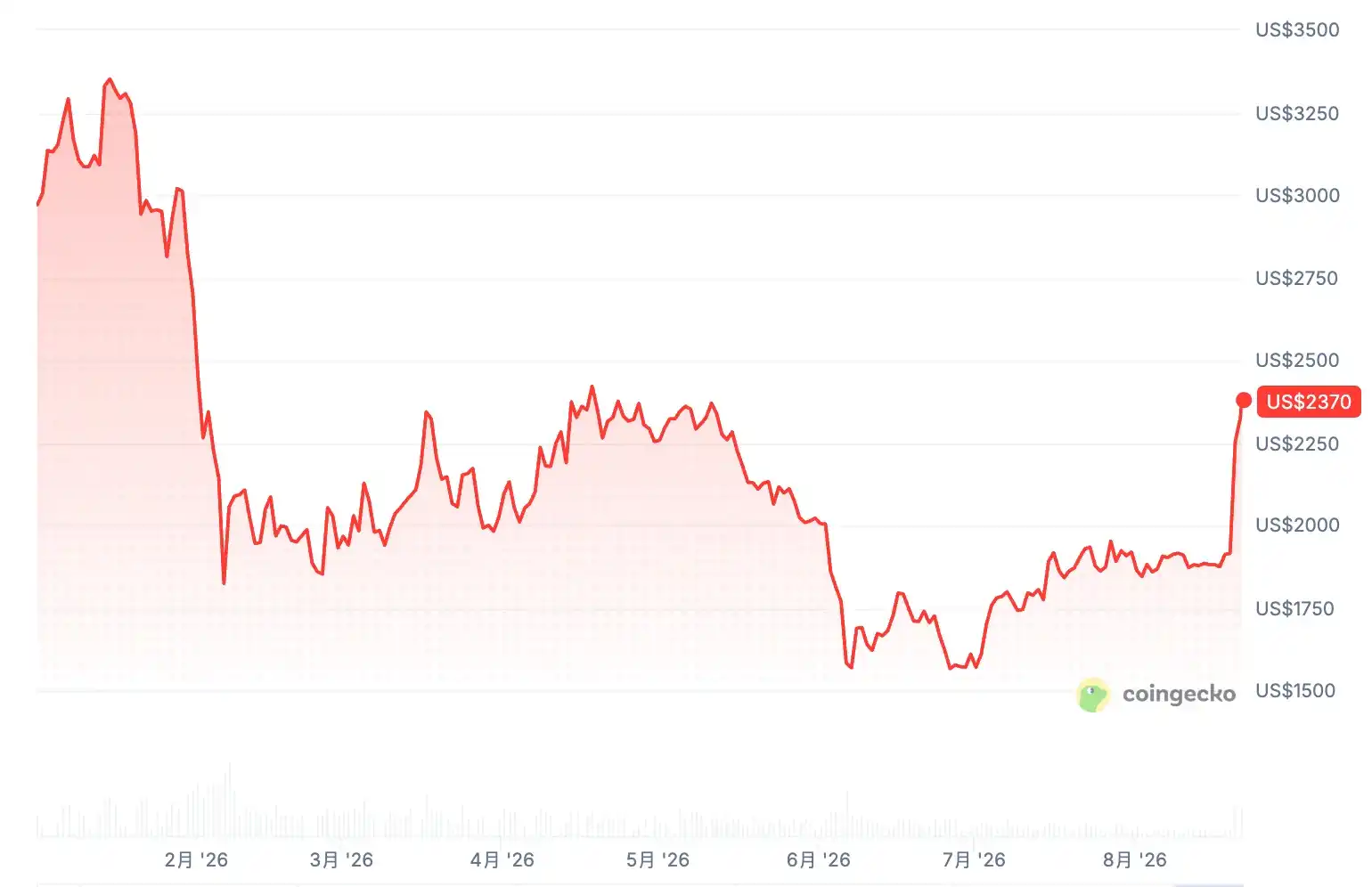
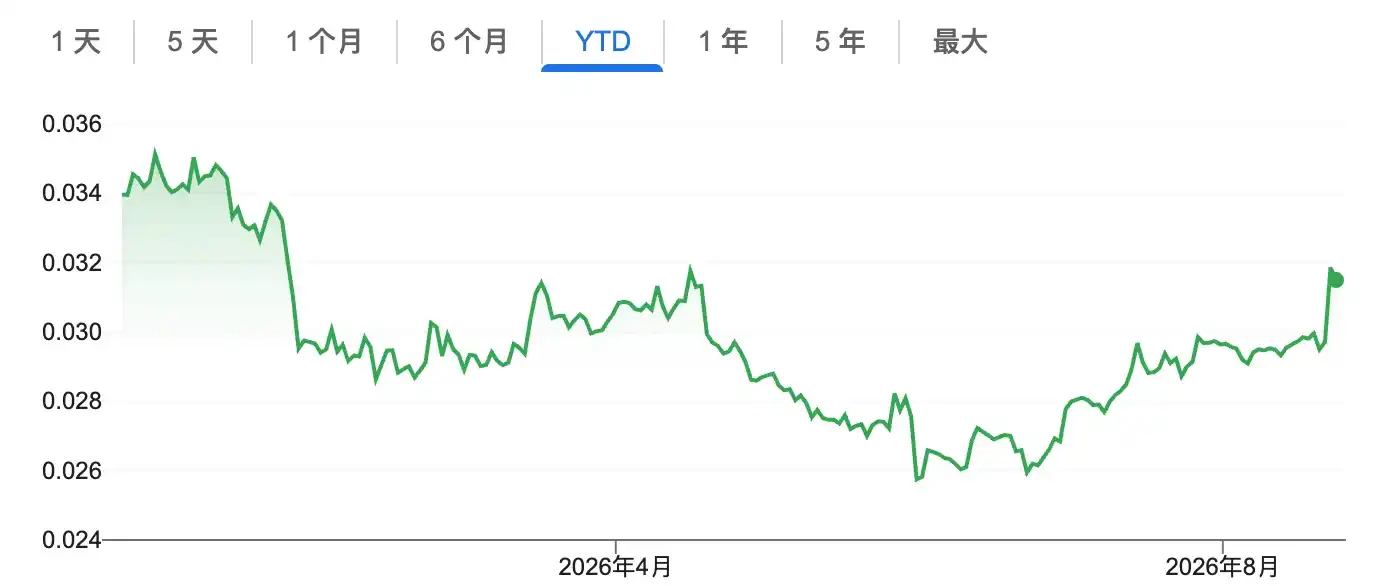
In just one week, ETH rose about 25%, ranking among the top ten gainers in the top 100 crypto assets by market cap, significantly outperforming Bitcoin over the same period. The ETH/BTC exchange rate is also continuing to break its long-term downtrend, currently rebounding to around 0.031, returning to April levels.
With Ethereum's price surging, its market capitalization has also re-entered the forefront of global mainstream assets. Data from 8 Market shows that Ethereum's total market cap has now risen to approximately $284.3 billion, surpassing Dell and ranking 72nd among global assets by market cap. Several months ago, dragged down by continuous price declines, Ethereum's market cap once fell out of the top 100 global assets.

In this rapid rebound, short sellers have been forced to become the biggest 'payers'. CoinGlass data shows that since August 19, the cumulative liquidation amount for Ethereum contracts has exceeded $1.33 billion, with short liquidations accounting for a staggering 88.4%. Of course, the large-scale short covering has further amplified ETH's upward momentum, leading to a significant short squeeze.

Noted trader Doctor Profit pointed out that Ethereum has now thoroughly broken through key resistance zones of the bear market phase and has, for the first time since the start of this bear market, re-crossed above what he calls the 'Golden Line (Weekly EMA50)'. In his view, this breakthrough is an important technical signal for ETH, and he bluntly advised to 'buckle up', while warning that short sellers might face further pressure.

BitMine Chairman Tom Lee noted that the rise in the ETH/BTC exchange rate indicates the market is starting to focus on the actual implementation of tokenization and AI agent applications, which will benefit Ethereum. Historically, the ETH/BTC exchange rate tends to rise during crypto bull markets as Ethereum's usage relative to Bitcoin increases, with previous drivers being the ICO boom of 2017-2018, the NFT wave of 2020-2021, and the stablecoin wave of 2025. The driving force for this cycle will be Wall Street's on-chain tokenization business and the large-scale use of blockchains by AI agents. Easing financial conditions will also provide a tailwind for the crypto market.

As a major Ethereum bull, BitMine has also ushered in a long-awaited 'bounce-back moment'. As of August 16, Ethereum's largest institutional holder, BitMine, holds 5.815164 million ETH with an average cost basis of $3,366. With Ethereum's recovery, BitMine's floating losses have narrowed from over $8.5 billion to $5.8 billion.

Ethereum ETF Inflows Outperform Bitcoin's, Multiple Institutions Buck the Trend to Increase Holdings

On the capital front, Ethereum spot ETFs continue to send positive signals.
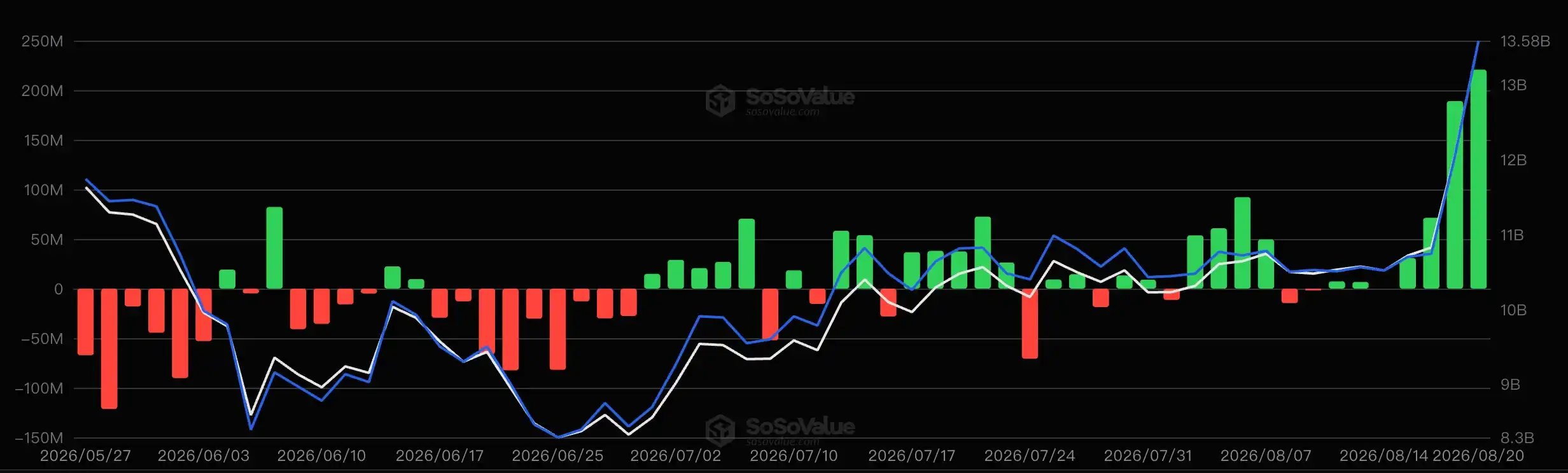
Sosovalue data shows that Ethereum spot ETFs have seen net inflows for four consecutive trading days, with cumulative net inflows exceeding $510 million this week. Among them, the net inflow on August 20 alone exceeded $220 million, the highest level since October last year. BlackRock's ETHA remains the primary source of funds, with the latest single-day net inflow reaching $173 million.

In recent times, the capital performance of Ethereum spot ETFs has also begun to significantly outperform that of Bitcoin spot ETFs. A recent report from DWF Labs shows that in June, ETH ETF net outflows accounted for 4.65% of fund size, significantly lower than BTC ETF's 8.09%. By July, ETH ETFs turned to net inflows, accounting for 3.19% of fund size, while BTC ETFs were only 0.34%, with the former being about 9.4 times the latter.

Institutional allocations are also changing. DWF Labs points out that Wall Street banks significantly increased their exposure to ETH in Q2, with growth rates noticeably higher than for BTC. For example, Morgan Stanley's BTC exposure grew 3.7% quarter-over-quarter, while its ETH exposure grew 18.6%; JPMorgan's BTC exposure grew 12.2%, while its ETH exposure grew 67.3%.

In addition, several other institutions have also increased their holdings of Ethereum ETFs against the trend. According to 13F filings, Bank of America's holdings of ETHA increased from about 67,500 shares to about 1.98 million shares, an expansion of about 29 times, with a reported value of about $23.6 million at the end of Q2; Italy's largest bank significantly reduced its holdings of BlackRock's Bitcoin ETF IBIT while nearly doubling its holdings of BlackRock's Staked Ethereum Trust; Spain's Santander Bank also disclosed holdings of BlackRock's Bitcoin and Ethereum ETFs for the first time in Q2.

Compared to the short-term price rebound, this shift in capital structure is perhaps more noteworthy.

Recently, several ETF issuers have also continued to enhance the appeal of their products. For instance, BlackRock's Ethereum ETF ETHA plans to implement a 1-for-3 reverse stock split on October 6, while Fidelity has applied to add a staking function to its Ethereum ETF FETH.

Over One-Third of ETH Staked, Declining Yields May Weaken Attractiveness

Unlike the recent persistent downtrend in Ethereum's price, its staking scale has maintained a growth trajectory.
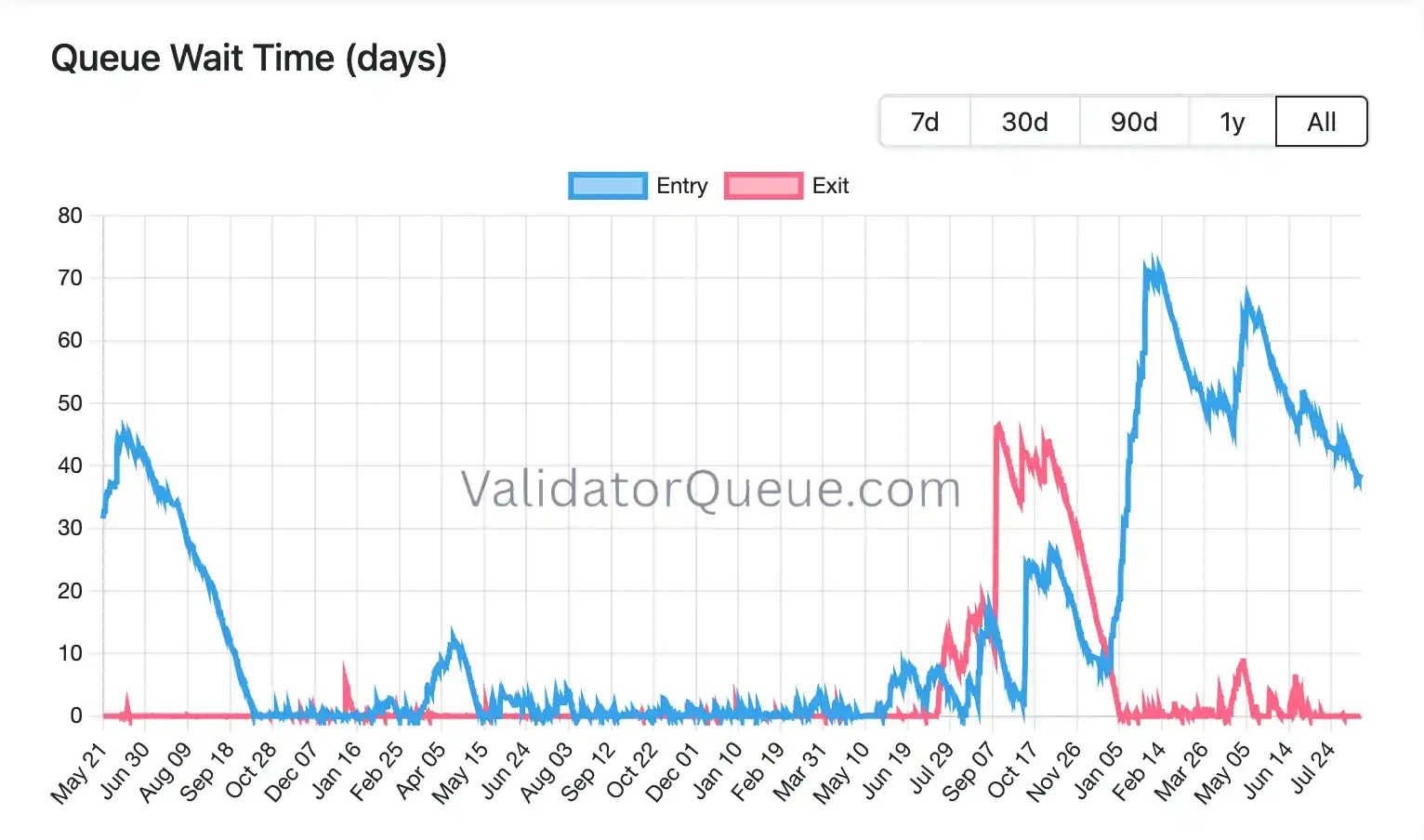
ValidatorQueue data shows that Ethereum's current staking ratio has climbed to a new all-time high, with over 41.1 million ETH in staking, accounting for nearly 33.7% of the total supply. Meanwhile, the validator exit queue is nearly zero, while the entry queue for staking still has about 2.21 million ETH waiting, with an estimated wait time exceeding 38 days.

On-chain data also confirms the market's long-term holding intent. Santiment data shows that from May 20 to August 20, large wallets holding over 1,000 ETH collectively reduced their holdings by about 1.7 million ETH, accounting for 2.9% of holdings in this tier. During the same period, the share of holdings in small wallets holding 1 to 10 ETH increased from 4.38% to 4.52%, with increases on 65 trading days and decreases on only 27.

However, the decline in large holder balances does not entirely mean ETH was sold. Santiment notes that of this outflowing ETH, only about 300,000 can be traced to smaller wallets, with most of the remainder likely entering staking or contract addresses. Concurrently, exchange ETH balances also fell from about 7.07 million to 6.54 million during this period.

The continuous rise in staking scale has also raised market concerns. Recently, Ethereum researchers Justin Drake and Jerome de Tychey proposed a new EIP-8363, suggesting that when Ethereum's staking rate reaches 50% of the total supply, a progressive burn mechanism would gradually reduce and eventually zero out the new issuance rewards for consensus layer validators. However, this proposal has faced opposition from the community.
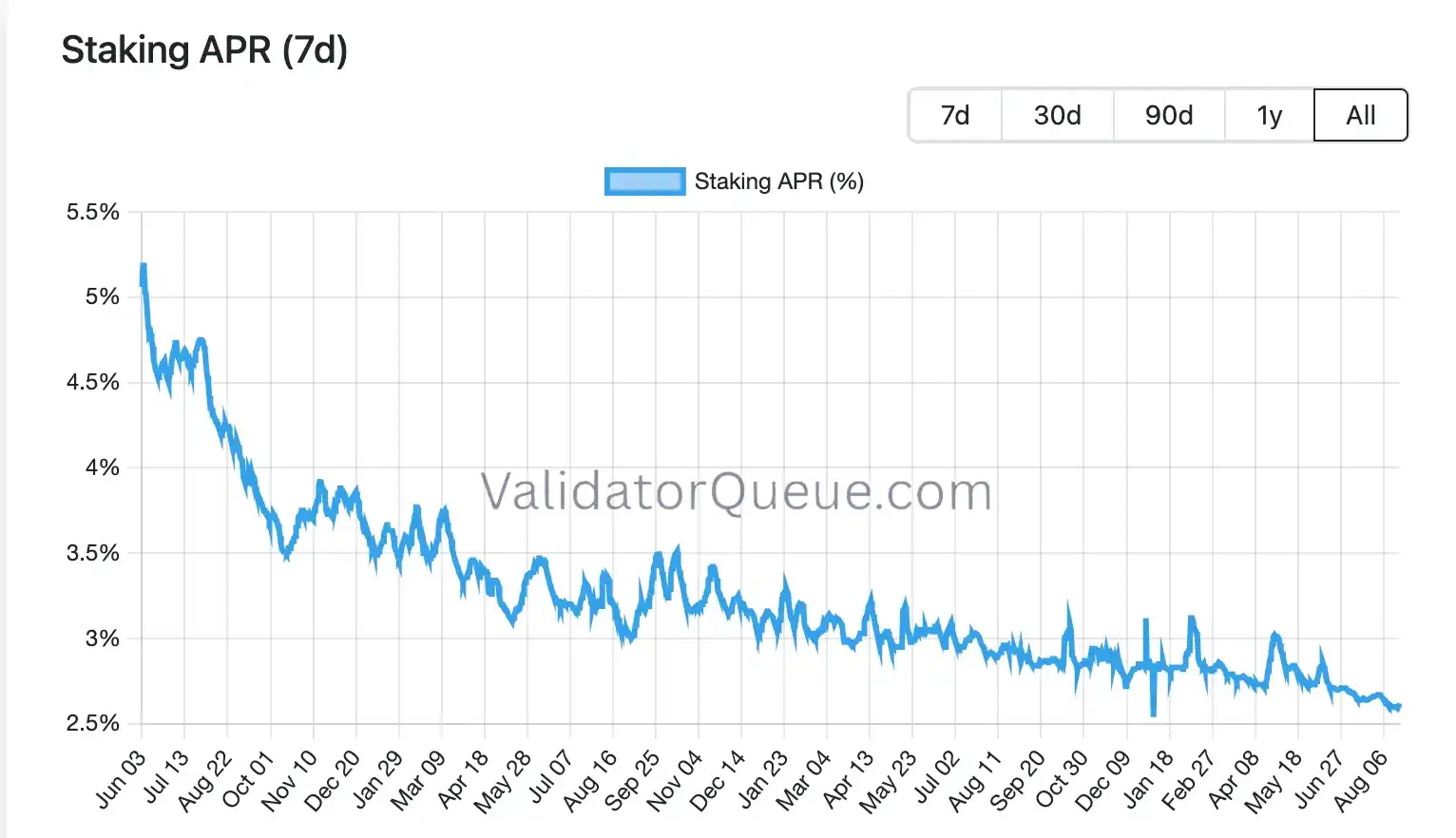
Meanwhile, as the amount of ETH and the number of validators participating in staking continue to increase, staking yields have also begun to decline. Data shows that over the past three months, ETH staking yields have fallen from a high of 2.86% to 2.59%, significantly lower than the peak of around 5.2% three years ago. If staking yields fall further, their attractiveness to new capital could be somewhat impacted.

Notably, Ethereum's next major upgrade, Glamsterdam, is scheduled for Q4 2026, and EIP-8061 is being considered for inclusion. This proposal aims to eliminate the validator exit queue limit and increase exit processing speed to about 4 times the current rate, thereby improving the efficiency and flexibility of ETH unstaking. If relevant proposals are finalized, stakers could manage capital liquidity more flexibly while earning yields. For institutional investors, higher unstaking efficiency means lower liquidity risk, potentially further boosting willingness to participate in staking.

Overall, this Ethereum rally has gained support from sentiment, capital, and fundamentals. However, whether it can truly mark a return to form will require time and more fundamental developments to provide the answer.


熱門幣種推薦

相關問答

QAccording to the article, what are the key internal and external factors driving Ethereum's recent price surge?

AExternally, the surge is driven by improved macro risk appetite, better regulatory expectations, and short squeezes. Internally, it's supported by continuous capital inflows into spot ETFs, accelerated institutional allocation, and the increasing scale of ETH staking.

QWhat significant technical milestone did Ethereum achieve recently, as mentioned by trader Doctor Profit?

AEthereum has broken through a key resistance area from the bear market phase and, for the first time since the start of this bear market, has climbed back above the 'Golden Line' (weekly EMA50), which is considered an important technical signal.

QHow has the performance of Ethereum spot ETFs compared to Bitcoin spot ETFs in recent months, according to DWF Labs' report?

AIn June, ETH ETF net outflows accounted for 4.65% of fund size, significantly lower than BTC ETF's 8.09%. By July, ETH ETFs turned to net inflows at 3.19% of fund size, while BTC ETFs were only at 0.34%, making ETH ETF inflows approximately 9.4 times that of BTC ETFs.

QWhat is the current proportion of Ethereum's total supply that is staked, and what potential issue is highlighted regarding staking rewards?

AOver 41.1 million ETH is currently staked, representing nearly 33.7% of the total supply. A highlighted issue is that the staking yield has declined from a high of 2.86% to 2.59% over the past three months, which could potentially reduce its attractiveness to new capital if yields fall further.

QWhat major future upgrade is mentioned for Ethereum, and which specific proposal is noted for potentially improving the staking experience?

AThe next major Ethereum upgrade, 'Glamsterdam,' is planned for Q4 2026. The proposal EIP-8061 is being considered for inclusion, which aims to remove the validator exit queue limit and increase exit processing speed by about 4 times, thereby improving exit efficiency and flexibility for stakers.

你可能也喜歡

熊市已经结束,新的牛市周期已经开始

近日,比特币市场在三天内经历剧烈上涨,价格从约64,100美元急速攀升至接近79,500美元,涨幅超20%,市场情绪由恐慌转向贪婪。此轮上涨伴随大规模空头轧空,全网爆仓额一度突破40亿美元,创下2021年以来纪录。比特币市值超越Meta,全球资产排名升至第13位。以太坊、瑞波币等主流山寨币也显著上涨,山寨币总市值重回1万亿美元。 上涨受多重因素推动:宏观层面,美国财政部宣布扩大长期国债回购规模,释放流动性信号;监管方面,特朗普政府召集加密行业领袖,推动《CLARITY法案》,美国SEC与CFTC也释放了积极的监管框架信号。市场结构上,大量积压的空头仓位被强制平仓,加剧了价格上涨。 链上数据显示,部分巨鲸在高位套现或反手做空,但也有巨鲸选择加仓多单,市场分歧明显。分析师观点分化:乐观者认为这是熊市结束、新牛市开始的确认,机构资金流入潜力巨大,并有分析师给出高达200万美元的长期目标价;谨慎者则指出市场短期超买,需观察能否站稳关键阻力位,并警惕9月法案投票前可能出现的波动。 未来市场关注点包括:比特币现货ETF能否持续净流入;价格能否有效突破78,000-80,000美元阻力区;以及9月15日美国参议院对《CLARITY法案》的投票结果。

marsbit27 分鐘前

熊市已经结束,新的牛市周期已经开始

marsbit27 分鐘前

如果没有 DeFi,RWA 还有意义吗?

文章探讨了RWA(真实世界资产)代币化的意义,指出其本身价值有限,关键在于与DeFi(去中心化金融)结合。作者将代币化比作给集装箱贴条形码,虽可识别但未构建完整的贸易体系。真正的变革性在于DeFi提供的市场操作系统,使资产能在压力下完成估值、融资、对冲、交易和损失处置。 RWA需具备六个层面:法律权益、可靠数据、清晰规则、流动性、抵押参数及清算路径。目前多数项目仅完成前五层。核心挑战在于RWA涉及多重时间节奏(区块链、预言机、传统市场、托管机构等),可能导致链上清算与现实处置脱节,产生风险。 流动性并非简单的总锁仓价值,而是压力下的实际变现能力。杠杆能释放资产效用,但也增加脆弱性,需综合考虑法律、数据、赎回延迟等多重风险。RWA风险应建模为关系图谱,监控节点间的依赖与传导。 国债代币化仅是起步,算力、能源等资产更具探索空间。代币化股票与永续合约结合将考验市场设计,需构建隔离、监控等机制以管理关联风险。 结论是,没有DeFi,RWA仅优化分发与结算;与DeFi结合后,资产才能成为可编程金融策略的基础设施。未来方向是构建坚韧的市场运行层,实现资本高效流转与风险管理。代币是条形码,市场才是运行的机器。

marsbit48 分鐘前

如果没有 DeFi,RWA 还有意义吗?

marsbit48 分鐘前

政府出手干预债券市场,究竟意味着什么

2026年8月19日,美国财政部宣布将从9月9日起,将其针对10至30年期长期国债的回购操作规模至少翻倍至40亿美元。此举旨在从市场买回流动性较差的旧债,以维护债券市场正常运转。公告后,长期美债收益率应声下跌,股市和黄金价格反弹。 此次干预的背景是长期美债市场面临结构性压力:美国公共债务突破40万亿美元,通胀居高不下,全球资本竞争加剧,导致常规买家(如外国央行、养老基金)需求减弱,出现“买方罢买”,推动收益率升至多年高位。此前一天,财政部一次20亿美元回购收到了近200亿美元的出售意向,凸显供需严重失衡。 分析指出,回购操作能暂时改善流动性并释放政策信号,引发空头回补,但无法减少债务总量或扭转财政赤字、通胀等根本性驱动因素。它是对债务到期结构的重组,而非量化宽松式的“印钞”。 对于投资者,此举为长久期债券提供了短期支撑,但对股票、短期利率直接影响有限。黄金的上涨可能反映了市场对美国财政长期压力的担忧。后续需关注9月关键经济数据、国债拍卖需求以及11月回购计划到期后的政策动向。 总之,这是一次针对市场流动性问题的战术性干预,并未解决美债收益率上行的深层结构性原因。投资者需区分战术缓解与根本解决方案之间的不同。

marsbit52 分鐘前

政府出手干预债券市场,究竟意味着什么

marsbit52 分鐘前

交易

現貨

熱門文章

什麼是 ETH 2.0

ETH 2.0:以太坊的新時代 介紹 ETH 2.0,廣為人知的以太坊 2.0,標誌著對以太坊區塊鏈的一次重大升級。這次過渡不僅僅是表面上的改造;其目標是從根本上增強網絡的可擴展性、安全性和可持續性。ETH 2.0 透過從能量密集型的工作量證明(PoW)共識機制轉向更高效的權益證明(PoS),承諾為區塊鏈生態系統帶來變革性的改變。 什麼是 ETH 2.0? ETH 2.0 是一系列獨特且相互連接的更新,專注於優化以太坊的能力和性能。這次全面改革旨在解決現有以太坊機制所面臨的主要挑戰,特別是交易速度和網絡擁堵問題。 ETH 2.0 的目標 ETH 2.0 的主要目標圍繞著改善三個核心方面: 可擴展性:旨在顯著提升網絡每秒可以處理的交易數量,ETH 2.0 希望突破目前約每秒 15 笔交易的限制,潛在地達到數千筆。 安全性:增強的安全措施是 ETH 2.0 的核心,特別是提高抵抗網絡攻擊的能力以及保護以太坊的去中心化精神。 可持續性:新的 PoS 機制旨在不僅提高效率,還大幅降低能耗,讓以太坊的運營框架與環保考量相符。 誰是 ETH 2.0 的創造者? ETH 2.0 的創建可追溯至以太坊基金會。這個非營利組織在支持以太坊發展方面發揮著關鍵作用,由著名的聯合創始人 Vitalik Buterin 主導。他對於更可擴展和更可持續以太坊的願景,是這次升級的推動力,並吸引了來自全球的開發者和愛好者的貢獻,共同致力於改善協議。 誰是 ETH 2.0 的投資者? 雖然有關 ETH 2.0 的投資者的具體信息尚未公開,但以太坊基金會已知方向來自區塊鏈及技術領域的各種組織和個人支持。這些合作夥伴包括創投公司、技術公司和慈善機構,它們共同致力於支持去中心化技術和區塊鏈基礎設施的發展。 ETH 2.0 如何運作? ETH 2.0 以引入一系列關鍵特性而著稱,使其與前身有所區別。 權益證明(PoS) 轉向 PoS 共識機制是 ETH 2.0 的標誌性變化之一。與依賴於能量密集型挖礦進行交易驗證的 PoW 不同,PoS 允許用戶根據他們在網絡中抵押的 ETH 數量來驗證交易和創建新區塊。這導致能量效率的提升,能耗降低約 99.95%,使以太坊 2.0 成為一個相當綠色的替代方案。 分片鏈 分片鏈是 ETH 2.0 的另一個關鍵創新。這些較小的鏈與主要的以太坊鏈平行運行,使得多筆交易可以同時處理。這種方法增強了網絡的整體容量,解決了困擾以太坊的可擴展性問題。 信標鏈 在 ETH 2.0 的核心是信標鏈,它協調網絡並管理 PoS 協議。它在某種程度上充當了組織者:它監督驗證者,確保各分片與網絡的連接,並監控整體區塊鏈生態系統的健康狀況。 ETH 2.0 的時間軸 ETH 2.0 的旅程標誌著幾個關鍵里程碑,描繪了這次重大升級的演變: 2020年12月:信標鏈的啟動標誌著 PoS 的引入,為 ETH 2.0 的遷移鋪平了道路。 2022年9月:“合併”的完成代表著以太坊網絡成功從 PoW 轉型為 PoS 框架,預示著以太坊的新時代。 2023年:預期分片鏈的推出旨在進一步增強以太坊網絡的可擴展性,鞏固 ETH 2.0 作為去中心化應用和服務的強大平台。 主要特性和優勢 改進的可擴展性 ETH 2.0 最重要的優勢之一是其改進的可擴展性。PoS 和分片鏈的結合使網絡能夠擴大容量,允許其處理的交易量遠超舊有系統。 能源效率 PoS 的實施對於區塊鏈技術中的能源效率來說是一個巨大的進步。通過大幅降低能源消耗,ETH 2.0 不僅減少了運營成本,還與全球可持續發展目標更加一致。 增強的安全性 ETH 2.0 的更新機制提高了網絡的安全性。PoS 的部署,加上通過分片鏈和信標鏈建立的創新控制措施,確保了對潛在威脅更高程度的保護。 降低用戶成本 隨著可擴展性的改善,交易成本也會明顯降低。預期增強的容量和減少的擁堵將轉化為用戶更低的手續費,使以太坊在日常交易中變得更可及。 結論 ETH 2.0 標誌著以太坊區塊鏈生態系統的一次重要演變。隨著其解決可擴展性、能源消耗、交易效率和整體安全性等關鍵問題,這次升級的重要性不言而喻。轉向權益證明、引入分片鏈以及信標鏈的基礎性工作,顯示出以太坊未來能夠滿足去中心化市場日益增長的需求。在一個由創新和進步推動的行業中,ETH 2.0 是區塊鏈技術在為更可持續和高效的數字經濟鋪路方面能力的見證。

398 人學過發佈於 2024.04.04更新於 2024.12.03

什麼是 ETH 2.0

什麼是 ETH 3.0

ETH3.0 與 $eth 3.0:以深入分析以太坊的未來 介紹 在快速發展的加密貨幣和區塊鏈技術領域,ETH3.0,通常標記為 $eth 3.0,已成為一個備受關注和猜測的話題。該術語包含兩個主要概念,值得說明: 以太坊 3.0:這代表潛在的未來升級,旨在增強現有的以太坊區塊鏈的能力,特別集中於提高可擴展性和性能。ETH3.0 表情符號代幣:這個獨特的加密貨幣項目旨在利用以太坊區塊鏈創建一個以表情符號為中心的生態系統,促進加密貨幣社區的參與。 理解這些 ETH3.0 的方面不僅對加密愛好者至關重要,也對觀察數字空間中的更廣泛技術趨勢的人有所幫助。 什麼是 ETH3.0? 以太坊 3.0 以太坊 3.0 被認為是對已建立的以太坊網絡的擬議升級,自其誕生以來,它一直是許多去中心化應用程式(dApps)和智能合約的支柱。預想的增強主要集中於可擴展性——整合先進技術,如分片和零知識證明(zk-proofs)。這些技術創新旨在促進每秒交易數量的前所未有(TPS),潛在地達到數百萬筆,從而解決當前區塊鏈技術面臨的最重大限制之一。 這次改進不僅是技術性的,更是戰略性的;它旨在為以太坊網絡的普遍採用和未來的實用性做準備,因為該未來將面臨對去中心化解決方案日益增長的需求。 ETH3.0 表情符號代幣 與以太坊 3.0 不同,ETH3.0 表情符號代幣進入了一個更輕鬆和更具玩樂性的領域,通過將互聯網表情符號文化與加密貨幣動態相結合。該項目使用戶能夠在以太坊區塊鏈上購買、出售和交易表情符號,提供一個促進社區通過創造力和共同利益參與的平台。 ETH3.0 表情符號代幣旨在展示區塊鏈技術如何與數字文化交匯,創造出既有趣又具有經濟價值的使用案例。 誰是 ETH3.0 的創造者? 以太坊 3.0 對以太坊 3.0 的倡議主要由以太坊社區內的一個開發者和研究人員的聯盟推動,特別是包括 Justin Drake。他因對以太坊演變的見解和貢獻而聞名,Drake 在關於將以太坊轉變為新共識層的討論中是一個重要人物,這被稱為「Beam Chain」。 這種協作開發的方式標誌著以太坊 3.0 不是單一創造者的產品,而是集中精力促進區塊鏈技術進步的集體智慧的體現。 ETH3.0 表情符號代幣 關於 ETH3.0 表情符號代幣的創造者的詳細資料目前無法追溯。表情符號代幣的特性通常導致更分散和社區驅動的結構,這可以解釋為什麼缺乏具體的歸屬感。這與更廣泛的加密社區的精神相符,該社區的創新往往源於協作而非個人努力。 誰是 ETH3.0 的投資者? 以太坊 3.0 對以太坊 3.0 的支持主要來自以太坊基金會以及一個充滿熱情的開發者和投資者社區。這種基礎聯繫提供了相當程度的合法性,並增強了成功落實的前景,因為它利用了多年網絡運營建立的信任和可信度。 在快速變化的加密貨幣氣候中,社區支持在推動開發和採用中發揮了關鍵作用,將以太坊 3.0 置於未來區塊鏈進步的重要競爭者地位。 ETH3.0 表情符號代幣 雖然目前可用的來源並沒有明確提供支持 ETH3.0 表情符號代幣的投資機構或組織的具體信息,但這反映出表情符號代幣典型的資金模型,通常依賴於基層支持和社區參與。此類項目的投資者通常由因社區驅動的創新潛力以及在加密社區中發現的合作精神而受到激勵的個人組成。 ETH3.0 如何運作? 以太坊 3.0 以太坊 3.0 的區別特點在於其擬議的分片和零知識證明技術的實施。分片是一種將區塊鏈劃分為更小、更易管理的單元或「分片」的方法,這些分片能夠同時處理交易,而不是按序處理。這種處理的去中心化有助於避免擁堵,並確保即使在高負載下,網絡也能保持響應。 零知識證明(zk-proof)技術通過允許交易驗證而不揭示涉及的基本數據,增加了一層複雜性。這一方面不僅增強了隱私性,還提高了整個網絡的效率。還有討論將零知識以太坊虛擬機(zkEVM)納入此次升級,進一步擴大網絡的能力和實用性。 ETH3.0 表情符號代幣 ETH3.0 表情符號代幣通過利用表情符號文化的受歡迎程度而脫穎而出。它建立了一個市場,讓用戶參與表情符號交易,不僅僅是為了娛樂,也是為了潛在的經濟利益。通過整合質押、流動性供應和治理機制等特性,該項目營造了一種促進社區互動和參與的環境。 通過提供娛樂和經濟機會的獨特結合,ETH3.0 表情符號代幣旨在吸引多樣的觀眾,範圍從加密愛好者到隨便的表情符號愛好者。 ETH3.0 的時間表 以太坊 3.0 2024年11月11日:Justin Drake 暗示即將到來的 ETH 3.0 升級,重點是可擴展性改進。這一公告標誌著關於以太坊未來架構正式討論的開始。2024年11月12日:預期中的以太坊 3.0 提案將在曼谷的 Devcon 上公佈,為更廣泛的社區反饋和潛在的開發後續步驟奠定基礎。 ETH3.0 表情符號代幣 2024年3月21日:ETH3.0 表情符號代幣正式在 CoinMarketCap 上列出,標誌著其進入公眾加密領域,並增強了其基於表情符號的生態系統的可見性。 關鍵要點 總之,以太坊 3.0 代表了以太坊網絡內的重要演變,集中於通過先進技術克服可擴展性和性能的限制。其擬議的升級反映出對未來需求和可用性的主動應對。 另一方面,ETH3.0 表情符號代幣 encapsulates 加密貨幣領域中以社區為驅動文化的本質,利用表情符號文化來創建鼓勵用戶創造力和參與的平台。 理解 ETH3.0 和 $eth 3.0 的不同目的和功能對於任何對加密領域中正在進行的發展感興趣的人來說都是至關重要的。隨著這兩個倡議鋪展獨特的道路,它們共同凸顯了區塊鏈創新動態和多樣化的本質。

414 人學過發佈於 2024.04.04更新於 2024.12.03

什麼是 ETH 3.0

如何購買ETH

歡迎來到HTX.com!在這裡,購買Ethereum (ETH)變得簡單而便捷。跟隨我們的逐步指南,放心開始您的加密貨幣之旅。第一步:創建您的HTX帳戶使用您的 Email、手機號碼在HTX註冊一個免費帳戶。體驗無憂的註冊過程並解鎖所有平台功能。立即註冊第二步:前往買幣頁面,選擇您的支付方式信用卡/金融卡購買:使用您的Visa或Mastercard即時購買Ethereum (ETH)。餘額購買:使用您HTX帳戶餘額中的資金進行無縫交易。第三方購買:探索諸如Google Pay或Apple Pay等流行支付方式以增加便利性。C2C購買:在HTX平台上直接與其他用戶交易。HTX 場外交易 (OTC) 購買:為大量交易者提供個性化服務和競爭性匯率。第三步:存儲您的Ethereum (ETH)購買Ethereum (ETH)後,將其存儲在您的HTX帳戶中。您也可以透過區塊鏈轉帳將其發送到其他地址或者用於交易其他加密貨幣。第四步:交易Ethereum (ETH)在HTX的現貨市場輕鬆交易Ethereum (ETH)。前往您的帳戶,選擇交易對,執行交易,並即時監控。HTX為初學者和經驗豐富的交易者提供了友好的用戶體驗。

4.9k 人學過發佈於 2024.12.10更新於 2026.06.02

如何購買ETH

相關討論

歡迎來到 HTX 社群。在這裡,您可以了解最新的平台發展動態並獲得專業的市場意見。 以下是用戶對 ETH (ETH)幣價的意見。

活动图片