The Department of Justice is trying to draw a brighter line around crypto software development, telling coders that writing code alone should not make them criminal targets. But for Roman Storm’s defense team, the continued prosecution of the Tornado Cash co-founder remains the clearest test of whether that policy shift is real.
Speaking at the Bitcoin 2026 conference in Las Vegas, Todd Blanche told the crypto industry that the DOJ had moved away from what he characterized as prosecutions aimed at software developers merely for building tools later used by third parties. In a panel with Coinbase Chief Legal Officer Paul Grewal, Blanche said the government’s position was that criminal liability turns on conduct, knowledge and intent, not the act of coding itself.
“The basic principle is that if you are developing software, if you are a coder, if you are part of that process and you are not the third-party user and you are not helping and knowing the third party is using what you develop to commit crimes, you are not going to be investigated and not going to be charged,” Blanche said. “And obviously facts matter because if you’re laundering money or violating sanctions, the mere fact that you happen to be a coder doesn’t excuse you from criminal liability.”
The remarks were framed as part of a broader message to the crypto sector: the DOJ wants developers and platforms to believe there has been a meaningful change in enforcement posture. Grewal summarized the message from Blanche and FBI Director Kash Patel as: “Crime is criminal; code alone shouldn’t be.”
That distinction matters deeply for crypto infrastructure teams, particularly those building privacy tools, decentralized protocols and open-source software. For years, one of the industry’s core complaints has been that US prosecutors and regulators blurred the line between writing neutral code and participating in illicit use of that code. Blanche’s comments were clearly designed to address that concern.
“I really need coders to understand. I really need the industry to understand that we have fundamentally changed the game when it comes to our investigations,” Blanche said. “And if you’re a coder out there and you’re listening to me speak and you are under investigation or you have to hire a lawyer to respond to subpoenas, your lawyer should feel very comfortable communicating with the FBI, communicating with the prosecutor on the case and making sure that they are not violating my memo.”
ACTING ATTORNEY GENERAL TODD BLANCHE SAYS DOJ HAS “FUNDAMENTALLY CHANGED THE GAME” AS SOFTWARE DEVELOPERS WHO DON’T HELP OTHERS COMMIT CRIMES WON’T BE CHARGED https://t.co/Tid9XAHWtk pic.twitter.com/CFMNrpTjCy
— The Wolf Of All Streets (@scottmelker) April 28, 2026
Blanche added that such concerns could be escalated within the department, including to him directly, if prosecutors were acting inconsistently with the memo he referenced. He also acknowledged that some existing cases remain unresolved, describing them as “lingering,” “very fact-specific” and “procedurally complicated.”
Are Crypto Coders Really Safe?
That caveat is where the Roman Storm case enters the center of the debate.
According to Crypto in America reporter Eleanor Terrett, she asked Storm’s defense team whether Blanche’s comments gave them any hope. Keri Curtis Axel, a lawyer for Storm, said they did not.
“DOJ cannot credibly claim it has ‘changed the game’ while still prosecuting Roman Storm,” Axel said. “The precedent SDNY is trying to set is wholly at odds with Blanche’s memo and the President’s policies.”
The response underscores the gap between policy signaling and courtroom reality. Blanche is telling crypto developers that the department no longer intends to pursue cases based on code alone. Storm’s defense argues that the Southern District of New York’s case against him is precisely the kind of precedent that threatens developers, especially if prosecutors can treat software authorship and protocol involvement as the basis for criminal exposure when third parties misuse a tool.
Meanwhile, Blanche appeared aware that some cases are still pending. “Those cases are something that we’re continuing to deal with,” he said. “But let me make myself crystal clear that I want to put my money where my mouth is. And I expect Director Patel does as well. And when we say that we’re not conducting those type of prosecutions anymore, we mean it.”
If the Roman Storm case is one of them, remains the big open questions. Reports claim that people with Free Samourai signs were being kicked out of the Bitcoin Conference just before the panel with Blanche.
This is why you don’t invite the Feds to talk about “free speech”. https://t.co/SWBUhNadXM
— L0la L33tz (@L0laL33tz) April 27, 2026
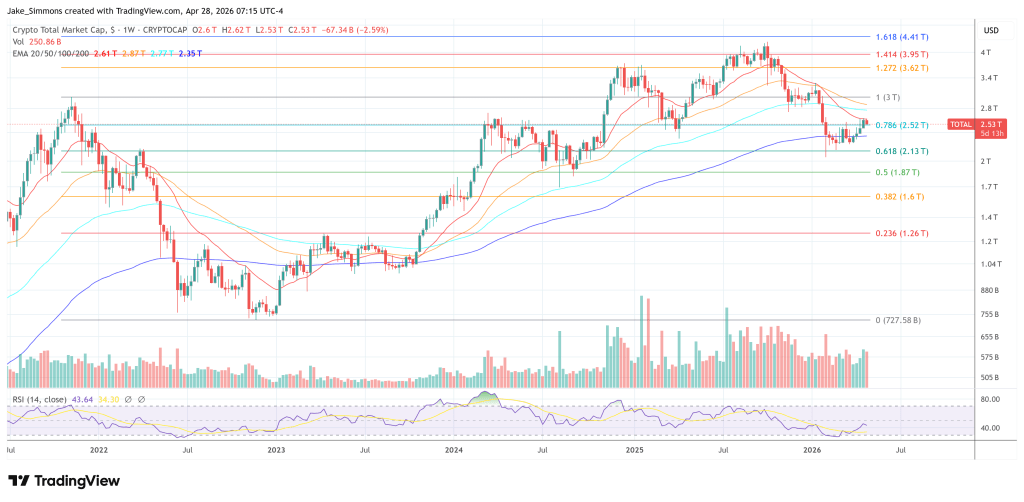
At press time, the total crypto market cap stood at $2.53 trillion.