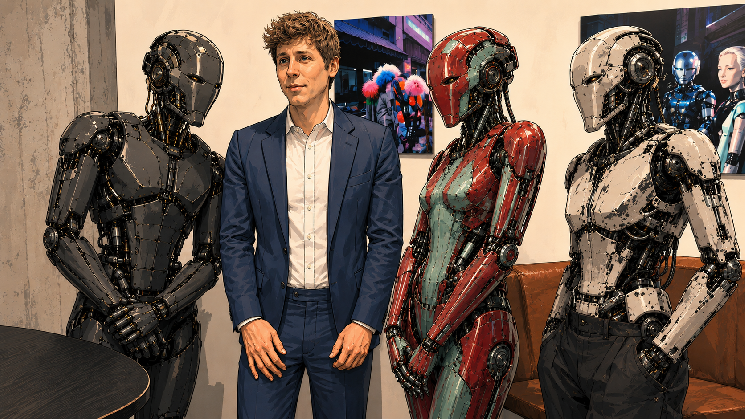
Old man Cook's final dance before retirement, he really emptied the magazine and went all out!!!
The first 2nm chip, the M6, is here.
But the new-process M6 isn't the most powerful; that title belongs to the newly released M5 Ultra, arguably the strongest M-series chip in Apple's history.
Although it uses a 3nm process, Apple specifically emphasized using a pioneering 4-die stacking technology—
This can be considered an application of Huawei's proposed Tao's Law.
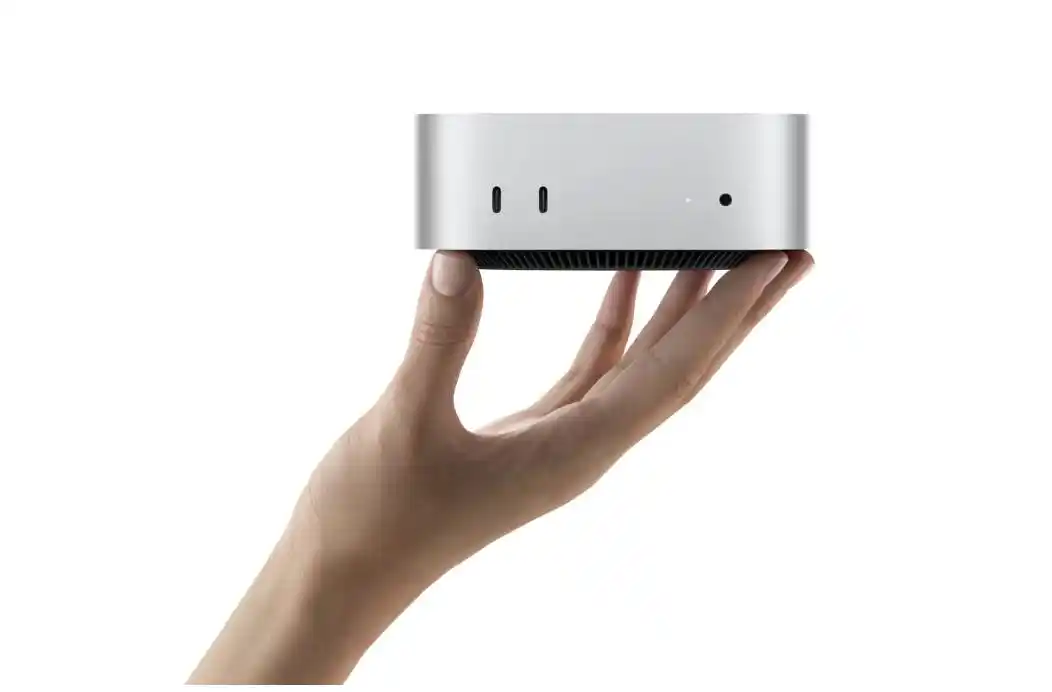
Not only that, these two chips are directly packed into the new Macs—
The Mac mini gets the M6/M5 Pro, with a China retail price starting at 6999 yuan; the Mac Studio is upgraded with the M5 Max/M5 Ultra, starting at 19999 yuan in China.
The chassis remains largely familiar, but inside, it's charging full speed ahead into AI.
The AI performance of the M6 Mac mini surges up to 4 times.
The M5 Ultra Mac Studio features up to a 36-core CPU, 80-core GPU, and can be configured with up to 512GB of unified memory.
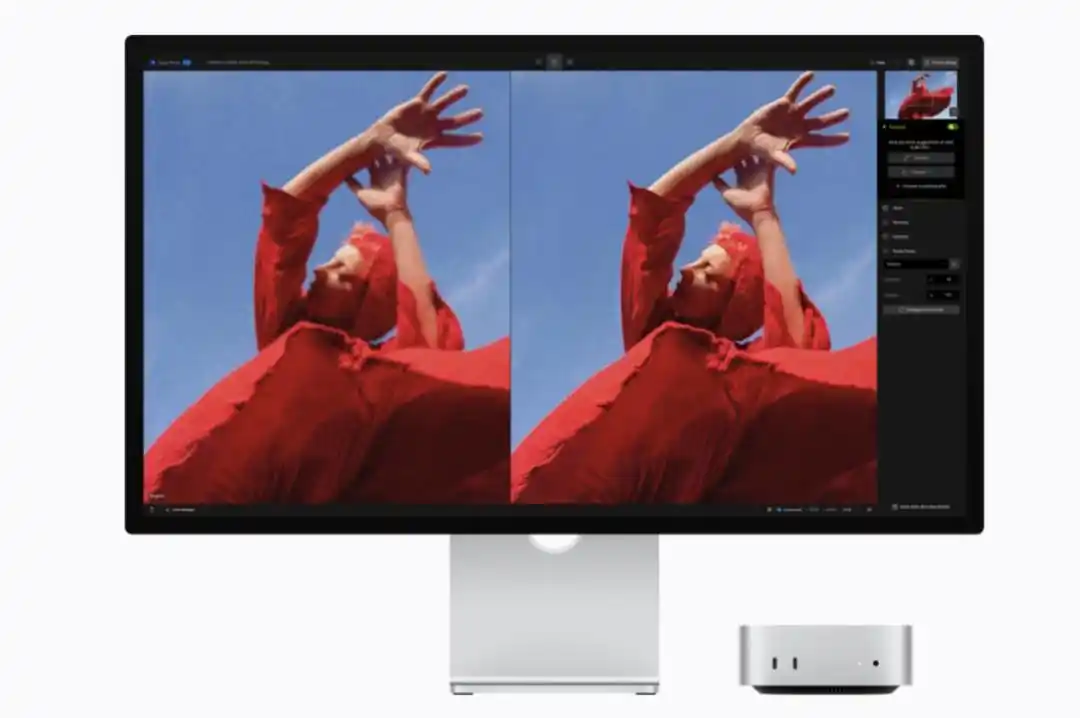
More interestingly, as soon as this wave of AI computing power is unleashed, memory supply buckles under the pressure...
Amidst a global memory shortage, further exacerbated by the intense demand for large memory from on-device AI, the 512GB version of the Mac Studio is already scheduled for delivery by the end of October.
Additionally, purchase limits have started.
This... Cook truly is firing off all his bullets before retiring from Apple.
Before leaving, he's given the Mac one final, massive boost!!!
2nm Debut: Apple Pumps the M6 Full of AI!
Let's start with the M6.
The reason for the emphasis is that the M6 truly ushers Apple's chips into the 2nm era!! (cheers.jpg)
The M6 is Apple's first chip manufactured using a 2nm process, expanding its CPU from the previous generation's 10 cores to 12 cores.
This includes 2 Super Cores, 4 performance cores, and 6 efficiency cores. The GPU also reaches 12 cores, and the unified memory bandwidth is increased to 170GB/s.
However, more noticeable changes are mainly reflected in the much-discussed AI capabilities—
Each GPU core in the M6 directly incorporates a Neural Accelerator, paired with a Dual 16-core Neural Engine.
In other words, the GPU, originally responsible for graphics and general parallel computing, now further grows an add-on specifically for AI computations!!
Looking at these specs alone might not give much of a feel, but the data becomes more intuitive when applied to the Mac mini—
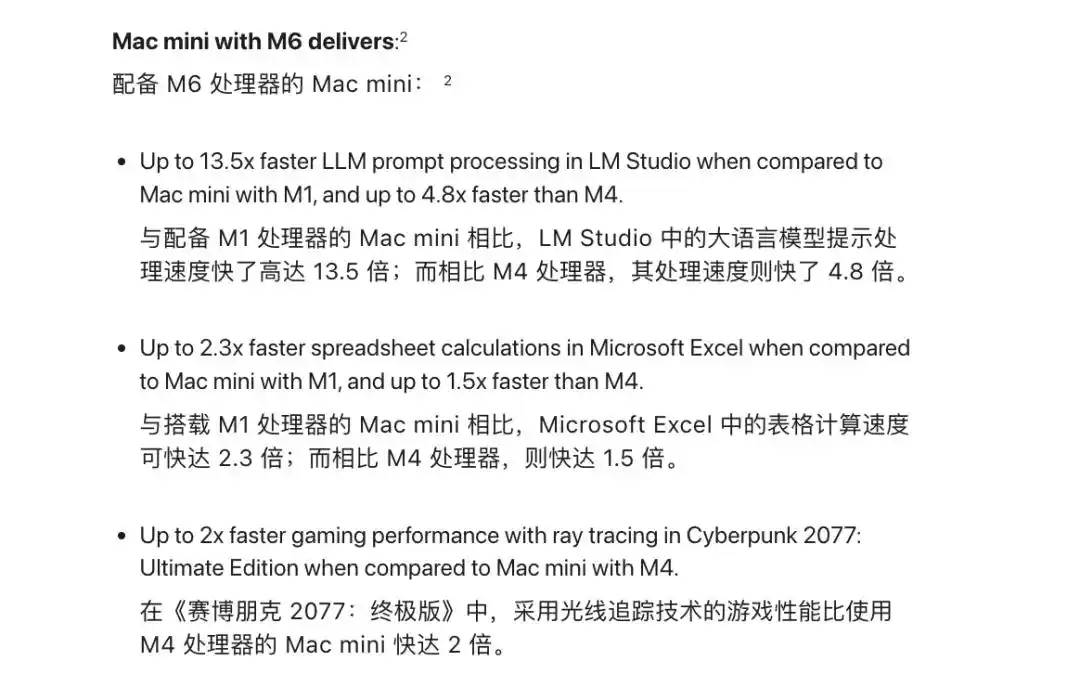
Compared to the M4 Mac mini, the AI performance of the M6 version sees up to a 4x increase, the GPU up to 2x faster, and the CPU up to 40% faster.
When running LLMs with LM Studio, prompt processing performance reaches up to 4.8 times that of the M4, and even up to 13.5 times faster compared to the original M1 Mac mini.
This time, the unified memory bandwidth also reaches 170GB/s, about 10% higher than the M5.
Although the base model still starts at 16GB, configurable up to 32GB, for running medium-to-small-sized models locally, persistent Agents, and AI workflows, the throughput capability clearly takes another step up.
This also shows that Apple's thinking about the Mac mini has somewhat changed...
Apple directly starts talking about agentic AI workflows and always-on agentic computing in its press release.
Johny Srouji even specifically mentions that the Mac mini can serve as a home computer, professional workstation, and also directly as an always-on agentic device.
The small box that used to cost around $600, quietly tucked behind a monitor for office work, is now being pushed by Apple towards being a desktop Agent mini-server.
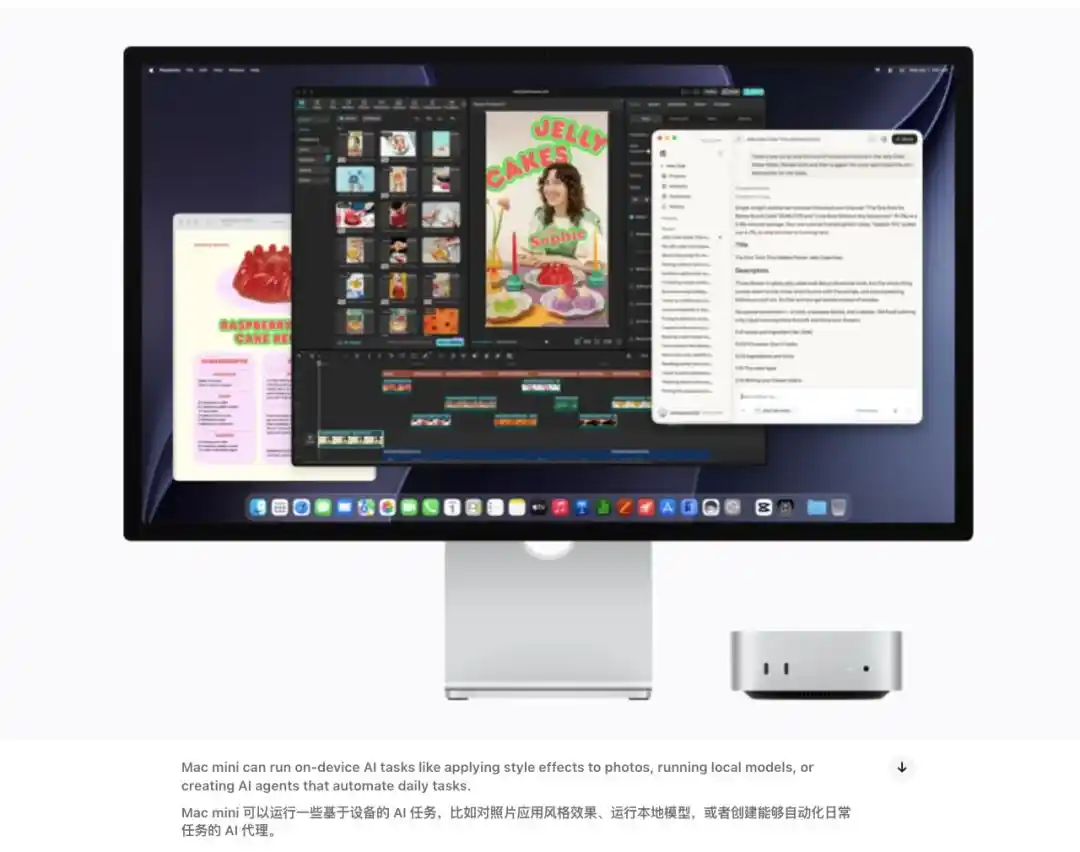
Models can run locally, Agents can stay active, and code, files, and tasks can all remain on the machine.
It's small, but the work it handles is increasingly resembling a server.
Of course, this little box's "status" has also undergone a leap...
The 2024 M4 Mac mini started at just 4499 yuan in China, while the M6 version's starting price now directly jumps to 6999 yuan.
In two years, it's a full 2500 yuan more expensive, an increase of over 55%.
After AI capability takes off, the "small and beautiful" price of the Mac mini is starting to become not so small. (doge)
Apple's First Quad-Die: The M5 Ultra Aggressively Piles on AI Compute in a Desktop
Now onto the real heavy hitter—the M5 Ultra.
If the M6 is aggressively supplementing AI computing power for regular Macs, then with the M5 Ultra, Apple is somewhat going all-in on building a desktop AI workstation.
It's worth noting, this is also the first time Apple has implemented a quad-die architecture in the M-series SoCs.
To briefly explain, what is a quad-die architecture?—
According to the official technical description, it actually connects two sets of dual-die M5 Max chips via the new-generation UltraFusion to form a four-die system, not simply understood as four chips stacked vertically like a mille-feuille.
The performance is also quite formidable, featuring up to a 36-core CPU, 80-core GPU, 32-core Neural Engine, 512GB of unified memory, and 1.2TB/s memory bandwidth.
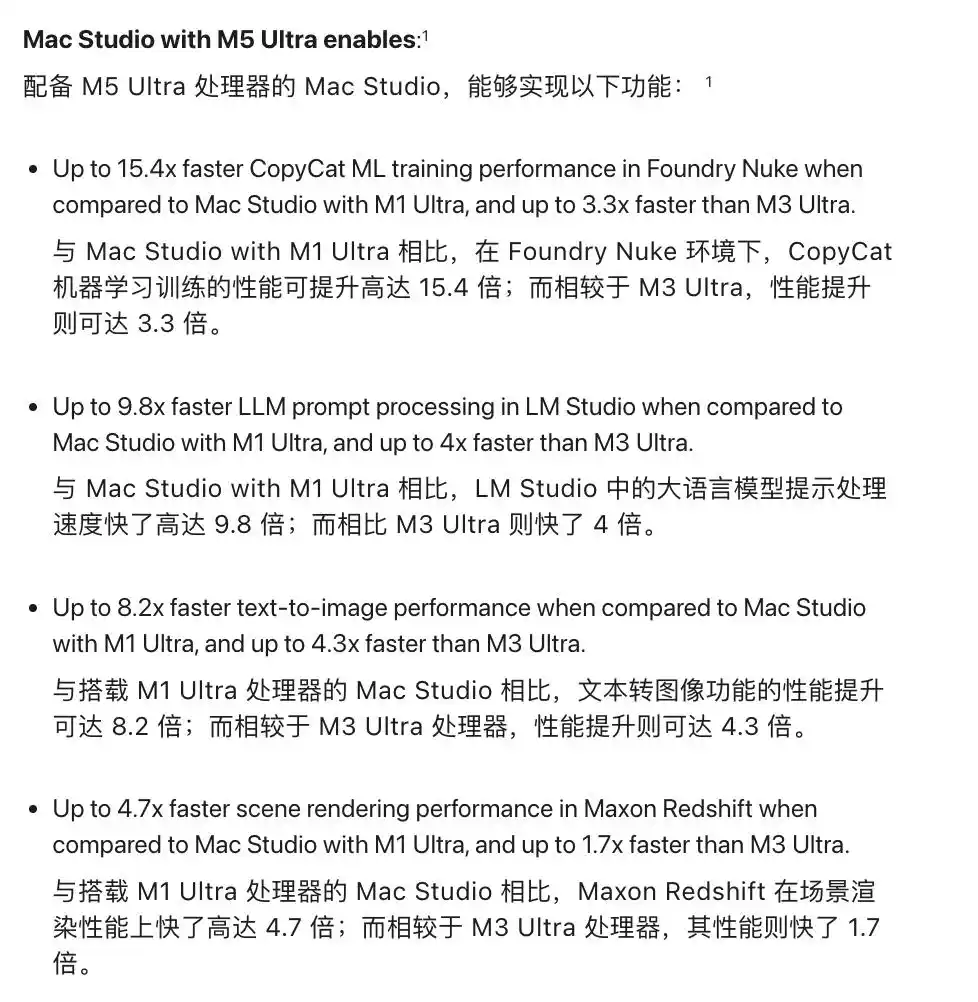
Peak AI performance reaches up to 4.3 times that of the M3 Ultra and 9.8 times that of the M1 Ultra; large model prompt processing in LM Studio is up to 4 times faster compared to the M3 Ultra.
There's also something very Apple and very suitable for on-device AI—Unified Memory.
On traditional PCs, CPU memory and GPU VRAM operate separately; trying to stuff several hundred GBs of VRAM into a GPU is both costly and engineeringly challenging...
But! The Mac Studio's 512GB of unified memory can be directly shared among computing units like the CPU and GPU.
This means as long as the model weights fit, many large models that previously required servers or multiple high-end GPUs can now reside directly within a single desktop machine.
And if one machine isn't enough, you can even chain more...
In a WWDC demo, Apple even gave an example using massive models: when a single model's weights don't fit into the 512GB memory of one Mac Studio, they split the weights across multiple Mac Studios to run together.
In a four-node setup, distributed AI inference performance can reach up to 3 times that of a single machine.
So by this point, the direction of this generation's Mac Studio is quite clear—
Apple is piecing together Apple Silicon + massive unified memory + MLX + Thunderbolt RDMA into a complete on-device AI computing stack.
512GB per machine, if it's not enough, just add more machines.
This is good; while others are still selling you an AI computer, Apple is starting to sell you a desktop AI server room??
AI Made Macs More Expensive, and is Also About to Make High-Memory Macs Sell Out
Problems follow.
Such powerful unified memory happens to collide with one of the hottest commodities in the AI industry in recent years: memory~
The Wall Street Journal notes that previous generations of Mac mini and Mac Studio have quietly become hot items in AI developer circles.
Especially with the rise of demand for on-device large models, Coding Agents, and tools like OpenClaw, the advantage of high-memory Macs was suddenly rediscovered—
After buying the machine, models can be run repeatedly without counting tokens for each call.
AI companies are scrambling for memory, data centers are scrambling for memory, PC manufacturers are scrambling for memory.
Now even people running Agents on Macs are joining the scramble for memory, causing a direct collision of supply and demand...
Apple's previous generation's highest memory configuration even temporarily disappeared from the official website, and while the new Mac Studio reopens the 512GB unified memory option, Apple has already warned—
This version will have to wait until the end of October, while other Mac Studios officially go on sale on September 22.
Naturally, the price isn't holding back either. For the previous generation Mac Studio, the M4 Max China model started at 16499 yuan, and the M3 Ultra started at 32999 yuan.
This generation directly becomes M5 Max starting at 19999 yuan, and M5 Ultra starting directly at 46999 yuan.
That means the Ultra entry-level model is 14000 yuan more expensive in one generation...
The price increase truly took off along with the AI computing power...
Interestingly, the person playing this card is also preparing to leave the position of Apple CEO.
On August 23, Apple just held a farewell party for Cook.
On September 1, John Ternus officially takes over.
So looking at the timeline, these two chips indeed carry a bit of the flavor of Old Man Cook's "final dance"—
In the final days of the Cook era, Apple stepped into 2nm with one hand, and with the other turned the Mac into a 512GB desktop AI prodigy.
What could be a better retirement gift for oneself?
Of course, the foldable iPhone to be released next month, while announced by the new CEO, theoretically the credit still belongs to Cook.
Steve Jobs created the iPhone, then Cook came along and... bent... folded it...
Reference Links:
[1]https://www.apple.com/newsroom/2026/08/apple-introduces-m6-and-m5-ultra-for-a-big-leap-in-performance-and-ai-compute/
[2]https://www.apple.com/newsroom/2026/08/apple-unveils-a-more-powerful-mac-mini-featuring-the-all-new-m6-and-m5-pro/
This article is from the WeChat public account "QbitAI", author: Meng Yao