Many large public American (and not only) mining companies are moving away from the model involving almost exclusively cryptocurrency mining. They have repurposed their activities towards developing infrastructure for artificial intelligence-based developments and high-performance computing (HPC). The largest players are IREN (formerly Iris Energy), HUT 8, TerraWulf, Riot Platforms, Bitdeer, and Cipher Digital.
The Rising Cost of Mining
Any business, including mining, must first and foremost be profitable. Certain difficulties with profitability have emerged in the Bitcoin mining market following the 2024 halving and the decline in the value of $BTC in late 2025.
According to a report from investment company CoinShares, mining the largest cryptocurrency by market capitalization was unprofitable for public American companies in the last quarter of last year. The average cost to mine 1 $BTC was $79,995, while the market price was around $70,000. For TerraWulf, mining one coin at a certain point even cost $385,000. In other words, revenue did not cover expenses at all.
No less telling data is shown by the Bitcoin Hash Price Index, which indicates the expected daily revenue for a miner from one petahash per second of computing power. As of August this year, the indicator is near its historically low values around $32. This is almost half of what it was a year earlier, more than ten times lower than the peak in 2021, and more than a hundred times lower than the 2017 peak. In short, the same amount of power brings less revenue to miners each year.
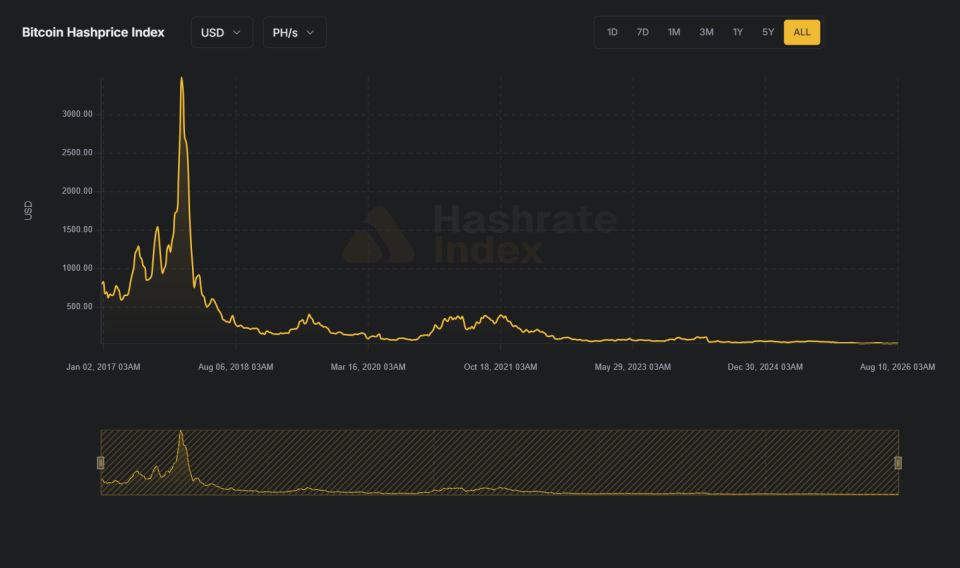
Source: hashrateindex.com
It turns out that large mining companies have faced realities where the economic feasibility of cryptocurrency mining has been called into question. Of course, the metrics above do not allow us to claim that Bitcoin mining suddenly became completely unprofitable everywhere. It's worth considering that miners in different countries and regions incur different costs: electricity and ASIC device prices vary, as do associated expenses like taxes, rent, and salaries for maintenance personnel. Equipment does not stand still and evolves, requiring timely replacement. Mining $BTC becomes less profitable for players unable to efficiently cover such costs.
However, there are other reasons for the shift to artificial intelligence.
Capital Availability
Let's clarify immediately: miners who previously mined Bitcoin do not themselves become AI operators. They merely provide their infrastructure to meet the needs of companies directly involved in artificial intelligence.
For providing their data centers, miners will receive very good money, which they did not have access to before. For example, HUT 8 signed a $7 billion deal to lease out its capacity, including the River Bend farm in Louisiana. The technical partners in the deal are the firm Anthropic, creator of the Claude neural network, and the cloud platform Fluidstack, with funding provided by tech giant Google and banks J.P. Morgan and Goldman Sachs.
IREN struck a deal with the world's largest software developer, Microsoft, for $9.7 billion. Microsoft thereby gains access to AI systems based on Nvidia GB-300 chips in Texas. And IREN will additionally purchase graphics processing units (GPUs) worth $5.8 billion from Dell Technologies, which is expected to bring in another $1.9 billion in annual revenue.
Economic Feasibility
Companies that have been exclusively mining cryptocurrency for years already have a certain infrastructure: specialized buildings, access to electricity, cooling systems. It's easier to repurpose a hypothetical data center from mining needs to AI needs than to build everything from scratch for the same Microsoft or Google. It's quite possible that fintech companies will someday switch to their own infrastructure, but that's not happening yet.
Speaking about converting mining farms for AI needs, it's necessary to understand that this doesn't happen in 100% of cases. New specialized data campuses will appear somewhere. Nevertheless, even here miners have it easier, as they know the specifics of data centers and have experience in organizational, operational-financial, and management issues. In other words, it is sometimes more profitable for large capital to delegate such matters to specialized companies.
Among the examples of infrastructure repurposing is the Bitdeer campus in the Norwegian municipality of Tydal.
ASIC Nuances
Modern large-scale cryptocurrency mining occurs primarily using highly specialized ASICs—equipment designed specifically for mining. Generally, an ASIC (Application Specific Integrated Circuit) is a special-purpose integrated circuit designed to solve one specific task. Such microchips can be implemented not only in mining but also in other fields where there is a need to minimize the cost of producing such equipment for specific needs.
ASIC miners themselves are different, which is related to the hashing algorithms used by specific coins. For example, Bitcoin uses the SHA-256 hashing algorithm, while Litecoin uses Scrypt. Manufacturers of such devices offer different and most often non-interchangeable units.
For instance, the manufacturer Bitmain releases the Antminer S21 model for the SHA-256 algorithm, the Antminer L9 for the Scrypt algorithm, and the Antminer D9—already for the X11 hashing algorithm. To explain in the simplest terms, an ASIC miner is a computing device from which everything unnecessary has been removed, increasing efficiency in mining cryptocurrencies and thereby reducing production costs.
On the other hand, advanced AI computations also require their own special technical capabilities. Moreover, even the efficiency of individual computations using graphics processing units (GPUs) varies depending on the manufacturer and specific model because their architectures differ fundamentally.
In other words, it's not enough to simply take down the "Mining" sign and hang up a new one—"Artificial Intelligence"—from a facility where coin mining previously took place and the corresponding ASICs stood. The equipment used will have to be replaced.
But did the reorientation of major American miners deal a decisive blow to Bitcoin?
What Happened to the Hashrate
The $BTC hashrate has definitely been influenced by miners moving into AI. From October 2025 to January 2026, the seven-day moving average of the hashrate fell by 28%, dropping from 1.15 EH/s to 0.83 EH/s. However, such dynamics shouldn't be too surprising, considering that American mining companies account for up to 40% of Bitcoin's total hashrate.
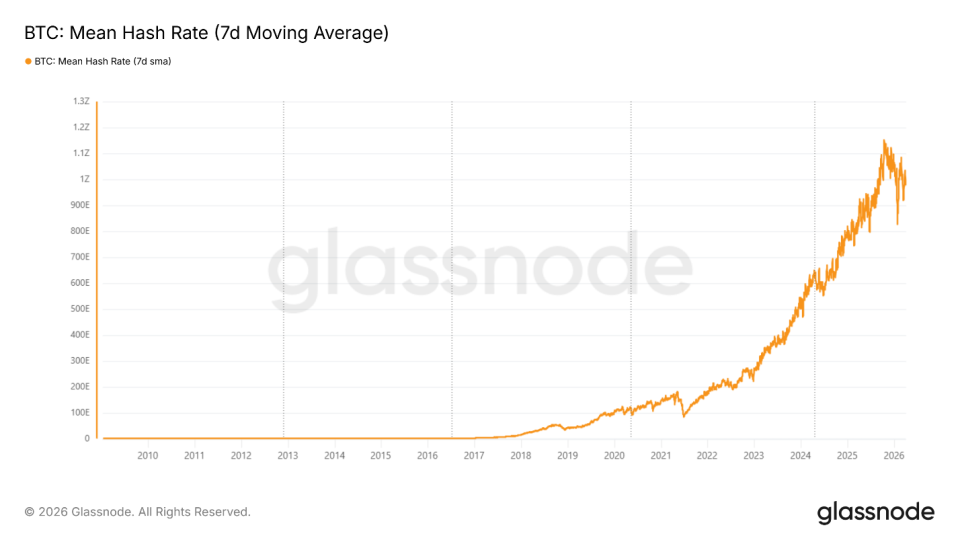
Source: studio.glassnode.com
By August 2026, some recovery in hashrate is already being observed. Its value fluctuates around 0.9 EH/s. Furthermore, according to CoinShares forecasts, the 1.8 EH/s mark should be broken by the end of the year, and by the end of 2027—2 EH/s.
It's worth remembering that reorienting towards AI does not mean miners are completely abandoning mining. In most cases, they are merely scaling back financial investments in this direction against the backdrop of expectations of greater profits from AI.
And how many bitcoins could miners potentially have mined if they hadn't reoriented to AI?
The Number of Missed Bitcoins
Actually, it's hardly possible to answer this question.
-
First, how to calculate it all? If miners had not started working on AI infrastructure, they would not have secured large contracts. Accordingly, this money cannot be factored into the potential expansion of the monetary base for mining. Similarly, the credit funds actively attracted by mining companies. From this angle—it seems the companies themselves may have earned even more than they could have without AI computing.
-
Second, the question: who missed out and how much? If we refer, for example, to Riot Platforms' report for the first quarter (data for the second quarter is not yet available), this company mined 1,473 $BTC. This is only 57 coins less than during the same period in 2025 (a 3.7% decrease). The change is more in the nature of a statistical error than a structural shift. Additionally, miners, without ceasing mining, are able to abandon further expansion in the field of mining and develop the AI direction as a short-term, highly profitable venture.
It is also worth considering here: if hypothetical IREN, TerraWulf, or HUT 8 did not mine $BTC, it means that only their balance sheets were not replenished. Bitcoin is still being mined as before, it's just that new coins went not to these companies' wallets but to other miners. The block reward remains fixed with predictable reduction during halvings and only the amount of network transaction fees changes. Moreover, if some major players suddenly switch off their power, it will become slightly easier for other participants to mine the cryptocurrency during the next network difficulty recalculation. In other words, these "bitcoins not mined by others" will still be mined somewhere in the world.
Miner Revenue
Amidst current economic/geopolitical instability, unfortunately, it's not yet possible to talk about exact figures. There are only forecast values. CoinShares believes that revenue from AI for mining companies will reach 70%, while at the beginning of the year it accounted for only 30%. In other words, the growth will be twofold. Essentially, if mining was the main activity for companies before, now it will become auxiliary. On the other hand, this doesn't mean mining will be abandoned for sure. Priorities will likely just be reassessed.
And how have such large-scale changes affected the stocks of cryptocurrency mining organizations?
Stocks and the Transition to AI
In most cases, the impact has been positive. Since the beginning of the year, the shares of five companies have shown price increases: IREN — 5.69%, Terra Wulf — 45.92%, MARA Holdings — 9.49%, Riot Platforms — 57.72%, Cipher Digital — 14.76%. The exception is Bitdeer, whose securities fell by 4.73%.
However, certain investor concerns regarding the transition to AI remain.
-
First, it's still unclear how successful this entire venture will be in the future. Will miners really be able to generate profits that cover all current and future costs?
-
Second, the transition from mining to developing infrastructure for artificial intelligence has forced a number of organizations to borrow huge sums. For TerraWulf — it's $5.7 billion, for IREN — $3.7 billion. Such a significant scale of debt load growth cannot but worry shareholders.
Conclusion
Large mining companies are transitioning from exclusively mining cryptocurrency to earning from AI due to economic feasibility and the availability of necessary infrastructure/management models. According to some forecasts, by the end of the year, the majority of their income will come from payments from AI operators, not from mining. The Bitcoin hashrate, after such companies reoriented their business, declined insignificantly and briefly but is already recovering. The stocks of most public miners are demonstrating price growth against the backdrop of business repurposing.
This material and the information in it are not individual or any other recommendation. The opinion of the editorial staff may not coincide with the opinions of analytical portals and experts.